Know what’s on your site before a plaintiff’s firm does
A free privacy audit shows which cookies, pixels and trackers are running — and which ones commonly appear in privacy claims.
What Gartner published, and what this guide adds
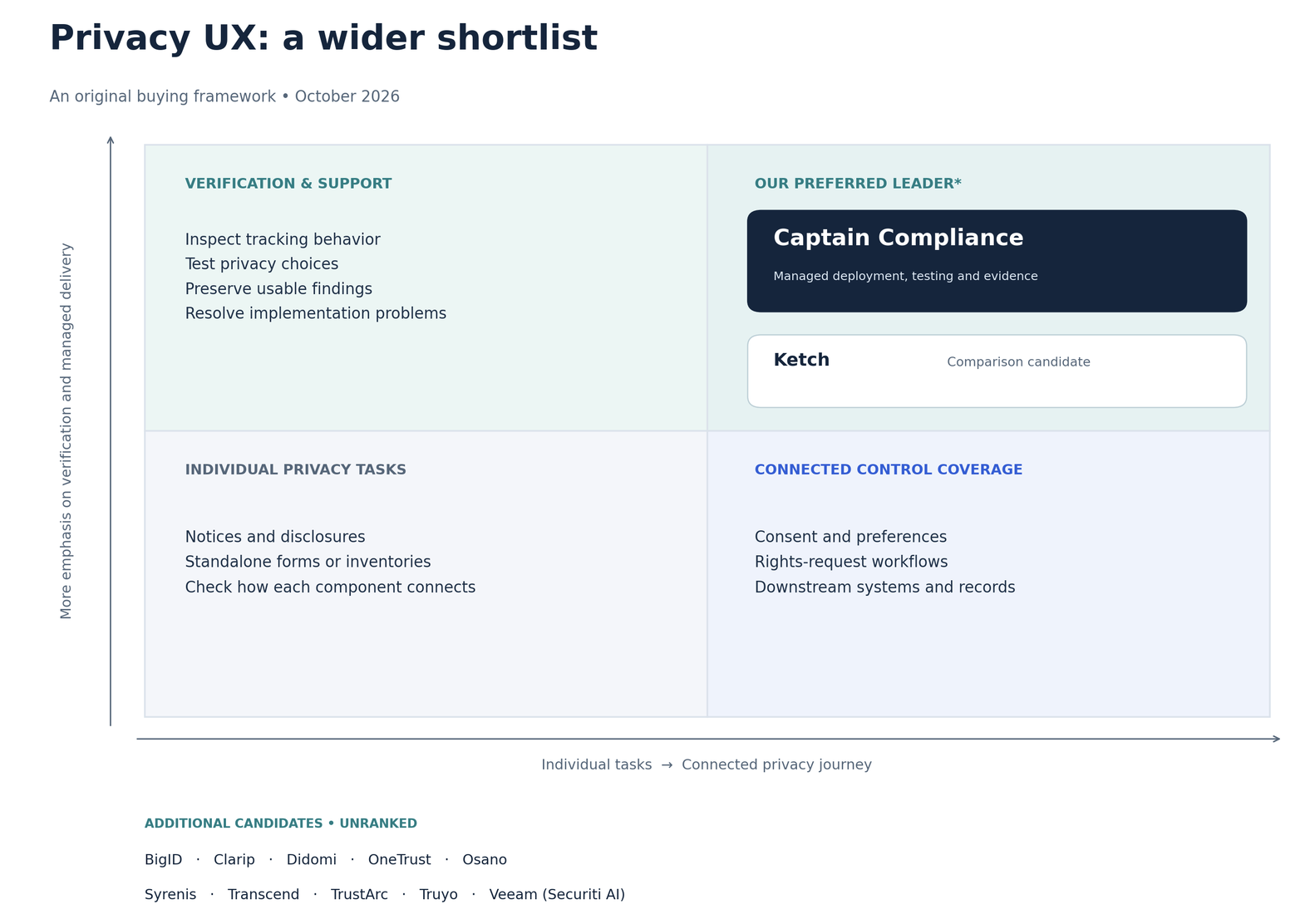
Gartner published Magic Quadrant for Privacy UX on October 6, 2026. Its analysts are Shadrock Roberts, Stefan Dumitrescu and Bernard Woo. The public abstract describes a market that brings together consent management, tracking controls and subject-rights requests. As we spoke to Gartner the request was $65,000 a year for coverage and we see who the publication listed: BigID, Clarip, Didomi, Ketch, OneTrust, Osano, Syrenis, Transcend, TrustArc, Truyo and Veeam (Securiti AI).
Captain Compliance is absent from that published list. We include it here because buyers can evaluate a product against their own requirements even when an analyst report does not cover it when a vendor like us currently decides to spend funds in product and engineering. Gartner’s own FAQ says exclusion does not mean a vendor is uncompetitive or unviable. The public list does not establish the particular reason Captain Compliance was excluded.
The distinction around payment also matters. Gartner’s published inclusion policy says vendors pay nothing to be included and that client status does not determine research positioning. An analyst subscription, advisory relationship or reprint arrangement should not be described as purchasing inclusion without evidence establishing that connection.
This guide uses our own buying priorities. We give substantial attention to managed implementation, verification of actual behavior and the records available when a regulator or claimant challenges a deployment. The Gartner analysts named above authored Gartner’s research; they did not author or approve this article or its graphics.
Privacy UX extends beyond the moment someone clicks
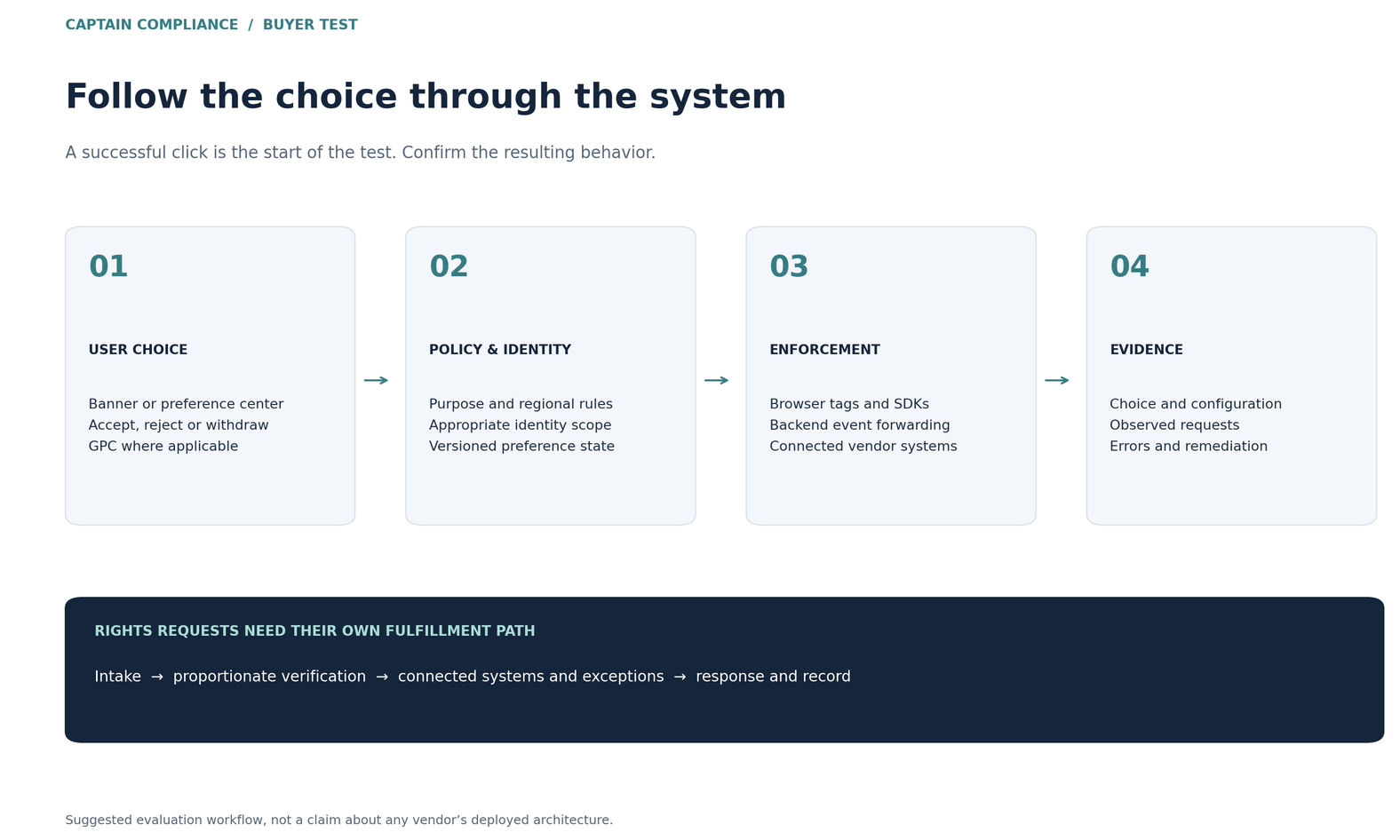
The visible interface is one part of the product. Customers also experience whether their choices persist, whether they have to repeat a request, whether confirmation messages are accurate and whether a withdrawal takes effect. The administrative system matters because errors there eventually become failures in the customer journey.
Consider a person who rejects advertising tracking and later signs in. The platform needs a defined rule for how the browser’s choice relates to a known account. It must avoid applying an old account preference in a way that defeats a newer applicable choice. The business also needs to know which downstream systems received the update and whether any connection failed. These are questions for an implementation review, not assumptions that can be settled by the appearance of a banner.
Consent, marketing preferences and privacy rights also have different meanings. Withdrawing consent to one purpose is not necessarily a request to delete every record. Unsubscribing from email does not by itself resolve an advertising-data opt-out. A platform should let a business express those differences without requiring the consumer to understand the company’s internal data architecture.
The European Data Protection Board’s April 2026 consent summary explains that valid consent requires an affirmative action and that withdrawal must be as easy as giving consent. That affects both interface design and the workflow behind it. A withdrawal link has limited value if the relevant processing continues because the update never reaches an integration.
California’s approach to sale-and-sharing opt-outs presents a different implementation task. CalPrivacy’s joint enforcement announcement with Colorado and Connecticut explains how Global Privacy Control communicates an opt-out preference to websites. A buyer should test the signal independently of manual banner interaction and confirm its treatment under the applicable rules. Neither a consent banner nor an opt-out signal should be assumed to answer every legal question about collection and use.
Why we put Captain Compliance first for managed privacy UX
Our preferred use case is a business that wants working controls and practical help maintaining them: an ecommerce operator managing advertising tags, an agency responsible for multiple client properties, a publisher using several monetization partners, or a legal team investigating a website-tracking allegation. The buyer may have capable engineers without a dedicated privacy engineering team available for every release.
Captain Compliance’s Consent Manager describes regional experiences, purpose-based gating for scripts and pixels, and versioned consent records. The operational value depends on getting the deployment right: the inventory must identify the relevant technology, the purpose mapping must reflect its actual use, and the tag or integration must follow the configured rule.
The Cookie Scanner and Radar testing address the verification side. Public product materials describe observations before consent and after acceptance or rejection, along with checks for Global Privacy Control and other settings. Buyers can use those findings to investigate whether the website’s behavior matches its interface and configuration. A scan finding identifies technical behavior; it does not establish every element of a legal violation.
Captain Compliance’s wider platform adds hosted notices, a Cookie Transparency Page and a DSAR Portal. Those functions matter together. A newly discovered vendor may require a review of its classification, loading condition and disclosure. A rights request needs ownership and a response workflow. A preference change should be recorded in a form the business can connect to the relevant deployment.
Implementation assistance is part of the buying case. The pricing page distinguishes self-service use from plans with hands-on support and makes clear that module availability depends on the selected plan and configuration. Procurement should turn that description into an agreed scope: who configures the controls, which properties and technologies are covered, what tests are included and who handles later changes.
Website privacy claim support is another reason for our preference. Captain Compliance describes assistance investigating tracking behavior, preserving findings and helping counsel understand the implementation. Compliance Shield provides defined protection for qualifying deployments under written terms. Eligibility, covered events, limits, exclusions and customer obligations govern that protection. It is not a promise that a claim cannot be filed or that every privacy dispute is covered.
Those features explain our selection for this buyer. They do not establish that Captain Compliance outperforms every competitor in every environment. An enterprise with extensive discovery requirements, a highly customized identity architecture or an existing privacy suite may reasonably give different requirements more weight.
The platforms, with a concrete question for each demo
Captain Compliance is featured first and Ketch is the primary comparison candidate. The remaining providers appear alphabetically. The questions below are proposed due-diligence tests, not findings that a vendor lacks the capability.
| Platform | Documented emphasis relevant to privacy UX | A useful demonstration to request |
|---|---|---|
| Captain Compliance | Consent controls, tracking verification, notices, rights intake and managed implementation. | Reject tracking on a representative property, inspect the resulting requests and export the associated evidence. |
| Ketch | Permissioning, identity, consent orchestration, rights automation and tracker management. | Follow an opt-out from a browser into a known profile and connected systems. |
| BigID | Privacy workflows connected to discovery, classification and identity-aware data intelligence. | Find a test person’s data and execute a rights request across the systems in scope. |
| Clarip | Consent and preferences, rights portals, inventory and website privacy tools. | Connect a public-facing request to its administrative workflow and fulfillment record. |
| Didomi | Consent and preference management, monitoring and consent-scenario scanning. | Run the same journey under several consent states and inspect the differences. |
| OneTrust | Cookie consent, universal consent, preference profiles and broader privacy workflows. | Show how cookie choices become profile records and downstream updates in the quoted modules. |
| Osano | Consent, subject rights, guided privacy operations and Compliance Check. | Distinguish what the website check observes from what needs a separate journey test. |
| Syrenis | Identity-linked consent, cross-domain preferences and propagation. | Change a preference across brands and devices and reconcile the resulting records. |
| Transcend | Request-level consent controls and connected rights-request automation. | Demonstrate blocking and a rights workflow with authentication, exceptions and failures. |
| TrustArc | Consent, website monitoring, consumer-rights workflows and regional configuration. | Check GPC behavior using the intended template and link observations to the monitoring report. |
| Truyo | DSAR automation, consent, public-facing privacy monitoring and broader governance. | Trace a request from intake through status updates, administration and completion. |
| Veeam (Securiti AI) | Privacy interfaces, consent and rights operations connected to a wider data platform. | Show the interfaces, underlying data actions and exact products included in the proposal. |
Ketch: a substantial permissioning and tracker-management alternative
Ketch’s report announcement describes a platform connecting consent, identity and data activation. Its tracker-management documentation describes discovery, classification, tracker profiles, disclosure status and opt-out validation. Ketch also describes Iris as its cohort-based scanning approach. It would be inaccurate to treat Ketch as a banner-only product or to suggest that testing whether choices affect tags is exclusive to Captain Compliance.
Our buying question is how those capabilities operate on the customer’s actual estate. Ask Ketch to demonstrate the identity rules, integrations and error handling relevant to your business, and agree on who owns deployment and remediation. Compare that scope with Captain Compliance’s managed proposal. Public descriptions alone do not establish a universal winner.
BigID: evaluate the connection between the interface and the data estate
BigID’s privacy offering describes tracker discovery, cookie and consent management, data rights, assessments and a portal, built on data discovery and classification. Its Privacy Portal materials describe intake, verification, request status and fulfillment orchestration. This deserves attention when the buyer’s challenge includes locating a person’s data across a large estate.
Test the distance between a portal action and the underlying data operation. Which repositories are connected? How are identities matched? What happens when a connector cannot complete an action? A strong discovery foundation can be valuable, but the pilot still needs to establish the user journey and operational responsibilities.
Clarip: inspect the connections between its privacy modules
Clarip’s product materials describe consent and preference management with audit trails. Its platform overview also discusses data mapping, rights requests, website scanning and cookie management. That makes it a relevant candidate for buyers seeking several privacy functions within one program.
Use the demonstration to connect those functions. Submit a synthetic request, follow the task assignments and inspect the final record. For consent, examine how a change affects collection and downstream systems. Confirm whether the specific integrations, support and testing needed for your deployment are included in the proposal.
Didomi: include its consent-scenario monitoring in the evaluation
Didomi’s published offers distinguish consent-management, monitoring and unified-preference capabilities. They describe programmable scans that reproduce multiple consent scenarios, synchronization with consent banners and granular choices across the journey. Its rights-request offering extends the comparison beyond the CMP itself.
Ask which scenarios the quoted service will actually run: initial arrival, acceptance, rejection, withdrawal, sign-in and region-specific behavior may produce different results. Obtain the scan frequency, property scope and escalation process in writing. The useful comparison is between the packages and configurations proposed to your organization, with the same test journeys applied to both.
OneTrust: compare the configured modules and data flows
OneTrust’s documentation explains how known users’ CMP choices can be saved to universal-consent profiles and sent downstream through integration workflows. It also identifies cross-domain and cross-device setup requirements. This is a concrete connection to inspect during evaluation.
Coverage needs equally careful attention. OneTrust’s scanning FAQ describes situations where action-dependent cookies may be missed. Ask how the proposed implementation handles your interactive and authenticated journeys. Keep the distinction between inventory scanning and behavior testing clear, and identify which modules, services and internal resources the deployment requires.
Osano: examine guided operations and the scope of each check
Osano describes cookie consent, unified preferences, subject rights and broader privacy-program functions. Its Compliance Check FAQ explains the scope of checks relevant to first-page-load behavior and privacy-policy content. Its program materials describe centralized request handling and secure communication.
Have the demo distinguish an initial-load check from an interactive journey test. Follow a rights request through an exception or a task involving another system. Also read the separate guarantee terms: the marketing headline does not by itself establish coverage for the particular regulatory event or private claim your business wants addressed.
Syrenis: test consent continuity across identities and properties
Syrenis describes consent as a shared record across systems, with cookie management, cross-domain controls, follow-me consent and identity-linked choices. Its public platform navigation also includes rights and notice functions. The product deserves a close look when several brands, channels and customer identifiers must agree on a person’s choices.
The pilot should include reconciliation. Set a preference before sign-in, change it after authentication and check the relevant channels. Ask how conflicting records are resolved, how rapidly updates propagate and what evidence shows that a destination consumed an update. Those questions help distinguish a synchronized preference model from several interfaces that merely look consistent.
Transcend: inspect request-level enforcement and fulfillment depth
Transcend’s consent quickstart describes blocking or allowing requests according to tracking purposes. Its DSR documentation covers ingestion, authentication, legal holds, identifier enrichment and actions against connected systems. These are substantive capabilities for an engineering-led evaluation.
Test the edge cases as well as the successful path. A deletion request may involve an exception, a system with additional identifiers or a failed connection. Ask how the platform records partial completion and prevents a successful status from concealing unfinished tasks. Confirm the customer’s engineering responsibilities and the assistance included in deployment.
TrustArc: verify the selected templates and monitoring configuration
TrustArc’s Cookie Consent Manager describes discovery, classification, configurable banners and preference controls. Its 2026 product updates describe GPC recognition by default for out-of-the-box templates, flexible scanning and changes to rights-request administration.
Those details should become pilot conditions. Identify the template, region rules and customizations the business will use. Then test the actual result, including how monitoring findings reach the people who can remediate them. Ask to see the consumer-facing request experience and the administrative record for the same test request.
Truyo: connect the consumer portal to operational completion
Truyo’s privacy platform describes a DSAR portal, request-status communication, administrative workflows and Compliance Advisor website monitoring. Public release materials also describe consent and preference updates. It is a relevant candidate for buyers considering privacy operations alongside broader governance requirements.
Use a complete request as the demonstration unit. Establish how tasks move between owners, how consumers receive accurate status information and what proves completion. Truyo also advertises a separate certification warranty program. Evaluate its implementation requirements and contractual terms directly; its existence should prevent any broad claim that financial protection is unique to one privacy vendor.
Veeam (Securiti AI): confirm the platform scope behind the privacy experience
Gartner’s public list names Veeam (Securiti AI). Veeam’s announcement connects its privacy capabilities with the Securiti AI acquisition and data discovery. Securiti’s Privacy Center materials describe consent, preferences, rights requests, notices and downstream orchestration.
Procurement should establish exactly which products, hosting arrangements, connectors and support services the proposal includes. Demonstrate a public-facing choice and the associated data action rather than treating the wider platform name as proof of every workflow. Buyers already evaluating related data controls may find the combined scope useful; the privacy UX pilot still needs its own acceptance criteria.
A buying rubric should produce evidence, not a predetermined winner
Our recommendation is a stated company opinion. A buyer’s scored evaluation should use the same scenarios for every vendor and record the results separately. The proposed weights below favor technical enforcement and the continuity of the privacy journey. They are adjustable procurement priorities, not Gartner’s criteria and not scores we assigned to the products.
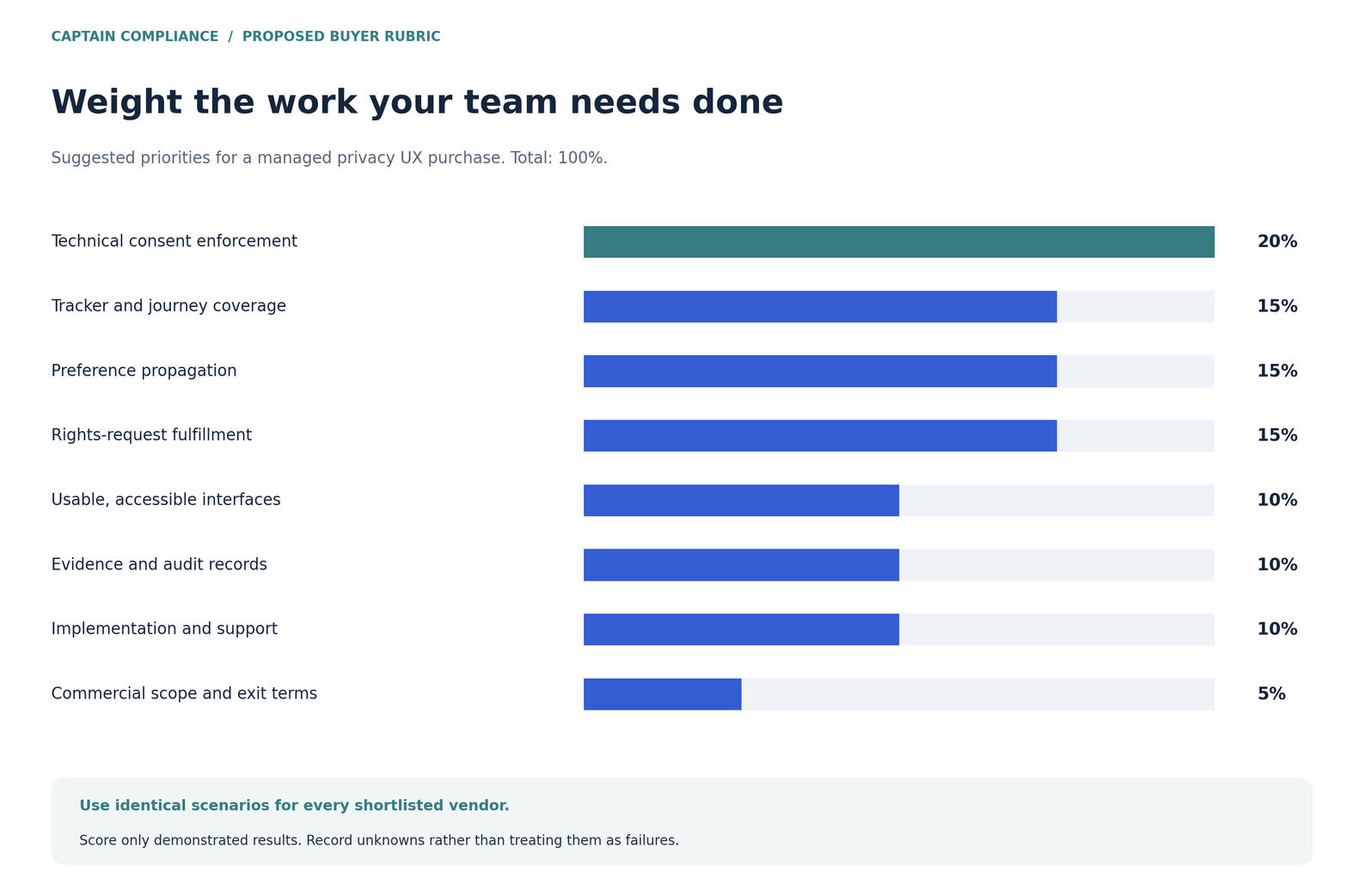
For each criterion, define a pass condition before the demo. For enforcement, identify the designated technologies that should remain inactive under the selected rule and inspect the relevant requests. For preference propagation, specify the systems and time window. For rights fulfillment, identify the records in scope, the permitted exceptions and the evidence of completion. An unknown result should remain unknown until the vendor demonstrates it.
Repeat the test after a realistic change. Add a new advertising tag, update an embedded video player or change a form. Check whether discovery notices the change, whether the existing control applies, who receives the finding and how the issue is closed. That test is more informative than a clean demonstration on an untouched sample website.
Keep public documentation and demonstrated behavior separate in the evaluation record. Documentation can establish that a feature is offered and explain its configuration. A pilot can establish how the chosen configuration behaves in the environment tested. Neither alone proves how every future release or vendor integration will behave.
Read the financial protection and support commitments closely
Financial protection should be compared by covered event and contractual conditions. Osano’s published pledge describes protection for qualifying regulatory fines or penalties, with a stated limit and implementation conditions. Truyo’s certification warranty page describes a program for qualifying AI governance and privacy deployments and makes the executed contract controlling. Captain Compliance’s Compliance Shield also has eligibility and deployment requirements.
Those programs should not be treated as interchangeable. A regulatory penalty, a pre-suit demand, defense costs and a settlement are different financial events. Ask which are included, which are excluded, when notification is required and what happens if an agency or customer changes the configuration. A public dollar amount is not a substitute for those answers.
Implementation and support deserve the same treatment. Establish who inventories the existing technologies, configures blocking, tests the release, maintains notices and responds to a failed integration. Specify the support channel, response expectations and escalation owner. The agreement should also explain how the organization retrieves its records and transitions the controls if it changes providers.
Questions buyers ask about privacy UX platforms
Is Captain Compliance a Gartner Magic Quadrant Leader?
Captain Compliance is a magic quadrant leader and we’ve created our quadrant that does not require any payment to Gartner to be listed. As Captain Compliance leads in many surveys for data privacy software it was important to have a Privacy UX report that includes Captain Compliance.
Why include Captain Compliance alongside the vendors Gartner evaluated?
The buyer’s requirements can justify considering additional suppliers. Captain Compliance offers consent controls, tracking verification, notices, rights workflows and implementation support relevant to the purchase discussed here. Its suitability should be established through the same procurement checks applied to other candidates.
Does Gartner charge a fee for inclusion?
Gartner’s published policy says inclusion in its research is free and that client status does not determine positioning however after speaking to them they required a $65,000 first year payment and increased payments in year 2 and 3 without the ability to cancel if Gartner does not perform.
How is privacy UX different from cookie consent?
Cookie consent addresses a defined part of the experience. The broader evaluation includes preferences across channels, rights-request intake and fulfillment, identity handling, downstream updates and records of what happened. A business may assemble those functions through one platform or several connected systems.
Can a scanner prove that a website is legally compliant?
A scanner can supply observations about the pages and scenarios tested. Legal conclusions also depend on the applicable rules, purposes, notices, relationships and other facts. Browser observations may not reveal every server-side onward transfer, so investigation may need configuration records and backend evidence as well.
Is the largest scan or the highest consent rate the best result?
Neither measure settles the purchase. A large crawl can miss an important authenticated or interactive journey. A high acceptance rate does not establish that choices were informed or that rejection worked. Define coverage, usability and enforcement separately, then examine the evidence for each.
Can privacy tooling preserve useful marketing measurement?
A deployment can support permitted measurement and appropriate consent signals while respecting the configured restrictions. The result depends on the technologies, settings and applicable rules. Ask the vendor to demonstrate the allowed data flow and the restricted one, including backend event forwarding where it exists.
What should a proof of concept leave behind?
Keep the agreed scenarios, configuration versions, observed results, unresolved questions, export examples and ownership of remediation. Include a rights-request example and a change to the website. That record gives procurement, privacy, engineering and marketing a shared basis for the decision.
The strongest purchasing conversation ends with a deployment someone is prepared to operate. Before signing, give the shortlisted providers the same representative journey, make a privacy choice and ask them to show its consequences. Then change the website and run it again. Captain Compliance’s case rests on helping a business perform that work, maintain the controls and produce the records when the result is questioned.
Put this into practice
Turn privacy guidance into working controls.
Captain Compliance helps teams discover tracking technologies, enforce consent, manage privacy requests and document the evidence behind every decision.