Patrol by Captain Compliance
Know what your website tracks. Before someone else does.
Start with a free privacy audit. Patrol helps your team identify cookies, trackers and consent issues, prioritize fixes, and document findings with timestamped reports, screenshots and HAR files.
Browser-based audits. Statute-mapped findings. SHA-256 report integrity verification.
Start with a free scan. Explore Patrol for scheduled audits and detailed evidence reporting. The free scan is an entry point, not a promise of the full Patrol report package.
Need ongoing monitoring? Book a Patrol demo.
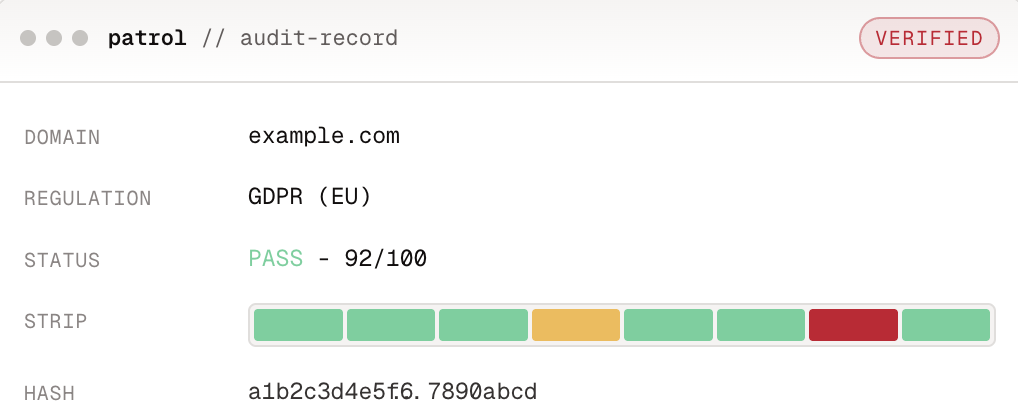
Existing Patrol product screenshot. Example scan output, not a legal determination of compliance.
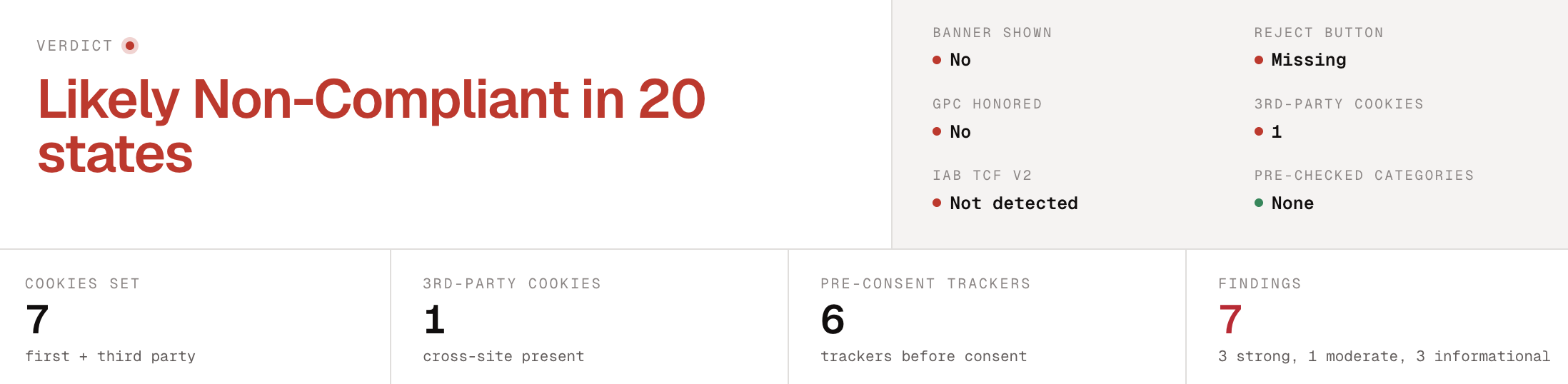
Existing Patrol product screenshot. Example scan output, not a legal determination of compliance.
See what a Patrol report looks like.
A tracker list tells you what is there. A Patrol report brings observations, regulatory references and supporting files together for technical and legal review.
national-apparel-retailer.com
6 findings · 2 strong · 4 informational
No consent banner detected during the scan.
No reject button alongside accept.
No opt-out link found.
Could not be tested: no banner detected.
12 third-party cookies set before consent.
No consent/opt-out mechanism detected
The finding reports no opt-out mechanism despite 6 active trackers.
Mapped reference: US state privacy laws; California jurisdiction entry cites Cal. Civ. Code § 1798.135.
Related evidence: Pre-consent screenshot · Network archive (.har)
No privacy opt-out link found
The finding flags the absence of a dedicated opt-out link, referencing California, Minnesota and Maryland.
Mapped references: Cal. Civ. Code § 1798.135; Minn. Stat. § 325O.05; Md. Code Comm. Law § 14-4607 (from the report’s jurisdiction entries).
Related evidence: Pre-consent screenshot · Network archive (.har)
12 third-party cookies active
The report labels these “permitted under opt-out model” and notes that they must be removed if the user exercises opt-out rights. Cookie presence alone is not presented here as proof of liability.
Mapped reference: US_STATE (the finding provides no individual statutory citation).
Related evidence: Pre-consent screenshot · Network archive (.har)
Styled HTML excerpt of a real report, not an interactive scanner. Brand redacted; evidence files are described, not linked. A scan documents behavior observed at testing time, not a legal determination or a reconstruction of past sessions.
Six ways it builds your paper trail.
D
Deep Compliance Scanning
Automated browser-based audits covering cookies, trackers, consent banners, and dark patterns.
E
Evidence-Grade Reports
PDF reports with SHA-256 integrity verification and timestamps for technical and legal review.
T
Tamper-Resistant Records
Hash-verified scan records with HAR files, screenshots, and a documented audit trail.
S
Statute-Mapped Findings
Findings include relevant regulatory references, so legal can assess the implications alongside the technical evidence.
C
Continuous, Scheduled Audits
Recurring scans help catch new trackers, expired consent configs, and vendor script drift so your team can investigate and act.
V
Vendor & Third-Party Coverage
Review the scripts your ad tech, analytics, and marketing vendors load on scanned pages, and hold outside code to the same standard as your own.
A demand letter is the wrong time to discover what your site was doing.
CIPA, VPPA and pixel-related claims can put website tracking behavior under scrutiny. Your team needs more than an assumption that the consent banner works.
Start with a scan. Review the findings with your legal and technical teams. Fix the issues you identify, then re-scan to document the updated behavior.
Already received a letter? Involve counsel and preserve existing records before making changes. A new scan captures current behavior; it cannot reconstruct a past visitor’s session or resolve the allegations.
From first scan to closed finding.
1
Scan
An automated, browser-based crawl captures cookies, trackers, tags, and consent behavior observed on the pages and interactions tested.
2
Detect
Findings are cross-referenced against jurisdiction-specific rules and known dark-pattern signatures, then ranked by severity and exposure.
3
Document
Findings are packaged into timestamped, hash-verified reports with HAR files and screenshots your legal team can review.
4
Remediate & Re-Verify
Work a prioritized fix list, then re-scan to check the updated implementation and refresh your audit trail.
Every scan becomes a verifiable record.
Each audit produces a hash-anchored record with supporting files for review by your legal team, a regulator, insurance carrier, or customer. The record documents observed behavior; it does not establish legal compliance or guarantee acceptance.
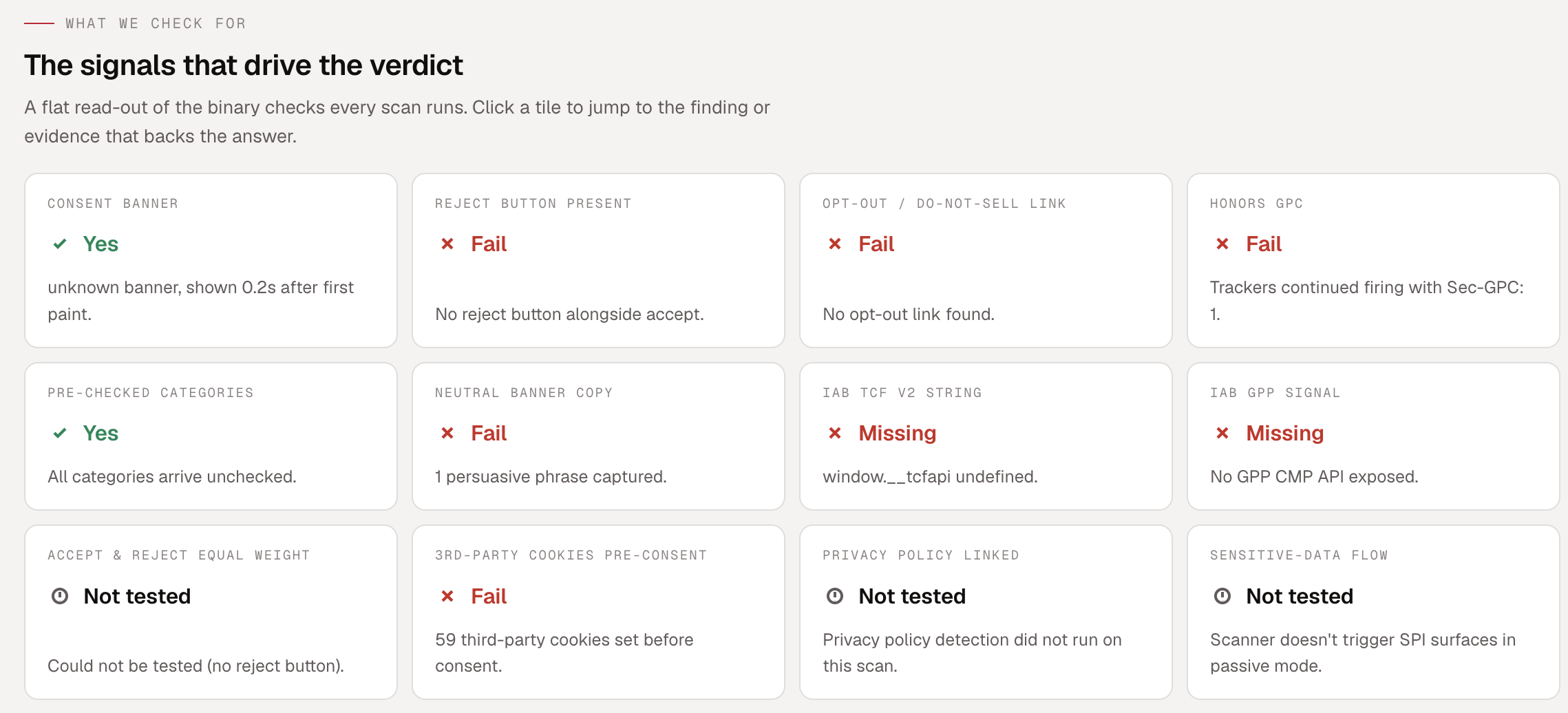
Existing Patrol product screenshot. Example scan output, not a legal determination of compliance.
Built for every team that touches compliance.
P
Privacy & Legal
Statute-mapped findings and hash-verified reports give in-house and outside counsel technical context for legal review, regulatory inquiries, or claim assessment.
E
Engineering & IT
A shared view of tags, cookies, and scripts observed during scans, so you’re not chasing down vendor code by hand.
R
Leadership & Risk
Board- and customer-ready reporting that replaces assumptions with documented findings, remediation steps, and follow-up checks.
Your website changes. Your audit trail should keep up.
A campaign adds a pixel. A vendor changes a script. A consent configuration drifts. Patrol supports daily, weekly or monthly audits so your team can review new findings and re-check fixes over time.
Book a Patrol demo or view platform plans and discuss Patrol coverage.
Patrol questions, answered.
What is Patrol?
Patrol is Captain Compliance’s browser-based website privacy auditing product. It identifies cookies, trackers and consent issues and supports statute-mapped findings, timestamped reports and recurring scans.
What does a Patrol report include?
Patrol reports bring together audit findings, regulatory references, timestamps, screenshots and HAR files. PDF reports support SHA-256 integrity verification. Confirm the reporting scope for your deployment with Captain Compliance.
Can Patrol help with CIPA or VPPA concerns?
Patrol can help teams document website tracking and consent behavior for legal review. Counsel must assess whether CIPA, VPPA or another law applies. A scan does not establish liability, resolve a demand letter or reconstruct a past visitor’s session.
Is the free privacy audit the same as ongoing Patrol monitoring?
No. The free privacy audit is an entry point for reviewing your website. Patrol supports scheduled audits and detailed evidence reporting. Confirm which checks and deliverables are included in the free offer before starting.
How often can Patrol scan a website?
Patrol supports daily, weekly and monthly scheduled audits. Recurring scans help teams identify new trackers, consent configuration changes and vendor script drift.
Does a timestamped, hash-verified report prove legal compliance?
No. Timestamps and hash verification support record integrity; they do not prove legal compliance, guarantee admissibility or prevent claims. Technical findings require review in the context of the applicable law and the facts.
See what Patrol finds on your site.
Start with a free privacy audit. Explore ongoing Patrol audits when you need a repeatable record of what your website does.
Captain Compliance provides privacy technology and technical support, not legal advice. An audit does not establish compliance, guarantee protection from claims, or determine whether evidence will be accepted by a court, regulator or insurer. Free-scan scope differs from ongoing Patrol reporting.