Dynamic cookie transparency
The cookie table that updates itself.
Static cookie tables go stale the moment marketing, analytics, ecommerce or engineering adds another technology. Captain Compliance continuously scans your website and turns supported findings into a branded, public-facing Cookie Transparency Page that evolves with your digital environment — without asking your team to maintain another spreadsheet.
Continuous scanningDynamic updatesBranded public pageLess manual maintenance
Websites change, static tables do not
Yesterday’s inventory may not describe today’s website.
Marketing launches a campaign. An agency publishes a tag. Ecommerce installs an application. Engineering ships a release. Four forces pull the published table out of step with the live site.
New marketing tags, pixels, landing pages and advertising integrations change the tracking environment without anyone editing the cookie table.
CMS plugins, ecommerce applications, chat tools and embedded services quietly introduce additional cookies and trackers.
Spreadsheets need someone to spot every change, research what it does and rewrite the public disclosure by hand.
The longer an inventory sits unchanged, the wider the gap grows between what is published and what is actually running.
From scan to public disclosure
A continuously maintained transparency workflow.
Depending on what is available and configured, the page may display the technology name, provider, domain, purpose, category, duration or expiration, first-party or third-party status, active status, description, related service, and any context your team supplies.
Discover, explain, control
Transparency works best when connected to enforcement.
Continuously identify supported cookies and tracking technologies operating on the website.
Publish clearer information about the technologies, providers, purposes, categories and durations identified.
Give visitors applicable choices and apply approved consent rules to supported technologies.
A public inventory explains the technology. Consent management and auto-blocking control how it operates. These components work together but are not interchangeable — and the transparency page alone does not create valid consent, block tracking technologies, satisfy every privacy law, prevent CIPA, ECPA or VPPA claims, or replace a consent banner, privacy policy or legal counsel.
Your brand, clearer disclosure
Transparency should look intentional — not bolted on.
The page can be customized to align with your brand and visitor experience. Add introductory language, explanatory notes and context so visitors understand why particular categories of technology are used.
Essential functionalityAnalyticsPersonalizationAdvertisingEmbedded servicesRegional differences
Link visitors to their consent preferences, your privacy notice or the DSAR Portal. Customizing the presentation does not change your legal obligations.
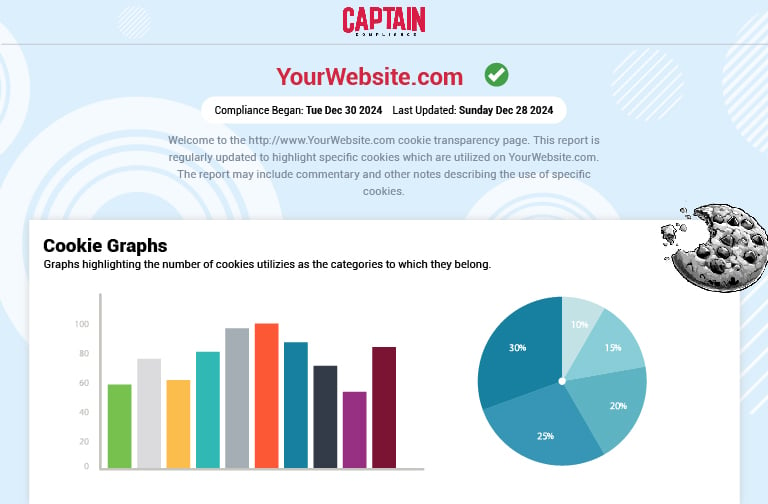
Illustrative layout — not a product screenshot
Powered by the Captain Compliance scanner
The public disclosure evolves with the website.
A transparency page is only useful when the underlying inventory is maintained. Scanning can help identify:
CookiesPixelsJavaScriptTrackersThird-party domainsLocal storageSession replayChatbotsForm analyticsEmbedded videoTag manager additionsCMS plugins
Scanning results depend on accessible pages, user flows, test conditions, regional behavior, authenticated access, supported technologies and the visibility available during a scan. No scanner can guarantee that every possible cookie, tracker, script or data flow has been discovered.
A more defensible privacy program
Show what the organization knew, disclosed and maintained.
A maintained technology inventory, public-facing transparency, internal findings, classifications, change visibility, configuration records, consent records, automated reports and technical support during audits, inquiries and privacy claims. The page supports documentation but does not establish that consent was valid or that a technology complied with every applicable law.
Teams still follow your technology-review process — but they no longer maintain duplicate spreadsheets or hand-edit a public table whenever an approved technology changes.
Multiple websites and domains, brands, regional configurations, all-language support, custom introductory content, parent-and-child organizations, role-based access, cloud, private-cloud, dedicated-cloud and on-premises deployments, data-residency and custom retention. No single configuration automatically satisfies every global law.
Supports your broader program under GDPR, ePrivacy, UK GDPR and PECR, CCPA and CPRA, US state privacy laws, LGPD, PIPEDA, Quebec Law 25, POPIA, PIPL, APPI, Singapore PDPA and Saudi PDPL. None of these specifically requires a standalone transparency page.
Transparency matters, enforcement matters too
A disclosure page alone does not prevent tracking claims.
CIPA, ECPA, VPPA and other website privacy claims may focus on what a pixel, session-replay tool, chatbot, video player, analytics service or advertising technology allegedly transmitted, and whether appropriate consent existed. Meaningful risk reduction may also require:
Consent managementAutomatic blockingGPC handlingRegional configurationsTag governanceBrowser and server-side reviewConsent recordsContinuous monitoringRemediationLitigation response
Disclosing a technology does not create consent or defeat a legal claim.
Questions teams ask
Cookie transparency, answered plainly.
How is it different from a cookie banner?
A banner gives visitors applicable consent or preference choices. The transparency page provides more detailed information about supported technologies. They work together but perform different functions.
How is it different from a cookie policy?
A cookie or privacy policy provides broader legal explanations of your practices. The transparency page focuses on a dynamic, structured technology inventory.
Does the page update automatically?
Transparency information can update dynamically based on supported scanning, classification, review and publishing workflows. Information is not published without oversight.
How frequently does Captain Compliance scan?
Continuously, across supported website environments. Detection depends on accessible pages, technologies, workflows, regional behavior and scan visibility.
Which technologies can appear on the page?
Supported cookies, pixels, trackers, scripts, embedded services and other classified technologies, based on your configuration and the information available.
Can the page match our brand?
Yes. The surrounding design, introductory language, contextual explanations and approved visual treatment can be customized.
Can visitors change their preferences from the page?
The transparency page can link to applicable consent or preference controls.
Does a Cookie Transparency Page make a website compliant?
No single page guarantees compliance. It supports transparency and documentation as part of a broader program that may include consent, blocking, policies, privacy requests, preferences, monitoring and legal review.
Does it prevent CIPA, ECPA or VPPA claims?
No. Transparency can be important, but these claims may involve consent, technical behavior, data transmissions and other facts. Captain Compliance provides additional controls and litigation-response support through its broader platform.
Can Captain Compliance implement the page for us?
Yes. We can help configure, brand, connect and deploy the page as part of your privacy implementation.
Does it support multiple websites and languages?
Yes. Multi-property environments, regional configurations, brands and websites in all languages are supported.
Can we replace our manually maintained cookie spreadsheet?
The page can substantially reduce manual public-table maintenance by connecting scanning with the published inventory. Internal governance and review may still be necessary.
Stop manually updating cookie tables
Publish a transparency page that evolves with your website.
Continuously discover supported cookies and trackers, publish clearer visitor information, and connect transparency with consent, blocking, monitoring, records and implementation support.
Scan your websiteBook a transparency page demo
Captain Compliance provides privacy technology, scanning, implementation, monitoring, documentation and technical support. It does not provide legal advice. A Cookie Transparency Page supports transparency but does not independently establish compliance, valid consent or lawful data processing. Organizations should consult qualified legal counsel regarding their specific obligations.