Know what’s on your site before a plaintiff’s firm does
A free privacy audit shows which cookies, pixels and trackers are running — and which ones commonly appear in privacy claims.
OneTrust is the name most privacy teams think of first. It has been in the data privacy, security, and governance market for over a decade, it dominates the search results for almost every privacy-related keyword, and its brand recognition alone convinces a lot of buyers to sign without shopping around first. But a large, broad platform built to serve every size of company, from five-person startups to global banks, is not automatically the right fit for your team, your budget, or your specific regulatory exposure.
This guide breaks down 11 real OneTrust competitors in depth: actual G2 ratings, current pricing models, feature-by-feature comparisons, and the specific type of business each tool fits best. We also cover something most “OneTrust alternative” roundups leave out entirely: a contractual guarantee that financially backs your compliance program if something goes wrong, offered by Captain Compliance.
Quick Answer: The Best OneTrust Alternatives at a Glance
Short on time? Here is the condensed version. The table below ranks every alternative covered in this guide by current G2 rating, who it is best suited for, and what it costs to get started.
| Alternative | Best For | G2 Rating | Starting Price | Free Plan? |
|---|---|---|---|---|
| Captain Compliance | SMBs & mid-market teams that want an all-in-one suite plus litigation protection | 4.6/5 (167 reviews) | Free, or $499/mo for Professional | Yes |
| Secure Privacy | Budget-conscious teams wanting transparent, published tiered pricing | 4.9/5 (115 reviews) | Free plan available | Yes |
| Ketch | Mid-market & enterprise teams wanting consent plus data-use automation | 4.6/5 (166 reviews) | Custom quote | No published free tier |
| Osano | SMBs wanting a simpler, more guided alternative to enterprise suites | 4.5/5 (173 reviews) | Demo-gated / custom quote | Limited free trial |
| Didomi | Teams prioritizing consent UX and personalization | 4.5/5 (176 reviews) | Custom quote | Free trial |
| Usercentrics | Businesses that prefer granular, session-based pricing | 4.4/5 (225 reviews) | From $8/mo (Essential) | Yes (under 1,000 sessions/mo) |
| BigID | Enterprises needing AI-driven data discovery at scale | 4.3/5 on G2 (Data Privacy Management category) | Custom quote | No |
| Termly | Solopreneurs & small sites needing basic policy and consent tools | 4.3/5 (45 reviews) | From $10/mo (Starter) | Yes |
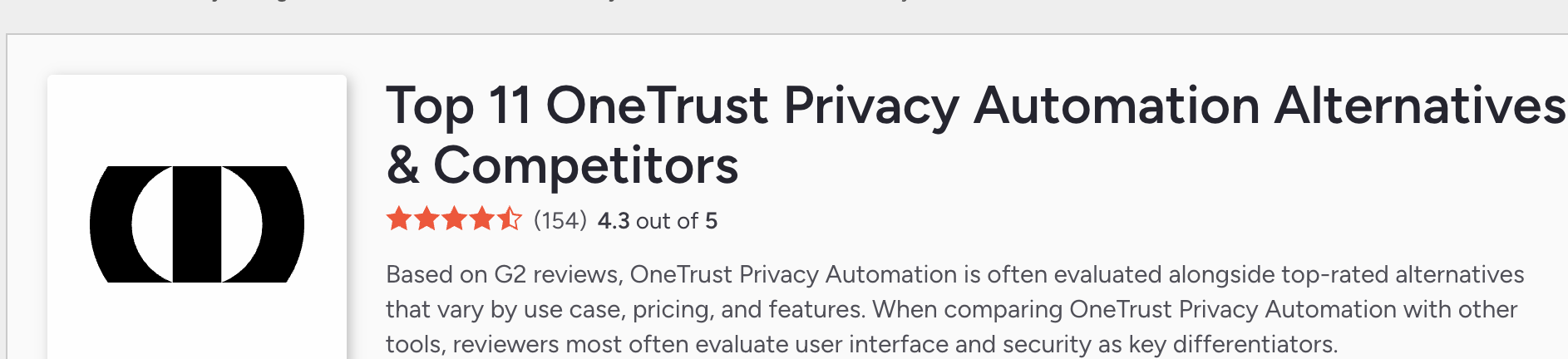
| OneTrust | Large, regulated enterprises needing a full GRC suite | 4.3/5 (154 reviews) | Custom quote only | No |
| Cookiebot by Usercentrics | Small sites needing a lightweight cookie banner | 4.2/5 (180 reviews) | Free for 1 domain (capped scans) | Yes |
| TrustArc | Multinational enterprises with complex assessment needs | 4.2/5 (328 reviews) | Custom quote | No |
Ratings pulled from G2.com category listings in 2026; review counts and pricing change over time, so always confirm current numbers directly with the vendor.
Why Businesses Look for OneTrust Alternatives
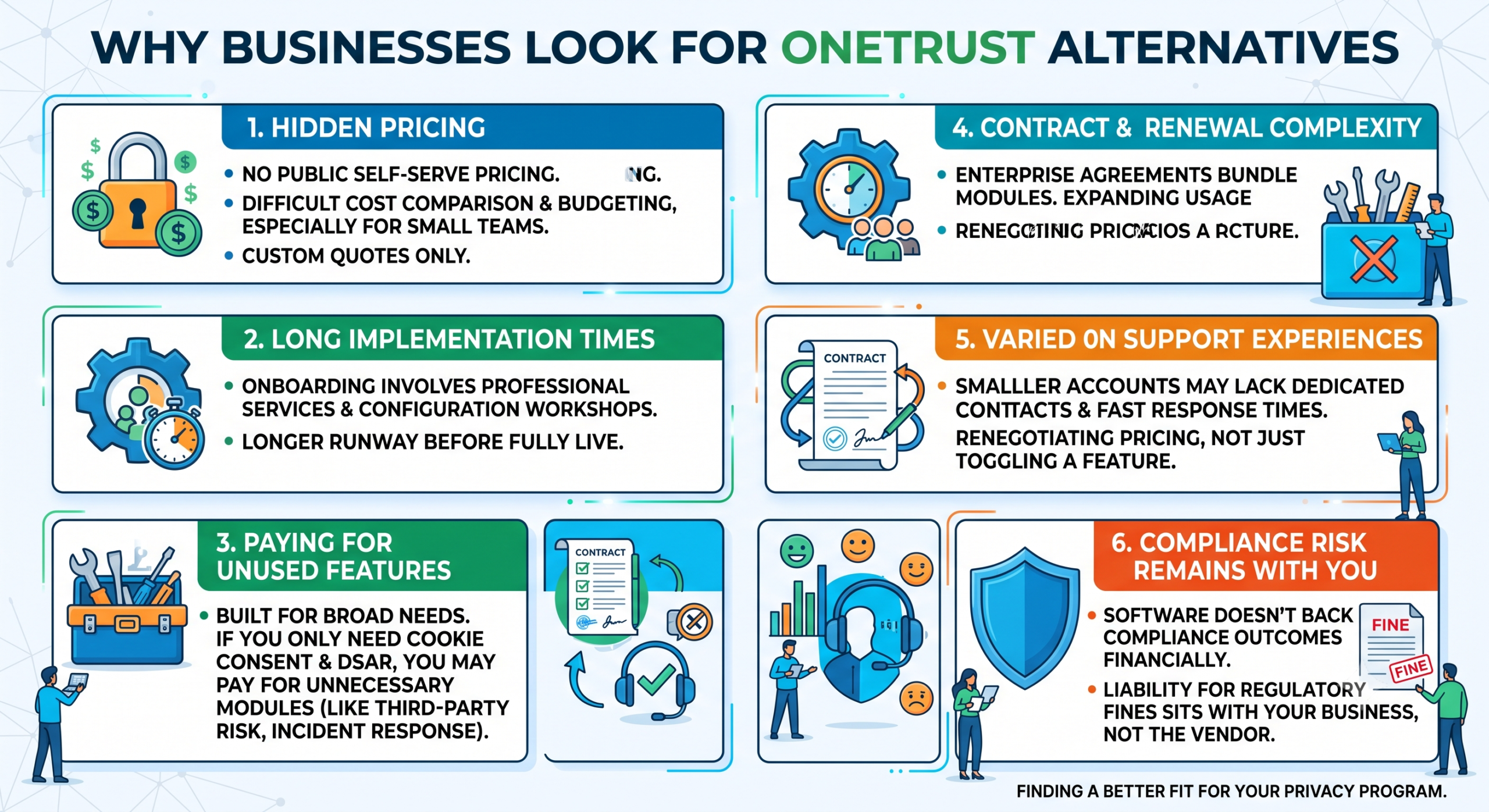
OneTrust earned its market position honestly through rapid growth where the CTO said “we grew too big too fast” it was one of the first platforms to build a full privacy, security, and governance suite, and it still offers one of the broadest feature sets available. But that breadth comes with trade-offs that show up repeatedly in buyer feedback and review sites. There were rumors of a OneTrust sale late last year but the deal never materialized.
Pricing is not public. OneTrust does not publish self-serve pricing. Every quote is custom, which makes it difficult to compare costs upfront or budget accurately, especially for smaller teams evaluating multiple vendors at once.
Implementation takes real time. Because the platform covers so many modules, onboarding often involves professional services, configuration workshops, and a longer runway before the tool is fully live across a business.
You may pay for more than you use. If your actual need is cookie consent and a DSAR portal, a platform built to also handle third-party risk, incident response, and enterprise governance can mean paying for capability you never touch.
Contract complexity and renewal upsells. Enterprise software agreements of this size often bundle modules together, and expanding usage later can mean renegotiating pricing rather than simply toggling on a feature.
Support experiences vary by tier. Smaller accounts do not always get the same response times or dedicated contacts as enterprise accounts, which matters if your privacy team is one or two people who need fast answers.
Compliance risk still sits with you. Even with the best software in place, most vendors in this space do not financially back your compliance outcomes. If a regulator issues a fine, the liability is yours alone.
Before comparing specific products, it helps to know what actually separates a strong privacy platform from a weak one. Use this checklist while you evaluate any vendor on this list.
1. Regulatory Coverage
Your platform should track and adapt to GDPR, CPRA/CCPA, VPPA, CIPA, LGPD, PIPEDA, and the growing list of US state privacy laws without requiring you to manually rebuild your compliance logic every time a law changes.
Why it matters: Regulations change constantly. A platform that lags behind new state laws leaves you exposed the moment a new statute takes effect.
2. Consent Management & Banner Customization
Look for geography-based banners, granular opt-in/opt-out categories, and a design that matches your brand rather than a generic pop-up.
Why it matters: A banner that is technically compliant but confusing or ugly hurts both your conversion rates and your legal standing if regulators view it as a “dark pattern.”
3. Data Subject Rights (DSAR) Automation
Consumers can request access to, correction of, or deletion of their data. Your platform should automate intake, identity verification, and fulfillment tracking so requests are never missed.
Why it matters: Missing a statutory DSAR deadline is one of the most common and avoidable sources of regulatory penalties.
4. Data Mapping & Discovery
You cannot protect data you cannot find. Automated discovery and classification across cloud storage, databases, and SaaS tools should feed a living map of where personal data lives.
Why it matters: Manual data inventories go stale within weeks. Automated mapping keeps your compliance posture accurate as your tech stack changes.
5. Privacy Impact Assessments & Risk Scoring
Templates and automated workflows for PIAs and DPIAs help you evaluate new tools, vendors, or features before they create exposure.
Why it matters: Assessing risk before launch is dramatically cheaper than remediating it after a regulator or plaintiff’s attorney finds it first.
6. Third-Party & Vendor Risk Management
Your vendors and sub-processors can create liability even when your own practices are sound. Look for vendor questionnaires, risk scoring, and ongoing monitoring.
Why it matters: Regulators increasingly hold companies accountable for the privacy practices of the vendors they share data with.
7. AI Governance
As companies adopt AI tools that touch personal data, a modern platform should help you inventory AI use cases and evaluate them against emerging AI-specific regulations.
Why it matters: AI governance is quickly becoming its own compliance category, and retrofitting it later is harder than building it in from the start.
8. Customization & Workflow Automation
Every privacy team has different workflows. The platform should let you automate repetitive tasks, like routing a DSAR to the right internal owner, without custom development work.
Why it matters: Automation is what lets a lean privacy team, even a team of one, keep pace with a growing volume of requests.
9. API & Integration Ecosystem
Your privacy tool needs to talk to your CRM, CMS, cloud storage, and marketing stack, ideally with pre-built connectors rather than custom engineering.
Why it matters: Privacy compliance touches nearly every system in your business; a platform that lives in isolation creates blind spots.
10. Pricing Transparency
Published, tiered pricing lets you budget accurately and compare vendors quickly, rather than spending weeks in a sales cycle just to learn what something costs.
Why it matters: Transparent pricing is also a signal of how a vendor treats customers after the contract is signed.
11. Onboarding & Support Quality
Look for a dedicated point of contact, realistic time-to-launch estimates, and support responsiveness that does not depend on your contract size.
Why it matters: The best privacy software in the world is only as good as your team’s ability to actually get it live and keep it running.
12. Litigation & Compliance Guarantees
A small number of vendors will contractually stand behind their product with a guarantee that helps cover qualifying claims if the tool was properly deployed and a privacy claim still arises.
Why it matters: Software that reduces risk is good. Software that financially backs its own compliance claims shows real confidence in the product.
The 11 Best OneTrust Alternatives, Reviewed in Depth
Below is a closer look at each alternative: what it does well, who it fits, current G2 sentiment, and pricing. We start with Captain Compliance, then move through the rest of the market roughly in order of overall value.
1. Captain Compliance vs. OneTrust
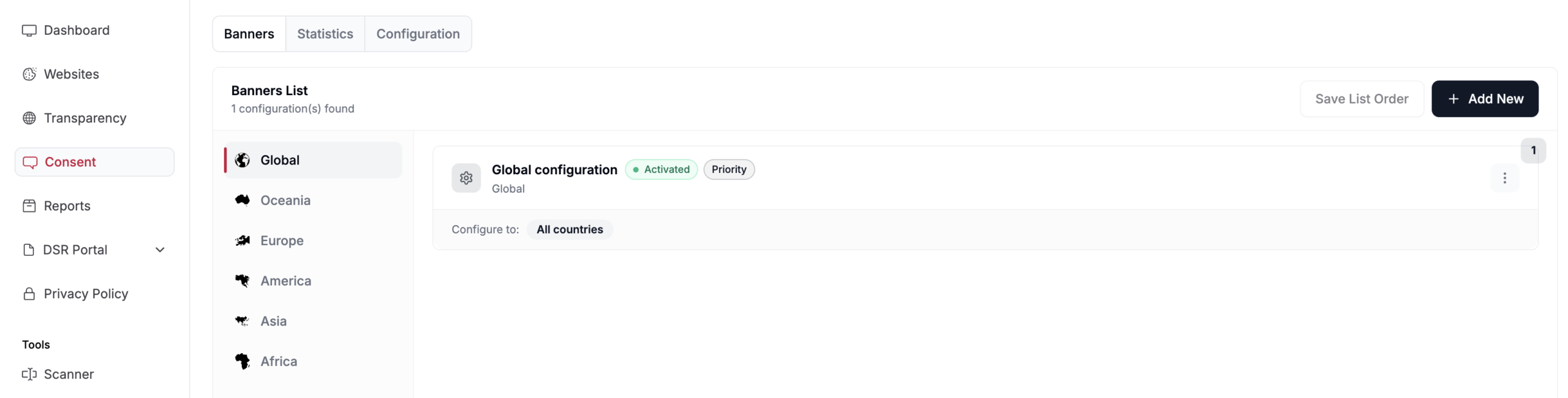
Captain Compliance is built around a simple idea: privacy compliance should not require a computer science degree, a six-figure budget, or a team of consultants to operate. The platform bundles Cookie Consent Management, a Hosted Privacy Notice generator, a DSAR Portal, a Cookie Transparency Page, and a free Cookie Scanner into one connected suite, backed by a named support contact (Captain Compliance calls this your “Dedicated Hero”) rather than a rotating help desk queue.
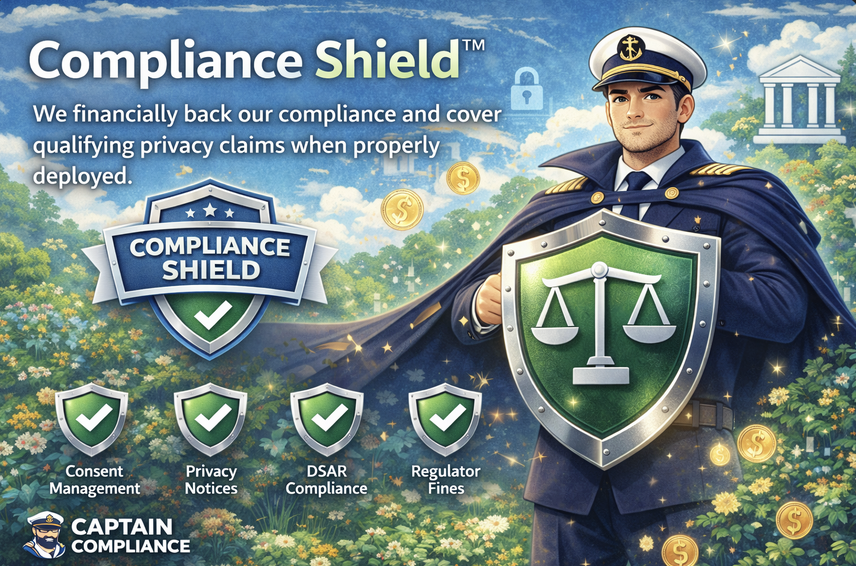
What sets it apart from every other name on this list is Compliance Shield: a litigation guarantee that financially backs qualifying privacy claims when the platform is properly deployed. No other vendor covered in this guide publicly offers anything comparable.
Key features:
- Geography-based, fully customizable cookie consent banners deployed in a few clicks
- Free public Cookie Scanner to audit your own site or any competitor’s site
- Hosted, auto-updating Cookie Transparency Page for building visitor trust
- DSAR/DSR portal for managing access, correction, and deletion requests
- Solutions mapped directly to GDPR, CPRA, CIPA, and VPPA
- Compliance Shield litigation guarantee on qualifying plans
G2 rating: 4.6/5 (167 reviews) — reviewers highlight the automated data discovery and mapping tools and the responsiveness of support, with the main critique being a lack of a progress indicator during long legacy-system scans.
Best for: SMBs and mid-market companies that want an all-in-one privacy suite without enterprise pricing or complexity.
Pricing: Free Personal plan (1 domain, 2,500 views/month, 50 scans); Professional at $499/month (5 modules, 3 team seats, Compliance Shield); custom Enterprise quotes for multi-domain organizations.
2. Osano vs. OneTrust
Osano positions itself as the simpler, SME-friendly alternative to OneTrust, combining cookie consent, subject rights automation, vendor risk, and data mapping into a single platform with a “No Fines, No Penalties” pledge of its own.
Key features: single-line-of-code deployment, pre-built rule sets for a large library of global regulations, unified consent and preference hub, vendor risk scoring.
G2 rating: 4.5/5 (173 reviews).
Best for: SMEs that want a guided, lower-complexity alternative to full enterprise suites.
Pricing: Not published; Osano’s own pricing page is demo-gated rather than self-serve, similar to OneTrust’s model.
3. Ketch vs. OneTrust
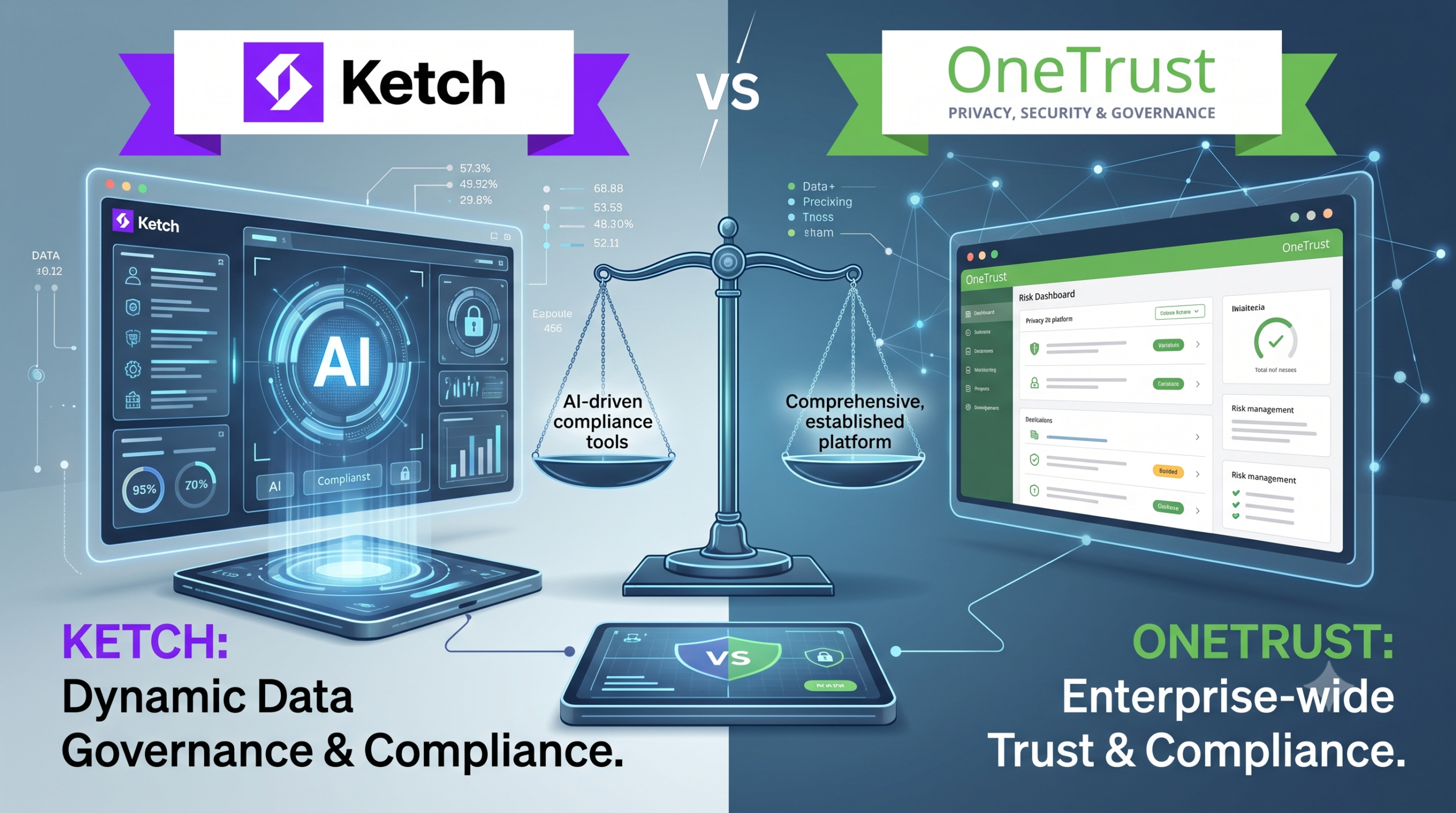
Ketch focuses on automating privacy compliance and data-use governance across jurisdictions, with particular strength in policy enforcement that follows data after consent is captured, not just at the point of collection.
Key features: automated consent management, data-use policy enforcement, strong data mapping, subject rights automation.
G2 rating: 4.6/5 (166 reviews) — users frequently cite the intuitive interface and strong customer support.
Best for: Mid-market and enterprise teams that need automated compliance without the full weight of OneTrust’s broader governance suite.
Pricing: Custom quote; no published self-serve tier.
4. TrustArc vs. OneTrust

TrustArc is arguably OneTrust’s closest direct competitor in terms of scope, with deep tooling for data governance, risk assessments, and third-party vendor management aimed at large, multinational organizations.
Key features: assessment automation, extensive regulatory templates, vendor risk management, enterprise-grade customization.
G2 rating: 4.2/5 (328 reviews) — the largest review sample of any alternative in this guide, with praise for its interface and support alongside some complaints about customer support responsiveness at scale.
Best for: Large multinational enterprises that need a fully configurable, enterprise-grade privacy management system.
Pricing: Custom quote, comparable in scale to OneTrust.
5. BigID vs. OneTrust
BigID takes a data-first approach, using machine learning to discover, classify, and map personal data across structured and unstructured sources at massive scale. It is less a full privacy suite and more a best-in-class data discovery and governance engine.
Key features: AI-driven data classification, coverage across structured and unstructured data, deep data governance tooling.
G2 rating: 4.3/5 within G2’s Data Privacy Management category (a smaller review sample there; BigID is more broadly reviewed under adjacent data security categories).
Best for: Large enterprises with complex, high-volume data environments that need discovery and classification depth above all else.
Pricing: Custom quote, enterprise-focused.
6. Didomi vs. OneTrust
Didomi who recently purchased a company called Source Point specializes in consent and preference management with a strong emphasis on customer experience personalization, letting users manage consent and communication preferences across multiple digital properties from one interface.
Key features: intuitive, quick-to-deploy consent tools, cross-property preference management, personalized privacy options for end users.
G2 rating: 4.5/5 (176 reviews).
Best for: Companies that prioritize consent UX and personalization over broader governance features.
Pricing: Custom quote; free trial available.
7. Usercentrics vs. OneTrust
Usercentrics offers one of the most transparent, session-based pricing models in this guide, with plans that scale from single-domain personal sites up to enterprise-level traffic volumes.
Key features: unlimited privacy regulations on paid tiers, advanced banner styling, cross-domain consent sharing, IAB TCF v2.3 support.
G2 rating: 4.4/5 (225 reviews).
Best for: Businesses that want clear, published, usage-based pricing instead of a custom sales quote.
Pricing: Free under 1,000 sessions/month; Essential from $8/month; Plus from $16/month; Pro from $34/month; Business from $56/month; Corporate by quote.
8. Cookiebot by Usercentrics vs. OneTrust
Cookiebot, now operating under the Usercentrics brand, is a lightweight, easy-to-integrate consent tool aimed at smaller sites that need straightforward cookie compliance without a full governance platform.
Key features: automated cookie scanning, simple banner deployment, multi-language support, minimal technical setup.
G2 rating: 4.2/5 (180 reviews).
Best for: Small businesses that need a simple, affordable consent banner rather than a broad privacy suite.
Pricing: Free tier for a single domain with capped scanning; paid tiers scale with pageviews.
9. Termly vs. OneTrust
Termly combines a consent management platform with attorney-drafted policy generators (privacy policy, terms and conditions, disclaimers) aimed squarely at small and medium-sized businesses that need essential compliance without legal fees. Termly is currently owned by a hosting company and specializes in selling to the masses with small personal websites.
Key features: policy generators with automatic legal updates, Google Certified CMP with Gold status, DSAR request tools, Google Consent Mode v2 and IAB TCF 2.2 support.
G2 rating: 4.3/5 (45 reviews).
Best for: Solopreneurs, small sites, and agencies managing multiple client websites on a budget.
Pricing: Free tier available; Starter from $10/month per website; Pro+ from $15/month per website (billed annually).
10. Secure Privacy vs. OneTrust
Secure Privacy markets itself heavily around pricing transparency, publishing a full self-serve pricing table that scales from a free plan up through Small, Business, and Advanced tiers before moving to custom Enterprise quotes.
Key features: cookie consent plus a separate privacy governance product line, published no-hidden-fee pricing, no credit card required to start.
G2 rating: 4.9/5 (115 reviews) — currently the highest-rated alternative in this guide.
Best for: Budget-conscious teams that want to see exact pricing before ever talking to sales.
Pricing: Free plan available; paid tiers scale by traffic and domain count; Advanced/Enterprise by quote.
11. A Note on CookiePro owned by OneTrust
Older comparison articles, including some still ranking in search results today, list CookiePro as an independent OneTrust competitor. That is outdated: CookiePro was acquired by OneTrust and has since been folded into OneTrust’s own Cookie Consent product. It is no longer a separate purchasing option, so it is not included as a standalone alternative in the table above.
Comparison Matrix: Captain Compliance vs. OneTrust vs. Top Alternatives
The table below lines up the core capabilities buyers ask about most, across six of the most-requested platforms in this guide.
| Feature | Captain Compliance | OneTrust | Osano | Ketch | TrustArc | Usercentrics |
|---|---|---|---|---|---|---|
| Cookie consent management | ✓ | ✓ | ✓ | ✓ | ✓ | ✓ |
| Free plan / free tier | ✓ | — | — | — | — | ✓ |
| Free cookie scanner tool | ✓ | — | — | — | — | — |
| Hosted privacy notice generator | ✓ | ✓ | ✓ | — | ✓ | — |
| DSAR / DSR portal | ✓ | ✓ | ✓ | ✓ | ✓ | — |
| Cookie transparency page | ✓ | — | — | — | — | — |
| Data mapping & discovery | ✓ | ✓ | ✓ | ✓ | ✓ | — |
| Third-party / vendor risk | Enterprise tier | ✓ | ✓ | Limited | ✓ | — |
| Published self-serve pricing | ✓ | — | — | — | — | ✓ |
| Litigation / compliance guarantee | ✓ (Compliance Shield) | — | Fines-only pledge | — | — | — |
| Dedicated named support contact | ✓ (“Dedicated Hero”) | Enterprise tiers only | — | — | — | — |
✓ = included / available. Feature availability changes over time and can vary by plan tier — confirm current details on each vendor’s site before purchasing.
Pricing Comparison: What Does Each OneTrust Alternative Actually Cost?
| Vendor | Entry-Level Price | Enterprise Pricing |
|---|---|---|
| Captain Compliance | Free (Personal); $499/month (Professional) | Custom quote |
| Termly | Free; $10/month (Starter) | Custom / bulk licensing |
| Usercentrics | Free (<1,000 sessions); $8/month (Essential) | Custom quote (Corporate) |
| Secure Privacy | Free; paid tiers scale by traffic | Custom quote |
| Cookiebot by Usercentrics | Free (1 domain, capped scans) | Custom quote |
| Osano | Not published (demo required) | Custom quote |
| Didomi | Not published (free trial) | Custom quote |
| Ketch | Not published | Custom quote |
| BigID | Not published | Custom quote |
| TrustArc | Not published | Custom quote |
| OneTrust | Not published | Custom quote |
Why Captain Compliance Is the Best OneTrust Alternative for Most Businesses
OneTrust and TrustArc were built for enterprises with dedicated privacy departments and seven-figure compliance budgets. Most companies are not that. Most companies need a privacy team of one or two people to be able to stand up cookie consent, a privacy notice, and a DSAR process quickly, keep it running without constant maintenance, and have a real answer if a regulator or plaintiff’s attorney ever comes calling.
That is the gap Captain Compliance is built to fill.
Everything in one connected suite. Instead of stitching together a cookie banner tool, a separate policy generator, and a separate DSAR mailbox, Captain Compliance runs Cookie Consent, Hosted Privacy Notices, the DSAR Portal, the Cookie Transparency Page, and the free Cookie Scanner from a single account.
Pricing you can actually see. There is a genuine free Personal plan, a published $499/month Professional tier, and Enterprise pricing for multi-domain organizations, a sharp contrast to OneTrust, TrustArc, Ketch, Osano, Didomi, and BigID, none of which publish self-serve pricing.
Compliance Shield. This is the differentiator no other vendor in this guide matches: unlike consent tools that shift all the risk back onto you, Captain Compliance financially backs qualifying privacy claims when the platform is properly deployed.
A dedicated human, not a ticket queue. Professional and Enterprise customers get a named “Dedicated Hero” as their point of contact, instead of starting over with a new support agent every time they reach out.
Proven track record. Captain Compliance holds a 4.6/5 rating on G2 across 167 reviews, ahead of OneTrust (4.3/5), TrustArc (4.2/5), and Cookiebot by Usercentrics (4.2/5), with reviewers specifically calling out its automated data discovery, mapping, and ease of implementation.
Where OneTrust makes sense is very large, heavily regulated enterprises that need incident response, extensive third-party risk modules, and enterprise governance all bundled into one contract. If that is not your situation, Captain Compliance gives you the core privacy stack you actually need, at a price you can see before you talk to sales, with a guarantee standing behind it.
How to Switch From OneTrust to Captain Compliance in 5 Steps
- Export your existing data. Pull your current cookie categories, consent logs, privacy notice content, and any open DSAR requests from OneTrust before you begin migrating.
- Get My Free Audit first. Use Captain Compliance’s free Cookie Scanner to generate an independent, up-to-date inventory of the trackers and cookies actually live on your site today.
- Rebuild your consent banner. Recreate your consent categories and geography-based rules inside Captain Compliance’s Cookie Consent module, matching or improving on your current setup.
- Migrate your privacy notice and DSAR workflow. Move your privacy notice to the Hosted Privacy Notice tool and reroute incoming data subject requests through the new DSAR Portal.
- Run both systems in parallel briefly, then cut over. Keep OneTrust active for a short overlap window while you confirm the new banner and DSAR workflow are firing correctly, then cancel the OneTrust contract.
Frequently Asked Questions
What is the best free OneTrust alternative?
Captain Compliance, Termly, Usercentrics, Cookiebot by Usercentrics, and Secure Privacy all offer genuine free plans, unlike OneTrust, which requires a custom quote regardless of company size.
Which OneTrust competitor is the cheapest for a small business?
Termly and Usercentrics both publish entry-level plans under $20/month, while Captain Compliance offers a fully free Personal plan for a single domain before its $499/month Professional tier.
Is there a OneTrust alternative that offers a litigation guarantee?
Yes. Captain Compliance’s Compliance Shield financially backs qualifying privacy claims when the platform is properly deployed, a feature not publicly offered by OneTrust, TrustArc, Ketch, Didomi, BigID, or Usercentrics.
What is the best OneTrust alternative for small and medium-sized businesses?
Captain Compliance and Osano are both purpose-built for SMBs that want essential privacy tooling without enterprise complexity, though Captain Compliance additionally publishes its pricing and includes a litigation guarantee.
What is the best OneTrust alternative for large enterprises?
TrustArc and BigID are the strongest fits for large, complex organizations, with TrustArc focused on broad governance and risk assessments and BigID focused on AI-driven data discovery at scale.
Does switching from OneTrust to another platform hurt my SEO or site performance?
No. Consent management platforms typically load asynchronously via a single script tag, so switching providers does not affect search rankings, and lightweight tools can actually improve page load speed.
How long does it take to migrate from OneTrust to Captain Compliance?
Most small-to-mid-size sites can complete the five-step migration above within a few business days, since the core work is recreating consent categories and privacy notice content rather than deep custom engineering. Captain Compliance provides custom migrations free of charge from any CMP and provides privacy litigation protection along the way.
Final Verdict
OneTrust remains a legitimate choice for very large, heavily regulated enterprises that need every module of a full governance suite bundled into a single contract. For everyone else, the alternatives above deliver the same core privacy outcomes, often with clearer pricing, faster implementation, and better-rated support.
If you want an all-in-one suite with transparent pricing and a guarantee standing behind it, see Captain Compliance’s plans or book a free demo to see the platform in action.
Put this into practice
Turn privacy guidance into working controls.
Captain Compliance helps teams discover tracking technologies, enforce consent, manage privacy requests and document the evidence behind every decision.