Minnesota’s first major privacy enforcement action, coordinated with California regulators, exposes the risks of improperly configured consent management systems and privacy controls that fail to honor consumer choices.
Polaris Industries, the Minnesota-based manufacturer of motorcycles, snowmobiles, ATVs and other recreational vehicles, has agreed to pay more than $1 million in combined penalties to California and Minnesota regulators after an investigation uncovered failures in its handling of consumer privacy requests and website tracking technologies.
The enforcement action, announced November 19, 2026, includes a $150,000 settlement with Minnesota Attorney General Keith Ellison and a separate $910,986 administrative fine imposed by the California Privacy Protection Agency, known as CalPrivacy.
The Minnesota settlement marks the state’s first enforcement action under the Minnesota Consumer Data Privacy Act (MCDPA), which took effect July 31, 2025.
But the most consequential finding may be technical rather than administrative: Polaris had website tracking technologies that failed to honor consumers’ Global Privacy Control (GPC) signals correctly, even after the company had attempted to resolve previously identified compliance deficiencies.
The case is another warning for businesses relying on consent management platforms (CMPs), cookie banners and automated privacy tools. Purchasing compliance software does not establish compliance if the implementation fails to stop prohibited tracking or process consumer requests as required by law.
What Went Wrong at Polaris?
According to the Minnesota attorney general’s announcement and the accompanying Assurance of Discontinuance, regulators identified several problems involving how Polaris processed privacy requests and disclosed its data practices.
The investigation was conducted collaboratively with CalPrivacy as part of growing cooperation among state privacy regulators and on the heels of CalPrivacy’s fine of Hertz rental cars this month.
1. Polaris Required Consumers to Verify Their Identity Before Opting Out
One of the central findings involved Polaris’s process for handling requests to opt out of the sale of personal information and targeted advertising.
Consumers seeking to exercise their opt-out rights were required to provide an email address. Polaris then sent an email requesting verification of the consumer’s identity.
If the consumer failed to respond, the company sent another email informing the individual that the opt-out request had been denied.
Regulators determined that this process imposed an unlawful additional step under Minnesota law.
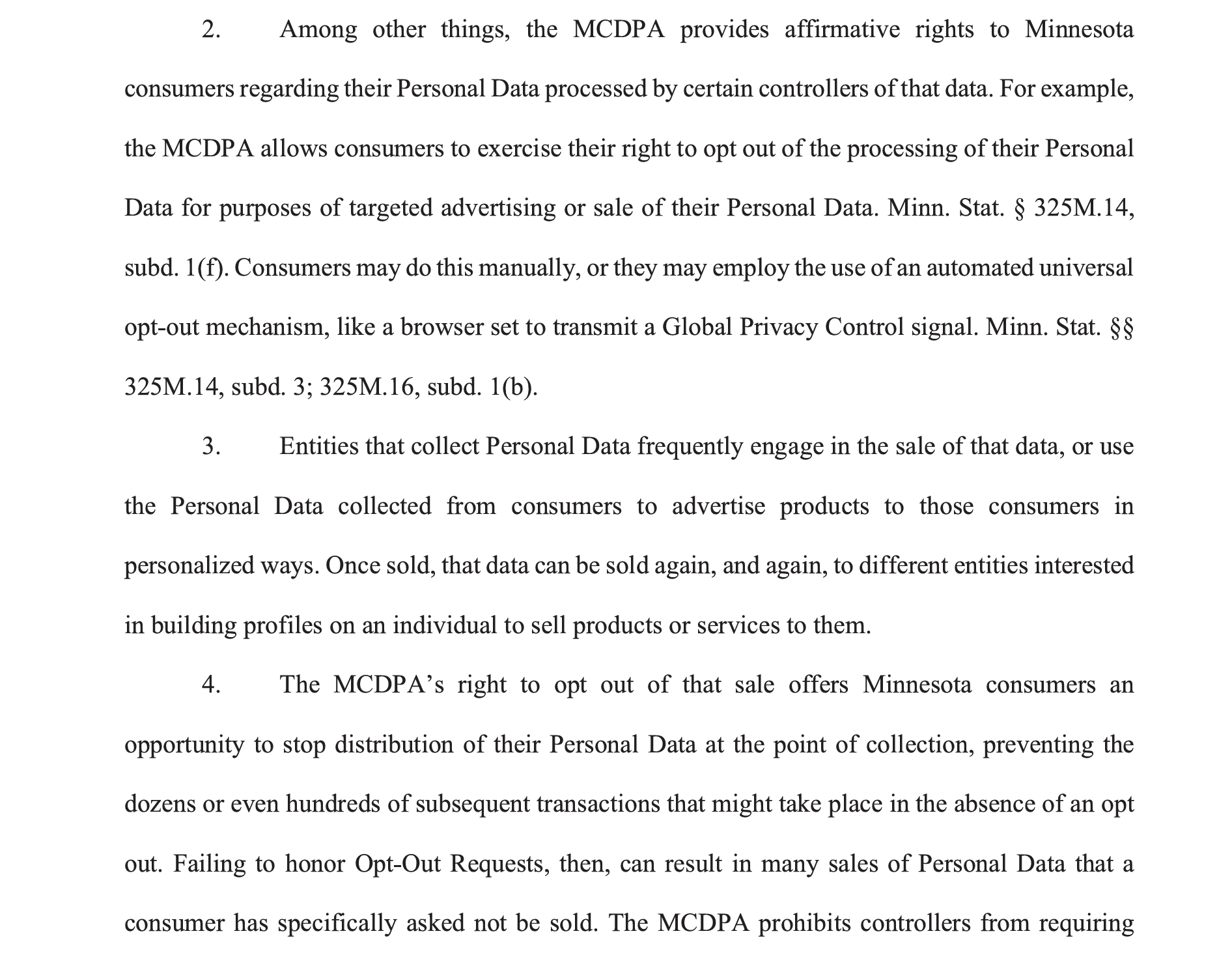
Although businesses may authenticate consumers when responding to certain privacy requests, such as requests to access personal data, the MCDPA generally prohibits requiring identity verification before honoring an opt-out request.
This distinction is important.
A business may have a legitimate reason to verify someone’s identity before disclosing sensitive personal information. It does not ordinarily need that same verification to stop selling or using information for targeted advertising.
Requiring consumers to complete additional steps can turn a legally protected privacy right into an unnecessarily burdensome process.
2. Website Tracking Technologies Failed to Properly Honor Global Privacy Control
The investigation also uncovered a technical failure involving how Polaris’s website handled Global Privacy Control signals.
GPC is a browser-based mechanism that allows consumers to communicate their preference to opt out of covered data sales, sharing and certain advertising activities without submitting a separate request on every website.
Under applicable state privacy laws, covered businesses must recognize and honor qualifying opt-out preference signals.
Minnesota regulators found that certain technologies deployed on the Polaris website were not properly configured to respond to those signals.
The settlement describes a particularly revealing problem.
When a consumer activated GPC while viewing a Polaris webpage, the preference was recognized for subsequent page views. However, activity on the webpage already open could continue to be processed without reflecting the consumer’s new opt-out preference until the next page loaded.
In other words, the website could recognize a privacy preference on the next page without immediately applying that preference to the page the consumer was currently using.
That distinction matters because consumers do not necessarily navigate to another page after activating a privacy control.
Tracking technologies operating during that interval could continue processing data in a manner inconsistent with the consumer’s opt-out request.
The finding illustrates how apparently small differences in JavaScript execution, consent-state management and tracking integrations can create regulatory exposure.
A functioning CMP must do more than display a banner or store a user’s selection. The privacy preference must be communicated correctly to the technologies that collect and transmit personal information.
3. Polaris’s Privacy Notice Was Incomplete
Regulators also determined that Polaris’s privacy notice failed to adequately disclose opt-out information required by Minnesota law.
Privacy notices are not merely documents that businesses publish to satisfy a disclosure requirement. They must accurately describe the privacy rights available to consumers and explain how those rights can be exercised.
A company can therefore face compliance problems on two levels: its published disclosures may be inadequate, and its underlying technical controls may fail to perform as required.
In the Polaris case, both issues appeared in the same enforcement action.
4. Regulators Also Questioned the Company’s Privacy Assessments
The settlement provides another detail that received less attention in the initial announcement.
Minnesota’s attorney general requested information about Polaris’s data privacy and protection assessments, which the MCDPA requires for certain processing activities.
Polaris produced a single assessment addressing the processing of personal data for sale and targeted advertising, dated April 2026.
According to the agreement, that document indicated a lack of formal written assessments before that date.
The finding is significant for businesses that treat privacy compliance primarily as a website implementation project.
Cookie consent and opt-out technology are important, but they do not replace the documented assessments, policies, procedures and governance controls required under applicable privacy laws.
Polaris Had Already Been Warned About Its Privacy Practices
Perhaps the most concerning aspect of the settlement is the chronology.
Minnesota’s attorney general sent Polaris a warning letter on November 21, 2025, identifying preliminary findings and requesting corrective action.
By the end of December 2025, Polaris represented that it believed the deficiencies described in the warning had been corrected.
However, subsequent testing uncovered continuing errors in how the website handled personal data following opt-out requests.
Regulators were not satisfied simply because the company believed it had fixed the problem.
They tested the website again.
The results showed that important technical deficiencies remained.
Polaris subsequently engaged an external technical consultant and reconfigured tracking technologies to address the identified issues.
The sequence offers a practical lesson for companies responding to regulatory inquiries: a remediation plan is not the same as verified remediation.
Businesses need to confirm that their changes actually affect the behavior of tracking scripts, advertising technologies and privacy request workflows.
The TrustArc Question: Who Is Responsible When Privacy Software Is Misconfigured?
The Polaris settlement raises an issue that extends well beyond one manufacturer or software provider.
Businesses increasingly depend on third-party CMPs, including platforms such as TrustArc, OneTrust, Usercentrics and other privacy technology vendors.
These systems can help companies manage cookie consent, opt-out requests, privacy preferences and regulatory disclosures.
However, the existence of a CMP does not guarantee that every tracking technology on a website will correctly respond to consumer choices. As we saw with Honda, Todd Snyder, Disney, and GM who collectively have paid out over $250 million in privacy fines recently all were using a legacy vendor OneTrust.
The Minnesota Polaris settlement identifies improperly configured tracking technologies but does not identify TrustArc or another CMP vendor as the source of those failures.
The distinction does not diminish the broader concern.
A CMP can appear to be functioning properly while advertising tags, analytics scripts or other third-party integrations continue operating contrary to a consumer’s expressed preferences.
That can happen when tracking scripts run independently of the consent management platform, when a tag manager does not correctly apply consent states, or when changes to a consumer’s preferences do not immediately update the behavior of technologies already loaded on a webpage.
The Polaris findings show why companies cannot rely exclusively on a CMP’s administrative dashboard to determine whether they are compliant.
The actual behavior of the website matters.
California regulators have made the same point in previous enforcement actions. In the 2025 Todd Snyder settlement, CalPrivacy warned that businesses remain responsible for the performance of their privacy management solutions.
The lesson applies regardless of which platform a business chooses.
A privacy vendor can provide software, but the business must ensure that its deployment, configuration and ongoing operation satisfy applicable legal requirements.
Why the $1 Million Settlement Matters Beyond Minnesota
The combined $1,060,986 in penalties illustrates the growing willingness of state regulators to coordinate investigations involving overlapping privacy laws.
Minnesota’s action was conducted in collaboration with California, which has developed an increasingly active privacy enforcement program.
The states are members of the Consortium of Privacy Regulators, an initiative that facilitates cooperation among authorities responsible for enforcing privacy protections.
For national businesses, a website tracking problem is rarely confined to the jurisdiction where the company operates.
A single tracking configuration can affect consumers visiting from California, Minnesota and other states with comprehensive privacy laws.
It can also create multiple forms of liability.
A company might fail to honor an opt-out preference signal, provide an inadequate privacy notice, mishandle consumer requests and continue transmitting personal data to advertising partners.
Those failures can overlap, even if they originate from the same underlying implementation.
This is especially relevant to companies using multiple advertising pixels, analytics providers, tag managers and customer data platforms.
Regulators are increasingly capable of testing actual website behavior rather than accepting a company’s description of its privacy program.
Polaris Must Conduct Ongoing Compliance Reviews
The resolution requires more than payment of the monetary penalties.
According to Minnesota’s announcement, Polaris agreed to changes that include an internal review process, quarterly website scans to verify that opt-out requests are honored, and employee training.
Quarterly testing is particularly noteworthy.
It recognizes that website privacy compliance can change after the initial implementation.
A marketing team may introduce a new advertising pixel. A developer may modify a tag manager. A third-party vendor may update its script. A website redesign may alter the timing or operation of consent controls.
Any of those changes can create new problems even when the original deployment was correctly configured.
Quarterly scanning provides a periodic opportunity to identify deficiencies.
For businesses operating complex websites with frequent marketing or development changes, more continuous monitoring may provide stronger protection.
The objective is not simply to confirm that a cookie banner appears. It is to verify that the website actually respects the consumer’s privacy choice.
How Captain Compliance Addresses the Problems Identified in the Polaris Case
The Polaris enforcement action illustrates why Captain Compliance approaches privacy management as a combination of software deployment, technical integration and ongoing verification.
A consent banner alone cannot prevent every tracking-related violation.
The critical issue is whether the website’s data collection technologies operate according to the choices consumers make.
Captain Compliance provides a consent management platform alongside cookie scanning, preference management, privacy notices and privacy request workflows.
Its implementation and integration process is designed to address the types of problems identified in the Polaris investigation.
Consent Management Integrated With Website Tracking
Captain Compliance supports integration with website platforms and tag management systems, including Google Tag Manager.
Proper implementation allows consent states to control whether applicable analytics, advertising and other nonessential tracking technologies are permitted to execute.
For businesses using Meta Pixel, TikTok Pixel, Google Analytics or similar services, the objective is to connect privacy choices to the technologies responsible for collecting and transmitting information.
This requires identifying the relevant scripts, assigning appropriate classifications, configuring blocking behavior and testing the results.
A banner that displays correctly while independently deployed trackers ignore its instructions is not sufficient.
Global Privacy Control Recognition and Enforcement
Captain Compliance supports Global Privacy Control as part of its consent and preference management capabilities.
The implementation must ensure that covered opt-out signals are detected and translated into the appropriate restrictions on tracking and data processing.
As the Polaris case illustrates, testing must include the timing of preference changes, not merely whether a signal is recognized on a subsequent page.
An effective integration should account for initial page loads, applicable changes in preference state and the behavior of scripts that may already be active.
Cookie Scanning and Technical Verification
Captain Compliance’s scanning capabilities help businesses identify cookies and tracking technologies deployed on their websites.
Its Patrol scanning tools can also evaluate website privacy behavior, including the handling of GPC signals.
The company recommends reviewing both the presence of tracking technologies and whether their behavior changes appropriately when a consumer rejects tracking or exercises an opt-out right.
That testing is particularly useful after marketing changes, website updates or new integrations.
Continuous monitoring and periodic technical reviews can help identify newly introduced tracking risks before they persist for months.
Privacy Notices and Consumer Rights Management
The Polaris investigation was not limited to website tracking. It also identified deficiencies in privacy notices and the handling of consumer rights requests.
Captain Compliance offers privacy notice and data subject request management capabilities that support these functions within a broader privacy program.
Its tools can help businesses publish privacy disclosures, manage consumer choices and route rights requests through workflows configured for the applicable legal requirements.
Those configurations must account for differences between requests that require identity verification and opt-out requests that generally must be processed without unnecessary authentication barriers.
A compliant process must be designed around the relevant privacy right, rather than imposing the same verification requirements on every request.
The Bigger Lesson: Privacy Compliance Must Be Tested, Not Assumed
The Polaris settlement is a reminder that privacy enforcement increasingly involves technical examination of real website behavior.
The company was warned about deficiencies, believed it had corrected them and subsequently faced additional findings when regulators tested its website.
The financial consequence exceeded $1 million across two states.
For companies operating websites that depend on advertising pixels, analytics technologies and third-party data collection, the question is no longer whether a consent banner has been installed.
It is whether that banner, the underlying consent management platform and every relevant integration actually work together.
Captain Compliance helps businesses address these risks through integrated consent management, GPC support, cookie scanning, privacy request management and ongoing technical verification.
Businesses that want to assess whether their website honors opt-out requests and properly controls tracking technologies can visit CaptainCompliance.com or review its website scanning and GPC testing guidance.
The lesson from Polaris is straightforward: compliance software cannot protect a business from misconfigured tracking. The implementation must work, and the business needs evidence that it works