What Is Privacy UX?
Privacy UX covers every point where a person meets your privacy program: the cookie banner, the preference center, the “Do Not Sell or Share” link, the access or deletion request form, and the confirmation that their choice was honored. A privacy UX platform brings those touchpoints together so that a choice made in one place is respected everywhere.
We look at three core capabilities:
- Tracker and cookie consent. Capturing consent on websites and apps, honoring browser signals such as Global Privacy Control (GPC), scanning for trackers, and actually blocking tags that lack consent.
- Consent and preference management. Keeping a single, current record of each person’s choices and syncing it to marketing, CRM, ad tech and data systems.
- Subject rights requests (DSARs). Taking in access, deletion, correction and opt-out requests, verifying identity, routing work, gathering data, and responding on time with an audit trail.
The 2026 Magic Quadrant for Privacy UX: An Independent Assessment of Consent, Preference and Subject Rights Platforms
Why This Market Matters Now
Enforcement has changed what buyers need from these tools. California regulators have penalized companies whose cookie banners did not actually stop tracking, whose opt-out flows added friction, and whose vendor contracts were too vague. Private plaintiffs have filed thousands of CIPA and wiretapping claims over pixels and session replay tools. More than twenty states now have comprehensive privacy laws, most of which require honoring universal opt-out signals.
The result is simple: a banner that looks right is no longer enough. Buyers need proof that consent choices are enforced, that opt-out signals are honored, and that requests are completed on time. That is the lens we used for this assessment.
Our Methodology
We scored each vendor on two axes using publicly available information, product documentation, published pricing where available, public customer reviews, and our own hands-on experience in competitive deals and migrations. Vendors were not paid, briefed or asked to participate, and no vendor paid for placement.
Axis 1: Delivery and Value (vertical axis)
How well the vendor delivers working compliance today, for the buyers it serves.
| Criterion | Weight | What we looked at |
|---|---|---|
| Core capability coverage | 25% | Depth across tracker consent, preference management and DSAR handling |
| Enforcement that works | 20% | Whether non-consented tags are actually blocked and GPC signals are honored by default |
| Time to value | 15% | How quickly a typical customer goes live without heavy professional services |
| Pricing transparency and total cost | 15% | Published or predictable pricing, renewal stability, add-on costs |
| Ease of use | 15% | Whether privacy, legal and marketing users can run the platform without engineering help |
| Support and service | 10% | Onboarding, responsiveness and reviewer sentiment |
Axis 2: Vision and Risk Coverage (horizontal axis)
How well the vendor anticipates where enforcement and litigation are heading.
| Criterion | Weight | What we looked at |
|---|---|---|
| Continuous monitoring and risk detection | 25% | Ongoing scanning for trackers, data leakage, and CIPA and VPPA exposure |
| Signal and framework support | 20% | GPC, IAB TCF, IAB GPP, Google Consent Mode and state opt-out requirements |
| Regulatory coverage and speed | 20% | How fast new laws and regulations are reflected in templates and logic |
| Integration ecosystem | 15% | Native connectors, APIs and tag manager support |
| Roadmap and innovation | 10% | AI governance, server-side tagging, agent-mediated consent |
| Global reach | 10% | Multi-jurisdiction support, languages and in-region representation |
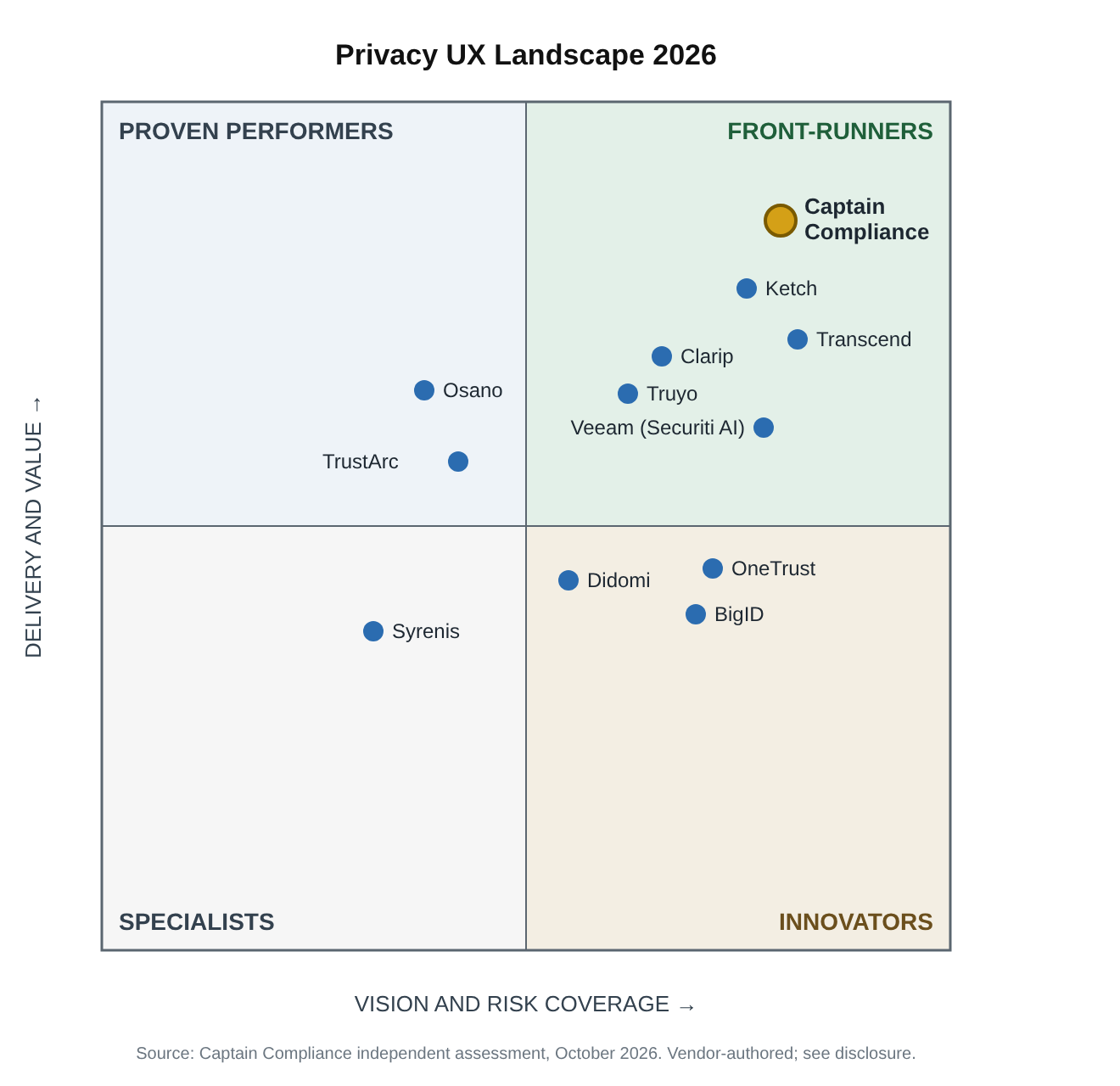
The 2026 Privacy UX Landscape
PROVEN PERFORMERS
FRONT-RUNNERS
SPECIALISTS
INNOVATORS
Privacy UX Landscape 2026
VISION AND RISK COVERAGE →
DELIVERY AND VALUE →
CaptainCompliance
Ketch
Transcend
Clarip
Truyo
Veeam (Securiti AI)
Osano
TrustArc
OneTrust
BigID
Didomi
Syrenis
Source: Captain Compliance independent assessment, October 2026. Vendor-authored; see disclosure.
How to Read the Landscape
- Front-Runners deliver strong, enforceable compliance today and are building for where enforcement is heading.
- Proven Performers deliver reliably for their target buyers but are narrower in monitoring, signals or roadmap.
- Innovators bring broad capabilities or strong technology but carry tradeoffs in cost, complexity or time to value.
- Specialists excel in particular use cases, regions or segments.
A position on this chart is not a recommendation for every buyer. A global bank with a data discovery program has different needs from a 200-person retailer facing a CIPA demand letter. Match vendors to your use case, team size and budget.
Scorecard Summary
| Vendor | Position | Delivery and Value (0 to 100) | Vision and Risk Coverage (0 to 100) | Best fit |
|---|---|---|---|---|
| Captain Compliance | Front-Runner | 86 | 80 | Mid-market to enterprise teams that need fast deployment, enforced consent and continuous risk monitoring |
| Ketch | Front-Runner | 78 | 76 | Consumer brands with complex identity and ad tech needs |
| Transcend | Front-Runner | 72 | 82 | Engineering-led enterprises wanting granular control |
| Clarip | Front-Runner | 70 | 66 | Organizations wanting high-touch service and deep customization |
| Truyo | Front-Runner | 66 | 62 | Regulated enterprises needing private cloud or on-premises options |
| Veeam (Securiti AI) | Front-Runner | 62 | 78 | Enterprises pairing privacy with data and AI governance |
| Osano | Proven Performer | 66 | 38 | Midsize companies on tight deadlines |
| TrustArc | Proven Performer | 58 | 42 | Large enterprises with established privacy programs |
| OneTrust | Innovator | 45 | 72 | Large enterprises wanting one broad trust platform |
| BigID | Innovator | 40 | 70 | Organizations investing heavily in data discovery |
| Didomi | Innovator | 44 | 55 | European publishers and media companies |
| Syrenis | Specialist | 38 | 32 | Multi-brand organizations focused on preference management |
Vendor Assessments
Captain Compliance (Front-Runner)
Captain Compliance, founded in 2023, offers a privacy compliance platform covering cookie consent management, DSAR workflows, Global Privacy Control handling, dynamic privacy policies, vendor disclosures and continuous website monitoring through its Patrol privacy risk tool. Its consent platform runs on more than 8,000 websites and processes over 50 million consent choices each month. Captain Compliance is part of the Google CMP Program, holds IAB TCF validator certification, and offers EU Article 27 representation through a partnership with EU Presence. It pairs software with consulting services.
Strengths
- Enforcement, not just display. GPC signals are honored and non-consented trackers are blocked, which addresses the failure behind several recent California penalties.
- Continuous risk monitoring. Patrol scans sites for trackers firing where they should not, which helps customers find CIPA, wiretapping and pixel exposure before plaintiffs do.
- Time to value. Customers can deploy core consent and DSAR capabilities quickly, with software and consulting from one provider.
- Framework support. Google CMP certification and IAB TCF validation support publishers and advertisers that depend on programmatic revenue.
Cautions
- Younger company. Founded in 2023, Captain Compliance has a shorter track record than vendors that have been in the market for a decade or more.
- Enterprise data discovery. Buyers wanting deep, built-in discovery across structured and unstructured enterprise data stores may pair Captain Compliance with a dedicated discovery tool.
- Team size. A team of about 50 people is smaller than the largest platform vendors, so very large global rollouts should confirm regional support coverage.
Ketch (Front-Runner)
Ketch, based in San Francisco, builds its platform around identity, connecting customer identifiers so that consent and rights requests follow the person across systems. It is popular with consumer brands that have complex marketing and ad tech stacks.
Strengths: strong real-time consent enforcement and tag governance; API-driven, automated DSAR workflows; growing traction replacing legacy platforms.
Cautions: configuration takes familiarity to get right; smaller teams may need more hands-on onboarding than they expect; a narrower connector library than the largest platforms.
Transcend (Front-Runner)
Transcend, also based in San Francisco, offers DSR automation, consent and preference management and a privacy center on one shared pipeline. It appeals to technical teams that want precise control.
Strengths: very granular control over outgoing website requests; a large integration and API ecosystem; a cohesive architecture across all three capabilities.
Cautions: more administrative effort than average; database-level DSR automation adds data discovery cost; best suited to organizations with engineering support.
Clarip (Front-Runner)
Clarip, headquartered in Delaware, offers a DSR portal, universal consent and preference management, and cookie consent, with a strong U.S. retail, travel and financial services base.
Strengths: deep banner and API customization; detailed tracker and data-flow mapping; high-touch implementation support.
Cautions: depth of options brings a learning curve; heavy customization can increase maintenance; lower market visibility can lengthen procurement validation.
Truyo (Front-Runner)
Truyo, founded in Arizona in 2017, offers consent and preference management and data privacy modules for midsize and large enterprises, including financial services and government clients.
Strengths: flexible centralized or federated preference models; strong redaction; private cloud and on-premises deployment options; AI features that can be fully turned off.
Cautions: fewer self-service connectors; self-service automation can take weeks to validate; some warranty-related features are sold separately.
Veeam (Securiti AI) (Front-Runner)
Veeam acquired Securiti AI in late 2025. The platform relies on data discovery and mapping to find personal data for rights requests and to manage consent, and it extends into broader data and AI governance.
Strengths: strong data classification and mapping; a broad set of prebuilt connectors; global reach expanded by the acquisition.
Cautions: longer sales cycles; some tag manager setup is manual; buyers should watch how product direction and branding settle after the acquisition.
Osano (Proven Performer)
Osano, based in Austin and founded in 2018, targets midsize companies with cookie consent, a consent and preference hub, and subject rights management.
Strengths: fast purchasing and deployment; strong customer satisfaction; a publicized compliance pledge backed by financial commitment.
Cautions: limited customization for large enterprises; a narrow roadmap; limited monitoring for litigation risks such as CIPA.
TrustArc (Proven Performer)
TrustArc, based in Walnut Creek, California, is one of the longest-standing privacy vendors, offering cookie consent, consent and preference management and individual rights management, mostly to large North American enterprises.
Strengths: regulatory guidance built into the platform; integrated identity verification; broad language support.
Cautions: preference syncing is often batched rather than real time; limited banner customization; administratively heavy request configuration.
OneTrust (Innovator)
OneTrust, based in Atlanta, offers the broadest trust and privacy suite on the market, with consent management and privacy automation used by large enterprises worldwide.
Strengths: a very large connector library; strong redaction and legal review workflows; an ambitious roadmap for AI agents and new device types.
Cautions: buyers frequently report renewal price increases after the move to consumption-based pricing; mixed reviews on support; a complex interface for non-technical users.
BigID (Innovator)
BigID, based in New York, is known for data discovery and offers data rights automation, a privacy portal, consent and preference management, and cookie consent as modular apps.
Strengths: strong automated discovery for fulfilling rights requests; offices in many countries; fast updates for new regulations.
Cautions: discovery takes time and money to set up; buyers may see it mainly as a data security vendor; high entry cost for budget-constrained teams.
Didomi (Innovator)
Didomi, based in Paris, focuses on consent and preference management for publishers, advertisers and e-commerce, with growing compliance monitoring.
Strengths: polished configuration and form building; good support for web, mobile and connected TV; server-side consent monitoring.
Cautions: more manual inventory and mapping; fewer native connectors; stronger at monitoring than automated enforcement and deletion.
Syrenis (Specialist)
Syrenis, based in the U.K., built its business on preference management and has added tracker consent and rights request features.
Strengths: highly configurable preferences for multi-brand, multi-region organizations; positive customer feedback; a new U.S. office.
Cautions: tracker consent lacks automatic enforcement; rights requests need manual work or another tool; a small team and longer sales cycles.
Buyer Recommendations
- Test enforcement, not screenshots. In every demo, decline consent and send a GPC signal, then check the network traffic. If tags still fire, the platform will not protect you.
- Ask about monitoring. Sites change every week. Ask how the vendor detects new trackers and alerts you before a plaintiff’s firm finds them.
- Get pricing in writing for renewal. Ask what happens to price when traffic, domains or request volume grow.
- Match complexity to your team. A platform that needs engineers to run will stall at a company that does not have them.
- Check frameworks. If you run programmatic advertising, confirm Google CMP certification, IAB TCF and GPP support.
- Call references in your industry and size range. Reviews from much larger or smaller companies may not apply to you.
Market Outlook
Over the next two years we expect the market to move in three directions. First, enforcement will keep shifting from “did you show a banner” to “can you prove the choice was honored,” which favors platforms that block and monitor rather than just display. Second, litigation over tracking technologies will keep pushing continuous scanning from a nice-to-have to a core requirement. Third, consent will extend to server-side tagging, connected devices and AI agents acting on a person’s behalf.
The vendors best positioned for that future are those that combine working enforcement, continuous monitoring and fast time to value at a price that does not jump at renewal.
About This Report
This landscape was produced in response to the $65,000 request by Gartner to be reviewed for inclusion in their magic quadrant for privacy UX. As we see better usage into customer support vs. paying for a ranking at this time drew inspiration to add to the report as users deserve the best choices. Captain Compliance competes with the vendors listed and places among the best in the data privacy software industry. As the criteria published applied equally to every vendor. No vendor paid to be included or to influence placement on the list above. Vendor descriptions are based on public information, product documentation, public reviews and our market experience as of October 2026. Gartner and Magic Quadrant are registered trademarks of Gartner, Inc. This report is not affiliated with or endorsed by Gartner.