Know what’s on your site before a plaintiff’s firm does
A free privacy audit shows which cookies, pixels and trackers are running — and which ones commonly appear in privacy claims.
A federal bill introduced in September 2026 seeks to shut down a wave of website-tracking lawsuits under aging wiretap and pen-register statutes. Supporters call it long-overdue relief for businesses drowning in demand letters. Privacy advocates see a broader shield for data practices that have long operated in regulatory gray zones—especially when companies like LiveRamp have publicly lobbied for it. The truth sits somewhere in the middle like all other legal questions that come up there is no black and white answer as we want to make sure there are good privacy laws on the books that are enforced but we also do not want the latter.
What the Bill Actually Does
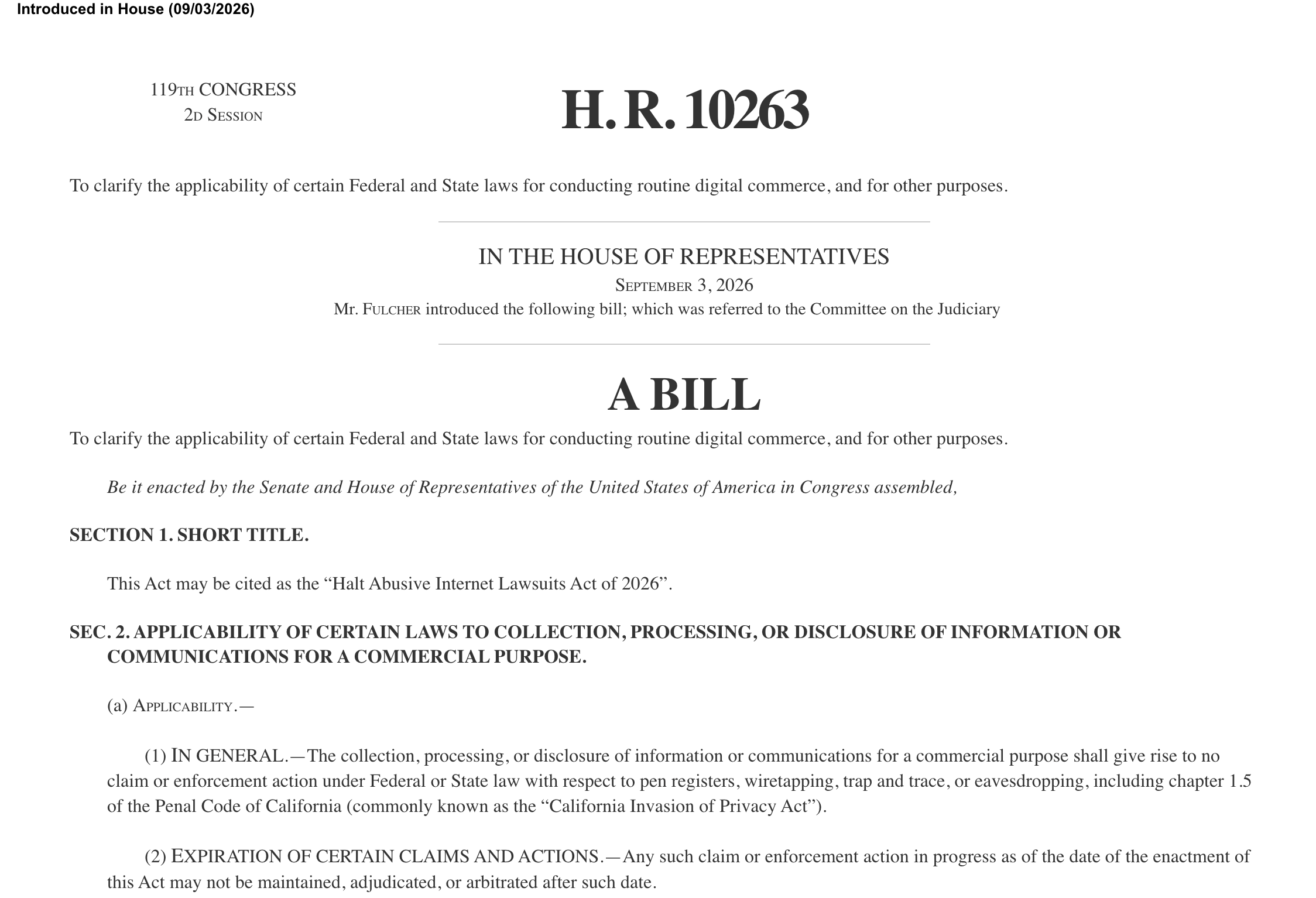
H.R. 10263, the Halt Abusive Internet Lawsuits Act of 2026, was introduced on September 3, 2026, by Rep. Russ Fulcher (R-ID) and referred to the House Judiciary Committee. It remains early-stage with no cosponsors and limited momentum.
The core provision is straightforward: collection, processing, or disclosure of information or communications for a commercial purpose in digital commerce would give rise to no claim or enforcement action under federal or state laws covering pen registers, wiretapping, trap-and-trace devices, or eavesdropping. It explicitly names the California Invasion of Privacy Act (CIPA). Pending claims of that type would be barred from continuing after enactment.
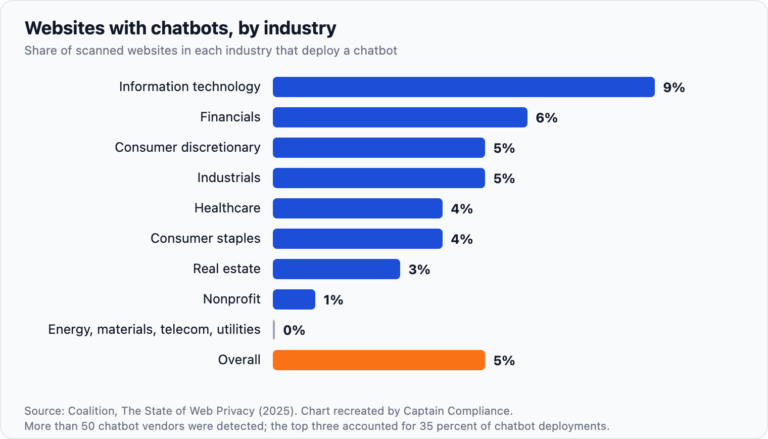
“Digital commerce” covers cookies, pixels, session replay, chatbots, tags, and analytics used for operations, marketing, advertising, responding to consumer input, or facilitating sales. The bill does not amend the CCPA/CPRA, biometric laws, the FTC Act, data-breach statutes, or most other privacy regimes. It targets the specific statutory theories plaintiffs have applied to ordinary website tools.
California already acted more narrowly. Governor Newsom signed SB 690 on September 30, 2026. Effective January 1, 2027 (with two-year retroactivity for claims filed on or after January 1, 2025), it eliminates the private right of action under CIPA’s pen-register/trap-and-trace provision (§ 638.51) for website and app activity, leaving enforcement to the Attorney General. Wiretapping claims under § 631 remain available to private plaintiffs. The federal bill goes further by covering wiretap theories nationwide and applying to both private and enforcement actions under the named statutes.
The Litigation Wave That Prompted It
CIPA is a 1967 wiretapping law. Beginning around 2022–2023, plaintiffs’ firms began alleging that cookies, pixels, session-replay tools, and analytics software function as illegal pen registers or intercept communications. Reports document thousands of lawsuits and far more demand letters—figures range from roughly 3,000–4,000 filed cases to estimates of nearly 6,000 or higher when including related claims. A handful of firms account for the majority of volume, often using repeat plaintiffs and templated allegations. Statutory damages of $5,000 per violation (with no actual harm required) create strong settlement pressure.
Small businesses, nonprofits, schools, hospitals, and local agencies have been frequent targets. Settlements in the $15,000–$25,000 range are common enough that cumulative costs have been estimated in the hundreds of millions. Many defendants use standard tools from major platforms and already attempt CCPA compliance. The mismatch between a decades-old criminal statute and modern web analytics is the core of the business complaint.
Privacy Advocates’ Concerns: Overreach and the LiveRamp Connection
Privacy advocates argue the bill overreaches by eliminating private enforcement for an entire category of claims rather than clarifying the underlying law. Private litigation has been one of the few mechanisms forcing transparency and consent around tracking tools that many consumers never meaningfully authorize. Removing that pressure while leaving the underlying practices intact risks freezing the status quo of widespread data collection.
The involvement of LiveRamp raises specific questions about incentives. LiveRamp, a major identity-resolution and data-collaboration company, disclosed Q3 2026 lobbying that included “Issues surrounding data and privacy” and explicitly referenced H.R. 10263 (referred to in the filing as the HAIL Act), alongside other privacy-related measures. LiveRamp’s core product, RampID, resolves identities across online and offline data for roughly 250 million U.S. consumers (virtually every adult), according to company figures cited in litigation. It operates a data marketplace that has offered audience segments tied to sensitive attributes, including health-related interests, military status, and other categories that privacy researchers and journalists have flagged.
LiveRamp has faced concrete challenges. In Riganian v. LiveRamp Holdings (N.D. Cal.), plaintiffs alleged the company tracked them across thousands of sites without direct interaction or meaningful consent, built detailed identity profiles, and sold data through its marketplace. In July 2025, Judge Jon Tigar denied most of LiveRamp’s motion to dismiss, allowing claims under the California Constitution, CIPA, the federal Wiretap Act, and related theories to proceed. The court rejected the idea that commercial profitability insulated the practices. Separately, the Open Rights Group filed complaints with UK and French regulators in 2024 alleging LiveRamp’s profiling lacked a valid legal basis, involved indiscriminate collection, and linked browsing data to real-world identities. LiveRamp has also been named in other tracking-related suits, and its recent acquisition by Publicis drew FTC conditions requiring data firewalls to protect competitive information.
From the advocates’ perspective, a company whose business model depends on linking identifiers, building persistent profiles, and enabling third-party activation has a clear interest in limiting theories that treat those activities as potential interceptions or pen-register uses. Broader industry groups (including retail and advertising associations) have also backed the measure. When the primary private enforcement tool against these practices is curtailed, and the lobbying comes from entities whose tools and data flows are frequently at issue, critics see regulatory capture rather than neutral litigation reform. They note that modern privacy statutes already exist; the problem is not the absence of rules but the gap between those rules and aggressive application of old wiretap statutes—and that gap can be closed without a sweeping federal bar on private claims.
The Business Case: Relief from Nuisance Litigation
Businesses and their advocates counter that the current wave is not primarily about privacy outcomes but about statutory damages and settlement economics. Many of the targeted tools (analytics, advertising pixels, chat widgets) are industry-standard and often deployed by platforms or vendors rather than the website owner alone. Defendants frequently lack the resources to litigate complex technical issues about whether a pixel “intercepts” content in transit or functions as a pen register. The result is settlements that divert money from operations—particularly for small businesses, nonprofits, and public entities—without producing clearer consent practices or better data governance.
California’s own experience supports the distinction. SB 690 passed with broad legislative support after lawmakers heard testimony about the volume of filings and the concentration among a small number of plaintiffs’ firms. Governor Newsom’s signing statement acknowledged the problem of “vexatious” use of CIPA and called for further work on remaining provisions. Proponents of the federal bill argue it restores the original focus of wiretap laws to surreptitious interception of private communications rather than ordinary commercial web analytics. They point out that CCPA/CPRA, state consumer protection laws, contract claims, and other tools remain available. In their view, private litigation under 1960s statutes has become a parallel enforcement system that bypasses the more tailored rules written for digital advertising and analytics.
Industry groups have described the situation as having reached a tipping point, with the basic operation of e-commerce at risk if the theories continue unchecked. For small businesses that already struggle with compliance costs, the combination of demand letters, arbitration threats, and the expense of defending even weak claims creates a tax that falls disproportionately on those least able to pay.
Why This Bill Is Unlikely to Pass
Despite support from the National Federation of Independent Business, the National Retail Federation, the Interactive Advertising Bureau, and elements of the U.S. Chamber of Commerce, H.R. 10263 faces steep odds. It was introduced late in the 119th Congress (September 3, 2026), has no cosponsors, and sits in the House Judiciary Committee with no further action. Tracking sites such as GovTrack have assigned it a roughly 1% chance of enactment.
Several structural barriers stand in the way. First, the timing is unfavorable: introduction near the end of a session, combined with the upcoming election and potential lame-duck dynamics, reduces the window for committee markup, floor time, and Senate action. Second, the plaintiffs’ bar has a strong interest in opposing the measure and is expected to lobby against it. Third, privacy organizations such as the Electronic Privacy Information Center have already framed similar proposals as efforts by large technology and advertising interests to weaken wiretap protections that serve as a backstop when modern privacy statutes fall short.
Even some industry advocates who describe the chances as “reasonable” or “good” after the election acknowledge that the bill is about “abusive litigation” rather than a broad privacy consensus. California’s experience is instructive: an earlier, broader version of SB 690 that would have covered wiretapping claims as well as pen-register claims was narrowed after pushback. A federal bill that goes further—barring both private and public enforcement under multiple statutes—will face comparable resistance in a divided Congress. Absent a sudden surge of bipartisan support or attachment to a must-pass vehicle, the measure is more likely to serve as a messaging and lobbying tool than as enacted law.
Federalism Concerns: Why Other States May Resist This Overreach
The bill’s text is explicit: the commercial-purpose digital-commerce activities it covers “shall give rise to no claim or enforcement action under Federal or State law” with respect to pen registers, wiretapping, trap-and-trace, or eavesdropping. This is not a narrow clarification of California law; it is a nationwide limitation on the ability of any state to use its own wiretap or pen-register statutes against commercial tracking tools.
States have increasingly relied on these older statutes—Florida’s Security of Communications Act, Pennsylvania’s Wiretapping and Electronic Surveillance Control Act, and analogous laws in other two-party or all-party consent jurisdictions—as plaintiffs and, in some cases, attorneys general look for tools beyond comprehensive privacy statutes. A federal bar would constrain both private litigation and potential state enforcement actions in this category. States that have enacted their own consumer privacy laws (California, Virginia, Colorado, Connecticut, and others) or that view wiretap statutes as complementary consumer-protection tools may see the bill as an unwanted preemption of their police powers.
In broader federal privacy debates, states and privacy advocates have consistently resisted “ceiling” preemption that prevents stronger state rules. They prefer a federal floor that sets a baseline while allowing states to go further. H.R. 10263 does the opposite for a specific but high-volume set of claims: it would prevent states from applying their own statutes to commercial digital activity even if those states conclude the practices warrant liability. Privacy groups have already characterized such efforts as consistent with industry campaigns to limit exposure under wiretap theories. State attorneys general and legislators who have defended their ability to enforce privacy and consumer-protection laws are unlikely to welcome a federal statute that removes one of the tools available to them and to their residents.
Practical note: Even if the bill advanced, its scope is limited to the named theories (pen register, wiretapping, trap-and-trace, eavesdropping) in the commercial digital-commerce context. It would not repeal state comprehensive privacy laws, biometric statutes, unfair-competition claims, or common-law privacy theories. Still, the direct limitation on state-law claims is the feature most likely to generate opposition from state officials and privacy organizations.
What Remains Unresolved and What Businesses Should Still Do
Even if enacted, the bill would not legalize unlimited tracking. Companies would still need to meet CCPA/CPRA requirements, provide notices, honor opt-outs, and comply with other statutes. Wiretap and pen-register theories under ECPA and CIPA for non-commercial contexts, or claims under other laws, would remain. Plaintiffs could continue to pursue surviving CIPA wiretap theories (at least until further legislation), VPPA claims, state unfair-competition theories, or common-law privacy claims. After SB 690, many plaintiffs’ firms are already shifting emphasis to CIPA § 631, the federal Wiretap Act, Florida’s FSCA, and similar statutes.
The practical effect would be to eliminate one high-volume, high-settlement channel while leaving the underlying data practices subject to the modern privacy framework. Whether that is the right balance depends on whether one views the CIPA wave as a necessary backstop against under-enforced tracking or as an inefficient and abusive application of outdated statutes. LiveRamp’s documented lobbying and its own litigation exposure make the incentives visible, but the broader support from small-business groups and the parallel action already taken in California show the pressure is not limited to a single adtech firm.
In the meantime, businesses should continue to treat website tracking as a compliance and litigation risk. Maintain accurate privacy notices and consent mechanisms, inventory third-party tools, document consent flows, and evaluate residual exposure under surviving wiretap theories and other privacy statutes. The tension between nuisance-litigation reform and private enforcement as a privacy backstop is unlikely to disappear even if H.R. 10263 never becomes law.
Conclusion
H.R. 10263 reflects a genuine problem—the explosion of CIPA and related claims against ordinary website tools—but it proposes a blunt federal solution that eliminates both private and public enforcement under an entire class of statutes for commercial digital activity. Privacy advocates rightly highlight the loss of a private-enforcement mechanism and the participation of companies such as LiveRamp whose business models depend on the data flows at issue. Businesses correctly note the cost of nuisance litigation, the concentration of claims among a small number of firms, and the mismatch between 1960s wiretap language and modern analytics. Other states have reason to resist a measure that would limit their ability to apply their own laws. Given the bill’s late introduction, lack of cosponsors, and the expected opposition from both the plaintiffs’ bar and privacy organizations, it is unlikely to advance. The underlying debate over how to address tracking technologies—through modern privacy statutes, targeted litigation reform, or continued private enforcement under older laws—will continue regardless of the fate of this particular proposal.
Put this into practice
Turn privacy guidance into working controls.
Captain Compliance helps teams discover tracking technologies, enforce consent, manage privacy requests and document the evidence behind every decision.