Know what’s on your site before a plaintiff’s firm does
A free privacy audit shows which cookies, pixels and trackers are running — and which ones commonly appear in privacy claims.
Pre-litigation privacy demands under the California Invasion of Privacy Act (CIPA) have evolved from class action threats into high-volume, pro se serial litigation campaigns. Pro se litigants using AI legal technology can file and send out more demands thanks to these new tools. As plaintiffs like Vivek Shah and Robert Bell the pro-se privacy plaintiff act as their own counsel, cutting traditional legal overhead and using standardized statutory damage multipliers to issue direct, certified settlement demands to digital businesses nationwide. While the claims have validitity to them and CalPrivacy enforcement has said that they think that running Facebooks Meta-Pixel is a “Disgusting Tool” as it surveils users it is causing havock among business owners not only in California but all over the country. Captain Compliance provides a privacy software solution to stop legitimate types of complaints like this from being filed. We can help you get the Bell letter claim dismissed by providing audits and documentation to help invalidate legal data privacy claims that you or your legal team can send off.
Discuss with one of our privacy experts the letter you received
Dual Legal Theories: Wiretaps and Pen Registers
Most modern CIPA demands rely on two primary statutory provisions within California Penal Code §§ 630 et seq.
-
Cal. Penal Code § 631(a) (Third-Party Wiretapping): Originally drafted to prohibit unauthorized wiretapping on physical telephone lines, § 631(a) is now leveraged against web tracking. Demands allege that embedding third-party code (such as marketing tools, analytics engines, or ad pixels) allows external vendors to read or attempt to read website communications in real-time without user consent. Plaintiffs rely on precedents like Javier v. Assurance IQ, LLC to argue that consent must be obtained prior to the execution of any data-capturing script.
-
Cal. Penal Code § 638.51 (Pen Registers & Trap/Trace Devices): Plaintiffs assert that standard web tags, cookies, and network requests act as software-based “pen registers” or “trap and trace devices“. By logging IP addresses, device signatures, user routing, and referral paths, these scripts capture identity metrics without a court order or prior express consent.
The Statutory Damage Stacking Model
CIPA features a private right of action under Cal. Penal Code § 637.2 that grants $5,000 in statutory damages per violation, explicit in stating that plaintiffs do not need to prove actual injury or monetary loss.
Litigants like Robert Bell exploit this framework by itemizing each third-party tool found on a target site as an independent statutory violation. If a site loads five separate unconsented tracking scripts during a single page view, the baseline demand rapidly scales to $35,000 or more. Settlement demands typically add thousands more to cover prospective litigation costs, pressuring site owners to settle out of court to avoid defense fees.
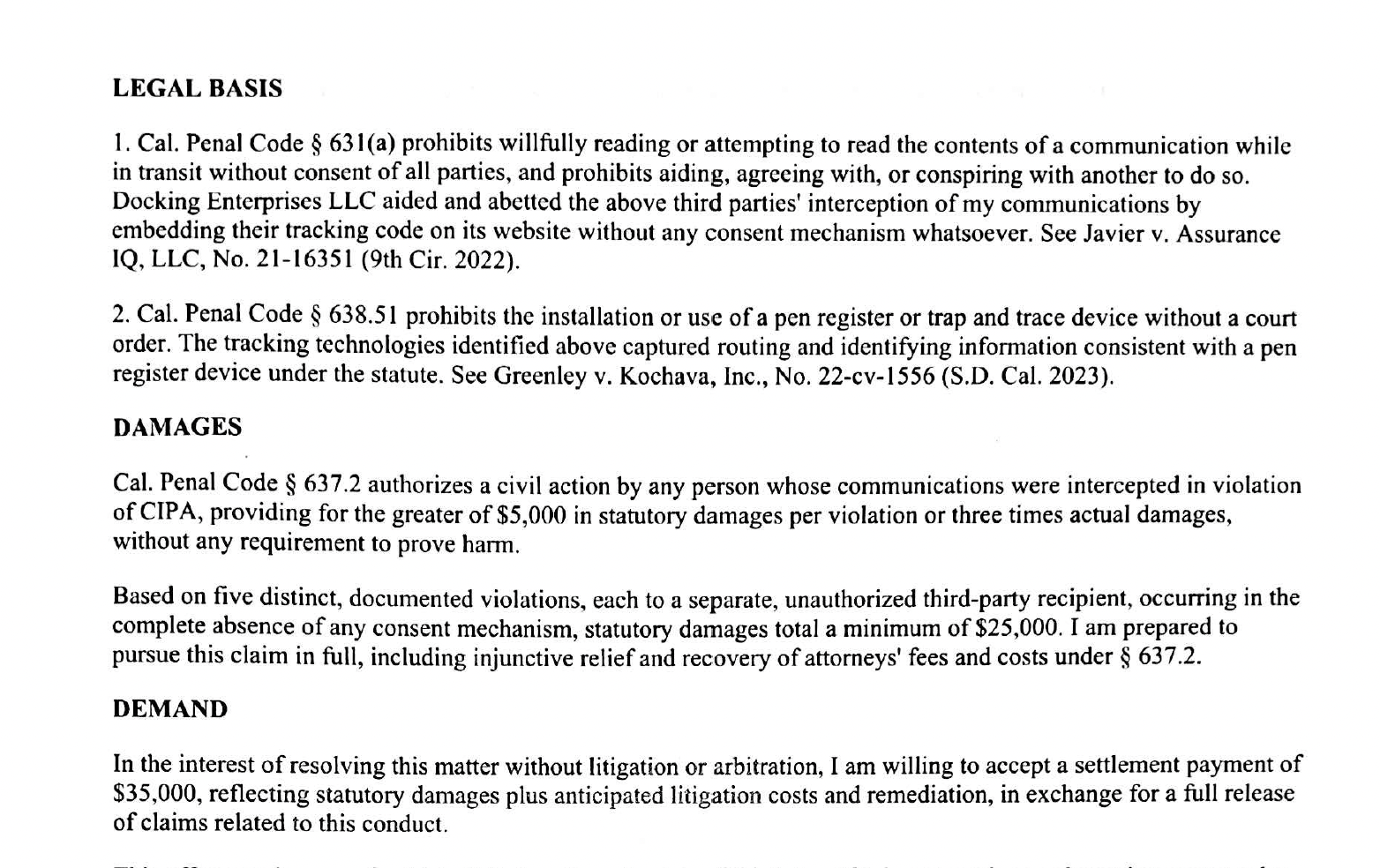
Decoding the Forensic Technical Evidence of a Data Privacy Litigation Claim from a Serial Plaintiff
Serial plaintiffs and litigants like a Vivek Shah rely on technical evidence captured directly through client-side browser developer tools during brief site visits. Understanding this forensic payload is critical to constructing an effective technical and legal defense.
┌─────────────────────────────────────────────────────────────────────────────┐
│                          HTTP Archive (.HAR) File                           │
│  [Timestamp: 0.02s] ──► Third-Party Script #1 Executed (No Cookie Banner)  │
│  [Timestamp: 0.31s] ──► Third-Party Script #2 Executed (Payload: IP/Device) │
│  [Timestamp: 1.05s] ──► Ad Pixel Executed (Payload: Hashed Email Identifier)│
│  [Timestamp: 1.17s] ──► Background App Executed (Persistent Event Polling)  │
└─────────────────────────────────────────────────────────────────────────────┘
HTTP Archives (.HAR) and Developer Console Logs
Litigants capture complete HTTP Archive (.HAR) files and Developer Console network logs to record every network request initiated by a website. The .HAR file records:
-
Exact Load Timestamps: Demonstrating that tracking scripts fire milliseconds after the document load starts, long before any user interface element or consent mechanism renders.
-
Full Network Headers & Parameters: Exposing exact URLs, query strings, and data payloads sent to external servers.
-
Resource Scheduling Data: Recording queue times, connection durations, and initiation chains to prove the site owner’s code directly prompted the third-party data transfer.
Specific Technical Triggers Exploited by Plaintiffs
Demand letters target four primary script execution patterns:
-
Zero-Consent Script Executions: Third-party scripts executing within fractions of a second (e.g., marketing tools at 0.02s or ad platforms at 0.31s) before any consent management platform (CMP) can present an opt-in banner.
-
Advanced Matching Identifiers: Meta Pixels or analytics tags transmitting sensitive payload data—such as hashed user email addresses or phone numbers—passed automatically through browser session data.
-
Persistent Event Polling: Embedded customer engagement, loyalty, or live-chat widgets that continuously transmit background network calls throughout a user’s session.
-
Third-Party Script Load Timing: Network traces showing that tracking technologies initiate calls to non-essential external endpoints immediately upon session start.
Cross-Plaintiff Playbook: The Vivek Shah Strategy
While litigants like Robert Bell build evidence files centered on zero-consent automated tag execution on arrival, serial plaintiff Vivek Shah has utilized a parallel, high-volume strategy targeting interactive website components across the country.
       Robert Bell Campaign                     Vivek Shah Campaign
┌───────────────────────────────────┐    ┌───────────────────────────────────┐
│ • Focus: Automated Script Firing  │    │ • Focus: Interactive Form Inputs  │
│ • Key Evidence: Client HAR Logs   │    │ • Key Evidence: Search & Chat Logs│
│ • Target: Ad Pixels & Tag Timing  │    │ • Target: Search Bars & Chatbots  │
└───────────────────────────────────┘    └───────────────────────────────────┘
Interactive Search and Session Capture
Shah’s pre-litigation demands and lawsuits focus heavily on interactive elements. Rather than looking only at passive pixel loads, Shah targets website search bars, customer service chatbots, and session replay tools, asserting that typing generic text into search prompts or chat boxes constitutes a private communication intercepted by backend analytics vendors.
Templated Demands and Mass Distribution
Shah’s methodology relies on distributing high-volume, templated demand letters paired with pre-drafted complaints. These notices demand immediate settlement, threatening prompt filings in California state courts or binding arbitration if businesses fail to comply within strict timelines.
Federal Court Vexatious Litigant Orders
The high volume of Shah’s litigation campaign has drawn significant judicial scrutiny. On July 20, 2026, Judge R. Gary Klausner of the U.S. District Court for the Central District of California declared Vivek Shah a vexatious litigant (Shah v. Crain Communications, Inc., No. 2:26-cv-03070).
The court issued a pre-filing order requiring Shah to obtain court permission before initiating any new CIPA or digital privacy actions in the Central District. The court noted that Shah had initiated dozens of proceedings while voluntarily dismissing actions when faced with motions to dismiss, demonstrating a pattern of using litigation to extract settlements rather than litigate claims on the merits.
Legal Realities for Businesses
While the federal vexatious litigant ruling provides significant defense leverage against Shah-style actions, it does not eliminate CIPA exposure:
-
Scope Limitations: Federal pre-filing orders apply specifically to designated jurisdictions (such as the Central District of California) and do not automatically bar state court filings or demands issued by other pro se plaintiffs.
-
Unsettled Merits: Courts remain split on whether common web analytics and pixels constitute illegal wiretaps or pen registers on the merits, leaving unshielded tracking setups vulnerable to emerging plaintiffs.
Technical Remediation and Defense Protocols
Relying on a static privacy policy or a footer link does not defend against CIPA claims. Under current Ninth Circuit interpretations, privacy disclosures posted after scripts have already loaded do not establish valid prior consent. Digital brands must implement a robust technical barrier.
Hard Blocking via Tag Management Systems
Configure Google Tag Manager (GTM) or custom tag containers to strictly block all non-essential third-party scripts until an explicit opt-in event occurs.
[ Visitor Arrives ]
       │
       ▼
[ Consent Banner Appears ] ──► (State: Pending / Default Block)
       │
       ├───────────────────────────────┐
       ▼                               ▼
[ User Ignores / Opts Out ]    [ User Clicks "Accept" ]
       │                               │
       ▼                               ▼
[ Non-Essential Tags Blocked ]  [ Consent Event Triggers Tag Execution ]
-
Set Default Consent States to Denied: Set default parameters to
deniedforanalytics_storage,ad_storage,ad_user_data, andad_personalizationprior to script evaluation. -
Implement Explicit Triggering: Re-architect Tag Manager triggers so third-party pixels (Meta, TikTok, ad networks) fire only on a custom event (e.g.,
consent_approved) dispatched by your Consent Management Platform (CMP) after user selection. -
Audit Hardcoded Page Scripts: Audit
header.phpor layout template files to ensure marketing code, chatbot containers, or custom tracking libraries are not hardcoded to bypass tag management rules.
Server-Side Tracking Architecture
Transitioning from client-side browser tracking to server-side APIs eliminates client-side network traces and limits CIPA exposure:
-
Payload Sanitization: Server-side implementations capture data on your own secure server first, allowing you to sanitize IP addresses, strip user identifiers, and filter payload data before sending events to third-party endpoints.
-
Elimination of Direct Browser Calls: Because third-party scripts are not loaded directly in the user’s browser, network tools do not reveal third-party network calls, neutralizing client-side HAR log evidence.
Incident Response Protocol for CIPA Demands
When a certified CIPA demand letter arrives from plaintiffs like Robert Bell or Vivek Shah, follow a strict response workflow that may differ from a legal demand letter from a Bursor and Fisher or Swigart Law:
-
Do Not Delete Code Immediately: Avoid abruptly clearing or altering site code without preserving initial state records. Immediate changes can spark spoliation disputes regarding evidence preservation.
-
Preserve Site Logs and Screenshots: Export server access logs, network captures, and CMP consent logs matching the exact timestamps cited in the letter.
-
Conduct Forensic Verification: Run a technical audit against the cited timestamps to evaluate whether third-party requests occurred before consent banner rendering.
-
Engage Legal Counsel: Coordinate with specialized privacy defense counsel to assess plaintiff status, evaluate jurisdictional leverage, and formulate a response strategy.
Put this into practice
Turn privacy guidance into working controls.
Captain Compliance helps teams discover tracking technologies, enforce consent, manage privacy requests and document the evidence behind every decision.