Know what’s on your site before a plaintiff’s firm does
A free privacy audit shows which cookies, pixels and trackers are running — and which ones commonly appear in privacy claims.
Contact us right away If you’ve received a demand from Vivek Shah if you’d like to fix your website and get the case dismissed as many defendants have settled and paid out while we can help with getting your site compliant while also stopping the need to pay out for the alleged privacy violation you just received. Please don’t be worried. There are hundreds of businesses receiving these each week and we can help you fix your website so that you’re compliant by standing up our industry leading data privacy software and we can help work towards a dismissal. Book a time below with our International Association of Privacy Professional Sam:
When facing a lawsuit from vexatious pro se litigant Vivek Shah who filed a California Invasion of Privacy Act (CIPA) wiretapping complaint against Crain Communications, Inc. alleging unlawful tracking of electronic communications on their website. California attorney Kevin J. Cole (of KJC Law Group) opted to aggressively fight the claim rather than negotiate a settlement. Cole filed a motion asking the U.S. District Court for the Central District of California to declare Shah a vexatious litigant, documenting Shah’s pattern of filing nearly identical lawsuits against various companies that were routinely dismissed once challenged. The strategy proved successful: Judge R. Gary Klausner granted Cole’s motion, declaring Shah a vexatious litigant and imposing a pre-filing order that restricts Shah from initiating future CIPA-related claims in the district without court permission.
The landscape of website privacy litigation in California is rapidly evolving, posing an urgent risk to companies that have not implemented a robust, all-party consent mechanism. At the forefront of this new wave of exposure is the rise of private right of action claims for privacy violations. Recent filings and demand letters sent from a Vivek Shah, a prominent “serial litigant” whose name is now synonymous with private right of action lawsuits filed under the California Invasion of Privacy Act (CIPA).
Update July 22, 2026 “In a landmark development for companies navigating the surge of privacy-related demand letters and lawsuits, the U.S. District Court for the Central District of California has officially declared Vivek Shah a vexatious litigant.” Story linked below
For corporate privacy leads and legal counsel, the pre-litigation demand letters, often titled “Violation of California’s Invasion of Privacy Act, Cal. Penal Code § 631(a)”, are a critical warning. While these may not yet be filed complaints, they signal a systematic and sophisticated effort to target businesses, particularly those operating without a functional cookie consent mechanism.
We have added an even more extensive guide to dealing with Vivek Shah with coverage on every topic you could want to know from handling these demand letters, what the courts are ruling each week, and tons more in our comprehensive Vivek Shah Guide.
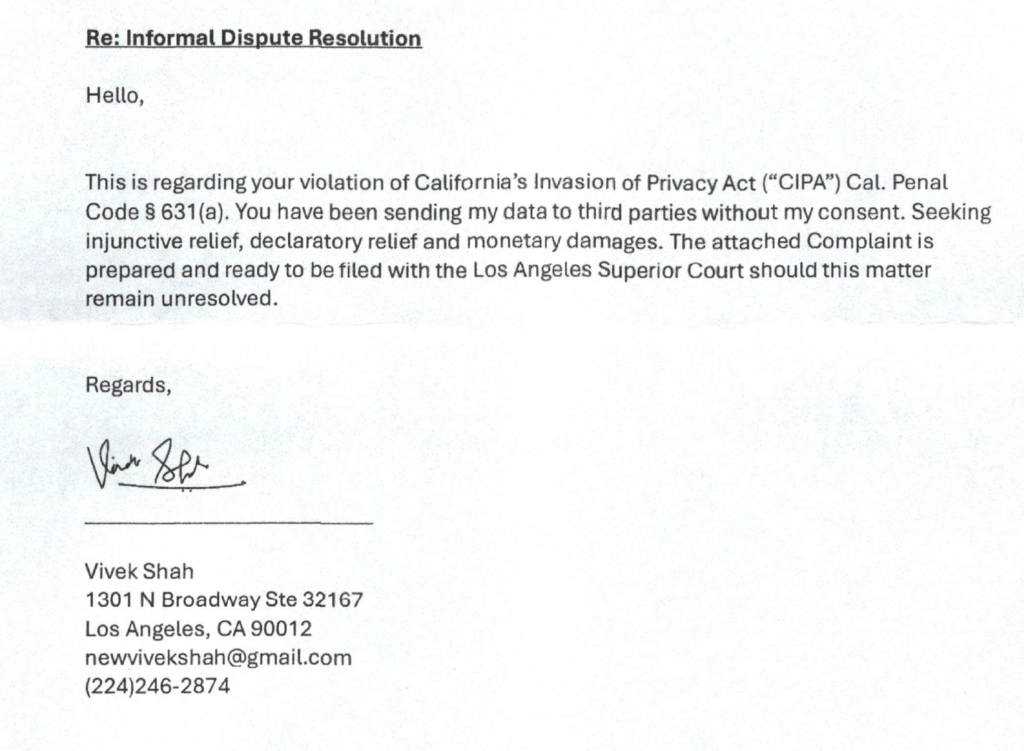
Below is an example of the document that Shah’s violation notice opens up with showcasing the violation of CIPA Cal Penal Code 631:
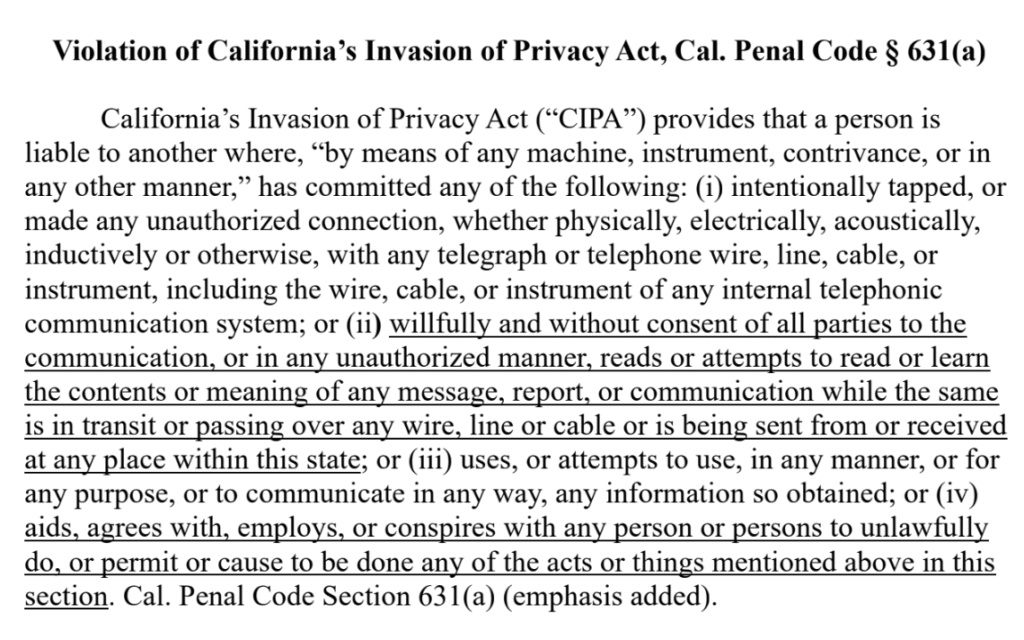
The CIPA § 631(a) “Wiretapping” Theory
The core of the legal threat stems from CIPA § 631(a), which prohibits the unauthorized interception of confidential communications—an outdated wiretapping statute being aggressively applied to modern web technology. If a business is using Captain Compliance’s consent management software they are able to avoid these expensive litigation cases but those who have not signed up yet are at risk of legal threats not just from Vivek but other plaintiffs firms.
Vivek Shah’s Theory of Violation in Private Right of Action CIPA Claims:
The argument, successfully advanced by firms working on behalf of plaintiffs like Shah, is that a website violates CIPA when it uses third-party tracking tools (such as Meta Pixel, Google Analytics, or session replay scripts) to collect and transmit user data.
- Confidential Communication: A user’s activities on a website (clicks, searches, form fills) are characterized as a confidential electronic communication.
- Unauthorized Interception: The embedding of a third-party tracker allows the vendor (the third party) to secretly “eavesdrop” on this communication in transit, violating CIPA’s all-party consent rule.
This litigation strategy is gaining traction, backed by plaintiff’s firms like Tauler Smith and Vivek Shah, which are filing legitimate claims. Defendants who choose to litigate these cases without a strong consent defense are facing adverse rulings and significant statutory exposure of $5,000 per violation. The underlying issue in these losses is a simple failure in fundamental compliance: the absence of proper privacy software and notification.
The Rise of Vivek Shah CIPA Demands Vivek Shah
In a short period of time he has become the number one filier of privacy complaints. As a frequent pro se litigant, is currently distributing demand letters to registered agents nationwide. These packets mimic formal lawsuits, featuring a cover letter requesting “Informal Dispute Resolution” for alleged violations of the California Invasion of Privacy Act (CIPA), Cal. Penal Code § 631(a). Attached to each demand is a draft complaint intended for the Los Angeles Superior Court, supported by “Exhibit A”—screenshots of a networking tool showing the website capturing the name “VIVEK” after he entered it into a search bar. While Mr. Shah has yet to officially file these suits in state court, his activity suggests litigation may be imminent. As far as we can tell we are the only script wrapping and blocking solution that fully integrates for clients to STOP and PREVENT Vivek Shah lawsuits.
Shah’s History: A Pattern of Litigation
Vivek Shah’s focus on privacy violations is part of a broader, well-documented history as a litigant in areas of digital law, demonstrating his persistent and active engagement with intellectual property and personal rights claims.
- Copyright and DMCA Litigation: Prior to his focus on CIPA, Shah was involved in notable lawsuits concerning copyright infringement and the Digital Millennium Copyright Act (DMCA). For example, he sued media outlets over the use of photographs taken of him at Hollywood parties.
- Focus on Authorship: The central legal question in those cases was who held the copyright to a photograph when Shah composed the image and owned the camera, but a bystander pressed the shutter button. His claims often failed due to the court finding he could not prove sole or joint authorship, nor did he have standing for a DMCA claim without copyright ownership.
This background illustrates that Shah is an informed and active litigant, making the recent flood of CIPA demand letters a serious operational risk, not merely a boilerplate nuisance. He also is asking for $50,000 in statutory damages in every letter he sends out along with other fees, costs, and relief.
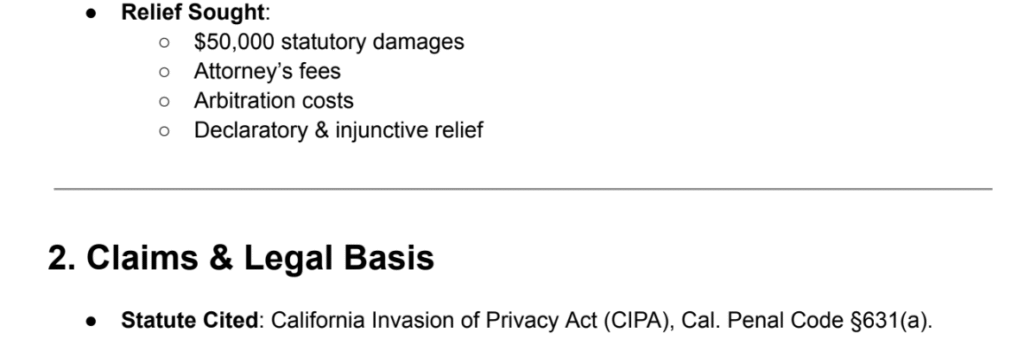
In his legal letters and subsequent draft complaints, Vivek Shah asserts that your website and company is operatung a “digital wiretap” via its website’s search bar. He alleges that this practice violates the California Invasion of Privacy Act (CIPA), specifically California Penal Code § 631(a).
Below is a breakdown of his primary privacy claims that we’re seeing from clients that have not had their sites properly protected with the Captain Compliance software and thus one of the reasons why they received one of these lawsuits:
1. Unauthorized “In Transit” Interception
Shah claims that when a user types a query into the website’s search bar, the data is not just sent to your website. Instead, hidden third-party tracking scripts (from entities like AdRoll, LinkedIn, and HubSpot) simultaneously “read and copy” the content of the search while it is still in transit.
-
Contemporaneous Capture: He argues this is a “real-time” interception rather than subsequent data sharing, making it the functional equivalent of a physical wiretap on a phone line.
-
Search Terms as “Contents”: He asserts that search queries (e.g., his search for “VIVEK”) represent the “substance, purport, or meaning” of a communication, which classifies them as protected “contents” under CIPA rather than mere metadata like an IP address.
2. Failure of Consent and “Deceptive Design”
Shah alleges that the website’s privacy protections are legally defective and misleading.
-
Lack of Prior Consent: He argues CIPA requires prior express consent before any interception begins. He claims the tracking code fires the moment a user arrives, before they can even interact with a cookie banner.
-
Disregard for “Decline”: In his specific test on a recent complaint we read, Shah clicked the “Decline” button on the cookie banner. He claims the website ignored this refusal and continued to transmit his search data to third parties regardless.
3. Aiding and Abetting Third-Party “Eavesdroppers”
As the website owner, he says that your business is a party to the communication. Under California law, a party generally cannot “wiretap” their own conversation. Shah bypasses this by claiming:
-
Third-Party Interlopers: The tracking entities (Google, Meta, etc.) are “uninvited interlopers” and not parties to the communication.
-
Corporate Culpability: By choosing to embed this code for its own commercial benefit, “aids, agrees with, employs, or conspires with“ these third parties to commit the unlawful interception.
4. Statutory Damages and Injunctive Relief
Shah is seeking a high-stakes resolution based on the following claims he is sending out to your registered agents:
-
Per-Violation Damages: He requests $5,000 for each violation. He argues that every search query sent to a distinct tracking entity (e.g., one search sent to four different trackers) constitutes multiple independent violations.
-
No Proof of Injury Needed: He points to CIPA § 637.2(c), which states that a plaintiff does not need to suffer actual monetary loss to bring a claim; the invasion of privacy itself is the harm.
-
Mandatory Dismantling: He is asking the court for a permanent injunction to force the company to “dismantle and remove” the surveillance scripts.
How To Respond to the Vivek Shah Search Bar Lawsuit?
While most of the complaints filed in Los Angeles, County California courts are the same there are some nuances. We ask that you send to us the formal compliant and court case filed by Shah and we can help with remediating the website and getting you compliant to avoid future issues and if you have counsel we can work with them to get a proper response and the case dismissed.
Search Bar Privacy Lawsuits from Vivek Shah
Vivek has come up with a theory that has caught thousands of businesses completely off guard. The premise is deceptively simple: when a user types something into a website’s search bar, that query is frequently transmitted in real time to third-party platforms like Google or Meta via tracking pixels and analytics scripts embedded in the site. Under California’s Invasion of Privacy Act, plaintiffs argue this constitutes an unauthorized interception of a private communication — a digital wiretap because the user never consented to their search terms being shared with uninvited third parties. The legal foundation for this theory solidified in the 2024 ruling in Heerde v. Learfield Communications, where a California federal court held that search terms constitute the protected “contents” of a communication rather than mere metadata, opening the floodgates for demand letters targeting businesses across every industry and every state.
What makes these lawsuits particularly dangerous for businesses is that any business owner who is not using Captain Compliance’s privacy software is at risk. We are the only solution according to the hundreds of business owners we’ve already helped defeat Vivek that knows how to stop these and protect against these claims. Every search query transmitted to a distinct third party is argued to constitute a separate violation, meaning a website with multiple embedded trackers can accumulate liability rapidly from a single user interaction. For businesses that have never audited what their search bar actually transmits or verified that their consent management platform is technically blocking scripts rather than just displaying a banner, the exposure is both real and immediate.
The Captain Compliance Solution: Mitigating CIPA Risk
The vulnerability highlighted by these lawsuits is preventable. The losses sustained by defendants who fight and lose these claims are often due to a lack of defensible, auditable consent protocols.
For companies seeking to neutralize this litigation risk, the most effective defense is a demonstrably compliant and legally sound consent framework. Solutions that automate the deployment of a legally sound cookie banner and integrate with third-party tracking technologies to ensure no data is collected until all necessary consent is secured are essential and you’re able to set it up this way with a Captain Compliance banner.
By failing to adopt and properly configure a comprehensive privacy compliance platform, businesses expose themselves to an ever-growing threat landscape, where repeat litigants like Vivek Shah stand ready to exploit the statutory damages provisions of California law. Investing in a robust platform is now a necessary cost of doing business online, protecting against statutory damages that can quickly escalate into multi-million dollar liabilities.
The message for privacy counsel is clear: relying on a non-compliant or absent consent mechanism is a losing strategy that cannot withstand the scrutiny of modern digital privacy litigation. Proper privacy software and notifications are the only legitimate defense.
Here is an addendum structured around your requested headers to perfectly complement the existing material on your page.
Vivek Shah: Serial Plaintiff
The legal landscape surrounding the California Invasion of Privacy Act (CIPA) has shifted dramatically with the emergence of systematic “tester” plaintiffs. Chief of these is the Indian king of pro-se privacy claims: Vivek Shah, a prolific pro se litigant which would be an understatement. Mr. Shah has launched an extensive nationwide campaign targeting businesses of all sizes and Captain Compliance has become the CIPA Defense company.
Far from a casual browser, Shah operates as a highly strategic serial plaintiff. His background reveals a history of active, sophisticated litigation, including past high-profile copyright and Digital Millennium Copyright Act (DMCA) lawsuits against various media entities. Transitioning his focus to data privacy, Shah has weaponized California’s outdated wiretapping laws to systematically audit commercial websites, scale massive compliance claims, and target any company with a California-facing digital footprint.
Vivek Shah CIPA Claims
The core legal theory underpinning the wave of CIPA claims filed by Vivek Shah targets a routine, everyday asset found on almost every modern business website: the search bar which we covered above and he has also grown into TIktok, Reddit, and other ad tracking claims.
While historical digital wiretapping lawsuits focused heavily on session-replay software or tracking pixels embedded in chat widgets, Shah’s specific claims rely on a “Search Bar Wiretapping” theory. Using technical network monitoring tools (such as browser developer tools), Shah captures data transmissions in real time. He documents what happens when he types a specific query—frequently his own name, “VIVEK”—into a website’s search box.
Shah’s CIPA claims assert that:
-
Search Terms Form “Content”: Unlike basic metadata (like an IP address), the text typed into a search box represents the “substance, purport, or meaning” of a communication, legally qualifying it as protected communication content under CIPA.
-
Unauthorized “In Transit” Interception: Because many websites instantly pass search terms to third-party analytics or advertising software (e.g., Google Analytics, Meta Pixel, HubSpot) as the user types, Shah argues this constitutes an active wiretap of data “in transit” without all-party consent.
Vivek Shah CIPA Demand Letters Against Business Websites
Before a formal lawsuit is even filed in a California court, companies are often alerted to Shah’s focus through a highly standardized and intimidating pre-litigation package sent directly to their registered agents.
These demand letters, often titled “Explanation of Dispute,” are meticulously organized and look identical to an active lawsuit. Each package typically includes:
-
A Formal Cover Letter: Requesting informal dispute resolution to avoid a public courtroom battle.
-
A Complete Draft Complaint: Predominantly formatted for the Los Angeles Superior Court, ready to be filed if the business fails to settle.
-
“Exhibit A” Evidence: Forensic screenshots showing the company’s website alongside a network packet analysis proving that his search query was contemporaneously shared with third-party tracking entities.
In these letters, Shah leverages CIPA Penal Code § 637.2(c), which notes that a plaintiff does not need to prove actual monetary loss or injury to seek damages—the invasion of privacy itself is the harm. He reportedly demands up to $50,000 in statutory damages per letter, evaluating each distinct third-party software recipient as an independent violation.
Vivek Shah Privacy Lawsuit
When informal demand letters do not lead to a swift settlement, they frequently escalate into a formal privacy lawsuit. Shah’s litigation strategy targets a broad spectrum of sectors, ranging from retail e-commerce sites to major corporations. He has found if you ignore his demands that he will follow up with a formal lawsuit and or arbitration demands through ADR.
A primary example of his litigation include high-stakes matters like Shah v. Capital One Financial Corporation and Shah v. Fandom, Inc. in the Northern District of California. In these major privacy lawsuits, courts have had to grapple with how decades-old wiretapping and pen register laws apply to contemporary data-sharing pixels. When these lawsuits advance past early motions to dismiss, they create immense operational, financial, and reputational pressure for the defending businesses, emphasizing that these filings are far from empty boilerplate threats.
Vivek Shah CIPA Lawsuit California
In a California-specific context, Shah’s lawsuits primarily seek enforcement under California Penal Code § 631(a). This statute forbids anyone from intentionally tapping, making an unauthorized connection with, or learning the contents of a communication without consent, as well as anyone who “aids, agrees with, employs, or conspires with” a third party to do so.
Shah’s litigation strategy maneuvers around common defense arguments in California courts by alleging:
-
Corporate Culpability: By choosing to embed tracking scripts for commercial gain, the business actively “aids and conspires” with third-party advertising giants to execute the unlawful intercept.
-
The Failure of Cookie Banners: Shah argues that standard cookie consent banners are legally defective if tracking codes fire the exact millisecond a user lands on a home page. Because the transmission happens before a user has a meaningful opportunity to interact with an “Accept” button, prior express consent was never achieved.
Legal Help With Vivek Shah Action Plan
Vivek Shah Lawyer
One of the most unique aspects of the legal threat posed by Vivek Shah is his choice of representation: he frequently acts as his own lawyer. Operating pro se (representing himself), Shah drafts his own highly technical complaints and legal briefs and he’s not the only one doing so copycats in Florida, Texas, Michigan, and Pennsylvania are starting to follow through with wiretapping claims.
Because he acts pro se, he is not constrained by the traditional hourly billing structures or overhead limitations that traditional plaintiffs’ firms face. This allows him to scale his campaign independently, delivering dozens of demand letters to businesses across the country simultaneously. However, his legal acumen is remarkably sharp; California courts afford pro se pleadings liberal construction, and Shah demonstrates a sophisticated understanding of digital networking, privacy statutes, and procedural law.
For businesses receiving these demands, treating Shah as an unrepresented novice is a dangerous mistake. Defending against his campaigns requires experienced, specialized data privacy defense counsel and immediate technical remediation.
For more about Vivek read this latest story: https://captaincompliance.com/education/federal-court-declares-serial-cipa-litigant-vivek-shah-a-vexatious-litigant/
Book a demo and get a free privacy audit for your clients or your business today and see how we can help you get your Vivek Shah privacy compliant dismissed.
Other prolific law firms that we have warned about as well as tester plaintiffs that file wiretapping claims under the California invasion of privacy include these names that we have covered in depth: Scott Ferrel of Pacific Trial Attorneys, Jarrett Charo, Manning Law APC, The Law Offices of Jibrael S. Hindi, Yao Mou, Swigart Law of San Diego, Miltita Casillas, Silvia Garcia, Almeida Law, Arisha Byars, Jose Licea, Anne Heiting, Monica Sanchez, Miguel Esparza, Rebeka Rodriguez, Marielita Palacios, Annette Cody, Jerry Aviles, Sonya Valenzuela, Gabriela Hernandez, Sonya Valenzuela, Elizabeth Haviland, Courtney Mitchener, Nora Guiterrez, Lillian Jurdi, Dana Hughes, Courtney Mitchener, Ramy Eden, Sheila Biglang-AWA-Castro, Michael Sandoval, Robert Bell, Apex Trial Attorneys, Heriberto Valliente, Srinivas Rangam, Seyed Hosseini, Bryson Harris, Levi & Korsinsky, Leeds Brown, Dwoskin Wasdin, Zermay Law, Tauler Smith, T.K.C. Lanagan, Stephanie St. Paul, Bursor and Fisher along with hundreds more that are learning that there are lots of opportunities to profit from this if a site has a faulty cookie banner. Some plaintiffs’ firms are now combining CIPA, UCL, CUCA, ECPA, and CDAFA claims with allegations related to website accessibility under the ADA or CA Unruh Civil Rights Act.
Put this into practice
Turn privacy guidance into working controls.
Captain Compliance helps teams discover tracking technologies, enforce consent, manage privacy requests and document the evidence behind every decision.