Know what’s on your site before a plaintiff’s firm does
A free privacy audit shows which cookies, pixels and trackers are running — and which ones commonly appear in privacy claims.
Most companies with a mature marketing operation use some form of tag management.
Google Tag Manager, in particular, has become one of the easiest ways for marketing and analytics teams to add technologies to a website without waiting for developers to release new code.
That convenience creates an obvious privacy problem.
A marketing employee can add a Meta Pixel, advertising tag, analytics tool or conversion tracker and publish it to a live website in minutes. If the tag is configured incorrectly, fires before consent or ignores an opt-out signal, the privacy team may not discover the problem until after visitors’ data has already been transmitted.
Tagmaps.io is trying to move that review earlier in the process.
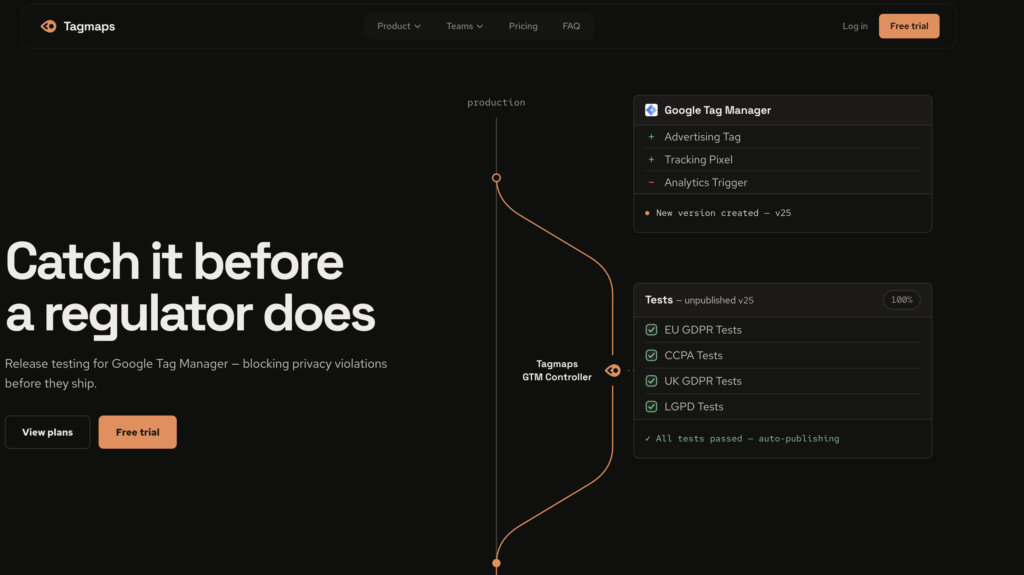
Rather than only scanning a production website to identify what is already running, Tagmaps can test changes to Google Tag Manager before those changes reach production. Its GTM Controller is designed to apply privacy tests to a proposed GTM version and then allow, block or otherwise control publication based on the results.
It is an interesting approach because it treats tag management more like a software deployment pipeline: test the change first, determine whether it violates a rule, and only then allow it onto the website.
What Is Tagmaps?
Tagmaps is a website privacy testing and tag governance platform operated by Tagmaps, LLC.
The product currently combines several related functions: website scanning, privacy testing, a tag and technology inventory, and a Google Tag Manager Controller. Its own description focuses heavily on testing GTM releases before they reach production.
The basic problem Tagmaps is addressing is not difficult to understand.
Google Tag Manager is intentionally designed to let authorized users make changes quickly. An organization might use GTM to deploy:
- Google Analytics
- Google Ads
- Meta Pixel
- LinkedIn Insight Tag
- TikTok Pixel
- conversion tracking
- affiliate technologies
- chat applications
- A/B testing tools
- custom JavaScript
Those tags may have very different privacy implications.
GTM itself does not determine whether a particular deployment complies with the GDPR, CCPA, Colorado Privacy Act or another privacy law. Nor does the existence of a consent management platform automatically guarantee that every new GTM tag respects the choices collected by that platform.
Tagmaps effectively inserts a testing layer between creating a GTM version and putting it into production.
How the Tagmaps GTM Controller Works
The GTM Controller is probably the most distinctive part of the product.
A company connects its Google Tag Manager environment to Tagmaps and selects the containers it wants to govern. It then assigns privacy tests to those containers.
When a new GTM version is ready, Tagmaps can load the proposed version on the company’s actual website using GTM’s preview capabilities. It then uses a real browser to observe how the site behaves with that unpublished configuration.
That means the company can potentially identify a privacy problem before ordinary users ever encounter it.
For example, imagine a marketing team adds a new Meta advertising tag.
The tag appears correct inside Google Tag Manager. The team submits the version for publication.
Tagmaps can test the proposed version from California with Global Privacy Control enabled and determine whether the Meta technology continues firing despite the opt-out signal.
If the test fails, the existing production version remains live instead.
Tagmaps shows a similar example on its own website involving a California privacy test failing because a Meta Pixel does not have the expected configuration.
That is considerably different from discovering the same problem during a website scan several days or weeks later.
Tagmaps Can Operate at Different Levels of Control
Companies do not necessarily have to hand Tagmaps complete control of their GTM publishing process on day one.
According to the company’s documentation, organizations can start in a read-only configuration, use Tagmaps to support human-controlled publishing, or eventually allow passing versions to be published automatically. Versions that fail the configured tests are not published by Tagmaps.
That gradual model makes sense for enterprise environments.
Privacy and marketing teams generally do not want a new compliance tool to immediately start blocking production changes without first understanding how it behaves.
An organization could initially use Tagmaps as another QA check. Once teams become comfortable with the tests, they could make the privacy check a formal part of their publishing workflow.
Tagmaps also offers optional publisher controls intended to prevent users from bypassing that workflow and publishing directly through GTM.
That addresses a governance problem that exists in many organizations: a privacy process can be excellent on paper but ineffective if someone can simply bypass it.
It Also Tests Live Websites
Tagmaps is not limited to unpublished GTM versions.
Its website-scanning product loads pages using a real browser and records the technologies it encounters, including cookies, scripts, network requests, local storage and other browser activity. Scans can be run manually or on a schedule.
This matters because cookies are only one part of modern website tracking.
A cookie scanner that reports cookie names may tell a privacy team that a certain identifier exists. It may not explain which script created it, which other technology caused that script to load, or what network requests occurred afterward.
Tagmaps attempts to capture that larger chain.
The Tag and Technology Inventory
One of the more useful concepts in Tagmaps is its technology inventory.
The platform takes the technical information collected during website scans and attempts to translate it into recognizable vendors and products.
Instead of leaving a privacy professional with a long list of obscure domains and JavaScript requests, Tagmaps identifies technologies and creates what it calls an initiator chain showing how a particular resource appeared on the website.
That can help answer an important question:
Who actually caused this tracker to load?
Sometimes the answer is straightforward. The company’s marketing team directly added a Meta Pixel through Google Tag Manager.
Other times it is several layers removed.
A company may approve Vendor A. Vendor A loads another resource from Vendor B. Vendor B then contacts Vendor C.
This is commonly referred to as piggybacking.
Tagmaps says its inventory can expose these relationships by tracing the initiator chain for browser resources and distinguishing technologies directly introduced by the organization from third parties loaded through another service.
That is useful for privacy audits because companies frequently discover technologies that nobody on the privacy team remembers approving.
Tagmaps Tests Consent and Opt-Out Behavior
Tagmaps also provides privacy testing designed to determine whether a website actually responds correctly to privacy choices.
This goes beyond identifying whether a consent banner exists.
The system can interact with the consent mechanism, observe the website before and after a choice, and record what happens to tags, cookies, browser storage and network requests.
For example, a test could examine what happens when someone:
- loads the website before making a choice;
- clicks Accept;
- clicks Reject;
- sends a Global Privacy Control signal; or
- combines an opt-out choice with GPC.
Tagmaps says these tests can run from different geographic locations so that an organization can test different regional configurations.
That matters because many websites intentionally behave differently depending on where the visitor is located.
A visitor in Germany might receive an opt-in consent experience while a visitor in California receives a different privacy control. A Colorado visitor may trigger another set of rules.
Testing only from the company’s headquarters can therefore miss significant configuration problems.
Global Privacy Control Testing Is Particularly Useful
GPC is a good example of why automated testing has become more relevant.
Global Privacy Control allows a browser or browser extension to send a technical signal indicating that the user wants to exercise certain privacy rights, including opt-out rights under laws that recognize GPC.
A website may appear to support GPC while still having an underlying implementation problem.
Perhaps the consent platform recognizes the signal, but a separate advertising tag ignores the resulting state.
Perhaps the homepage handles GPC properly but a checkout page does not.
Perhaps a newly deployed marketing tag never received the same consent configuration as the older tags.
Tagmaps can run tests with GPC enabled and determine whether technologies continue operating despite the signal. Its own product example shows a test in which the consent platform and GPC signal pass, but a Meta Pixel continuing after opt-out produces a failure.
That type of test gets much closer to the actual privacy question than simply checking whether a website contains a GPC-related setting.
Does Tagmaps Replace a Consent Management Platform?
No. The two products perform different jobs.
A consent management platform is responsible for presenting privacy choices, collecting user preferences, communicating consent states and controlling technologies according to those preferences.
Tagmaps is primarily testing and governing the implementation.
In fact, Tagmaps says its privacy testing is designed to work with different CMPs, including both commercial platforms and custom-built consent systems. It can use APIs or browser interaction to operate the consent interface during testing.
A simple way to think about the relationship is:
The CMP manages the visitor’s privacy choice.
Tagmaps checks whether the website and its tags actually respect that choice.
Those functions are complementary.
A company could have a properly configured CMP today, then have a marketing employee add a new tracking tag tomorrow that does not respect the CMP’s consent state.
The consent platform did not necessarily fail. The deployment process failed.
Tagmaps is trying to catch that second category of problem.
Why This Matters for Marketing Teams
This should not be viewed purely as a tool for lawyers or privacy departments.
Marketing teams are often caught in the middle of cookie and tracking compliance.
They need analytics and attribution. They need to deploy campaign pixels quickly. They may work with multiple agencies and advertising platforms at the same time.
At the same time, they usually do not want to accidentally create a regulatory or litigation problem because somebody copied a JavaScript snippet into GTM.
A pre-production testing system gives marketing teams a way to continue moving quickly while establishing a defined release process.
Instead of privacy telling marketing, “Don’t touch GTM without calling us,” the organization can create objective tests that each release has to pass.
That is a more scalable model.
Why Privacy Teams Should Care About GTM Governance
Privacy programs frequently spend considerable time reviewing privacy policies, vendor contracts and consent language while comparatively little attention is paid to who can publish code through the tag manager.
That is an unusual imbalance when GTM users can potentially change the organization’s actual data flows without deploying traditional application code.
If a company has 15 employees and three agencies with publishing rights, any of those users may be able to introduce a new third-party data recipient.
Organizations should therefore consider GTM permissions part of privacy governance.
The questions are fairly basic:
- Who can add tags?
- Who can publish them?
- Does anyone review them?
- Are privacy tests required before publication?
- Can someone bypass the review?
- Is there a record showing what changed?
Tagmaps is effectively building a product around answering those questions technically rather than relying solely on internal procedures.
It Creates an Audit Trail
Another potentially valuable feature is evidence preservation.
Tagmaps says its GTM Controller stores the results of each test, allowing organizations to compare versions over time. The product records testing results and publishing actions together rather than leaving the history scattered between GTM, spreadsheets and separate audit reports.
That may become increasingly useful as privacy litigation focuses on what websites were actually doing at a particular point in time.
It is one thing to say that a company had a privacy policy and CMP.
It is more useful to be able to show that version 24 of a tag container was tested before publication, passed the organization’s California opt-out test and produced a record of the result.
That does not prove compliance with every possible legal requirement, but it creates far better operational evidence than simply asserting that the website was configured correctly.
What Tagmaps Does Not Decide
Automated testing also has limits.
A technical tool can determine whether a tag fired, a cookie appeared, a network request occurred or a GPC signal produced a particular response.
It cannot independently settle every legal question surrounding those events.
Whether a particular technology requires consent, whether an exemption applies, whether a transmission constitutes a sale or sharing of personal information, or whether a particular data flow violates a privacy statute may still require legal analysis.
Tagmaps itself describes the service as producing automated output about websites rather than making legally significant decisions about individuals.
That distinction is important.
Privacy testing works best when the organization first establishes its rules and then uses technology to determine whether its website follows them.
Where Tagmaps Fits in a Modern Privacy Stack
Tagmaps is best understood as a privacy QA and tag-governance layer.
A mature website privacy stack may include several separate functions:
- a consent management platform to collect and enforce visitor choices;
- a website scanner to continuously identify cookies and trackers;
- tag management to deploy marketing and analytics technologies;
- privacy testing to confirm that opt-in, opt-out and GPC behavior works;
- governance controls over who can deploy new technologies; and
- audit records showing what was running and when.
Tagmaps touches several of those categories, but its most interesting feature is what happens before publication.
Most privacy monitoring has historically been reactive.
A scanner visits a live website, discovers a problem and tells the company what already happened.
Tagmaps is attempting to add a preventive layer by asking whether a proposed change should be allowed onto the website in the first place.
For organizations that rely heavily on Google Tag Manager, that is worth paying attention to.
The broader lesson is not really about Tagmaps alone.
Website privacy programs are starting to resemble other mature software-control systems. Companies test security vulnerabilities before code reaches production. They test whether new releases break important functionality. Privacy controls are beginning to move in the same direction.
That is probably where tag governance needs to go.
Knowing that a privacy problem exists after thousands of visitors have encountered it is useful.
Preventing the problematic tag from reaching those visitors in the first place is better.
Put this into practice
Turn privacy guidance into working controls.
Captain Compliance helps teams discover tracking technologies, enforce consent, manage privacy requests and document the evidence behind every decision.