Know what’s on your site before a plaintiff’s firm does
A free privacy audit shows which cookies, pixels and trackers are running — and which ones commonly appear in privacy claims.
Keeping data forever used to be the easy answer.
Storage was cheap, deletion was difficult, and nobody wanted to discover that an old customer record, contract, security log, or employee file had disappeared when it was suddenly needed.
Privacy law has changed that calculation.
A company now needs to know not only what data it collects, but why it still has that data six months, three years, or ten years later. In some cases, deleting a record too soon can create a tax, regulatory, litigation, or operational problem. In others, keeping it too long creates the problem.
That is what a data retention policy is supposed to solve.
A useful data retention policy does more than assign an arbitrary number of years to a list of records. It identifies the data an organization holds, establishes why each category is being retained, defines when the retention period begins, accounts for legal and contractual requirements, and determines what happens when the retention period expires.
The last part matters. A policy that says customer data is retained for 24 months accomplishes very little if the same customer information remains indefinitely in backups, support software, analytics databases, employee inboxes, exported spreadsheets, and third-party SaaS applications.
What is a data retention policy?
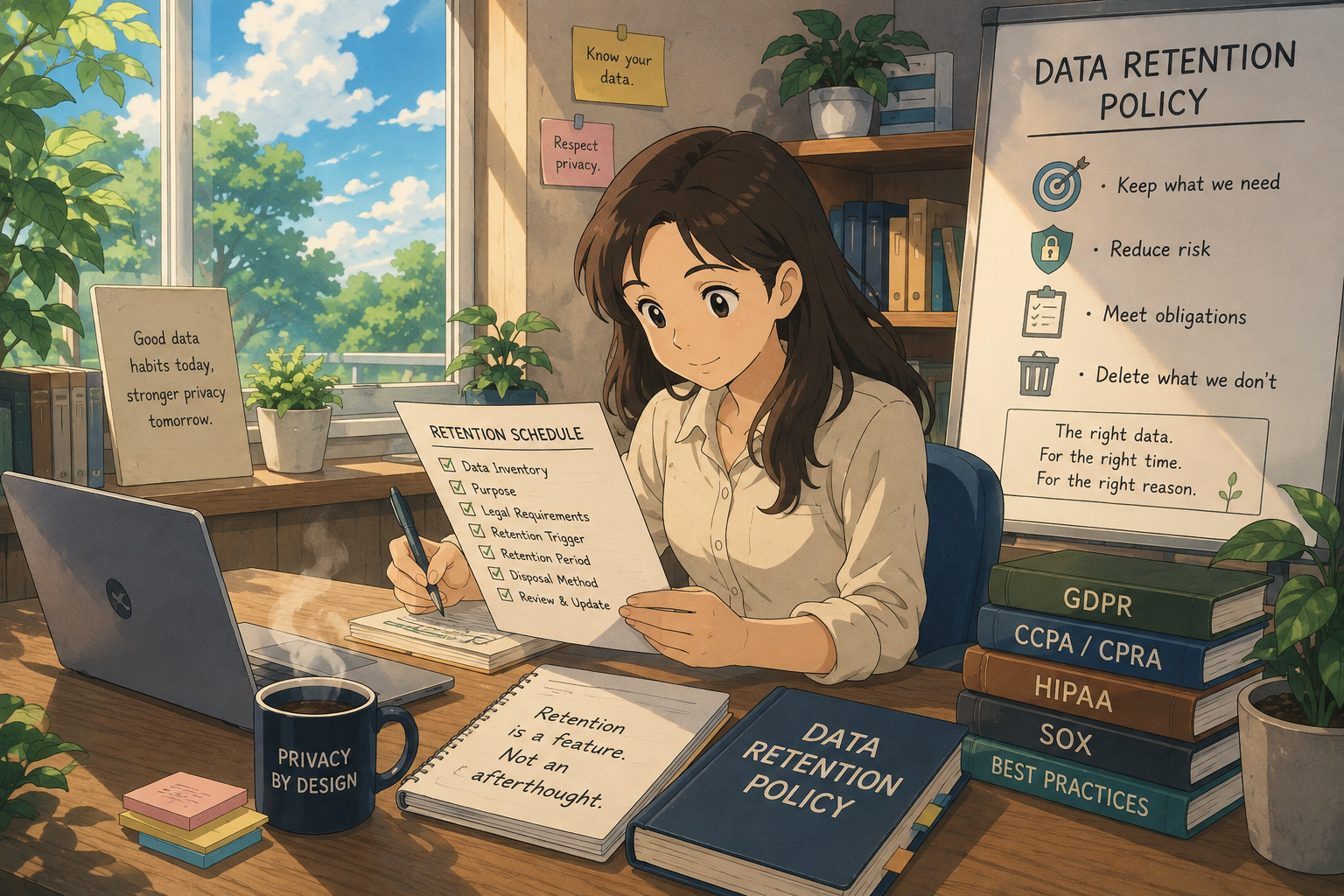
A data retention policy is an organization’s documented set of rules for determining how long different types of information are kept and what happens to that information when it is no longer needed.
For each major category of data, the policy should answer questions such as:
- What information are we keeping?
- Why are we keeping it?
- Which systems contain it?
- What event starts the retention period?
- How long will it be retained?
- Is a particular law, contract, or business requirement responsible for that period?
- Who owns the data?
- Can an active legal hold suspend deletion?
- Will the information be deleted, anonymized, archived, or otherwise disposed of at the end of the period?
- How can we prove that the rule was actually followed?
The retention period is only one part of the policy.
This distinction becomes important when businesses start building retention schedules. “Keep for seven years” sounds precise. It is not precise until the company can answer seven years from what: creation, transaction date, termination of the customer relationship, filing of a tax return, expiration of a contract, employee separation, or some other event?
That starting event is commonly called the retention trigger.
Data retention policy vs. data retention schedule
The terms are often used together, but they refer to different things.
The data retention policy establishes the organization’s rules and responsibilities. It explains how retention decisions are made, who has authority over them, how exceptions work, and how information is disposed of.
The data retention schedule applies those rules to specific categories of information.
A schedule might contain entries for customer accounts, contracts, invoices, employee records, support tickets, marketing records, security logs, website analytics, consent records, backups, and dozens of other categories.
For example:
| Data category | Retention trigger | Retention period | Reason | End-of-life action |
|---|---|---|---|---|
| Customer account data | Account termination | Defined business/legal period | Contract administration and legal claims | Delete or anonymize |
| Marketing lead data | Last meaningful interaction | Period approved by privacy/legal | Marketing purpose | Delete or suppress |
| Consent records | Consent or preference event | Period based on applicable legal and evidentiary need | Proof of consent/preferences | Secure deletion |
| Security logs | Log creation | Period based on security purpose and regulatory requirements | Incident detection/investigation | Automated deletion |
| Vendor contracts | Contract expiration | Applicable legal limitation period | Contract and claims management | Secure deletion |
| Backups | Backup creation | Backup rotation period | Business continuity | Automated expiration |
Those periods intentionally are not filled with universal numbers. There is no defensible universal rule saying customer information should always be retained for three years or contracts for seven.
A retention schedule has to be built around the organization that will actually use it.
Data retention is not the same as archiving or backup
These concepts are regularly confused.
Retention answers how long information should continue to exist.
Archiving moves information that is no longer actively used into another storage environment, usually for long-term preservation or lower-cost storage.
Backup creates copies so information or systems can be restored after deletion, corruption, ransomware, hardware failure, or another incident.
Deletion removes information when the organization no longer has a reason or right to retain it.
Moving a five-year-old customer database into an archive does not solve an over-retention problem. The company still possesses the data.
The same issue applies to backups. If a customer’s information disappears from the production database but remains recoverable from backup infrastructure for another year, the company needs to understand and document that lifecycle.
Why does a business need a data retention policy?
The simplest reason is that companies accumulate information much faster than they remove it.
Consider one customer account at a typical software company.
The CRM contains the customer’s contact details. The application database contains account information. Stripe or another payment processor has transaction records. The support platform contains conversations. Marketing software contains campaign activity. Product analytics contains behavioral events. Security systems contain IP addresses and authentication logs. Employees may have emails or exported files containing the same information.
Canceling the account does not make those copies disappear.
Without a retention program, each system effectively develops its own policy based on default settings, employee habits, storage capacity, or whether somebody remembered to configure deletion.
That creates several separate problems.
Privacy compliance
A growing number of privacy regimes limit how long personal information should remain identifiable or require businesses to justify their retention periods.
Under the GDPR’s storage limitation principle, personal data generally may not be kept in identifiable form for longer than necessary for the purposes for which it is processed. The GDPR does not give every category of data a predefined retention period. The organization has to establish and justify its periods.
California takes a similar approach through the CCPA as amended by the CPRA, but adds an important disclosure requirement. California Civil Code §1798.100 requires covered businesses to disclose the intended retention period for categories of personal information or, when a fixed period cannot be provided, the criteria used to determine the period. It also says personal information should not be retained longer than reasonably necessary for the disclosed purpose.
This means retention increasingly connects directly to what a business tells consumers in its privacy documentation.
Data breach exposure
A breach cannot expose data that the organization no longer possesses.
That sounds obvious, but it changes how retention should be viewed. An old customer database with no remaining business purpose is not simply consuming storage. It is another dataset that must be secured, governed, located during an investigation, reviewed for notification obligations, and potentially disclosed as part of litigation or regulatory proceedings.
The Federal Trade Commission has specifically connected limits on collection and retention with reduced security risk.
The point is not to delete everything quickly. It is to stop keeping information indefinitely without knowing why.
Consumer deletion and access requests
Retention also affects a company’s ability to respond to privacy rights requests.
If an individual asks what personal information a company has about them, the answer may require searching multiple systems.
If the person asks for deletion, the organization then has to determine what can be deleted, what must be retained, which exceptions apply, and where copies exist.
A well-maintained data map makes that job substantially easier because the business has already documented where information enters the organization, where it moves, which systems receive it, and who is responsible for it.
Litigation and legal holds
A company can also create serious problems by deleting information at the wrong time.
Routine deletion normally must be suspended when information becomes subject to a valid legal hold. Litigation, a regulatory investigation, an audit, or a reasonably anticipated dispute can change the rules for particular records.
The policy therefore needs an exception process.
A legal hold should identify the affected information, prevent normal destruction while the hold remains active, preserve necessary records, and allow the normal retention schedule to resume when counsel releases the hold.
This is one reason “delete everything after X years” is not a complete retention program.
How long should data be retained?
There is no single answer.
The right retention period depends on what the information is, why it was collected, which laws apply, what contractual obligations exist, whether litigation is reasonably anticipated, and whether the organization still has a legitimate operational need for it.
A sensible retention analysis usually works in roughly this order.
First determine whether a law or regulation requires the organization to preserve the record for a minimum period.
Then identify contractual obligations. Enterprise customers, insurers, payment partners, government contracts, data processing agreements, and other arrangements may impose their own preservation or deletion requirements.
Next determine whether litigation, an investigation, or another legal hold requires preservation.
After those requirements are accounted for, ask why the business itself needs the information.
Then examine privacy and security risk. Sensitive information deserves particular scrutiny when the remaining business reason for keeping it is weak.
The resulting period should be something the organization can explain.
“Because we have always kept it” is not much of an explanation.
“Indefinitely” should receive even more scrutiny.
Data retention requirements under major laws
One of the easiest ways to create a bad retention schedule is to copy a chart from the internet and assume every number applies to your organization.
Retention requirements are often much narrower than a chart makes them appear.
GDPR and UK GDPR
GDPR Article 5(1)(e) establishes the storage limitation principle.
Personal information should generally remain identifiable only for as long as necessary for the purpose for which it is being processed. Certain exceptions exist for public-interest archiving, scientific or historical research, and statistical purposes when the required safeguards apply.
There is no universal “GDPR retention period.”
A company may reasonably keep different categories of information for different periods because the purposes differ. The important part is being able to explain the decision and review whether the reason for keeping the information continues to exist.
The UK’s Information Commissioner’s Office recommends documented standard retention periods where possible and periodic deletion or anonymization when personal information is no longer needed.
CCPA and CPRA
California is especially important because retention is tied directly to consumer disclosure.
The CCPA requires businesses within its scope to state the length of time they intend to retain each category of personal information, including sensitive personal information, or provide the criteria used to determine that period when a specific period cannot be provided.
The statute also limits retention to what is reasonably necessary for the disclosed purpose.
California’s Notice at Collection regulations similarly require the retention period for each category or the criteria used to determine it.
A company therefore should be cautious about writing vague retention language into a California notice while operating systems that preserve data indefinitely.
The disclosure and the actual technical behavior need to agree.
HIPAA
HIPAA is frequently summarized incorrectly as requiring all medical records to be kept for six years.
That is not what the federal HIPAA documentation rule says.
The HIPAA Security Rule requires regulated entities to preserve specified documentation, including required policies and procedures and documented actions, activities, and assessments, for six years from creation or from the date the document was last in effect, whichever is later.
Medical-record retention itself can depend on other federal requirements and state law.
A healthcare organization’s schedule therefore should not simply label every record containing protected health information “HIPAA — six years.”
The record type matters.
Sarbanes-Oxley
Another common shortcut is “SOX requires financial records to be kept seven years.”
The actual federal requirement is more specific.
SEC Rule 2-06, adopted to implement Section 802 of the Sarbanes-Oxley Act, requires accountants to retain specified records relevant to audits and reviews of covered issuers and registered investment companies for seven years after the audit or review concludes. Those records include audit workpapers and certain documents containing conclusions, opinions, analyses, or financial data related to the audit or review.
A company may have other reasons to retain financial material for seven years, but those should not all be attributed casually to SOX.
IRS records
Federal tax retention also depends on the record.
The IRS generally tells businesses to preserve records for as long as they may be needed to administer the Internal Revenue Code. Records supporting income or deductions generally need to remain available through the applicable limitations period.
For many ordinary tax situations that period is three years, but the IRS describes circumstances involving six years, seven years, or no limitation period at all. Employment tax records generally must be kept for at least four years after the tax becomes due or is paid, whichever occurs later. Records establishing basis in property may need to be kept much longer.
This is another reason a generic “financial records: seven years” row is not enough.
OSHA records
Some occupational records have very long retention requirements.
Under 29 CFR §1910.1020, covered employee exposure records generally must be preserved for at least 30 years, while certain covered employee medical records generally must be preserved for the duration of employment plus 30 years, subject to specified exceptions and more specific OSHA standards.
Even here, the precise record matters. OSHA has confirmed, for example, that a more specific standard can establish a different retention period.
The lesson is fairly simple: regulations should be mapped to records, not just placed in a column next to an entire department.
Example data retention schedule
A retention schedule should be specific enough that someone can implement it without guessing what the policy author meant.
This is a starting structure, not a universal schedule:
| Information | Trigger | Retention approach | Questions to resolve |
|---|---|---|---|
| Customer account/profile | Account closure | Defined period after closure, then delete or anonymize | Contract claims, tax records, fraud prevention, privacy rights |
| Customer contracts | Expiration/termination | Applicable claims and recordkeeping period | Governing law, limitation periods, regulatory requirements |
| Transaction records | Transaction or tax filing event | Applicable financial/tax period | IRS, state tax, payment obligations |
| Marketing prospects | Collection or last interaction | Short purpose-based period with periodic review | Consent, suppression lists, applicable privacy law |
| Cookie/consent records | Consent event | Evidentiary period appropriate to applicable law | Ability to prove what choice was made and when |
| Website analytics | Collection | Purpose-based period | Identifiability, analytics need, privacy notice |
| Support tickets | Ticket closure/customer termination | Defined operational/legal period | Account disputes, product issues, personal information contained in messages |
| Security logs | Log creation | Security-driven period | Detection needs, regulatory framework, storage volume |
| Employee personnel records | Separation or record creation | Jurisdiction-specific schedule | Employment, tax, benefits, discrimination and safety laws |
| Job applicants | Hiring decision | Jurisdiction-specific period | Employment claims and recruiting purpose |
| Vendor records | Contract end | Contract/legal period | Financial records, disputes, security documentation |
| Backups | Backup creation | Defined rotation schedule | Recovery requirements, legal holds, deletion propagation |
| AI prompts and outputs | Creation or end of business use | Purpose- and risk-based period | Personal data, confidential data, vendor retention, model training |
The column organizations most often forget is the trigger.
“Retain for three years” is not operational.
“Retain for three years after account termination unless a legal hold or statutory exception applies” is something engineering, legal, and operations can actually implement.
How to create a data retention policy
A retention project should start with the data, not the policy document.
1. Find out what the company actually has
You cannot establish meaningful retention periods for information you do not know exists.
Build or update the organization’s data inventory and data map.
Look beyond primary databases. Include SaaS applications, cloud storage, data warehouses, analytics tools, CRM systems, advertising platforms, employee systems, support platforms, collaboration software, email, local exports, development environments, archives, and backup infrastructure.
For each system, determine what categories of information are present and whether personal or sensitive information is included.
2. Identify the purpose
Ask why each category exists.
“Business purposes” is too broad.
Payment information may be needed to process transactions. Security logs may be needed to investigate attacks. An email address may exist to administer an account, deliver transactional messages, send marketing, or all of those at different points in the relationship.
Those purposes can create different retention decisions for the same identifier.
3. Identify the legal requirements that actually apply
Map specific laws to specific records.
Do not begin with a generic online chart.
Federal requirements, state laws, employment rules, tax rules, industry regulation, privacy law, contractual obligations, statutes of limitation, and professional requirements may overlap.
Where requirements conflict or appear to conflict, legal counsel should determine which obligation controls and document the reasoning.
4. Define the trigger
Every retention period needs a starting point.
Possible triggers include:
- creation of the record;
- completion of a transaction;
- filing of a tax return;
- closure of a support ticket;
- withdrawal of consent;
- account deletion;
- contract termination;
- employee separation;
- completion of an audit;
- expiration of a warranty; or
- resolution of a legal matter.
The trigger often matters as much as the duration.
5. Account for duplicate copies
This is where paper policies often fail.
A company may delete a customer from its principal application while keeping the person’s information in the CRM, support platform, analytics environment, marketing platform, warehouse, email system, archived exports, and backups.
Retention has to follow the data across the environment.
A data map is useful here because it connects the policy to the systems where the information actually lives.
6. Decide what happens at expiration
Expiration does not always mean the same thing.
Data can be:
- permanently deleted;
- anonymized so it can no longer reasonably be linked to an individual;
- archived when continued retention is justified;
- aggregated into non-personal statistics;
- or preserved because a legal hold or another documented exception applies.
The policy should say which action occurs.
Be careful with pseudonymization. Replacing a person’s name with an identifier does not necessarily make the information anonymous if the individual can still be reidentified.
7. Deal with backups separately
Backup retention deserves its own rules.
Immediate deletion from every backup whenever a record is deleted from production may not be technically feasible or desirable. Backups are designed to preserve prior system states.
That does not mean backup copies should exist forever.
Organizations should document the backup rotation period, limit ordinary access to backup data, prevent deleted information from being casually restored into active systems, and allow expired backups to age out according to the documented schedule.
If restoration does occur, deletion workflows may need to account for information that had previously reached the end of its retention period.
8. Build a legal-hold process
The policy should state who can issue a hold, how affected systems and custodians are identified, how normal deletion is suspended, who tracks the hold, and who has authority to release it.
A legal hold should be an exception to the retention process, not an excuse to turn off deletion across the entire company indefinitely.
9. Connect retention with privacy requests
Retention and data subject rights should be designed together.
When someone submits an access or deletion request, the privacy team needs to determine where the person’s information resides and whether an exception permits or requires continued retention.
A mature process should also prevent deleted information from quietly being recollected or restored because another system did not receive the request.
10. Test whether the policy works
Ask a practical question:
If the retention schedule says a particular category is deleted 90 days after a specific trigger, can the company show that this actually happens?
Evidence might include automated lifecycle rules, deletion logs, system settings, workflow records, tickets, audit results, or documented reviews.
A beautiful PDF is not evidence that retention is working.
Data retention policy template
A basic policy can use the following structure.
Purpose
State why the organization has adopted the policy, including legal compliance, privacy, security, business operations, records management, and defensible disposal.
Scope
Identify the entities, employees, contractors, systems, records, and categories of data covered by the policy.
Policy statement
State that information will be retained only for documented business, contractual, legal, regulatory, security, or other authorized purposes and disposed of when continued retention is no longer justified.
Roles and responsibilities
Assign responsibility to legal, privacy, information security, IT, records management, business owners, and system owners as appropriate.
Someone needs authority to approve and change retention periods.
Data classification
Define the major categories used by the retention schedule.
The categories should be specific enough to connect to actual systems and obligations.
Retention schedule
For each category, document:
Data category
Purpose
Systems or repositories
Record owner
Retention trigger
Retention period
Legal or business basis
Disposition method
Applicable exceptions
Legal holds
Explain how normal deletion is suspended for information subject to litigation, investigations, regulatory inquiries, audits, or other preservation obligations.
Secure disposal
Describe approved methods for destroying paper records, electronic records, storage media, and information held by third parties.
Where consumer-report information is involved, for example, the FTC Disposal Rule requires appropriate measures designed to protect against unauthorized access to or use of that information during disposal.
Backups and archives
Document how retention applies to backup copies and archives, including their rotation periods and access restrictions.
Third parties
Require service providers and other vendors to follow applicable retention and deletion obligations.
Contract language and actual vendor configuration should agree.
Exceptions
Identify the process for approving deviations from the normal schedule and require the reason to be documented.
Review
Specify when the retention schedule is reassessed.
A calendar review can help, but changes in law, products, systems, vendors, business operations, litigation, and data collection should also trigger review.
Data retention and AI systems
AI has created another retention problem that many policies written even a few years ago never considered.
Prompts may contain customer information, employee information, source code, contracts, health information, financial information, or other confidential data.
AI applications may also create outputs, conversation histories, telemetry, retrieval logs, agent activity, evaluation datasets, embeddings, cached information, and records of tool calls.
Some of this may be stored by the organization. Some may be retained by an AI vendor. Some may end up in logging or monitoring systems that employees never think of as part of the AI application.
By 2026, privacy professionals are explicitly treating AI-generated and AI-related information as part of the retention problem rather than as a separate issue. The IAPP, for example, has identified questions around prompts, outputs, training data, AI-generated records, and conflicts between privacy retention requirements and broader records-management obligations.
An organization’s retention inventory should therefore ask:
What information enters the AI system?
What does the organization retain?
What does the provider retain?
Is the information used to train or improve models?
Do zero-retention or configurable-retention options exist?
Where do prompts and outputs appear elsewhere, such as application logs or observability platforms?
What happens when a user exercises a deletion right?
Does deleting an AI conversation actually remove every relevant copy?
“AI data” is not a useful retention category by itself. The underlying information and its purpose still matter.
Common data retention policy mistakes
One of the most common mistakes is copying another company’s retention schedule.
Another company’s seven-year period may arise from a law that does not apply to you, a contract you do not have, a different statute of limitations, or an internal requirement that makes no sense for your systems.
Another problem is applying one period to an entire category such as “customer data.”
Customer data is not one record type. Transaction records, account credentials, support messages, consent records, analytics events, invoices, contracts, advertising identifiers, and fraud records may all involve the same customer and still have very different retention requirements.
Indefinite retention is another warning sign.
Sometimes indefinite retention can be justified. More often, it simply means nobody made a decision.
Policies also fail when they ignore third-party applications. Deleting information from your own database does not necessarily delete copies held by processors, subprocessors, analytics providers, marketing vendors, CRM platforms, or cloud services.
And then there is the simplest failure of all: the written policy says one thing while the technology does another.
That discrepancy can become especially difficult when a privacy notice promises consumers that information will be retained for a particular period.
Data minimization and retention belong together
Data minimization asks whether the organization needs to collect the information in the first place.
Retention asks how long the organization continues to need it afterward.
A company that collects unnecessary personal information and deletes it efficiently still has a collection problem.
A company that limits collection but keeps everything forever has a retention problem.
A good privacy program deals with both ends of the lifecycle.
Who should own the data retention policy?
There usually should not be a single department making every retention decision.
Legal may interpret statutory requirements and litigation exposure. Privacy may address storage limitation, purpose limitation, notices, and individual rights. Security needs logs and evidence for investigations. Finance understands tax and accounting requirements. HR owns employee processes. Engineering knows whether deletion can actually be implemented. Business owners know whether particular information still has operational value.
What the organization does need is clear authority.
Someone must own the policy, maintain the schedule, resolve conflicting requirements, approve exceptions, and make sure changes eventually reach the systems where retention occurs.
Without that ownership, the retention schedule becomes a spreadsheet everyone assumes somebody else is maintaining.
How data mapping supports a retention policy
Data mapping answers a question a retention policy cannot answer on its own:
Where is the data?
An organization can declare that former-customer information will be deleted after a defined period, but deletion cannot be reliably enforced until the organization knows which systems receive that information.
A useful data map identifies sources, categories, purposes, processing activities, recipients, vendors, storage locations, and movement between systems.
From there, retention stops being purely a legal-document exercise.
The organization can connect a retention rule to the CRM, production database, support platform, analytics environment, marketing software, data warehouse, cloud storage, and vendors that need to enforce it.
Data retention and privacy notices
The internal schedule and external privacy notice should not be written independently.
This is particularly important in California, where retention periods or the criteria used to determine them form part of the statutory disclosure framework.
If the notice says information is retained only as long as necessary, the organization should be able to explain what “necessary” means for the categories it actually collects.
If the notice provides a specific period, the systems need to support it.
Privacy documentation should describe reality, not an aspirational version of the company’s data practices.
Data retention policy best practices
The strongest retention programs tend to have a few practical characteristics.
They know where important data lives.
Their retention periods have identifiable reasons.
Their schedules define when each clock starts.
They distinguish regulatory minimums from business choices.
They account for backups and vendors.
They can suspend deletion narrowly when a legitimate legal hold applies.
They connect consumer deletion workflows with retention exceptions.
They use automation where the underlying systems allow it.
They preserve evidence that the policy is operating.
And they change the schedule when the business changes.
That last point is easy to overlook. A company can adopt a perfectly reasonable retention schedule in 2026 and make it obsolete six months later by deploying a new CRM, introducing an AI assistant, changing analytics providers, entering another jurisdiction, acquiring another company, or collecting an entirely new category of personal information.
The retention policy has to follow the data.
How Captain Compliance can help with data retention
A workable retention program begins with visibility into the organization’s processing activities.
Captain Compliance helps organizations document data flows through Data Mapping, examine privacy risks and processing through Privacy Assessments and Privacy Risk Management, maintain consumer-facing privacy notices, and manage privacy rights requests through DSAR workflows.
Those pieces connect directly to retention.
Data mapping identifies where information exists. Privacy documentation records what the organization tells consumers about collection, use, and retention. DSAR processes address requests for access and deletion. Governance and assessment work can identify cases where information is being retained without a continuing purpose or where stated policy and actual system behavior have drifted apart.
The goal is not to find one retention period and apply it everywhere.
It is to know what information the organization has, why it has it, where it exists, how long the reason for keeping it lasts, and whether the information actually disappears when that reason ends.
Frequently asked questions about data retention policies
What is a data retention policy?
A data retention policy establishes how long an organization keeps different types of information, why those periods apply, when each retention period begins, and what happens when the period expires.
What is the purpose of a data retention policy?
It helps an organization preserve information it legitimately needs while removing information that no longer has a sufficient legal, contractual, regulatory, security, or operational purpose.
How long should personal data be retained?
There is no universal period. Retention depends on the purpose for processing the information, applicable laws, contractual obligations, legal claims, regulatory requirements, and the nature of the data. Under GDPR, for example, identifiable personal data generally should not be kept longer than necessary for the processing purpose.
Does GDPR require a data retention policy?
GDPR establishes a storage limitation obligation rather than a universal list of retention periods. Organizations need to be able to justify how long they retain personal data. The ICO recommends documented standard retention periods where possible and regular review of information that may no longer be needed.
Does CCPA require retention periods?
California requires covered businesses to disclose the intended retention period for each category of personal information or, when that is not possible, the criteria used to determine the period. The CCPA also limits retention to what is reasonably necessary for the disclosed purpose.
Does HIPAA require medical records to be kept for six years?
Not as a universal federal medical-record retention rule. HIPAA requires specified compliance documentation to be maintained for six years from creation or from when it last was in effect, whichever is later. Other federal or state requirements can govern actual medical-record retention.
What is a data retention schedule?
A data retention schedule is the operational part of a retention program. It lists categories of records or data and assigns their retention trigger, retention period, justification, owner, and eventual disposal method.
Should a company delete data when the retention period expires?
Usually the schedule should specify deletion, anonymization, archival, or another approved disposition. Information subject to a valid legal hold or another applicable preservation requirement may need to be retained beyond the ordinary period.
Should backups follow the data retention policy?
Yes, although backup deletion may operate differently from deletion in active systems. Organizations should define backup rotation periods, restrict access, document how deleted information ages out of backups, and account for what happens if an older backup is restored.
How often should a data retention policy be reviewed?
A regular review cycle is useful, but material changes should also trigger review. New laws, products, vendors, jurisdictions, data categories, AI systems, acquisitions, litigation, and changes to business operations can all alter retention requirements.
What should a data retention policy include?
At minimum, the organization should document its scope, responsibilities, data categories, retention schedule, retention triggers, reasons for the selected periods, legal-hold process, secure disposal procedures, backup treatment, third-party requirements, exceptions, and review process.
Put this into practice
Turn privacy guidance into working controls.
Captain Compliance helps teams discover tracking technologies, enforce consent, manage privacy requests and document the evidence behind every decision.