Know what’s on your site before a plaintiff’s firm does
A free privacy audit shows which cookies, pixels and trackers are running — and which ones commonly appear in privacy claims.
If you run a website, an app, or a marketing stack, you have probably seen two similar acronyms in privacy headlines: ECPA and CalECPA. They sound like the federal and state versions of the same law. They are not. One of them is a core source of private lawsuits against businesses. The other is a limit on what government can do with your data. Mixing them up leads companies to aim their compliance effort at the wrong target.
This guide explains what each law does, where they overlap, and how the real litigation risk for businesses comes from a different California statute that rides alongside them. It also covers the biggest recent change in this space: California’s SB 690.
The Short Version
- ECPA is the federal Electronic Communications Privacy Act of 1986. It includes the Wiretap Act, the Stored Communications Act, and the Pen Register Act. Private parties can sue under parts of it, which is why it shows up in pixel and tracking class actions.
- CalECPA is the California Electronic Communications Privacy Act, effective in 2016. It governs government access to electronic information and generally requires a warrant. It is not a tool for suing businesses over website tracking.
- The California statute that drives most business-facing privacy suits is the California Invasion of Privacy Act, known as CIPA, not CalECPA.
What Is ECPA?
Congress passed ECPA in 1986 to extend wiretap protections to electronic communications. It has three parts that matter to businesses:
- The Wiretap Act (18 U.S.C. 2510 and following) prohibits intercepting the contents of communications in transit. It allows interception when one party to the communication consents, and it has a crime-tort exception that plaintiffs invoke when the interception is done to commit a criminal or tortious act.
- The Stored Communications Act (18 U.S.C. 2701 and following) covers unauthorized access to stored communications held by certain providers.
- The Pen Register Act (18 U.S.C. 3121 and following) governs devices that record dialing, routing, and signaling information.
Two features make ECPA important for commercial defendants. First, it includes private rights of action. Second, the Wiretap Act allows statutory damages, which is the greater of 100 dollars per day of violation or 10,000 dollars. When a plaintiff’s lawyer can plead a class of website visitors, that math gets large quickly.
What Is CalECPA?
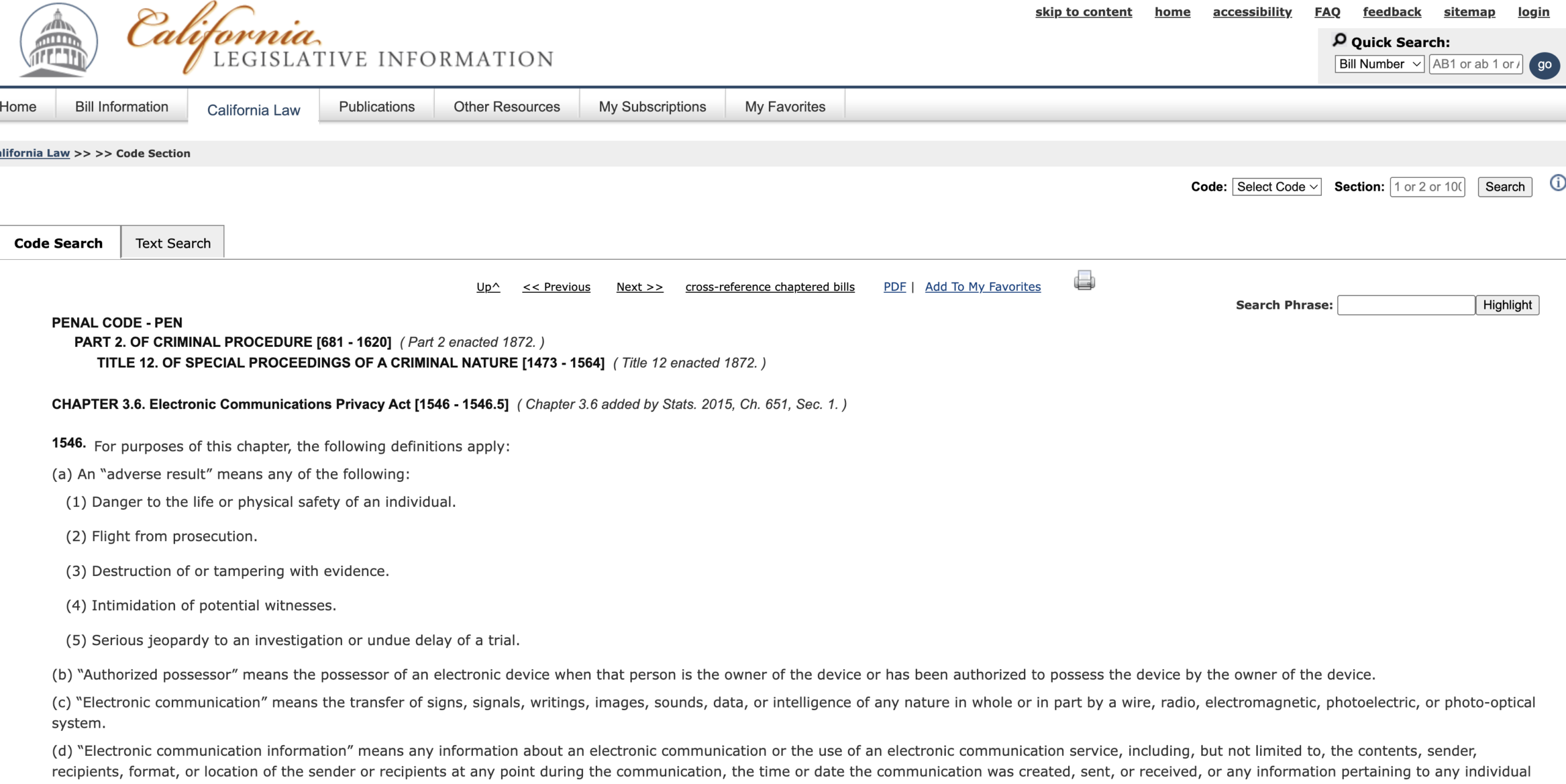
CalECPA, found at California Penal Code sections 1546 and following, was enacted through SB 178 and took effect on January 1, 2016. It is often described as one of the strongest state laws limiting government surveillance of digital data.
In general, CalECPA requires a government entity to obtain a warrant before compelling the production of electronic communication information, or accessing electronic device information, subject to defined exceptions such as consent and emergencies. It also adds notice requirements, so the person whose data was obtained is told about it, and it provides a suppression remedy when the rules are violated. The California Attorney General can also bring civil action to compel compliance.
The key point for business readers is the target of the law. CalECPA regulates government agencies and the service providers they approach. It is not designed as a general private damages statute against a retailer, publisher, or healthcare website that installs a tracking tool.
ECPA vs CalECPA at a Glance
- Jurisdiction: ECPA is federal. CalECPA applies in California.
- Main focus: ECPA addresses interception, stored communications, and pen registers across public and private actors. CalECPA focuses on government access to electronic information.
- Warrant requirement: CalECPA sets a broader warrant requirement for digital data than federal law historically did, including for device and location information.
- Private lawsuits against businesses: ECPA provides private civil remedies and appears regularly in tracking class actions. CalECPA does not function as the basis for typical website tracking suits.
- Remedies: ECPA offers statutory and actual damages in private actions. CalECPA relies mainly on suppression, voiding of orders, and Attorney General enforcement.
The Statute That Really Drives California Tracking Suits: CIPA
The California Invasion of Privacy Act, enacted in 1967, is the state law behind the wave of website tracking litigation. Plaintiffs have relied on it in two main ways:
- Section 631 claims, which allege unlawful wiretapping or interception of communications, applied to tools like session replay, chat widgets, and tracking pixels.
- Section 638.51 claims, which allege that a tracking tool operates as an unlawful pen register or trap and trace device because it captures routing or addressing information such as IP addresses.
CIPA’s civil remedy provides statutory damages of 5,000 dollars per violation, which is why a single website visitor can be pleaded into significant exposure and why demand letters have been so common. According to the sponsors of SB 690, pen register lawsuits alone grew from roughly 600 to nearly 4,000 over the period the bill was pending.
How These Laws Show Up Together in a Complaint
It is common for a single privacy complaint to stack several theories. A plaintiff suing over a tracking pixel might plead a federal Wiretap Act claim under ECPA, a CIPA Section 631 claim, a CIPA Section 638.51 claim, and various state common law or consumer protection claims. Courts then sort through which theories survive, often on questions of consent, whether the data counts as “contents” of a communication, and whether the plaintiff has standing.
CalECPA tends to appear in a different setting: criminal cases, government investigations, and disputes about warrants for devices, accounts, and location data. Businesses encounter it when they receive government demands for customer data and need a process for responding correctly.
Why Government Access Law Still Matters to Your Business
Even though CalECPA does not generate class actions, it affects operations. If your company stores communications or device data for California users, a government request raises questions about warrants, notice, and what you are permitted or required to disclose. A documented response process, and clear language in your privacy policy about how you handle legal requests, supports both compliance and user trust.
SB 690: A Major Change, but Not the End of the Story
On September 30, 2026, Governor Newsom signed SB 690. The law amends CIPA’s civil remedy provision so that private plaintiffs can no longer sue over website and app tracking under the pen register and trap and trace provisions of Section 638.51. Enforcement of that section shifts to the California Attorney General. The statute becomes operative on January 1, 2027, and law firm analyses indicate courts have already begun applying its logic to pending cases.
Several limits are worth understanding:
- SB 690 addresses Section 638.51 only. It does not remove private rights of action under CIPA Section 631.
- Plaintiffs can recast the same pixel and tracking allegations as interception claims.
- Federal claims under ECPA’s Wiretap Act and other state and federal theories remain available.
- The bill as originally introduced would have created a broader commercial business purpose exemption. The version that passed is narrower.
The practical takeaway is that the volume of one category of lawsuit should fall, while the underlying compliance obligations stay the same. Companies that treat SB 690 as permission to relax their consent and tracking controls are likely to see plaintiffs shift to the theories that remain.
How To Protect Against California Privacy Litigation
- Inventory every tracker, pixel, SDK, and session replay tool on your site and app, including the ones marketing added without a review.
- Make sure consent is collected before non-essential tracking fires, and that your banner reflects what the site actually does.
- Honor Global Privacy Control signals where required, and test that the signal is respected in practice.
- Review vendor contracts and disclosures so that your privacy policy accurately describes who receives visitor data.
- Be especially careful on pages that touch health, financial, or other sensitive information, where plaintiffs have pushed the crime-tort theory under the federal Wiretap Act.
- Create a written process for handling government requests for user data, with attention to California’s warrant and notice rules.
- Monitor continuously. A site that was clean in January can be carrying a new tracker by March.
How Captain Compliance Helps
Captain Compliance gives businesses the controls that reduce exposure under ECPA, CIPA, and the broader privacy landscape. Our consent management platform helps ensure tracking technologies respect visitor choices and Global Privacy Control signals. Our dynamic privacy policies and vendor disclosures keep your public statements aligned with what your site really does. Our Patrol privacy risk monitoring tool scans for trackers and configuration changes so that problems are found before a plaintiff finds them.
If you want to see how your website looks through the eyes of a plaintiff’s firm, contact the Captain Compliance team for a review of your tracking and consent setup.
Put this into practice
Turn privacy guidance into working controls.
Captain Compliance helps teams discover tracking technologies, enforce consent, manage privacy requests and document the evidence behind every decision.