Know what’s on your site before a plaintiff’s firm does
A free privacy audit shows which cookies, pixels and trackers are running — and which ones commonly appear in privacy claims.
Andrew Ready Tate is the lawyer whose name sits under Sonjay Singh’s on the Samsung smart-TV complaint filed October 6 in San Francisco. He is not the British-American influencer who shares the surname. He is a Georgia-barred plaintiffs’ lawyer in Atlanta, founder of Privacy Rights Law LLC, and, until he hung that shingle, of counsel and then a privacy lead at Peiffer Wolf Carr Kane Conway & Wise. The Samsung case is the public face of a practice he has been building since 2023: wiretap statutes pointed at code, not at a tape recorder.
What he says the cases are about
Tate describes the work as fluency in the system before fluency in the count. Tracking code on a website, a software kit inside an app, a connected device in the home, a data broker on the other end of the identifier. The recent concentration, on his telling, is the Meta Pixel and Google Analytics on hospital, school, and consumer sites, plus children’s data. The question he wants a complaint to answer is narrow: what the code collected, where it went, who was paid, and how that compares with the sentence on the privacy page.
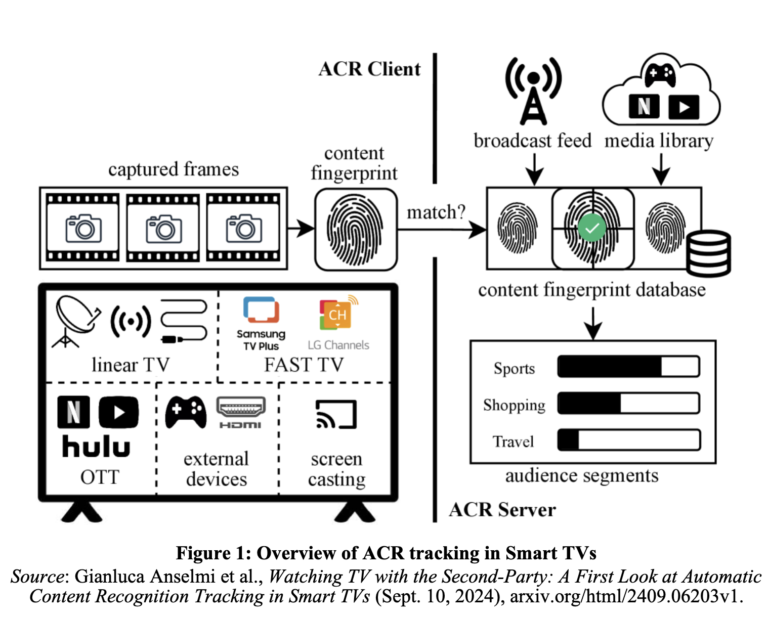
That is also the structure of Tillery v. Samsung Electronics America, No. 3:26-cv-11448. The pleading does not stop at “smart TVs track you.” It names Viewing Information Services, a capture alleged at about every 500 milliseconds, the Personalized Service ID, Samsung Ads, an Experian match announced in December 2023, and a February 2026 Texas injunction that already forced Samsung to say the feature uses automatic content recognition. Tate’s site has a separate page that walks a reader from a television that “can recognize what appears on its screen” to an identity graph built on hashed email, a home IP address, and a device ID. The Samsung complaint is that page with a caption.
He is explicit about arbitration. Companies, he writes, try to leave court through a clause in the terms. He says he has beaten motions to compel and kept cases in a courtroom. On a smart-TV case that theory matters less, because the buyer often never clicked a website contract. On a hospital-portal case it is the first motion.
The hospital pixels
The number on the site is “$50 million-plus in class settlements negotiated in under three years of class-action practice.” He marks two 2026 matters as Class Counsel: settlements over tracking on hospital websites and patient portals, totaling about $17 million. He is careful, in a footer, that results from before Privacy Rights Law should not be read as results of the new firm unless he says so. Prior results, the site adds, do not guarantee the next one.
Public filings put his name on that hospital docket while he was still at Peiffer Wolf. In Doe v. Wellstar Health System, No. 1:24-cv-01748 in the Northern District of Georgia, Wellstar agreed to a $4.25 million fund over pixels that plaintiffs said sent patient-portal and website activity to Meta and Google. The class window runs from February 19, 2020, to July 22, 2026. Claims are due November 10, 2026. A fairness hearing is set for December 1. Tate is listed with Peiffer Wolf; C.J. Cuneo of Milberg is also on the papers. Wellstar did not admit the conduct.
A May 2026 joint declaration in a Minnesota case, No. 0:24-cv-03674, names Brandon Wise and Andrew Tate of Peiffer Wolf among class counsel supporting preliminary approval of a non-reversionary fund of $12.5 million. The allegation is the same family: Meta Pixel and Google Analytics on a health system’s sites, divulging information plaintiffs say should have stayed in the portal. Tate identifies himself there as of counsel at the firm and a Georgia licensee. Those two funds, $4.25 million and $12.5 million, add to $16.75 million, which is the neighborhood of the “approximately $17 million” on his site. He does not name the systems in the bio. The filings do.
The wider pixel settlements are the market he is practicing in, not all his cases. Kaiser’s fund has been reported around $46 million. Sutter Health settled at $21.5 million. Mass General Brigham and Dana-Farber combined at $18.4 million years earlier. Christ Hospital in Ohio settled a pixel case for as much as $7 million plus credit monitoring and a promise to pull the tools off portal and booking pages. Tate’s $17 million claim is a slice of that wave, not the wave.
Six million driver’s-license records, reinstated
The other result he leads with is an appeal, not a check. Doga v. State of Louisiana, Office of Motor Vehicles, No. 2024-1116, 2025 WL 1912320 (La. App. 1 Cir. July 11, 2025). Melissa Doga and Joseph Martin sued the Office of Motor Vehicles after a June 2023 intrusion. The state told residents that names, addresses, Social Security numbers, dates of birth, license numbers, and registration data had been exposed. Plaintiffs put the figure at about six million people and said the unauthorized party had a window from May 27, 2023. The trial court dismissed. The First Circuit reversed.
Peiffer Wolf’s own note on the decision named partner Brandon Wise, Andrew Ready Tate, and Nicole Bell. The appellate point that mattered was standing: at least one plaintiff had alleged actual identity theft, which the court treated as injury enough to put the claims back in the case. Tate’s site calls it a complete reversal and a reinstatement of a proposed class. It is not a judgment on the merits. It is the difference between a closed file and a live one for a state motor-vehicle breach.
Before the pixels
The privacy docket is three years old. The trial record is older. In Kinlaw v. Nwaokocha, No. 3:17-cv-00772 in the Eastern District of Virginia, Tate was first-chair in a medical-malpractice trial and took a $1.3 million verdict for a client whose hand was fractured while incarcerated. TopVerdict put the result among the top 100 medical-malpractice verdicts in the country for 2019. He cites that case so readers do not think the privacy practice is his first time in front of a jury.
The site’s tally of the earlier book is more than 100 depositions and more than 500 complaints, briefs, and motions, with him responsible from filing through appeal rather than sitting second chair. The subject list before 2023 is malpractice, excessive force, cruel and unusual punishment, coerced sterilization, due process, neglect at nursing homes and fertility clinics, denied retirement benefits for police and firefighters, workplace torts, and whistleblower retaliation. In 2018 he worked on cases challenging family separation at the southern border, work he says reunited parents with children. None of that is a privacy holding. It is why a wiretap class action from this lawyer reads like a trial pleading instead of a demand letter.
One public CIPA filing with his signature, still at Peiffer Wolf, is the amended complaint in Jones v. Tonal Systems, Inc., No. 3:23-cv-01267 in the Southern District of California, signed October 21, 2024. The count is Penal Code section 631. The co-counsel there was the Law Offices of Ronald A. Marron. It is the same statute that now leads the Samsung case, aimed at a fitness-hardware site rather than a television.
How the new firm is built
Privacy Rights Law is currently a single-lawyer shop with a co-counsel network he says reaches every state. The site is attorney advertising. It says viewing it does not create a relationship, and it names Tate as the lawyer responsible for the content. The practice pages do something most plaintiffs’ sites skip: they explain the identifier, not just the statute. A cookie ID, a mobile advertising ID, a home IP address that ties the phone to the television, a hashed email that matches across companies, a VIN, a loyalty number. Then the graph, then the segment, then the use: an ad, a price, a screen, a resale. He is training the client, and the reporter, before the complaint quotes CIPA.
The rights page is equally plain that there is no single American privacy law. Knowledge, opt-out, wiretap limits, extra rules for health and biometrics and precise location, a duty to secure, and a private right of action only where a statute actually gives one. That last sentence is the one a lot of intake sites bury. Agency enforcement and a private claim are not the same door.
Education is Emory for college and for the J.D., with an internship for the late Chief Justice P. Harris Hines of the Georgia Supreme Court, and a concentration in theater at NYU’s Tisch School of the Arts. He mentions Bottom and Hamlet on purpose. He is a member of the St. Thomas More Society of Atlanta. He lives with his wife and three children in an older Atlanta suburb. The childhood line on the site is the practice in miniature: his was the last generation whose childhood was not recorded, measured, and sold, and he wants his children to have the tools without the file.
Why Samsung is the case that shows the practice
Hospital pixels were the first place this bar proved a tracker on a logged-in page could be pleaded as a wiretap and settled for eight figures. The Louisiana appeal showed a state data breach can get back into court if someone alleges the stolen file was actually used. Samsung is the device case. The defendant manufactured the screen, labeled the feature Viewing Information Services, and, on the plaintiffs’ account, told buyers it collected neither video footage nor content on the device. Tate’s job on that team is the one his site describes: read what the system does, put it next to the sentence the company used, and file where the statute still reaches.
He is one lawyer in a three-firm caption. Siri & Glimstad is on the papers. The class is not certified. Samsung has not answered. The $50 million and the $17 million are settlement values from the prior firm, not judgments of the new one. What the October filing does show is where he is taking the same theory next: off the hospital website and onto the set in the living room.
Put this into practice
Turn privacy guidance into working controls.
Captain Compliance helps teams discover tracking technologies, enforce consent, manage privacy requests and document the evidence behind every decision.