Know what’s on your site before a plaintiff’s firm does
A free privacy audit shows which cookies, pixels and trackers are running — and which ones commonly appear in privacy claims.
Captain Compliance is a privacy software and consulting company, not a law firm. This article describes a document and general compliance practice. It is not legal advice. If you have received a letter like the one described here, speak with one of our privacy analysts on how to remediate and fix your site and we can recommend a licensed privacy attorney if you’d like representation that specializes in data privacy litigation.
A growing number of website owners are opening their inboxes to a letter signed by Mario Costanz and branded with PrivacyResolve.com. If you searched for Mario Costanz Privacy Resolve, you are probably holding one, or you have just been told your company received one. This article walks through what one of these letters actually says, based on a full copy we reviewed, and what a business should and should not do next.
We have deliberately kept the recipient anonymous. The letter we reviewed went to a mental health care provider, and we refer to it below as the Recipient. We are describing the contents of a document, not making claims about anyone’s character or about whether any allegation in it is correct.
Who is Mario Costanz in the context of Privacy Resolve?
On the letter we reviewed, the sender is Mario Costanz, and the signature block reads Mario Costanz, PrivacyResolve.com, contact@privacyresolve.com, with a toll free telephone number. The letterhead lists a return address of 14 Harwood Ct, Suite 415 #1058, Scarsdale, NY 10583, which is why people searching for Mario Costanz Scarsdale or Mario Costanz Scarsdale NY Privacy Resolve land on this topic. The letter is dated October 13, 2026.
Two details are worth noting for anyone trying to understand who is behind it. First, the letter describes the claim as an individual claim: one visit by the sender to the Recipient’s website on October 12, 2026. Second, it states that the sender has not retained counsel. The letter lists the sender’s location for the visit as New Rochelle, NY, and the sender’s mailing address as the Scarsdale address above.
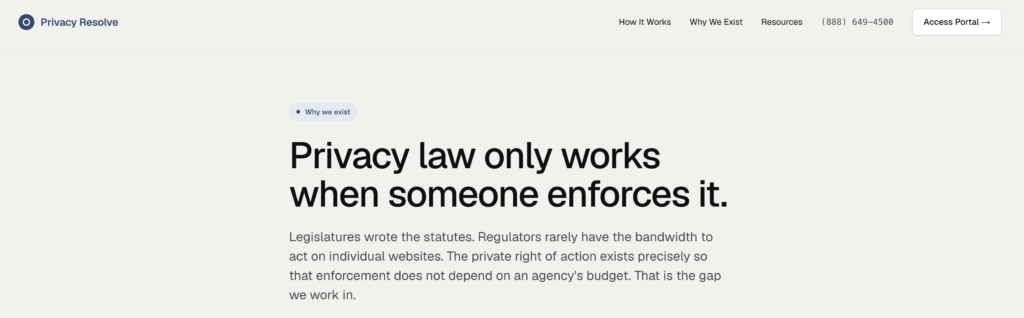
For background on how the Privacy Resolve platform describes itself, see our earlier analysis, PrivacyResolve.com and the industrialization of website privacy claims. We are known for breaking the news about privacy litigants and helping business owners secure their websites to help invalidate claims like the ones described below from Mario.
What kind of letter is this?
It is a pre-suit demand letter, a document sent before any case is filed that asserts a violation and proposes a settlement. Our broader guide, prelitigation demand for privacy rights violations, explains the category. A demand letter is not a finding of wrongdoing, a court order, or a filed complaint. It is one party’s account of events and one party’s legal theory.
The Mario Costanz wiretap claim, in plain English
The headline allegation is a violation of the federal Wiretap Act, 18 U.S.C. Section 2510 and following, which is part of the Electronic Communications Privacy Act. This is why people search for Mario Costanz wiretap. The theory in the letter runs as follows:
- The sender visited the Recipient’s website on October 12, 2026 and opened several pages about mental health conditions, plus a registration page and a contact page.
- During that visit, the Recipient’s pages allegedly sent data to Google through Google Analytics, Google Tag Manager and Google Ads.
- The letter says the page addresses sent to Google, which name the condition page being read, are the intercepted communication.
- The letter argues the one-party consent exception does not protect the Recipient because Google is a third party, and it points to the fact that the transmissions are alleged to have occurred before any consent was given.
The letter counts specific requests: 38 requests to Google carrying the full address of an interior page, 124 Google Ads requests, 35 Google Analytics requests carrying the same client identifier, and 31 measurement hits routed through a path on the Recipient’s own domain. It also references a cryptographic hash of a preserved session record and lists six exhibits, labeled A through F, covering consent state, the network log, scripts, session context, payloads and custody metadata.
The form field allegation
One part of the letter deserves special attention from anyone running a healthcare, wellness or intake website. The letter says the sender typed an email address and a question into the contact and registration forms but never submitted either form, and that tracking requests were sent after text entry began. This is the kind of allegation that makes form handling and tag configuration on pages with input fields a priority, because many businesses assume nothing leaves the browser until someone clicks submit.
What the letter demands, and the deadlines
The letter demands payment of $50,000 by 5:00 p.m. Eastern on October 20, 2026, seven calendar days after the date of the letter. It asks the Recipient to confirm receipt with a one line email by October 16, 2026. It describes the offer as a good faith settlement communication under Federal Rule of Evidence 408 and says that if the matter settles, the sender will release his individual claims through a written agreement with confidentiality provisions.
It is worth reading the numbers side by side. The letter itself states that the statutory award it relies on is $10,000. The demand is five times that amount. The letter bridges the gap by pointing to punitive damages, attorney fees and costs under the same statute, and the expected cost of defending a contested proceeding. Whether those additional categories would be available in any particular case is a question for counsel, but the structure shows how the figure is built: the price of settling is framed against the cost of fighting, not just against the statutory minimum.
The deadlines in a letter like this are set by the sender. They are not set by a court or by a statute. That does not mean a business should ignore them, but it does mean they are a negotiating tool, not a legal clock, and counsel can decide how to handle them.
Arbitration, not a lawsuit: Mario Costanz lawsuits explained
Many people searching for Mario Costanz lawsuits want to know whether cases have been filed. The letter we reviewed does not describe any filed case. Instead, it says the sender has read the dispute resolution section of the Recipient’s Terms of Use, which provides for binding arbitration before the American Arbitration Association, and that he is prepared to commence arbitration on three counts: the Wiretap Act, negligence pleaded in the alternative, and unjust enrichment pleaded in the alternative.
We are not asserting that any lawsuit or arbitration exists. If you need to confirm whether a case has been filed against your company, your counsel can search federal and state court dockets. Keep in mind that arbitration filings are generally not public in the way court dockets are, so the absence of a public docket entry does not tell you whether a demand has been made.
The arbitration framing is also strategically interesting. A sender who invokes a company’s own arbitration clause is choosing a forum in which the business typically bears significant administrative costs once a demand is filed. Whether the clause is enforceable against a website visitor, and whether it covers a statutory claim like this one, are issues a lawyer should evaluate before anyone concedes the point.
The authorities the letter cites
The letter relies on a mix of regulatory orders, court decisions and settlements, including the FTC matter involving BetterHelp, the Cooper v. Mount Sinai Health System decision in the Southern District of New York, the Ninth Circuit’s In re Facebook Internet Tracking Litigation decision, and a series of healthcare pixel settlements. These are the sender’s characterizations of those matters. Several are consent orders or settlements in which no liability was admitted, and several come from different courts applying different laws. A business responding to a letter like this should have counsel read each authority on its own terms rather than accept the letter’s summary of it.
What the letter does not establish
Reading closely, a few features stand out, and they are the sort of thing counsel and a technical reviewer will look at as these ECPA privacy laws around website tracking were not originally written with these type of wiretapping claims:
- On the first party routing path, the letter acknowledges that the sender’s browser record ends at the Recipient’s own server. It states a belief that the Recipient’s server forwards those measurements to Google, and it asks the Recipient to confirm or deny. The claim at that point rests on inference, not on a captured transmission.
- The letter says no successful refusal is established by the session record. That is different from alleging that a visitor clicked a reject control and tracking continued anyway.
- The letter itself notes that a tag manager container shows how a site is configured, not what it sent, and that only a request log proves a transmission.
- The letter states that the preserved record does not establish when any terms or privacy notice first appeared relative to the requests.
None of this means a claim is weak. It means the strength of any claim depends on evidence that your own team and counsel can test.
Mario Costanz Privacy Resolve Reddit reviews
People often turn to forums and review threads after receiving a letter like this. We did not rely on any of that for this article. Anonymous posts are anecdotal, they cannot be verified, and the outcome of someone else’s letter says little about yours. If you read discussion threads, treat them as a source of questions to ask your attorney, not as evidence of how your matter will end. Anonymous posters try to drive users to their privacy reddit threads and others called him a scammer and asked Redditors to not engage with him.
What to do if you receive a Privacy Resolve or similar demand letter
- Do not ignore it, and do not answer it yourself. Send the full letter and every attachment to privacy counsel and tell them about any stated dates.
- Preserve evidence before changing anything. The letter includes a litigation hold. Export your tag manager container history and publish log, consent platform logs, analytics and advertising account configuration, vendor agreements, and every version of your privacy policy and cookie notice. Then work with counsel on remediation timing.
- Check your insurance. Some cyber and privacy liability policies require prompt notice of a claim or a demand. Late notice can create coverage problems.
- Be careful with any online portal. The letter describes an optional resolution portal and says using it is not an admission. Have counsel decide whether and how to use it, because you may be sharing information or terms in a channel you do not control.
- Verify the claim technically. Have someone reproduce the session: which tags loaded, in what order, before or after consent, on which pages, and what data each request carried.
- Review your terms. Have counsel read your dispute resolution clause and how it is presented to visitors.
How to reduce the conditions these letters rely on
Whatever happens with a particular letter, the underlying exposure is usually a technical one. A few practices make a website a harder target:
- Gate non-essential tags behind consent. Analytics and advertising tags should not fire until a visitor has opted in where consent is required, and a rejection should actually stop them.
- Treat health pages as sensitive. Pages that describe conditions, treatments or intake should not feed advertising audiences. Review whether remarketing and conversion tags belong on those pages at all.
- Review form handling. Confirm that analytics and session tools do not capture keystrokes or field values before submission.
- Configure Google settings deliberately. Consent mode, ad personalization signals and server side or first party routing should be set on purpose and documented.
- Honor browser signals. Support Global Privacy Control where applicable and keep logs of what was set before and after each visitor choice.
- Keep your disclosures accurate. Your privacy policy, vendor list and cookie notice should match what your site actually does.
- Monitor continuously. Marketing teams add tags all the time. A scan that was clean last quarter may not be clean today.
This is the work Captain Compliance does every day. Our consent management platform handles cookie consent, Global Privacy Control signals and consent logging, and our Patrol monitoring tool continuously scans your site so you can see what your pages are sending before a letter arrives. If you would like to see what a scan of your own website shows, we are happy to run one.
Frequently asked questions
Who is Mario Costanz and what is Privacy Resolve?
On the letter we reviewed, Mario Costanz is the named sender, signing with PrivacyResolve.com, contact@privacyresolve.com and a toll free number. Privacy Resolve describes itself as a technology platform for documenting and resolving website privacy claims. We are describing what the document says, not vouching for it.
Is a Mario Costanz demand letter a lawsuit?
No. While he is referencing real privacy laws around website tracking issues. The letter we reviewed is a pre-suit demand. It threatens arbitration under the recipient’s terms but does not describe a filed case. If you ignore it he may file a privacy lawsuit or file for an arbitration hearing. We can not provide legal advice on what will happen next as with all things legal it depends..
What is the Mario Costanz wiretap claim about?
Typically the privacy violation alleges that Google Analytics and Google Ads tags on a website transmitted page addresses and related data to Google without consent, in violation of the federal Wiretap Act.
Why does the letter come from 14 Harwood Ct Scarsdale, NY?
The letterhead lists a return address of 14 Harwood Ct, Suite 415 #1058, Scarsdale, NY 10583. The letter separately lists the location of the website visit as New Rochelle, NY.
How much does the letter demand?
The letter we reviewed demanded $50,000 within seven days, while stating that the statutory damages figure it relies on is $10,000.
Should I pay?
That is a decision for you and your attorney. Paying, negotiating, and contesting each carry different costs and risks, and the right answer depends on your facts, your consent setup, your insurance and your terms.
Should I respond to the sender directly?
Not before talking to counsel. Anything you write can be used later. We also recommend you do a complementary privacy audit from our team
Put this into practice
Turn privacy guidance into working controls.
Captain Compliance helps teams discover tracking technologies, enforce consent, manage privacy requests and document the evidence behind every decision.