Know what’s on your site before a plaintiff’s firm does
A free privacy audit shows which cookies, pixels and trackers are running — and which ones commonly appear in privacy claims.
For years, privacy class-action litigation has concentrated on websites. Plaintiffs have challenged advertising pixels, session replay software, chat applications, cookies and other technologies under statutes such as the California Invasion of Privacy Act (CIPA), the federal Electronic Communications Privacy Act (ECPA) and the Video Privacy Protection Act (VPPA).
Now plaintiffs are testing a different target: customer information collected inside physical retail stores and subsequently monetized through advertising networks, data brokers and other third-party relationships.
The legal theory comes from Virginia’s Personal Information Privacy Act (VPIPA), a statute enacted in 1992 that received relatively little litigation attention for more than three decades.
That changed in 2026, when class-action complaints against Best Buy and Home Depot alleged violations of Virginia Code § 59.1-442 involving the sale of information collected from retail customers.
The allegations center on a business model that has become increasingly valuable to major retailers: collecting first-party customer information, matching it with outside datasets and using it to sell targeted advertising opportunities to brands.
VPIPA contains a private right of action, authorizes $100 in statutory damages per violation and permits prevailing plaintiffs to recover reasonable attorneys’ fees and court costs. Those provisions offer plaintiffs’ attorneys an incentive to investigate practices that previously received less scrutiny than website tracking.
The lawsuits remain allegations, and significant questions about the statute’s scope, the meaning of a sale, adequate notice, available defenses and class certification remain unresolved.
But retailers should not assume their existing website privacy programs address these claims. A business might have a functioning cookie consent banner, an updated privacy policy and a process for handling consumer data requests while still facing questions about information collected at checkout and later used for advertising.
The next privacy lawsuit may begin not with a tracking pixel, but with a purchase at a cash register.
What Is Virginia’s Personal Information Privacy Act?
Virginia’s Personal Information Privacy Act is codified at Virginia Code §§ 59.1-442 through 59.1-444.
The central provision, § 59.1-442(A), restricts the sale of certain purchaser information collected in connection with transactions involving tangible personal property at a merchant’s physical place of business.
The statute states:
“No merchant, without giving notice to the purchaser, shall sell to any third person information that concerns the purchaser and that is gathered in connection with the sale, rental, or exchange of tangible personal property to the purchaser at the merchant’s place of business.”
It also specifies that notice may be provided through a posted sign or another reasonable method.
The statute contains an additional restriction that deserves equal attention: if a purchaser requests that the merchant not sell the covered information, the merchant must honor that request.
Finally, the provision prohibits the sale of information gathered solely as a result of certain payment-related activities, including customer payments by personal check or credit card and specified recording of driver’s license information.
These are distinct requirements. Providing notice is not necessarily enough when a purchaser has objected to a sale, and the statute’s payment-information restriction cannot be disregarded merely because a business posts a disclosure.
Section 59.1-442(B) defines a merchant as a person or entity engaged in selling goods from a fixed retail location in Virginia.
That definition matters because VPIPA is narrower than a comprehensive consumer privacy law. Its central sales restriction concerns qualifying in-person transactions at physical Virginia retail locations, rather than every collection or disclosure of information by every company operating in the state.
The law’s wording also raises questions about modern business arrangements that were uncommon when the statute was enacted: customer identity graphs, retail media networks, data clean rooms, loyalty programs and cross-device advertising systems.
Why VPIPA Is Attracting Privacy Class-Action Attorneys in 2026
Privacy litigation increasingly involves statutes enacted long before today’s advertising infrastructure existed.
California’s wiretapping laws have been applied to allegations involving website communications. The federal Video Privacy Protection Act, originally associated with video rental histories, has been invoked in disputes involving video content and online tracking technologies.
Virginia’s VPIPA presents another opportunity for plaintiffs to argue that older statutory language reaches contemporary data practices.
The attraction is straightforward: the law expressly addresses the sale of purchaser information, authorizes statutory damages and provides a private enforcement mechanism.
Unlike statutes that require proof of a financial loss, VPIPA expressly fixes damages at $100 per violation. Whether a particular plaintiff has established a statutory violation, Article III standing in federal court or entitlement to a particular remedy remains a separate question.
The size of the potential class matters more than the relatively modest individual damages figure.
For illustration, if a court found 10,000 independently compensable violations, the statutory damages calculation would be $1 million. At 100,000 violations, the calculation would reach $10 million.
Those figures are mathematical illustrations, not predictions of exposure. Plaintiffs must still establish the statutory elements, the appropriate unit of violation, any jurisdictional requirements and entitlement to relief. Class certification and other procedural restrictions can substantially affect a case.
VPIPA also contains an unusual venue provision. Under § 59.1-444, actions must be brought in the general district court for the city or county where the transaction or violation occurred.
That provision creates a potentially significant obstacle for plaintiffs attempting to pursue broad class actions in other courts. Questions about its effect on federal jurisdiction, removal, venue and class proceedings could become important early litigation issues.
The broader warning is not that every retailer faces automatic multimillion-dollar liability. It is that a relatively obscure state statute has become a vehicle for challenging the economics of modern retail advertising.
Best Buy Faces a VPIPA Class Action Over Its Retail Media Network
One of the first prominent 2026 complaints was Moon v. Best Buy Co., Inc., initially filed in Minnesota state court on March 27, 2026, and subsequently reflected in federal proceedings following an April 27 removal.
The plaintiff alleged that Best Buy collected customer information from its retail operations and monetized that information without adequate notice under VPIPA.
According to the filed complaint, the allegations concern Best Buy Ads, the retailer’s advertising business, and its asserted use of LiveRamp data-clean-room technology.
The complaint identifies several categories of allegedly shared information, including customer names, email addresses, postal addresses, telephone numbers and purchase histories.
The plaintiff alleged that this information was combined or matched with other data to develop enhanced customer profiles that could improve advertising targeting and generate revenue.
In the plaintiff’s theory, Best Buy’s ability to offer advertisers access to more valuable audience information constitutes a commercial exploitation of customer data that triggers VPIPA’s notice requirements.
The complaint also advances an unjust-enrichment claim.
These allegations should not be confused with judicial findings. The filing does not establish that identifiable purchaser records were unlawfully sold, that the relevant data was covered by the Virginia statute or that the retailer failed to provide legally sufficient notice.
Several factual questions are particularly important.
- Was the information collected in connection with qualifying purchases at physical retail locations in Virginia?
- What information, if any, was actually made available to third parties?
- Did advertisers purchase customer information, advertising services, aggregated measurement results or some combination of these?
- What notices were provided to Virginia purchasers, and when?
- Did any purchaser request that the information not be sold?
The answers could substantially affect whether the complaint states a viable VPIPA claim.
Nevertheless, the case illustrates how plaintiffs can connect familiar retail marketing practices to a statute that was enacted decades before retail media networks became a major advertising business.
Home Depot Is Also Targeted Over Customer Data and Orange Apron Media
A second significant lawsuit, Wright v. The Home Depot, Inc., No. 2:26-cv-00683, was filed July 1, 2026, in the U.S. District Court for the Eastern District of Virginia.
The plaintiff, William E. Wright, alleged that Home Depot sold information collected from retail customers without the notice required by VPIPA.
According to the complaint as described in coverage of the lawsuit, the claims focus on Orange Apron Media, Home Depot’s retail advertising business, and alleged use of LiveRamp technology to support customer targeting.
The plaintiff contends that information associated with retail purchases was used to create or enrich customer profiles made commercially valuable to advertising partners.
The complaint alleges that these arrangements amounted to sales of purchaser information without adequate notice, in violation of Virginia law.
As with the Best Buy litigation, allegations about the operation of a retail media network do not by themselves establish an unlawful sale.
Advertising platforms can operate through materially different arrangements. Some provide brands with aggregated audience insights. Others conduct matching operations, support customer-level activation or permit transfers of information between independent businesses.
Whether a particular arrangement satisfies VPIPA’s statutory language requires examining what data moves, which entities receive it, the contractual rights associated with it and what compensation or commercial benefit is exchanged.
The court’s publicly indexed docket confirms the July 2026 filing. The publicly accessible docket information reviewed for this article did not establish a final merits ruling on the VPIPA allegations.
The presence of both Best Buy and Home Depot litigation is noteworthy because the complaints target the broader commercial practice of monetizing retail transaction data, not simply a defective online privacy disclosure.
Retail Media Networks Are the New Focus of In-Store Privacy Litigation
Retail media networks allow merchants to sell advertising opportunities to brands seeking to reach consumers based on shopping activity.
A grocery chain might help a food manufacturer reach customers who regularly purchase competing products. A home improvement retailer might offer advertising targeted at shoppers who purchased paint, flooring or construction supplies. An electronics retailer might help manufacturers reach customers based on past device purchases.
Retailers often possess information that advertisers cannot easily obtain elsewhere: actual transaction histories.
A customer who purchases a product at a physical store may provide an email address for an electronic receipt, use a loyalty account, supply a telephone number or pay with a method that permits the retailer to associate the transaction with an existing customer record.
The retailer can potentially connect this transaction to online browsing activity, previous purchases, customer-service interactions or advertising identifiers.
The resulting information can support audience targeting, measurement of advertising performance, product recommendations and commercial relationships with third-party brands.
Not all these practices constitute a sale under VPIPA. Nor does every disclosure of information to a service provider necessarily involve a sale to a third person within the meaning of the statute.
But companies should avoid assuming that a transaction falls outside the statute merely because the business labels the arrangement advertising, analytics or data collaboration rather than data sales.
Why data clean rooms deserve particular attention
A data clean room is a technology environment used to compare, combine or analyze datasets subject to configured access and disclosure restrictions.
Companies sometimes use clean rooms to match customer records without providing every participant unrestricted access to raw personal information.
Those safeguards can be meaningful, but their effectiveness depends on implementation.
In November 2024, the Federal Trade Commission published Data Clean Rooms: Separating Fact from Fiction, warning that clean-room technology does not inherently prevent unlawful disclosures.
The FTC explained that some clean rooms can reduce privacy risks, while others can enable more extensive data matching, identification and sharing.
For VPIPA purposes, the technology’s name is less important than its actual operation.
A retailer should know whether identifiable or pseudonymous purchaser records are transferred, what data the recipient can access, whether outputs are attributable to particular consumers and how the arrangement generates revenue.
Pseudonymization also should not automatically be equated with anonymization. A customer identifier may remain capable of being connected to an individual through additional information.
Importantly, VPIPA does not contain the same comprehensive definitions of personal data, sale or deidentified information found in many modern privacy statutes. Whether pseudonymized records or clean-room outputs fall within its restrictions may therefore depend on statutory interpretation and the particular facts.
Does VPIPA Require a Cookie Consent Banner?
No. VPIPA does not expressly require a cookie consent banner, and a standard website banner does not automatically satisfy its notice requirements.
Under § 59.1-442(A), the relevant question is whether the merchant gave notice to the purchaser before selling covered information collected in connection with a qualifying in-store transaction.
The statute expressly allows notice by posting a sign or using another reasonable method.
That language is different from privacy laws that require particular online disclosures, affirmative consent mechanisms or technical controls for website tracking.
A cookie banner generally addresses technologies operating during a website visit. It might describe advertising cookies, analytics software, tracking pixels and choices available to the user.
But a customer who enters a Virginia store, purchases merchandise and never visits the retailer’s website may never encounter that banner.
Even a customer who previously visited the website may not have received notice specifically addressing the subsequent sale of information collected during an in-store purchase.
Businesses should therefore treat a website cookie notice and a VPIPA retail notice as separate compliance questions.
Can an online privacy notice ever provide adequate VPIPA notice?
Possibly. The statute permits notice through any reasonable method, which leaves room for arguments that electronic disclosures can satisfy the requirement in appropriate circumstances.
For example, a merchant might provide a clear disclosure through a loyalty application, checkout interface, electronic receipt process or other customer-facing mechanism used in connection with the purchase.
But adequacy may turn on whether the notice was actually presented in a manner reasonably calculated to inform purchasers before the covered sale.
A general privacy policy buried behind a website footer link could be more difficult to defend, particularly when the consumer completed the transaction without any meaningful interaction with that website.
No generally applicable judicial rule identified in the 2026 materials reviewed establishes that a conventional cookie banner, by itself, satisfies VPIPA.
Nor does the statute expressly prescribe a particular font size, disclosure format or mandatory sign wording.
The safer compliance approach is to evaluate actual retail customer touchpoints rather than assume that online transparency automatically extends to physical transactions.
Does the law require opt-in consent?
Not categorically under § 59.1-442(A).
The statute establishes a notice requirement for covered sales and separately prohibits a merchant from selling covered information after the purchaser requests that it not do so.
That is not the same as a universal affirmative-consent requirement.
Other laws may impose additional consent, notice or opt-out obligations depending on the information involved and the intended use.
For example, European cookie and tracking rules, U.S. state privacy statutes and sector-specific laws may apply independently.
A merchant must analyze those obligations separately rather than assume that compliance with one statute satisfies all others.
What Actually Counts as Selling Customer Information?
The meaning of a sale could become one of the most contested issues in VPIPA litigation.
Unlike Virginia’s modern Consumer Data Protection Act, VPIPA does not supply an elaborate statutory definition of sale for § 59.1-442.
That leaves litigants to dispute whether particular commercial arrangements fall within the ordinary meaning of selling information to a third person.
Consider three different arrangements.
In the first, a retailer transfers a file containing customer names, addresses and transaction histories to an independent data broker in exchange for payment. That is a comparatively straightforward factual scenario for a plaintiff arguing that purchaser information was sold.
In the second, a retailer uses a technology vendor to process customer information solely on the retailer’s behalf, subject to contractual restrictions. The retailer might argue that it purchased processing services rather than sold information.
In the third, a retailer charges advertisers to reach selected customer audiences through a data clean room, while the advertisers receive limited reports or targeting capabilities rather than downloadable customer records.
The third scenario presents more difficult questions. Plaintiffs may argue that the commercial availability of customer-level information amounts to a sale. Defendants may respond that the transaction involves advertising services, not a transfer of purchaser information.
The outcome could depend on the exact data flows, access rights, contracts and relevant judicial interpretation.
Courts also may need to address whether a third-party technology provider operating under strict contractual restrictions is a third person for purposes of the statute and whether indirect financial arrangements constitute a sale.
Retailers should document these distinctions before litigation rather than reconstruct them after receiving a complaint.
VPIPA Contains a Restriction on Payment-Derived Information
One potentially overlooked part of § 59.1-442(A) concerns information gathered solely through certain payment-related activities.
The law separately prohibits merchants from selling information gathered solely as a result of payments by personal check or credit card, or specified recording of driver’s license information.
This language is significant because it is not merely another notice requirement.
A merchant cannot assume that providing a general sign or privacy disclosure authorizes a transaction that the statute otherwise prohibits.
However, the word “solely” matters. If a retailer obtained a customer’s name or contact details independently through a loyalty program, account registration or another interaction, determining the statutory treatment of that information may require examining its source and how it was collected.
Businesses should also consider § 59.1-443.3, which regulates scanning information from driver’s licenses and comparable identification documents.
That provision restricts permissible scanning purposes, limits retention in specified circumstances and prohibits selling or disseminating scanned information for marketing, advertising or promotional purposes, subject to its statutory provisions.
These restrictions may affect retailers that scan identification for returns, age verification, fraud prevention or account verification.
They should not be collapsed into a single generic requirement to publish a privacy policy.
VPIPA Versus Virginia’s Consumer Data Protection Act
Virginia now has two substantially different privacy frameworks relevant to retail operations.
The Virginia Consumer Data Protection Act (VCDPA), which took effect in 2023, provides comprehensive consumer data rights and obligations for covered businesses.
Among other things, it regulates qualifying processing of personal data and establishes rights relating to access, deletion and certain opt-outs.
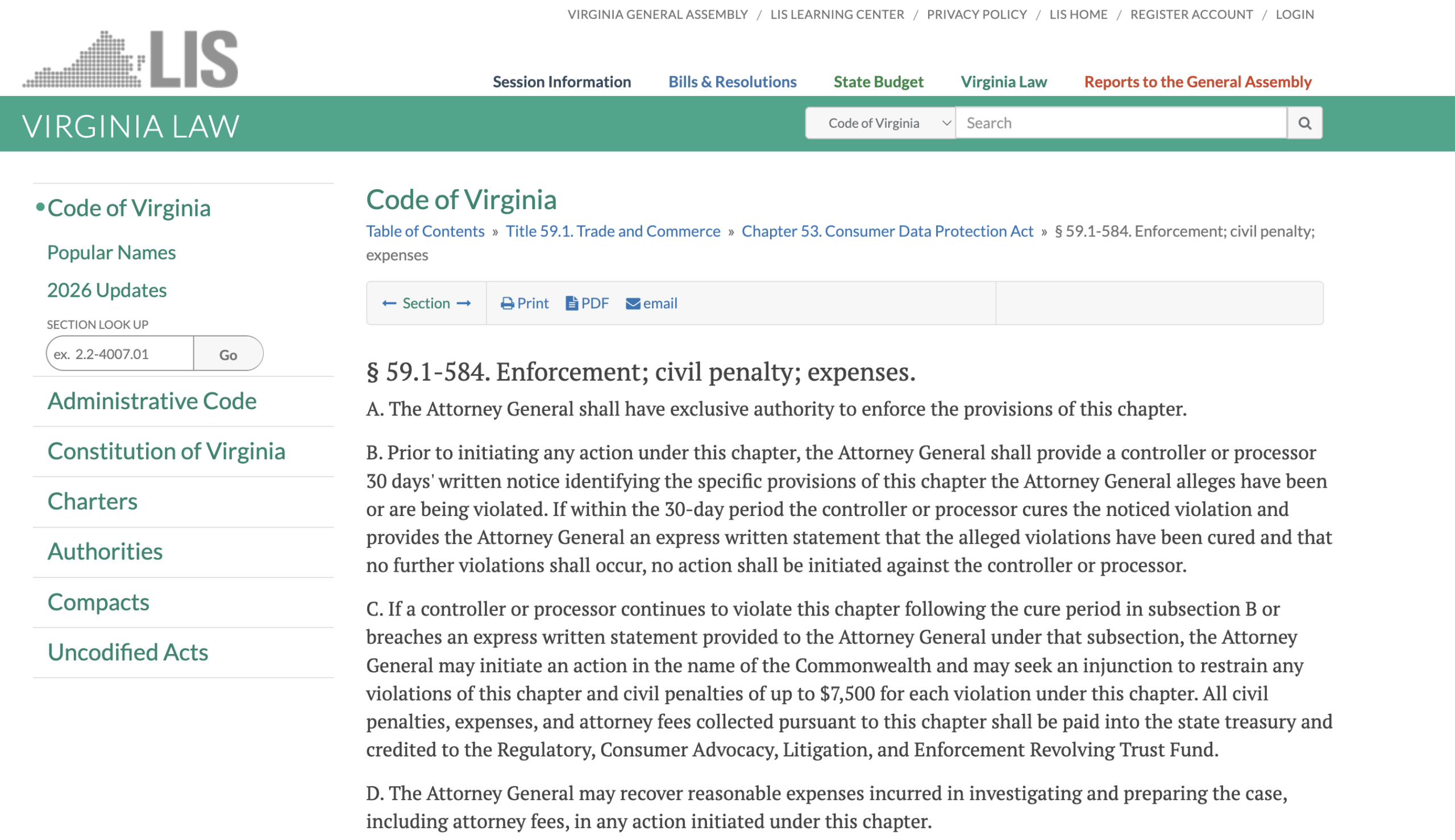
The VCDPA generally gives enforcement authority to the Virginia attorney general rather than authorizing consumers to sue directly for violations of that chapter.
That limitation appears in § 59.1-584.
VPIPA is different.
It applies to particular merchant conduct involving retail purchaser information and includes its own private damages provision.
The distinction matters because a retailer’s compliance with the VCDPA does not automatically resolve claims under VPIPA.
The two statutes use different operative language, address different circumstances and provide different enforcement mechanisms.
Likewise, a business that falls outside the VCDPA’s general applicability thresholds should not assume that it is exempt from VPIPA.
A physical retailer can fall within VPIPA’s merchant definition without necessarily satisfying the thresholds that govern the comprehensive VCDPA.
There may also be overlap between consumer rights and operational controls. For example, a centralized privacy request system may help process purchaser objections under VPIPA, but the retailer must configure the relevant business rules so that an objection actually prevents a covered sale.
Potential Legal Defenses in VPIPA Lawsuits
The 2026 complaints do not establish that plaintiffs will prevail. Retailers facing VPIPA allegations may have substantial statutory, factual and procedural defenses.
1. The challenged conduct was not a sale
A defendant may argue that an advertising relationship involved providing services, aggregated reports or restricted processing rather than selling purchaser information to a third person.
This defense requires more than labeling the transaction a service agreement. The actual operation of the system will matter.
2. The information was not collected in a qualifying transaction
Section 59.1-442 focuses on information gathered in connection with the sale, rental or exchange of tangible personal property at a merchant’s place of business.
A company may dispute whether particular records originated from such a transaction.
For example, data collected exclusively through a separate online interaction may raise different statutory questions than information collected during an in-store purchase.
3. The merchant provided reasonable notice
VPIPA expressly permits notice through a sign or another reasonable method.
A retailer may have provided disclosures through signage, checkout materials, customer accounts, receipts or other mechanisms.
Contemporaneous documentation can help establish exactly what was disclosed and how customers encountered it.
A merchant should preserve versions of notices, deployment dates, store procedures and relevant evidence of consumer-facing disclosures.
4. A statutory exception applies
Section 59.1-443 establishes several exceptions, including provisions addressing information gathered for extending credit, certain receivables transactions, specified check-validation activity and information transferred in connection with the sale of retail operations.
The exceptions are specific and should not be treated as broad exemptions for ordinary advertising data sales.
5. Procedural defects limit the claims
The statute’s express general district court venue language may become particularly important.
Defendants may challenge whether the plaintiff filed in the proper forum, whether the chosen court has jurisdiction and whether the litigation can proceed as a proposed class action.
Federal constitutional standing, the appropriateness of class treatment and the definition of a compensable violation may also be disputed.
A request for attorneys’ fees does not eliminate these requirements.
6. The plaintiff cannot establish the alleged data transaction
Assertions that a retailer operates a retail media network or uses a data clean room do not necessarily establish that it sold a particular purchaser’s covered information.
Technical records, vendor agreements, data dictionaries, access permissions and commercial terms may show that the asserted information transfer did not occur as alleged.
For companies already facing privacy demand letters, evidence preservation should begin as soon as a potential dispute becomes reasonably foreseeable.
What Businesses Should Do Before Receiving a VPIPA Demand Letter
Retailers with locations in Virginia should conduct a targeted review of how in-store customer information enters their marketing and data-sharing infrastructure.
Map the information collected at physical checkout
Identify whether stores collect names, email addresses, telephone numbers, loyalty identifiers, transaction histories, payment-related information, returns data and identification-document information.
Record why each category is collected and which systems receive it.
It is especially important to distinguish information obtained directly from the purchase from data previously collected through unrelated interactions.
Review retail media and data broker agreements
Identify every third party that receives or accesses purchaser information.
This may include advertising networks, data brokers, identity-resolution providers, analytics vendors, customer data platforms and clean-room operators.
Review whether contracts permit the recipient to retain, reuse, combine, disclose or independently monetize customer information.
Determine whether compensation is connected to access to or transfer of the data.
Examine actual data flows
Contracts and privacy policies alone may not describe the technical operation of an advertising system.
Privacy and engineering teams should determine whether raw customer records, hashed identifiers, pseudonymous IDs, matched audiences or aggregate reports move between participating organizations.
They should also evaluate whether recipients can identify particular customers through matching or other available information.
Evaluate in-store notice
Determine what Virginia purchasers encounter before information is sold.
Relevant touchpoints may include signs near checkout, point-of-sale screens, loyalty enrollment interfaces, receipts and customer applications.
Assess whether the notice accurately describes the practices at issue and whether the method of communicating that notice is reasonable under the statute.
Create a workable no-sale process
Section 59.1-442 expressly requires merchants to respect a purchaser’s request not to sell covered information.
Businesses should have a process to receive such requests, associate them with the appropriate customer records and communicate the restriction to relevant downstream systems.
A request logged in a customer-service ticket does little good if the customer remains eligible for subsequent data monetization.
Test the entire privacy program
Review online tracking as well as offline customer-data practices.
Retailers that connect website activity with in-store transactions may need both an effective consent management platform and controls covering customer information collected through retail operations.
As Captain Compliance has explained in its analysis of consent gating failures and privacy litigation, publishing a consent interface is not equivalent to verifying that the underlying technologies honor user choices.
That same operational principle applies to retail data governance: disclosures, customer choices and actual data transfers must be consistent.
Could VPIPA Become the Next CIPA or VPPA?
The analogy is tempting, but there are important differences.
CIPA litigation has generated extensive disputes involving website technologies, including alleged interception of communications and use of tracking tools.
VPPA litigation has focused on whether particular disclosures of video-viewing information fall within the federal statute.
VPIPA targets a narrower category of conduct involving purchaser information associated with transactions at physical retail locations in Virginia.
Its $100 damages provision is lower than the statutory recovery provisions associated with some other privacy claims. Its venue language and lack of extensive reported precedent may also restrict or complicate class-action litigation.
Nevertheless, the economic incentives are recognizable.
A plaintiff’s attorney can investigate a business model, identify a potentially applicable statutory provision and allege that a large group of customers experienced substantially similar conduct.
For the retailer, defending the case may require technical discovery into advertising relationships, customer databases, commercial agreements and notice practices.
That process can be expensive even when the company has strong defenses.
It also creates reputational concerns because allegations about selling customer information can attract attention before a court determines whether any unlawful conduct occurred.
The comparison with CIPA is therefore best understood as a litigation-risk warning rather than a prediction that VPIPA will necessarily produce the same volume of lawsuits.
The statute’s future will depend on whether plaintiffs can establish covered sales, overcome procedural objections and obtain favorable judicial interpretations.
What Attorneys Should Examine When Defending a VPIPA Claim
Attorneys representing retailers should approach VPIPA claims as both statutory interpretation disputes and technical data-flow investigations.
An initial assessment should identify the precise transaction relied upon by the plaintiff, the location where it occurred, the information allegedly collected and the third party that supposedly purchased it.
Counsel should then examine whether the defendant qualifies as a merchant under the statutory definition and whether the alleged information was gathered in connection with the transaction covered by the law.
Equally important is the distinction between selling information and providing advertising or processing services.
Discovery may require examining whether advertisers received identifiable customer records, restricted audience access or only aggregate outputs.
Notice evidence should be preserved early. A retailer that can demonstrate the content, placement and timing of a disclosure may have a materially different defense from one that cannot reconstruct historical notices.
Attorneys should also address the statute’s unusual venue provision before assuming that a conventional federal class-action framework applies.
Finally, counsel should separate allegations involving § 59.1-442’s notice and purchaser-objection requirements from claims potentially involving its payment-derived information restriction or the separate driver’s-license scanning provisions.
The operative facts and legal defenses may differ substantially.
The Next Privacy Compliance Problem May Start at the Checkout Counter
Businesses have invested heavily in online privacy compliance, but their physical retail operations often rely on different personnel, systems and data-handling procedures.
Marketing teams may operate retail media networks. Store operations may collect identifiers during checkout. Technology vendors may connect loyalty records with advertising datasets. Privacy teams may maintain disclosures that were written before those arrangements existed.
VPIPA litigation raises a basic question: can the retailer explain, document and legally justify what happens to purchaser information after an in-store transaction?
For some merchants, the answer may be straightforward. They provide appropriate notice, respect customer objections and maintain contractual and technical restrictions on downstream use.
Others may discover that their physical retail disclosures have not kept pace with their advertising businesses.
The 2026 lawsuits against Best Buy and Home Depot do not establish that either retailer violated Virginia law. They do establish that plaintiffs are attempting to use a decades-old retail privacy statute to challenge contemporary data monetization practices.
For businesses operating physical stores in Virginia, reviewing those practices now is more useful than assuming that a website cookie banner resolves the issue.
Captain Compliance helps businesses manage website consent, monitor tracking technologies, maintain privacy notices and administer data-rights requests. These capabilities can support a broader retail privacy program, although VPIPA compliance also requires reviewing in-store notices, commercial data arrangements and statutory restrictions that website software alone cannot resolve.
Retailers concerned about their exposure should coordinate with privacy counsel to assess whether their customer-data practices, notices and opt-out procedures satisfy the applicable requirements.
Put this into practice
Turn privacy guidance into working controls.
Captain Compliance helps teams discover tracking technologies, enforce consent, manage privacy requests and document the evidence behind every decision.