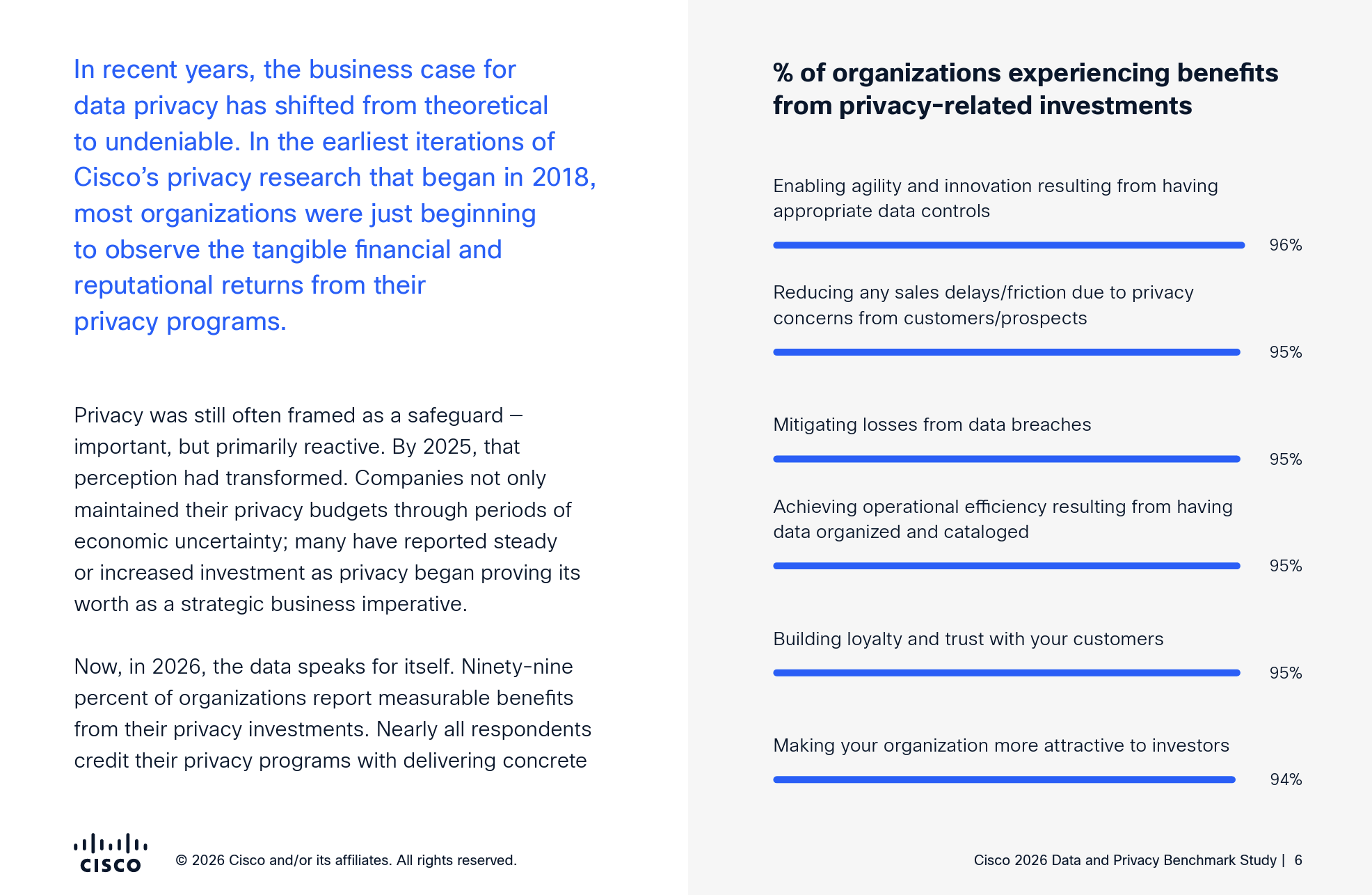
Businesses are spending more money on privacy than ever, but Cisco’s latest research suggests that investment is not always translating into effective control over personal information, artificial intelligence systems and third-party technology providers. The graph above shows that organizations are truly benefiting from privacy related investments. This is a good sign as privacy budgets increase alongside ai governance needs and cybersecurity risks continue to increase each year.
According to the Cisco 2026 Data and Privacy Benchmark Study, 90% of surveyed organizations have expanded their privacy programs because of artificial intelligence. Another 93% expect to allocate additional resources to privacy and data governance over the following two years.
Yet the same research exposes substantial operational weaknesses. Only 12% describe their AI governance committees as mature and proactive. Nearly two-thirds struggle to access relevant, high-quality data efficiently. And although 81% believe their generative AI vendors are transparent about data practices, just 55% require clear contractual provisions addressing data ownership, usage rights and related responsibilities.
These findings suggest that increased privacy spending and effective privacy governance are not necessarily the same thing.
A company can invest millions in compliance programs while continuing to operate advertising pixels that disclose unexpected personal information, retain customer data without a documented purpose or permit an AI vendor to process sensitive business records under insufficient contractual restrictions.
For privacy officers, legal teams and businesses adopting AI, Cisco’s research raises a practical question: How much of today’s privacy investment is actually changing the way information is collected, used, shared and protected?
Cisco’s 2026 Privacy Study Finds Spending Rising Faster Than Governance Maturity
Cisco released its ninth annual Data and Privacy Benchmark Study on January 26, 2026. The research was based on a double-blind survey conducted in September 2025 by Sandpiper Research & Insights.
The survey included more than 5,200 professionals with privacy responsibilities across 12 markets, including the United States, United Kingdom, Germany, France, Brazil, India, Japan and China.
Respondents worked across industries including financial services, healthcare, retail, manufacturing, education and technology.
Cisco reported several significant findings:
- 90% said AI had expanded the scope of their privacy programs.
- 43% increased privacy spending during the preceding year.
- 38% reported spending at least $5 million annually on privacy, compared with 14% in the preceding benchmark.
- 93% planned additional investment in at least one privacy or data governance area.
- 99% reported at least one tangible benefit from privacy initiatives.
- Only 12% described their AI governance committees as mature and proactive.
The spending figures require some context. Cisco’s survey measures self-reported organizational practices and perceptions, not independently audited compliance outcomes. The sample was also substantially larger than in earlier studies, which should be considered when comparing annual results.
Nevertheless, the overall pattern is clear: AI has expanded the responsibilities assigned to privacy teams, and companies are responding with larger budgets.
Whether those budgets produce stronger data protection depends on how the money is used.
AI Has Turned Privacy Into a Data Governance Problem
Traditional privacy programs often concentrate on regulatory requirements: maintaining privacy policies, managing consumer rights requests, documenting vendors, obtaining consent and preparing for audits.
Those responsibilities remain necessary, but AI introduces additional questions about information that a company has already collected.
Consider a business that collects customer service conversations, marketing leads, purchase histories and website behavior.
Before introducing AI, the company might use this information primarily for customer support, order fulfillment and marketing analytics.
Once AI tools are introduced, the same information might be used to train models, produce automated summaries, score prospective customers, personalize recommendations or support autonomous decisionmaking.
Each new use raises questions about purpose limitation, lawful processing, data minimization, transparency, retention, access controls and third-party sharing.
Information originally collected for one reason does not automatically become available for every subsequent AI application.
Under the European Union’s General Data Protection Regulation, organizations must assess applicable lawful bases and purpose compatibility. Certain secondary uses may require additional safeguards or consent.
California’s privacy framework also imposes obligations concerning disclosed purposes, consumer rights and limitations on certain uses of personal information.
AI governance therefore cannot operate independently of the organization’s existing privacy program. Before approving a new AI application, a business needs to understand where the underlying information originated, what individuals were told, what permissions apply and whether the new processing is legally permissible.
Cisco’s research suggests that many organizations are still building the infrastructure needed to answer those questions consistently.
Only 12% Have Mature AI Governance Committees
One of Cisco’s most revealing findings concerns the gap between formal governance structures and operational maturity.
Approximately three-quarters of surveyed organizations have dedicated AI governance committees. Yet only 12% describe those committees as mature and proactive.
Creating a committee is relatively straightforward. Giving it authority over AI procurement, data access, model deployment and ongoing monitoring is considerably more difficult.
Cisco found that governance committees remain heavily concentrated in technical functions.
IT and technology representatives participate in 57% of the committees surveyed, cybersecurity representatives in 42%, and legal, risk or compliance representatives in 35%.
Product and engineering functions have substantially lower representation.
This matters because privacy concerns frequently arise outside the security department.
A marketing team may introduce a new tracking pixel. A sales department may connect customer records to an AI enrichment platform. A product manager may deploy behavioral analytics. A customer service organization may send transcripts to an AI vendor.
Each decision can alter how personal information is processed, sometimes without requiring a traditional software development project.
An effective AI governance program therefore needs more than a periodic committee meeting. It needs a defined approval process, an inventory of AI use cases, clear accountability for data sources and mechanisms to identify changes after deployment.
Privacy impact assessments, data protection impact assessments and records of processing activities can help document those decisions.
But documentation must connect to actual technical controls. An assessment completed before deployment has limited value if the system later begins collecting new categories of data or transmitting information to additional providers.
65% Struggle to Access High-Quality Data: A Hidden Privacy Risk
Cisco found that 65% of organizations struggle to access relevant, high-quality data efficiently.
Although this appears primarily to be a data management problem, it also has direct consequences for privacy compliance.
Organizations cannot consistently govern information they cannot locate, classify or trace to its source.
For example, responding to a consumer’s deletion request requires identifying personal information across relevant systems, determining applicable exceptions and taking appropriate action.
If information has been copied into a marketing database, transferred to an analytics provider, incorporated into an AI dataset and retained in a support platform, the business needs sufficient visibility to determine the scope of its obligations.
A deletion workflow that addresses only the primary customer database may leave other relevant copies untouched.
The same visibility problem arises when evaluating AI training datasets.
Before using customer information to train or fine-tune a model, a business should be able to establish the source of the information, the applicable legal basis, relevant restrictions and retention requirements.
Without reliable data lineage, those determinations become difficult to verify.
Data Classification Remains Incomplete
Cisco reports that 66% of organizations have implemented a formal data tagging system, while 18% are developing one and 16% have not implemented one.
Among organizations with tagging systems, only about half describe them as comprehensive.
This leaves substantial room for sensitive or restricted information to move through systems without consistent classification.
A healthcare-related customer service transcript, for example, may contain information requiring different treatment from an ordinary product inquiry.
A financial record may include account information that should not be transferred to an external AI system without specific safeguards.
Data classification should help distinguish among ordinary business information, personal data, sensitive personal information, confidential commercial information and data subject to specific contractual restrictions.
The relevant classification should then influence who can access the information, which systems can process it and whether it can be used for model development.
Nearly One-Third of Organizations Use Unredacted Customer Data in Generative AI
One of the more consequential statistics appears in Cisco’s analysis of datasets used for generative AI.
The study found that 29% of organizations reported using unedited or unredacted customer data in developing or using generative AI.
Other data sources included system-generated information, anonymized or pseudonymized customer data, aggregated information, telemetry and synthetic datasets.
Using unredacted customer information is not necessarily unlawful. Its permissibility depends on the nature of the data, the processing purpose, applicable legal requirements and safeguards.
However, it creates a greater need for oversight because the datasets may contain personal identifiers, sensitive information, confidential communications or material subject to contractual restrictions.
Cisco also found that 70% of organizations recognize risks associated with using proprietary or customer data in AI training, while 77% consider intellectual property protection of AI datasets a major concern.
These findings deserve attention from companies deploying customer support AI, sales automation, recruitment tools, AI-powered analytics and document processing systems.
A business should know whether a provider receives raw customer data, whether the information is retained, whether model training is permitted and whether the provider can use the information for other customers.
It should also distinguish between ordinary inference processing and model training. Sending a prompt to produce a response does not necessarily mean that the prompt will be incorporated into a model’s training data, but the contractual and technical arrangements determine what is permitted.
Businesses should not assume that an AI vendor’s marketing description resolves these questions.
The AI Vendor Accountability Gap: 81% Report Transparency, but Only 55% Require Clear Contracts
Cisco’s findings reveal a notable difference between confidence in AI vendors and formal accountability.
According to the study, 81% of respondents believe their generative AI providers are transparent about how data is used. The same percentage say providers have clearly explained their systems.
Yet only 55% require clear contractual terms concerning data ownership, usage rights and intellectual property parameters when working with AI vendors.
That gap should concern privacy officers and legal teams.
A vendor can explain its privacy practices on a website while retaining substantial flexibility under its commercial agreement.
For example, a company may believe that information supplied to an AI provider will be used exclusively to perform contracted services. But the provider’s terms may permit broader retention, product improvement, subcontractor access or other secondary processing.
Whether those activities are lawful depends on the applicable circumstances, but customers should not rely on assumptions.
Vendor reviews should establish whether contractual terms address the purposes of processing, data ownership, subprocessors, retention, deletion, security incidents, audit rights and the use of customer data for AI training.
Applicable data processing agreements should also address controller-processor obligations where required.
Cisco reports that 79% of organizations believe generative AI providers are willing to negotiate contractual terms or configurations that limit how data is used.
That suggests businesses may have more practical options than simply accepting a vendor’s default settings.
Contractual protections should be matched with appropriate technical configuration. A prohibition on training use in a contract is important, but organizations should also verify any available settings that restrict retention, logging or secondary use.
Website Tracking Creates the Same Governance Problem as AI
Although Cisco’s report focuses heavily on artificial intelligence, the underlying issue extends to website tracking technologies.
Businesses frequently install advertising pixels, analytics scripts, chat widgets, session-replay software and marketing integrations without maintaining a complete inventory of the resulting data flows.
A website may disclose in its privacy policy that it uses analytics for performance measurement while transmitting detailed browsing events to advertising platforms.
A lead generation form may collect sensitive information that is inadvertently included in URLs, event properties or network requests.
A consent banner may display Reject All while certain scripts continue operating because they were not correctly connected to the consent management system.
These are not hypothetical categories of risk. Website tracking practices have generated litigation under the federal Wiretap Act, California’s Invasion of Privacy Act and the Video Privacy Protection Act, among other laws.
Liability depends on the particular statute, technology, information disclosed and circumstances. The presence of a pixel alone does not establish a violation.
But the technical governance principle is the same: a business needs to know what information its technology collects, where the information goes, and whether that activity matches its disclosures and applicable permissions.
An AI platform and an advertising pixel may have very different purposes, but both can introduce third-party processing that the business must understand and control.
Transparency Outranks Compliance as the Leading Driver of Customer Confidence
One of the most useful findings for companies maintaining privacy policies comes from Cisco’s analysis of customer trust.
When asked to identify the most effective action for building customer confidence in data handling, 46% of organizations selected clearly explaining what information is collected and how it is used.
Only 18% selected demonstrating compliance with relevant privacy laws. Another 14% chose avoiding data breaches.
These responses do not prove that transparency is objectively more important than security or legal compliance. They reflect what surveyed professionals believe is most effective for building customer confidence.
Still, the finding offers a useful lesson about the limitations of conventional privacy notices.
Privacy policies often rely on broad descriptions of data processing that provide limited practical information about what actually happens to a consumer’s information.
A company may state that it shares information with service providers for business purposes without clearly explaining whether customer support transcripts are processed by AI, whether advertising vendors receive browsing events or whether personal information is used to train models.
Legal requirements do not always demand naming every individual vendor. But businesses should examine whether their disclosures are sufficiently specific, understandable and consistent with actual practices.
Meaningful transparency also requires choices that work.
A privacy notice that explains opt-out rights is of limited practical value if the website continues prohibited data sharing after a consumer exercises those rights.
Similarly, an AI disclosure should not promise restricted use of customer information unless the business has verified the relevant vendor arrangements.
Privacy Spending Is Producing Benefits, but the Results Are Self-Reported
Cisco’s study presents an encouraging business case for privacy investment.
Nearly all surveyed organizations, 99%, reported at least one tangible benefit from their privacy initiatives.
More specifically, 96% reported benefits involving agility and innovation, while 95% reported improvements in customer trust and loyalty. The same percentage cited operational efficiencies from better data organization and management.
Privacy initiatives can also help businesses respond to customer due diligence, complete vendor security questionnaires and reduce friction during enterprise procurement.
However, these figures should not be presented as proof that privacy spending directly caused revenue growth or improved customer retention.
The study is based on survey responses, not a controlled causal analysis of financial performance.
Its findings are better understood as evidence that organizations increasingly associate privacy investment with operational and commercial benefits.
For management teams, the next question is how to measure the performance of specific privacy controls.
Useful indicators may include reductions in unauthorized tracking, the time required to complete data subject requests, the percentage of vendors with completed assessments, the proportion of systems included in data inventories and the number of processing activities with documented legal bases.
Those measurements are more actionable than a single annual privacy spending figure.
Global Data Privacy Is Becoming More Expensive as AI Crosses Borders
Cisco found that 85% of organizations believe data localization requirements increase the cost, complexity and risk associated with cross-border service delivery.
Another 81% reported heightened demand for localization resulting from generative and agentic AI.
For multinational businesses, AI systems can create complicated international data flows.
Customer information may originate in one jurisdiction, be stored in another, processed by a cloud provider elsewhere and accessed by a model or support team operating across several markets.
Different privacy laws impose different requirements concerning cross-border transfers, vendor safeguards, sensitive data and data localization.
For example, GDPR regulates transfers of personal data to third countries under Chapter V. Other jurisdictions maintain their own transfer mechanisms or sector-specific restrictions.
Localization does not automatically mean that data is more secure. Security depends on technical and organizational controls, access restrictions, infrastructure management and other factors.
Nor does every international transfer violate privacy law. Many jurisdictions provide lawful transfer mechanisms subject to specified conditions.
Businesses should map where information is stored and processed, identify relevant subprocessors and assess the legal requirements applicable to each transfer.
That process becomes more complex when AI vendors use distributed infrastructure or multiple subprocessors.
Cisco found that 83% of respondents believe more harmonized international data protection standards would reduce the need for country-specific localization requirements.
Until greater harmonization exists, organizations need practical controls that can accommodate different regional requirements without creating unnecessary duplication.
Agentic AI Introduces New Privacy Risks Beyond Traditional Chatbots
Cisco also examines the implications of agentic AI, meaning systems capable of performing multiple actions with varying degrees of autonomy rather than simply generating responses to individual prompts.
An AI assistant that summarizes a document presents one set of privacy risks.
An autonomous agent that can access customer records, query external databases, update accounts, send messages and initiate transactions introduces a wider range of potential consequences.
The system may need access to multiple datasets and applications. It may also disclose information to external services as part of completing a task.
This raises questions about data minimization, access permissions, approval procedures, logging, retention and accountability.
A company should not give an autonomous system unrestricted access to every customer record merely because doing so would make its tasks easier.
Instead, authorization should be limited to the information and actions necessary for the intended purpose.
Higher-risk activities may require human approval, escalation procedures or technical restrictions that prevent the agent from taking certain actions without authorization.
Cisco describes growing adoption of human validation, pre-action approvals, escalation thresholds and override mechanisms as organizations extend governance practices to agentic AI.
For privacy teams, this means assessments should cover not only what an AI model is designed to do but also what information the system can access and what actions its connected tools can perform.
What Businesses Should Change in Their Privacy Programs
The most useful response to Cisco’s findings is not necessarily a larger compliance budget. It is a clearer understanding of where an organization’s data is located, how it moves and what controls govern its use.
Establish a Complete Data Inventory
Organizations should maintain an inventory of systems that collect, store, process or disclose personal information.
That inventory should include website tracking technologies, internal databases, marketing platforms, customer service systems, AI applications and relevant third-party processors.
For each material processing activity, the business should identify the purpose, categories of data involved, recipients, retention periods and applicable legal requirements.
Review AI Use Cases Before Deployment
AI systems should be assessed before they begin processing customer information, particularly where sensitive data, automated decisions or external model providers are involved.
Depending on the circumstances, the assessment may require a DPIA, privacy impact assessment, vendor review, security evaluation or other documentation.
Businesses should also examine how material changes in the AI system will be reviewed after launch.
Verify Vendor Contracts and Data Use Restrictions
Organizations should determine whether AI and analytics vendors are permitted to retain data, use it for training, combine it with other information or disclose it to subprocessors.
Contractual obligations should be consistent with the technical settings and the organization’s privacy disclosures.
Test Consent and Consumer Rights Controls
Privacy choices must operate as described.
For websites, this means testing whether tracking technologies respond correctly when visitors accept, reject or change their consent preferences, and whether qualifying opt-out preference signals are honored.
For consumer rights programs, it means verifying that requests reach the relevant systems and are addressed according to applicable legal obligations.
Monitor Changes Continuously
Data processing environments change when new applications are installed, vendors update their scripts, marketing campaigns launch or AI features are added.
A one-time audit can identify existing risks, but it cannot establish that the environment will remain unchanged.
Businesses should monitor relevant changes and determine whether they require updates to privacy notices, assessments, vendor records or technical controls.
How Captain Compliance Connects Privacy Policies, Consent Management and AI Governance
We view privacy governance as a continuing operational responsibility rather than an annual documentation exercise.
Cisco’s research describes a gap that many businesses encounter: organizations recognize the importance of data privacy, but their technology environments change faster than their compliance records and controls.
Captain Compliance provides privacy management software designed to help organizations maintain visibility over website tracking technologies, administer consumer privacy choices and manage privacy documentation.
Its capabilities include continuous cookie and tracker scanning, consent management, automated blocking, dynamic privacy policies, privacy notices, preference management and data subject request workflows.
These functions address several of the operational challenges identified by Cisco.
Website scanning can help identify third-party technologies that may not be reflected in existing documentation. Consent management can help enforce applicable user choices. Dynamic privacy notices can support maintenance of disclosures as processing practices change. Consumer rights workflows can reduce manual coordination when individuals request access, deletion or correction.
Captain Compliance’s Compliance Atlas and privacy assessment capabilities can also support broader governance work involving processing inventories, regulatory requirements and assessments.
For businesses adopting AI, those capabilities should form part of a larger governance program that includes AI use-case inventories, vendor contracts, data classification, appropriate security controls and legal review.
A cookie consent platform cannot by itself establish that every AI training dataset is lawful or that an automated decisionmaking system meets all applicable requirements.
But organizations cannot build reliable AI governance without first understanding the personal information they collect and the third parties that receive it.
That is where privacy management must connect legal requirements with technical operations.
Frequently Asked Questions About Cisco’s 2026 Privacy Benchmark
What Is the Cisco 2026 Data and Privacy Benchmark Study?
It is Cisco’s ninth annual study examining organizational privacy practices, investment, governance and business outcomes. The 2026 report is based on a survey of more than 5,200 professionals with privacy responsibilities across 12 markets, conducted in September 2025.
How Many Companies Expanded Their Privacy Programs Because of AI?
Cisco found that 90% of surveyed organizations reported expanding their privacy programs because of artificial intelligence. The figure includes organizations reporting both significant and moderate expansion.
How Much Are Companies Spending on Data Privacy?
According to Cisco, 38% of respondents reported that their organizations spent at least $5 million on privacy in the preceding 12 months, compared with 14% in the previous benchmark. Spending varies substantially by organizational size and other factors.
What Is the Biggest AI Governance Gap?
Cisco identifies several gaps, including immature governance structures, difficulty accessing high-quality data, incomplete classification and insufficient contractual controls. Only 12% described their AI governance committees as mature and proactive.
Can Customer Data Be Used to Train AI?
Potentially, depending on the information, applicable law, original collection purpose, lawful basis, contractual restrictions and technical safeguards. Businesses should not assume that customer information collected for one purpose can automatically be reused for AI training.
Does GDPR Apply to AI Training Data?
GDPR applies when AI development or deployment involves processing personal data within its territorial scope. Organizations must assess relevant obligations, including lawful basis, transparency, purpose limitation, data minimization, security and applicable individual rights.
Why Does Vendor Governance Matter for AI Privacy?
External AI vendors may receive customer records, business documents or other information. Contracts and technical settings help determine permitted uses, retention, subprocessors, security responsibilities and whether information can be used for model training.
How Can Businesses Measure Privacy Program Effectiveness?
Useful measures include data inventory completeness, consent enforcement, vendor assessment coverage, consumer request performance, privacy incident trends and the proportion of AI applications reviewed before deployment. These provide more operational insight than spending alone.
Privacy Investment Is Increasing. The Next Test Is Whether Controls Actually Work.
Cisco’s 2026 study offers evidence that businesses increasingly recognize the operational and commercial value of privacy programs.
Organizations report benefits from stronger data controls, greater customer confidence and more organized information. AI is also expanding the responsibilities assigned to privacy teams and encouraging additional investment.
But the report’s governance findings show why spending alone is not a sufficient measure of readiness.
A business can establish an AI committee without giving it operational authority. It can invest in data security while lacking a complete inventory of personal information. It can trust an AI provider without obtaining contractual restrictions on how customer data will be used.
It can also publish a comprehensive privacy policy while allowing tracking technologies or AI systems to process information in ways that are inconsistent with its disclosures.
These gaps are particularly important as businesses prepare for new regulatory obligations, growing scrutiny of automated decisionmaking and continued privacy litigation concerning website tracking and data disclosures.
Organizations should measure privacy maturity through the controls they can demonstrate: documented data flows, enforceable vendor obligations, functioning consent mechanisms, reliable consumer rights processes and clear accountability for AI systems.
For companies developing their privacy programs, Captain Compliance provides tools for monitoring website tracking, administering consent, maintaining privacy notices and supporting ongoing compliance workflows.
The most consequential finding in Cisco’s study may be the difference between what companies are investing in privacy and how much control they actually have over their data.
Closing that gap requires more than another policy or committee. It requires knowing what happens to personal information after it enters the organization and being able to prove that the resulting processing follows the rules.