Know what’s on your site before a plaintiff’s firm does
A free privacy audit shows which cookies, pixels and trackers are running — and which ones commonly appear in privacy claims.
That difference in perspective has produced years of litigation over website chat. Now AI assistants, automated call centers, meeting transcription tools and model-training practices have made the underlying question more complicated. Who is actually listening when someone speaks to a business, and what permission did that person give?
These are not hypothetical claims. California courts have considered cases involving American Eagle Outfitters, Sephora, Ford and Beyond Yoga. A federal court ruled on Google’s AI-powered customer-contact system in October 2026. Another federal court allowed an Electronic Communications Privacy Act claim against the AI meeting assistant Otter.ai to move past dismissal in August 2026. The results differ materially. Some complaints failed because plaintiffs could not show interception in transit, an independent third-party eavesdropper or legally insufficient consent. Others survived because the allegations described more than a vendor acting as a digital recorder.
For companies, the practical problem is that a chatbot is rarely one piece of technology. It may combine a website widget, customer relationship management system, transcript database, live-agent dashboard, language model, analytics platform and multiple subprocessors. The legal answer depends on what each component actually does, not the marketing description of the product.
This guide examines the cases, the law, the firms pursuing digital wiretap claims, the defenses that have worked, and the technical evidence that businesses and insurers should obtain before assessing exposure.
How live chat became a wiretapping target
Website chat is older than generative AI. Businesses have used live-agent widgets for years to answer product questions, handle refunds and collect sales leads. Many widgets rely on outside technology providers that host chat infrastructure and retain conversation logs. That architecture gave plaintiffs a relatively simple allegation: a customer intended to communicate with a business, but an outside vendor received the contents at the same time.
In a review of the early live-chat docket, law firm Hueston Hennigan described more than 70 putative class actions involving website chat features filed over roughly an 18-month period. The figure refers to that early period and specific litigation category; it should not be treated as a 2026 national chatbot case count. More recent analyses describe renewed growth in AI-related wiretap disputes, although the datasets and definitions are not identical.
A 2026 Legal 500 analysis cited a Baker Botts review of 284 deployer-facing AI litigation matters and reported that chatbot wiretap matters increased from two in 2021 to 30 in 2025. That dataset concerns identified AI-deployer litigation, not every chat-widget complaint, private demand letter or arbitration filing. It is evidence of an expanding theory, not proof that every chatbot presents a statutory violation.
Claims started with an apparently familiar form of consumer interaction. Plaintiffs later focused on session replay, embedded analytics, online forms and pixels. Generative AI has brought the question back to conversations themselves. A chatbot that merely relays a question raises one set of issues; a provider that independently retains the text, evaluates sentiment, builds user profiles or trains models with it raises another.
What laws do chatbot plaintiffs actually invoke?
California Penal Code Section 631: interception and third-party access
California Penal Code Section 631, part of the California Invasion of Privacy Act (CIPA), prohibits specified wiretapping and unauthorized attempts to read or learn the contents of communications in transit without the required consent. The statute also reaches people who aid or assist conduct prohibited by its operative provisions. Although written decades before modern websites, courts have recognized its potential application to internet communications.
In a typical chatbot complaint, the claimed interception happens when a software provider receives the substance of a chat before it reaches the intended business, or at the same time the business receives it. Plaintiffs may claim the website operator aided that conduct by installing the software and making the connection available. Defendants may respond that the provider was the business’s agent or an instrument used to conduct its own conversation, not a distinct eavesdropper.
The timing matters. Acquiring a completed transcript from storage is not necessarily the same as intercepting a communication during transmission. Nor is receiving a communication automatically unlawful simply because an outside vendor owns the server. Courts have examined the provider’s actual role, its use of the data, the design of the connection and the plaintiff’s factual allegations.
Section 632: confidential communications
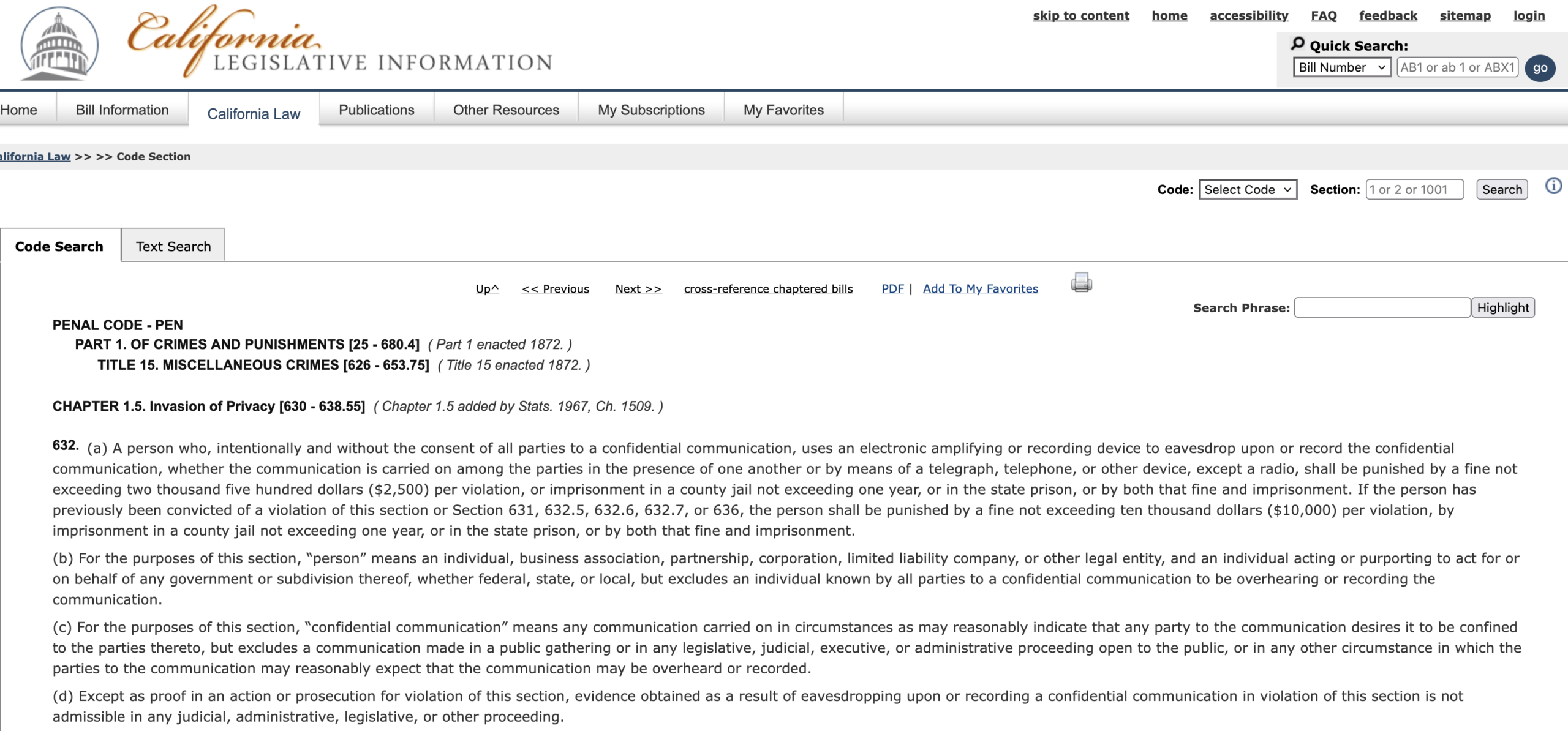
Section 632 addresses intentional recording or eavesdropping on a confidential communication without all-party consent. Its confidentiality requirement is important. Not every customer-service interaction qualifies merely because a user considered it personal. The setting, subject matter, disclosures and reasonable expectations can affect the analysis. A private discussion about health or finances may present different facts from a public-facing exchange asking for store hours.
Section 632.7: cellular and cordless telephone communications
Section 632.7 applies to recording specified communications involving cellular and cordless telephones. Plaintiffs have tried to use it for internet chats performed on smartphones. Courts have rejected that extension where the facts describe a web chat rather than a qualifying telephone communication. A smartphone browser does not automatically turn every typed message into a telephone call.
The federal Wiretap Act and ECPA
The federal Wiretap Act, 18 U.S.C. Section 2511, prohibits certain intentional interceptions of wire, oral or electronic communications. It contains important exceptions, including interception by a party to the communication or with the prior consent of a party, subject to the statute’s criminal-or-tortious-purpose qualification. A federal civil remedy is available under 18 U.S.C. Section 2520. Federal statutory-damages calculations are different from California’s; they cannot responsibly be summarized as a universal $5,000-per-chat penalty.
The central federal disputes are whether the vendor contemporaneously acquired the communication, whether it was itself a party, whether another party consented, and whether an exception is unavailable because of the purpose of the interception. The mere use of artificial intelligence does not answer any of those questions.
Other state laws, consumer claims and biometrics
Pennsylvania’s Wiretapping and Electronic Surveillance Control Act, Florida’s Security of Communications Act and other state statutes create additional questions about consent, location and the characteristics of covered communications. Some states require all-party consent for particular kinds of recordings; the exact rules are not interchangeable. A chatbot that records spoken conversation may implicate materially different laws from a text-only widget.
AI voice systems also create potential biometric issues when they generate or retain voiceprints capable of identifying individuals. Illinois’ Biometric Information Privacy Act (BIPA) has specific notice, consent and retention provisions. Privacy-notice accuracy, unfair or deceptive practices, children’s data and sector-specific confidentiality obligations can add exposure even when a wiretap theory fails. A HIPAA-covered entity, for example, must separately examine whether its vendor relationship and handling of protected health information meet applicable requirements.
How much can a chatbot privacy claim cost?
Under California Penal Code Section 637.2 as amended in 2026, qualifying civil CIPA claims may seek the greater of $5,000 per violation or three times actual damages, with the relevant exceptions and restrictions. The statute does not mean every message, page visit or transmitted packet automatically produces a separate award. Whether a violation occurred, how it should be counted, standing, class treatment, other defenses and the applicable cause of action are all disputed issues.
A plaintiff may nevertheless invoke the statutory figure to frame settlement negotiations. For a large retailer with substantial chat volume, multiplying a proposed per-violation amount by hypothetical interactions produces an intimidating headline number. That calculation is not an adjudicated exposure estimate. It often leaves unanswered whether every class member communicated without consent, which vendor received which data, and whether the same transmission supports separate counts.
Companies also incur costs without any judgment: investigating network activity, preserving logs, reviewing contracts, retaining expert witnesses, responding to discovery, and defending a putative class action or individual arbitration. Cyber insurers have to distinguish a credible privacy event from a complaint built mainly around a website scan and assumptions about the vendor’s capabilities.
The actual cases: what judges decided
1. Licea v. Cinmar: the vendor as a tool, not automatically an eavesdropper
In Licea v. Cinmar, LLC, plaintiffs challenged the chat function on Frontgate’s website. On February 13, 2023, a federal district court in California dismissed the Section 631 claim because the allegations did not overcome the party-exemption theory or adequately establish interception in transit. It also dismissed the Section 632.7 claim with prejudice based on the statutory telephone-communication requirement. Counsel’s contemporaneous account of the ruling identifies the distinct grounds.
The point was not that outsourced chat platforms enjoy blanket immunity. Rather, a plaintiff must plead more than the existence of a third-party software vendor. Courts need a legally meaningful distinction between a provider that facilitates a company’s own exchange and an outside actor that allegedly intercepts it for independent purposes.
2. Martin v. Sephora: recordings and a named vendor were not enough
In Martin v. Sephora USA, Inc., the plaintiff alleged that the retailer used chat software that created transcripts and allowed HubSpot and/or Salesforce to receive the content. The complaint asserted CIPA claims under Sections 631 and 632.7. A March 2023 findings and recommendations examined the party-exemption and interception issues, and an April 24, 2023 order granted dismissal with leave to amend.
Importantly, identifying a popular CRM brand in a pleading does not establish that the brand read a particular message during transit. Technical evidence must tie the disputed software to the actual communications. A general assertion that a vendor collects chat transcripts is not a substitute for proving statutory interception.
3. Licea v. American Eagle Outfitters: a pleading cannot skip the architecture
In Licea v. American Eagle Outfitters, Inc., the plaintiff alleged that the retailer’s chat feature secretly recorded exchanges and enabled third-party eavesdropping. The 2023 court order granted dismissal with leave to amend, finding deficiencies in the asserted Section 631 theories, including the party exemption and inadequately pleaded interception during transmission.
For risk reviews, the decision illustrates the gap between what browser inspection can establish and what a lawsuit must prove. A scan may reveal a remote endpoint and a loaded chat script. It does not, by itself, establish that the vendor wrongfully learned the contents of a particular exchange while it was in transit.
4. Rodriguez v. Ford: alleged independent vendor use kept a theory alive
The Rodriguez v. Ford Motor Co. litigation shows why defendants cannot assume early chatbot dismissals settled the question. The plaintiff alleged that LivePerson operated the chat service from its own servers and exploited the information beyond delivering chat functionality. In a December 3, 2024 order, the Southern District of California allowed the remaining aiding-and-abetting allegations under Section 631 to proceed while dismissing a direct claim under the first clause with prejudice.
The court was deciding a pleading motion, not finding that Ford or LivePerson had committed wiretapping. Nonetheless, it treated allegations about the vendor’s own commercial uses and Ford’s knowledge as sufficient at that stage. The practical question is not just whether a chat provider maintains the transcript. It is whether the provider acts beyond the business’s authorized service relationship in a way relevant to the statute.
5. Beyond Yoga: evidence of interception matters at summary judgment
A 2026 California state-court ruling involving I Am Beyond, doing business as Beyond Yoga, provides a different example. Judge Carolyn B. Kuhl granted summary judgment against a Section 631 aiding-and-abetting theory over website chat. According to Covington’s February 9, 2026 case analysis, the defense submitted expert evidence that messages were encrypted when sent, in transit and when received, while the plaintiff did not offer admissible evidence establishing a prohibited in-transit interception. The court also flagged fabricated or inaccurate AI-generated case quotations in the plaintiff’s briefing.
This outcome should not be read as a holding that TLS encryption makes all chat architectures lawful. Encryption protects data along a given path, but the authorized receiving endpoint may still decrypt and process a message. The significance of the case is narrower: on that evidentiary record, the plaintiff did not prove the required interception by the provider. Technical proof and admissible expert analysis were decisive.
6. Google Cloud Contact Center AI: an October 2026 ruling on consent and intent
One of the most instructive recent decisions involves In re Google Cloud Contact Center AI Privacy Litigation, Case No. 3:23-cv-05437 (N.D. Cal.). Consumers challenged Google’s alleged recording and analysis of calls to businesses using its AI-powered contact-center product. The pleadings described virtual agents, real-time transcripts, suggested replies and potential AI-model improvement. The plaintiffs alleged that callers had not adequately consented to Google’s participation.
On October 22, 2026, Judge Rita F. Lin dismissed the remaining Section 631 claims with leave to amend. Two Home Depot account holders had agreed to account documents incorporating a privacy statement that disclosed recordings of customer-care calls and disclosure to service providers. The court held that those plaintiffs had not plausibly alleged absence of consent to Google’s access. A non-account holder, by contrast, had plausibly alleged no consent because his awareness of or agreement to those terms was not established.
Even that non-account holder’s claim was dismissed, however, because the complaint failed to plausibly allege the required intent: that Google intended to listen without consent. The court distinguished intentionally processing calls, which the product was designed to do, from deliberately doing so in the absence of permission. It allowed amendment because additional allegations might address the deficiency. The same date, the court compelled three other plaintiffs to arbitrate their claims pursuant to agreements with the companies they had called.
The ruling contains an operational lesson. Notice, actual assent, the scope of disclosed service-provider access, the vendor’s knowledge of consent practices and enforceable contract terms all mattered. It does not establish that every general privacy policy confers consent, nor that an AI vendor has an automatic defense simply because its business customer promises to obtain permission.
7. In re Otter.ai: real-time AI transcription and model training
In re Otter.ai Privacy Litigation, Case No. 25-cv-06911-EKL (N.D. Cal.), is not a retailer chat-window case. It concerns an AI note-taking assistant that allegedly joined virtual meetings, transcribed conversations and retained data for commercial uses without consent from all speakers. It belongs in the same discussion because it tests whether a machine acting within a conversation is a neutral service tool or an independent collector of communications.
In its August 13, 2026 order, the court denied dismissal of the plaintiffs’ ECPA claim. It found that the allegations plausibly described contemporaneous acquisition of communications and that the asserted commercial use of conversation data for machine learning could support the alleged tortious-purpose exception to federal party-consent protections at the pleading stage. Other claims received different treatment, including allegations under Illinois BIPA concerning identifiable voiceprints.
No liability finding followed from that ruling. The court accepted specific allegations for purposes of deciding whether the claims could proceed. The decision nonetheless makes clear why AI training rights, retention and speaker-level consent cannot be dismissed as incidental product details.
8. Popa v. Harriet Carter Gifts: the limits of the party exception vary by state
In Popa v. Harriet Carter Gifts, Inc., the Third Circuit considered website tracking under Pennsylvania law rather than chat transcripts. The 2022 appellate opinion rejected a broad party-exception approach and held that a third-party marketing service’s receipt of website data could qualify as interception at the user’s browser. On remand, a subsequent judgment reported in 2025 favored the defendants based on consent.
The case was not about an AI chatbot and should not be portrayed that way. Its relevance is jurisdictional: a party-exemption argument that works under one statute may not work under another, while evidence of valid notice and consent can still change the result.
The plaintiff-side ecosystem: named firms, repeat claims and demand letters
These disputes do not arrive solely as conventional class actions. Businesses also receive prelitigation notices, requests for settlement and demands to arbitrate. Defense-side accounts identify firms including Pacific Trial Attorneys, Manning Law APC, Tauler Smith LLP, Potter Handy LLP and Victims Advocacy Group PLLC in the wider CIPA website-tracking ecosystem. A September 2026 analysis by Jeffer Mangels & Mitchell discusses the shift in legal theories, while Donahue Fitzgerald names Tauler Smith and the Swigart Law Group in connection with website-tracking demands.
These names concern documented activity in the broader website privacy litigation market. They should not be read as an assertion that each firm has filed a chatbot-specific case, used identical tactics, or engaged in improper conduct. A named attorney or firm must be connected to a particular filed matter before that particular claim is attributed to them.
Some complainants are repeat visitors or self-described privacy testers. The Martin v. Sephora pleadings, for instance, described the plaintiff as both a consumer and a tester. Testing can uncover real compliance deficiencies; it can also create disputes about standing, injury, the nature of the interaction and whether a scripted visit establishes the facts alleged. A plaintiff’s repeated filing history is not itself proof that a claim is frivolous. Equally, a routine chat-widget installation is not itself proof that the plaintiff experienced unlawful interception.
The economic structure encourages early evaluation. A demand letter may cite an elevated statutory multiplier, identify a tracker or a chat vendor, and propose settlement before discovery. Some disputes enter private arbitration rather than appearing in publicly searchable court dockets. That makes comprehensive nationwide counting difficult, particularly when the claimant or defendant has confidentiality obligations. Public filing totals cannot simply be added to estimates of demand letters or arbitration notices as though they measured the same thing.
Businesses should assess the legal and technical merits of each demand independently. A claimant who provides a screenshot showing a chat button and a request to a remote domain may have shown a deployed vendor. The submission may not establish who received message contents, when they received them, whether consent was obtained, or whether the statutory exception applies. Conversely, an organization should not dismiss a demand as boilerplate if its own vendor agreement permits independent use of identifiable transcripts or its pre-chat notice is demonstrably absent.
Why the 2026 CIPA reform does not end chatbot cases
California enacted Senate Bill 690 on September 30, 2026. Effective January 1, 2027, the law restricts private civil actions against private actors under the CIPA pen-register and trap-and-trace provision, Section 638.51, when the alleged conduct occurred on a website, online application or mobile application. In those circumstances, the California Attorney General retains the specified authority to sue. The legislation also contains a retroactivity rule affecting certain pending actions commenced within two years before its operative date.
What the law does not do is repeal Sections 631, 632 or 632.7. It does not categorically legalize chatbot transcript collection, retroactively validate every consent notice or change the federal Wiretap Act. The operative-date and retroactivity language also require careful treatment; the measure was signed in September 2026 but is not yet effective as of this article’s November 3 publication date.
DLA Piper’s October 2026 analysis describes the narrowed private remedy and the continuing availability of other wiretap theories. As a result, businesses should not treat SB 690 as a blanket defense to a live-chat claim under Section 631. Nor should every CIPA tracking suit be called a chatbot lawsuit. Pen-register disputes involving IP addresses and metadata involve different statutory elements from alleged acquisition of the contents of typed or spoken customer messages.
How an AI chatbot can create privacy exposure technically
Message content is routed to an outside processor
When a visitor types a question into a chat widget, the browser often sends the message to the vendor’s endpoint rather than directly to the website operator’s own application server. That can be a legitimate hosted service. The legal review must determine whether the vendor is processing solely for the business or also for itself, what the user was told, and which statute applies.
Engineers should document the actual sequence: browser submission; network destination; TLS termination; message queue; model gateway; transcript store; live-agent handoff; downstream analytics; and deletion or archival. Each stage may have a different recipient and purpose. A single vendor name on a list of scripts reveals only part of that architecture.
Draft messages and abandoned chats may still be collected
Some applications capture typing events, draft text or interaction telemetry before a user presses Send. Whether a particular product does this must be verified, not assumed. If it does, a customer may disclose sensitive content without completing a chat. The issue is especially relevant where the interface gives no meaningful notice until the first message is submitted.
Testing should determine whether keystroke or draft-event payloads contain actual text, masked text or merely event counts. It should also check whether a partially typed phone number, symptom, financial balance or email address appears in logs or vendor dashboards.
Conversation transcripts feed analytics or AI training
Chat vendors may provide quality scoring, sentiment analysis, conversation summarization, intent classification, agent coaching and training-data features. The fact that a service supports these functions does not prove they are enabled for a particular customer. Vendor defaults, enterprise contracts, privacy controls and product versions matter.
The highest-value question is whether identifiable conversation content can be used for the provider’s independent purposes. A contract might prohibit training on customer data while allowing limited abuse monitoring or service improvement. Other contracts may allow broader analysis unless the customer opts out. Those are different arrangements, and a privacy notice must not pretend they are equivalent.
Chat identities are linked to advertising and CRM profiles
A chat conversation may be joined to cookies, customer IDs, analytics events, campaign parameters, emails or CRM records. Such linkage can enable helpful customer support, but it also creates a more extensive record than a one-off message. If a chatbot contains health, legal, financial or other sensitive statements, profile enrichment and ad-platform transmission deserve particularly close scrutiny.
Do not assume a global cookie banner governs the chat flow correctly. Chat may use essential-service processing, independent analytics, or optional marketing features with different legal bases or disclosure obligations. A blanket rule that every chat message must wait for advertising-cookie consent would oversimplify the law; a blanket assertion that chat is always essential would be equally unsound.
Audio, voiceprints and meeting participation change the risk
Voice bots and meeting assistants bring in additional questions: whether a call recording announcement was delivered, whether all speakers understood that a recording assistant joined, whether speech was converted to identifying biometric templates, and whether audio is retained after a transcript is generated. As the Otter.ai litigation shows, an AI transcription dispute can involve federal interception claims and state biometric rules simultaneously.
A company that supplies a spoken assistant should separately inventory raw audio, speech-to-text output, speaker embeddings, training samples and agent summaries. Deleting the visible transcript may not delete every associated copy or model-development record.
What a defensible chatbot consent process looks like
There is no universal checkbox that resolves every state and federal claim. A defensible system starts with a precise description of the processing and a legally appropriate way to notify users and obtain any required permission before the relevant collection or recording.
A pre-chat disclosure should explain, in plain language, that the exchange may be recorded or retained, whether a third-party service provider processes it, and the relevant purposes. For AI-powered applications, it should accurately describe whether the user is speaking to automation, a live agent or both. Where applicable law requires all-party consent or a specific form of consent, the product team should build a corresponding interaction rather than relying solely on a distant privacy-policy link.
The consent event should be recorded with the notice version, timestamp, jurisdictional configuration, channel and interaction to which it applied. If a user declines optional processing, the system should honor the selection technically. Where service provision cannot occur without necessary processing, the interface should explain the choice and provide an alternative contact method when feasible.
The Ninth Circuit’s 2022 decision in Javier v. Assurance IQ is instructive on timing. In a website recording dispute, the court held that a plaintiff had sufficiently alleged lack of prior consent and rejected the premise that subsequently accepting a privacy policy necessarily retroactively authorized an earlier interception. That was not a chatbot case, but it directly affects designs in which collection begins before a visitor has seen or accepted the pertinent terms.
The October 2026 Google ruling shows a different side of consent: an actual contractual agreement incorporating a privacy disclosure can matter where it meaningfully covers the activity at issue. The right approach is to document exactly what the customer agreed to and exactly what the vendor did, rather than assuming either a generic link or a generic consent banner always suffices.
A technical audit that is useful in litigation, not just marketing
A website audit should reproduce concrete user journeys and preserve results in a form that counsel or a technical expert can evaluate. A practical methodology includes the following steps.
- Identify each deployed conversation product. Inventory web chat, embedded sales chat, support widgets, AI assistants, voice bots, contact-center tools and meeting add-ons. Capture vendor, version, integration method, account owner and relevant contract.
- Test a clean visitor session. Use a fresh browser profile with no existing cookies or authenticated session. Record what loads before any choice, before opening chat, while typing, on sending a message and after closing the widget.
- Repeat across consent states. Test before choice, after accept, after reject and after changes to preferences. If a banner is geo-adaptive, test the relevant jurisdiction configurations rather than extrapolating from a single Florida or California session.
- Inspect network payloads. Capture HAR files and developer-tool traces, recording destination domains, request times, methods and fields actually transmitted. Do not put live sensitive customer information into third-party test environments. A request to a vendor alone does not establish unlawful interception.
- Examine the chat interface itself. Check what notice appears before a message is transmitted, how any acknowledgment is captured and what happens when a user refuses optional processing. Verify keyboard and mobile experiences as well as desktop.
- Check draft, replay and telemetry features. Determine whether typing, cursor behavior, chat text or hidden field values can reach analytics or session-replay providers. Confirm masking and redaction in actual traffic, not just vendor documentation.
- Review vendor-side evidence. Identify who can view transcripts; whether admins can export them; whether the provider trains on them; retention and deletion settings; subprocessors; cross-border transfers; and whether controls differ by plan or contract.
- Validate the server-side path. Browser analysis cannot reveal all downstream processing. Ask vendors for architecture diagrams, data-flow maps, relevant logs, model-training terms and proof that disabled features are actually disabled.
- Preserve reproducible records. Maintain timestamps, screenshot sequences, consent-state records, tested URLs, configuration versions and artifact hashes. The method must permit another reviewer to understand what was observed and when.
- Have counsel map facts to elements. Identify the precise statute, the allegedly intercepted content, timing, third-party role, consent evidence and available exceptions. A scan finding is an investigative lead, not a legal conclusion.
Businesses that deploy chat through Google Tag Manager or another tag-management system should not assume that disabling one tag removes all copies. A widget may be installed through the site template, a commerce plug-in and a vendor SDK simultaneously. Consent Mode, CMP settings and customer-support configurations may also operate independently. After remediation, rerun the exact failed journey and retain before-and-after evidence.
Legal defenses businesses should evaluate before settling
The recipient or party exception
The strongest defense in many early California chat cases was that the business could receive and record its own communications, and its service provider functioned like an instrument for doing so. The outcome depends on the applicable statute and allegations about a vendor’s independent conduct. This is not a universal exemption for any third party called a processor.
No acquisition of contents in transit
Section 631 claims require careful examination of what was allegedly read or learned and when. A transcript generated after a message is received may present a different theory from a vendor simultaneously receiving content during transmission. Beyond Yoga shows that expert evidence can matter at summary judgment. Conversely, encryption alone should not be treated as a universal defense when the provider itself is the intended decrypting endpoint.
Actual prior consent within scope
Courts examine whether permission was obtained, how terms were presented and whether the challenged activity fits what was disclosed. A statement that a company uses analytics is not necessarily equivalent to notice that an AI provider receives and processes the contents of sensitive conversations. But the Google case also warns against assuming that a vendor must always be individually named where a valid agreement meaningfully covers service-provider disclosure.
Intent and vendor knowledge
As the Google court explained in October 2026, allegations of intentionally running an AI transcription product do not necessarily show intent to intercept without consent. Vendor contracts that require the customer to obtain consent may help establish good-faith operating expectations, although a contractual promise alone does not immunize a vendor that knows the required permission is absent.
Standing, jurisdiction, pleading and proof
Defense counsel should review the plaintiff’s actual interaction, alleged injury, connection to the forum, timing and whether the pleadings establish the specific statutory elements. An out-of-state corporate parent is not necessarily subject to personal jurisdiction for every subsidiary’s or vendor’s California operations; a June 2026 AutoNation call-analytics decision illustrates that distinction without deciding the merits of the alleged interception.
Arbitration and class-action provisions
Where legally enforceable and applicable to the claimant and claim, arbitration terms may change the forum. Google’s October 2026 arbitration order illustrates how agreements with a business can affect litigation against its technology provider. But arbitration is not a guaranteed cost-saving mechanism: filing fees, mass-arbitration provisions, enforceability challenges and individualized defense costs may alter the economics. A company should not add terms without considering how assent will be documented and whether those provisions actually cover claims against its vendors.
How businesses should respond to a chatbot wiretap demand
First, preserve the evidence. Do not immediately remove or reconfigure the chat platform without retaining relevant code versions, vendor settings, policies, data-flow records and logs under counsel’s preservation instructions. Remediation may be necessary, but destroying the pre-change configuration can make it harder to establish what the plaintiff actually encountered.
Second, ask for particularity. Which date and URL? Was the claimant signed in? What did the chat notice say? Which communication content was supposedly intercepted? Which third party received it, and was the assertion based on a browser request, a copied vendor statement or a verified transcript? Which statute and remedy does the claimant invoke? A defensible response addresses facts rather than merely denying everything.
Third, investigate the vendor relationship. Read the actual order form, data processing agreement, subprocessors list and product settings effective on the alleged date. A current vendor FAQ may not describe an earlier integration. Obtain documentation of training defaults, opt-outs, log retention and administrative access. If the vendor provides an indemnity, tender or notice mechanism, consult counsel and follow the contract’s deadlines.
Fourth, map the insurance issues early. Privacy-related claims can implicate cyber, technology errors and omissions, media liability or other coverage, depending on policy wording and exclusions. Notification timing, defense control, statutory-damages coverage, consent to settle and allocation may matter. A carrier should ask for the same technical record that counsel needs, rather than relying entirely on the demand letter’s characterization of the site.
Finally, consider targeted remediation with documented verification. A clear pre-chat notice, restricted vendor training permissions, better transcript minimization or an architecture change may address real weaknesses. The chosen measure should match the legal and technical problem; switching vendors while retaining the same data flow may not eliminate exposure.
What cyber insurers and outside counsel should ask in underwriting and diligence
Traditional security questionnaires often ask whether a company has a privacy policy, a cookie banner and a written incident-response program. Those questions say little about what an AI contact-center integration does with the contents of live conversations. Underwriting should distinguish ordinary processor access from independent commercial reuse and identify where a company lacks evidence.
Useful diligence includes the number and type of deployed chat systems; whether the customer’s location is known; how recording consent is obtained; whether notices differ by channel; whether voiceprints are created; whether vendors can train on customer conversations; whether real-time content reaches advertising or analytics systems; whether the organization can honor deletion requests across copies; and whether the business has faced prior demands concerning the same deployment.
Insurers should also ask how configuration changes are monitored. A compliant-looking test in March may not prove the site behaved the same way in September after a vendor released an SDK update, a marketing team changed its tag manager or a support department enabled a conversation intelligence module. Evidence needs a date, scope and reproducible method.
Law firms assessing a demand should avoid treating automated risk scores as answers to legal questions. A scanner can show that a network call occurred before an acceptance click; it cannot, by observation alone, determine whether the actor was a legally separate interceptor, whether a user’s prior agreement covered the exchange or whether a particular statutory remedy is available.
What happens next for chatbot privacy litigation?
There is a reason to expect continued disputes over how AI providers use conversations. Products are increasingly capable of live transcription, summarization, personalized follow-ups and model improvement. Each function creates another question about recipients and purposes. A court may reject a poorly pleaded wiretapping complaint while leaving unanswered whether a different configuration, a stronger evidentiary record or a separate consumer-privacy law would support a claim.
At the same time, published decisions do not show a single, uniform plaintiff victory. The early Cinmar, Sephora and American Eagle decisions were skeptical of expansive chat allegations. Ford permitted an aiding-and-abetting theory to proceed. Beyond Yoga prevailed on summary judgment. Google obtained dismissal with leave to amend on consent and intent grounds, while Otter.ai faced a surviving federal interception claim at the pleading stage. These outcomes are distinct, and treating them as interchangeable would misstate the state of the law.
California’s SB 690 changes the economics of a subset of website-tracking cases beginning January 2027, but it leaves core chatbot wiretap provisions untouched. Plaintiffs can continue to test federal and state claims; defendants can continue to contest whether their actual technology satisfies the statutory elements. For businesses, the strongest position is neither panic nor dismissal. It is an accurate map of the conversations, vendors, consent flows and retained data, supported by evidence that can survive scrutiny outside the engineering department.
Frequently asked questions about chatbot privacy lawsuits
Are AI chatbots illegal under CIPA?
No. CIPA does not prohibit businesses from using AI chatbots as a category. Whether conduct violates the law depends on the relevant provision, what was collected or recorded, who received it, when it was acquired, the user’s consent and any applicable exception.
Can a business be sued for using a third-party chat service?
Yes, businesses have been sued over third-party chat services. Being sued does not mean a violation occurred. Courts have dismissed some complaints and allowed others to proceed on more detailed allegations, particularly involving possible independent use of conversations by a vendor.
Does a privacy policy alone provide sufficient chatbot consent?
Not necessarily. The answer depends on applicable law, whether the visitor actually agreed to or received the relevant notice, its language, the timing of collection and the processing at issue. The October 2026 Google decision illustrates both a successful consent analysis for account holders and an insufficient consent showing for a non-account holder.
Can chat transcripts be used to train AI models?
Whether training is lawful depends on the contractual permissions, disclosures, applicable privacy laws, content, individual rights and the circumstances of collection. Training rights do not automatically make a vendor a wiretapper, but independent model-training use can complicate consent, party-exemption and data-governance analyses.
Did California end CIPA chatbot lawsuits with SB 690?
No. Effective January 1, 2027, SB 690 restricts certain private claims under Section 638.51 involving websites and apps. It does not repeal CIPA Sections 631, 632 or 632.7 or the federal Wiretap Act.
Can a scanner determine whether a chatbot violates CIPA?
Not conclusively. A scanner can identify observable scripts, network transmissions, consent behavior and possible configuration gaps. Legal conclusions also require analysis of vendor relationships, transcript processing, timing, user agreement and statutory requirements.
Detect and document potential exposures before a demand arrives
Captain Compliance developed Patrol to help businesses, counsel and insurers inspect website privacy configurations, including consent flows, pre-consent tracking, GPC behavior and possible CIPA-related exposure indicators. Its evidence-oriented scans can support an investigation into chat-widget behavior and connected tracking technology. Patrol is heavily used by law firms, insurance companies, and businesses to understand and assess risk.
For organizations deploying customer-service chat, AI assistants or contact-center tools, the priority is to know what information moves, to whom, under which permissions, and what evidence supports the answer. Start with a free privacy audit from the Captain Compliance data privacy analysts tto learn more about privacy scanning, risk, and compliance operations.
Put this into practice
Turn privacy guidance into working controls.
Captain Compliance helps teams discover tracking technologies, enforce consent, manage privacy requests and document the evidence behind every decision.