Know what’s on your site before a plaintiff’s firm does
A free privacy audit shows which cookies, pixels and trackers are running — and which ones commonly appear in privacy claims.
The New Privacy Litigation Playbook: Filing Arbitration Demands Without Ever Going to Court
One law firm associated with this practice is San Diego-based Swigart Law Group, APC, led by attorney Joshua B. Swigart. The firm has pursued individual privacy arbitration demands alleging that businesses unlawfully intercepted website visitors’ communications through advertising pixels and other third-party technologies.
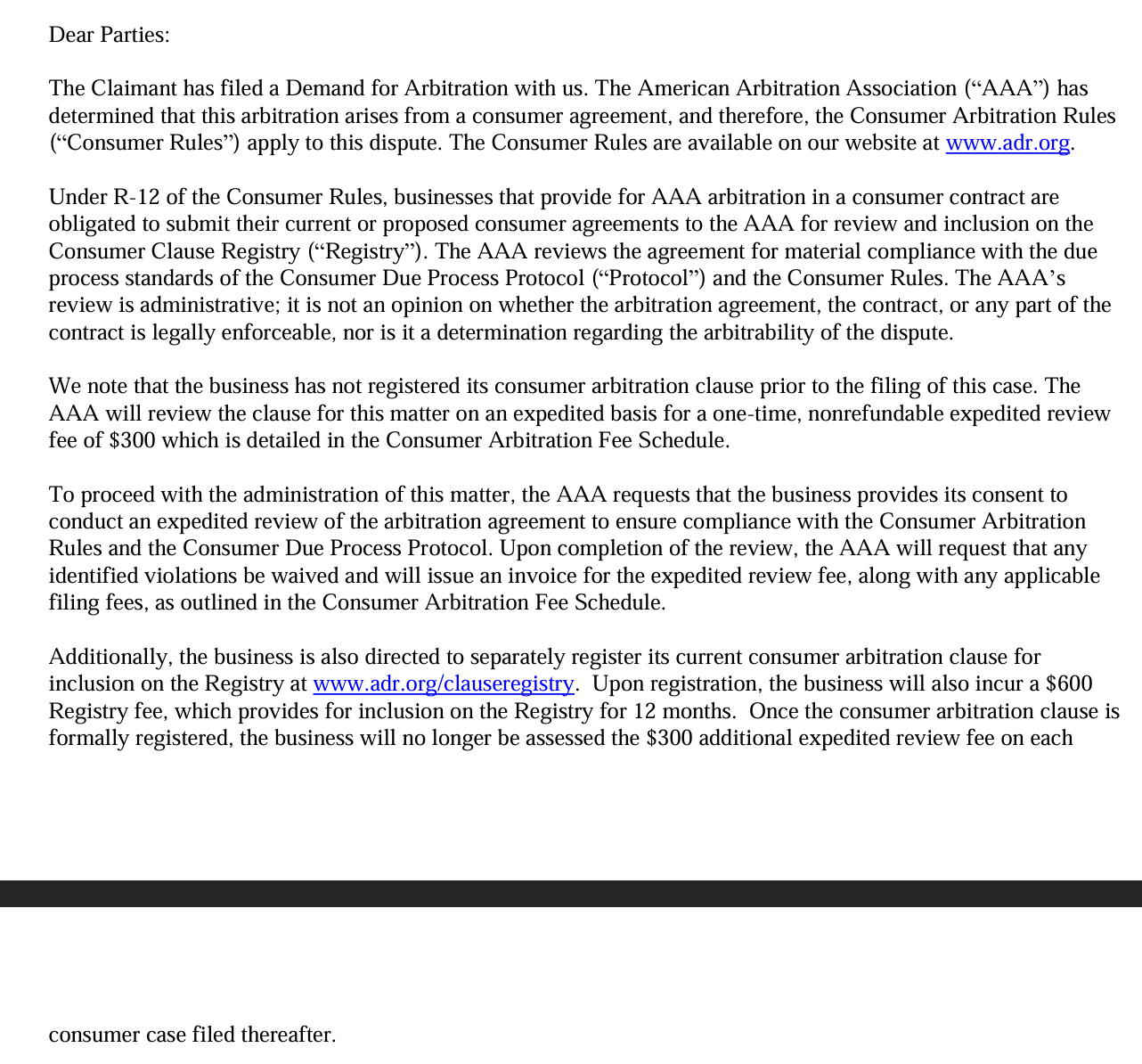
A notice from the American Arbitration Association (AAA), reviewed for this article, illustrates how the process works. The document concerns a consumer arbitration demand against an ecommerce business. Rather than beginning with a lawsuit, the claimant’s attorney submitted a demand to AAA, which contacted the business about administering the dispute.
At that stage, the AAA had not determined that the company violated any privacy law. Nor had it decided that the underlying arbitration agreement was enforceable. Nevertheless, the company was already facing administrative deadlines and potential arbitration expenses arising from a private proceeding.
This is an important development in website privacy disputes because arbitration was historically promoted by businesses as a mechanism to avoid costly court litigation and class actions. Plaintiffs’ attorneys are now using those same contractual provisions to initiate individual claims, sometimes in substantial numbers.
How Privacy Arbitration Demands Bypass the Initial Court Filing
Traditional civil litigation ordinarily begins with a complaint filed in a state or federal court. The complaint becomes part of the court record, the defendant receives formal notice, and a judge oversees the proceeding under applicable procedural rules.
Consumer arbitration follows a different process.
When a business and consumer have agreed to arbitrate qualifying disputes, either party may initiate the process by submitting a demand directly to the arbitration provider identified in the agreement.
Common administrators include the American Arbitration Association and JAMS.
The claimant generally submits the arbitration demand, the relevant agreement and the applicable filing fee. The administrator then reviews the submission under its rules and notifies the respondent.
A court complaint is not necessarily required.
This is not an unlawful circumvention of the judicial system by itself. Arbitration is a recognized dispute-resolution process supported by the Federal Arbitration Act. Parties that enter enforceable arbitration agreements can resolve disputes without first obtaining permission from a judge.
However, the practical consequences are significant. Arbitration demands are generally less visible than public lawsuits, administrative expenses may begin accumulating before the merits are decided, and the responding business may have fewer opportunities to obtain early judicial review unless a genuine dispute over arbitrability or another legally recognized ground permits court intervention.
The result is a parallel avenue for privacy claims that can operate largely outside publicly searchable litigation records.
Privacy Lawsuit Precursor AAA Notice Shows How the Process Begins
AAA issued a consumer arbitration notice involving a claim brought by an individual represented by Joshua B. Swigart of Swigart Law Group against a business that they had no prior discussions with.

The notice, provided to Captain Compliance for review, confirms that a Demand for Arbitration had been filed. It does not include the underlying demand or establish what substantive privacy allegations, if any, were asserted in that particular matter.
AAA determined administratively that the dispute arose from a consumer agreement and that its Consumer Arbitration Rules applied.
There was a procedural complication: the business had not registered its consumer arbitration clause with AAA before the case was filed.
Under Rule R-12 of the AAA Consumer Arbitration Rules, businesses that designate AAA arbitration in consumer agreements must submit their arbitration provisions for administrative review and inclusion in the organization’s Consumer Clause Registry.
AAA informed the respondent that it could conduct an expedited review for a one-time, nonrefundable $300 fee. The business was also directed to register its consumer arbitration clause, which carried a separate $600 fee for 12 months of inclusion in the registry.
In other words, the letter identified $900 in potential clause-review and registration charges, separate from the filing fees and other costs that could arise if the arbitration proceeded.
Those fees should not be confused with a judgment, settlement or penalty for violating privacy law.
The administrator expressly explained that its clause review was administrative and was not a determination that the arbitration agreement was legally enforceable or that the underlying dispute was arbitrable.
The notice requested confirmation within 1 month. Without the company’s consent to proceed with the expedited review, AAA stated that it would be unable to administer the matter and would close the file unless further instructions were provided.
That qualification is important. The notice did not establish that the business was compelled to submit to a full arbitration proceeding merely because a claimant filed a demand.
It demonstrates something narrower but still consequential: a claimant can initiate formal arbitration administration before any court has considered the dispute, and the resulting notice can create an immediate deadline for the business to evaluate its contractual obligations, defenses and potential costs.
Swigart Law Group’s Privacy Arbitration Strategy Has Already Reached Federal Court
The use of individual arbitration demands by Swigart Law Group is not merely theoretical. A federal court addressed a related dispute in DesignTechnica Corporation v. Swigart Law Group, Case No. 3:24-cv-01054, in the U.S. District Court for the Southern District of California.
DesignTechnica operates Digital Trends and The Manual, two consumer-oriented publishing websites.
According to the court’s December 9, 2024 order, Swigart Law Group filed 36 separate arbitration claims through JAMS on behalf of individuals alleging violations of CIPA.
The allegations involved website communications and alleged disclosures of information to Meta Platforms through tracking technology.
DesignTechnica’s website terms contained both a mandatory arbitration provision and an Oregon choice-of-law provision. The company argued that the claimants were asserting California statutory claims despite having agreed to Oregon law.
DesignTechnica also alleged that the claims lacked merit and were being pursued to create settlement pressure through cumulative arbitration costs.
These were the company’s allegations, not findings by the court.
Rather than simply defend all 36 arbitrations, DesignTechnica filed its own federal lawsuit seeking declarations concerning the enforceability of its contractual provisions and an injunction against the disputed arbitration claims.
The company’s position was that the combined economic exposure from individual arbitration proceedings justified judicial intervention.
The court did not reach the underlying CIPA allegations or decide whether the arbitration demands were abusive.
Instead, U.S. District Judge Thomas J. Whelan dismissed the federal action for lack of subject matter jurisdiction. The court concluded that DesignTechnica could not aggregate the independent claims and arbitration expenses in the manner proposed to satisfy the relevant federal diversity jurisdiction threshold.
The decision did not establish that Swigart Law Group’s privacy allegations were valid. It also did not rule that DesignTechnica’s choice-of-law defenses lacked merit.
It did, however, demonstrate a practical difficulty businesses may face when attempting to move a collection of individual arbitration disputes into federal court for a consolidated determination.
How Arbitration Clauses Intended to Protect Businesses Became a Tool for Plaintiffs
For years, businesses adopted mandatory arbitration provisions for several familiar reasons.
Individual arbitration could reduce exposure to class-action litigation, limit the procedural complexity of large court cases and provide a more private forum for resolving consumer disputes.
Many agreements also contain class-action waivers that require consumers to pursue claims individually.
But a prohibition on class actions does not necessarily prevent hundreds of individuals from filing separate arbitration demands.
That distinction created the conditions for mass arbitration, where multiple consumers, often represented by the same law firm, submit individual claims involving similar allegations against the same company.
Unlike a conventional class action, each claimant generally maintains an individual dispute. The proceedings may nevertheless be coordinated administratively under rules designed for high-volume claims.
The AAA Mass Arbitration Supplementary Rules address coordinated filings and provide mechanisms for managing common procedural issues.
Under AAA’s current framework, 25 or more similar consumer demands involving coordinated representation can qualify for treatment as mass arbitration, subject to the administrator’s determination.
The economic problem for businesses is straightforward: consumer arbitration agreements frequently require the business to pay most administrative expenses and arbitrator compensation.
Privacy Litigation Without a Lawsuit: How Law Firms Are Taking Website Tracking Claims Straight to Arbitration
A company that adopted individual arbitration to avoid the cost of defending a class action may discover that numerous separate claims create substantial expenses before any liability has been established. While Vivek Shah sent out demand letters, Gutride Safier, Pacific Trial Attorneys, and Tauler are known for actually filing and enforcing privacy rights for consumers we have the opposite of that happening with the straight to arbitration and an almost instant cost to businesses who are not compliant and using a working consent management platform like Captain Compliance.
How Much Does an AAA Privacy Arbitration Cost?
The costs depend on the applicable fee schedule, the number of claimants, the arbitration agreement and the stage reached in the proceeding.
Under the AAA’s published individual Consumer Arbitration Fee Schedule, a consumer filing a standard case before one arbitrator ordinarily pays a filing fee capped at $225, subject to contractual provisions and applicable fee-waiver rules.
The business’s standard filing fee is $375 once the claimant satisfies the filing requirements.
The same published schedule identifies a $1,400 case management fee for a proceeding before one arbitrator, a $500 hearing fee where applicable, and arbitrator compensation of $300 per hour.
Those expenses are separate from the business’s legal defense costs.
Consider a hypothetical 36-claim portfolio under the ordinary individual consumer fee schedule, assuming the matters were administered separately rather than under AAA’s mass arbitration framework. The cheaper solution is to be compliant by using data privacy tools like what Captain Compliance provides.
| Cost Component | Illustrative Amount |
|---|---|
| Business filing fees: 36 × $375 | $13,500 |
| Case management fees: 36 × $1,400 | $50,400 |
| Subtotal | $63,900 |
| Additional hearing fees, if applicable | $500 per case |
| Arbitrator compensation | $300 per hour |
| Outside legal counsel | Varies by matter |
These figures illustrate how the ordinary fee structure can accumulate. They do not represent charges assessed against DesignTechnica, and they should not be applied to an actual mass arbitration without reviewing the specific supplementary fee schedule.
Mass arbitration rules use separate procedures and fee structures that may materially alter the calculation.
Still, the example explains why arbitration expenses can become part of settlement discussions even where the business disputes liability.
A company might ultimately prevail on the merits but incur substantial administrative and legal costs in reaching that result.
Why Website Tracking Claims Are Well Suited to Individual Arbitration Demands
Website tracking litigation frequently involves alleged conduct that is repeatable across many visitors.
For example, a plaintiff may allege that a website automatically transmitted information to Meta Pixel, TikTok Pixel, Google Analytics, a session-replay provider or another third-party service when the individual opened a page or interacted with a feature.
Under certain theories of California Penal Code Section 631, plaintiffs argue that the transmissions constitute unlawful interception or eavesdropping on communications without the required consent.
Other claims may invoke the federal Wiretap Act, part of ECPA, or the Video Privacy Protection Act when the alleged disclosure involves qualifying video-viewing information.
The relevant legal elements differ substantially. The fact that a website sends information to an advertising or analytics service does not, by itself, prove unlawful interception or disclosure.
Nevertheless, the underlying technical behavior can be similar across many visitors. A single tracking configuration may operate repeatedly unless the website modifies its consent settings, tag manager rules or integration code.
That can allow plaintiff firms to pursue numerous individual demands based on substantially similar alleged conduct.
The claims still require individualized proof where necessary, including issues such as the claimant’s interactions with the website, whether an enforceable agreement exists, applicable consent, the information transmitted and whether the relevant statutory requirements have been satisfied.
Law firm Klein Moynihan Turco reported in May 2025 that Swigart Law Group and Pacific Trial Attorneys were regularly serving businesses with CIPA arbitration demands involving website tracking technologies.
Its analysis also noted that the unsettled treatment of tracking tools under California privacy law contributed to the continuation of these disputes.
Is Filing Arbitration Directly an Attempt to Circumvent the U.S. Court System?
The criticism deserves careful examination because two distinct issues are involved.
First, direct arbitration is lawful when the parties have made an enforceable agreement to resolve qualifying disputes through that process. The Federal Arbitration Act provides the legal framework for enforcing such agreements.
A plaintiff who submits an eligible claim directly to AAA or JAMS is not automatically engaging in misconduct or evading the law.
Second, the process can reduce the availability of immediate public judicial scrutiny.
Most arbitration demands do not initially become public court filings. Arbitrators operate outside the ordinary state and federal trial court systems, and judicial review of a final arbitration award is generally more limited than review of a court judgment.
Although arbitration can provide a legitimate and accessible remedy for consumers, these features can create difficulties when the same legal theory is asserted repeatedly against businesses without producing publicly accessible judicial decisions.
A recurring allegation may generate numerous private proceedings without a judge issuing a precedential ruling on whether the underlying website tracking behavior violates the statute.
Defendants may therefore incur substantial costs litigating questions that remain unsettled across the broader court system.
Critics argue that such circumstances can create settlement pressure unrelated to the ultimate merits. Consumer advocates respond that businesses voluntarily adopted arbitration provisions and should not expect consumers to lose their individual remedies merely because aggregated claims become expensive.
Both positions identify a real feature of mandatory consumer arbitration: contractual restrictions on collective litigation do not automatically eliminate aggregate financial exposure.
The proper legal distinction is not whether the claim avoids a courthouse at the outset, but whether the claimant has an enforceable right to arbitrate and whether the demand has substantive merit.
Can a Business Challenge an Arbitration Demand Without Defending the Entire Case?
Yes, potentially. Arbitration does not eliminate the requirement for a valid agreement, and initiating a claim with AAA does not itself establish that a dispute must be arbitrated.
Under the Federal Arbitration Act, arbitration is generally a matter of contractual consent.
The U.S. Supreme Court reaffirmed that principle in Coinbase, Inc. v. Suski, decided May 23, 2024.
The Court held that when two agreements conflict over who decides arbitrability, a court must determine which agreement controls.
That decision does not permit businesses to disregard every arbitration demand. However, it confirms that arbitration provisions do not automatically displace the courts’ role in deciding certain threshold contractual questions.
Depending on the circumstances, a company may dispute whether the claimant accepted the relevant terms, whether the arbitration clause covers the asserted privacy claim, whether another agreement governs or whether the clause is enforceable.
Some agreements contain delegation provisions assigning threshold arbitrability disputes to an arbitrator. The validity and effect of those provisions must be evaluated separately.
For website privacy claims, the timing and manner of contract formation are particularly important.
A consumer who affirmatively accepted website terms through a clearly presented clickwrap agreement may present a different contract-formation question from an anonymous visitor who merely browsed a site containing a hyperlink to terms of use.
Courts evaluate the notice and manifestation of assent under applicable contract law.
Businesses should also distinguish contractual arbitration consent from consent to website tracking. Agreeing to arbitrate disputes does not necessarily mean a visitor consented to advertising pixels, recordings or other data collection.
What Happens if the Business Refuses AAA’s Clause Review?
The October 23 AAA notice illustrates an important procedural point: an arbitration demand can be filed even when the respondent has not previously registered its consumer clause with AAA.
Under AAA’s Consumer Clause Registry procedures, the business may then be required to submit its agreement for review before administration continues.
The registry review considers substantial and material compliance with the AAA Consumer Due Process Protocol and applicable consumer rules.
It does not provide a judicial ruling on whether the parties formed an enforceable arbitration agreement.
In the notice reviewed for this article, AAA stated that it would close the matter if the respondent did not agree to the expedited review by the specified deadline, absent further instructions.
That does not necessarily mean the underlying consumer claim disappears.
Depending on the agreement and applicable law, the claimant may seek relief in court, attempt to proceed through another available forum or pursue judicial intervention concerning the arbitration agreement.
A business’s refusal to cooperate with an administrator can also create legal risks if the refusal violates an enforceable agreement or constitutes a failure to pay required arbitration fees.
Accordingly, companies should not treat administrative closure as an automatic victory or assume that ignoring AAA correspondence is a sound defense strategy.
The better approach is to evaluate the contractual and jurisdictional issues with counsel before the response deadline.
California’s SB 690 Changes Some Privacy Claims, but Not the Entire Arbitration Strategy
California’s recent legislative response to website tracking litigation adds another important development.
Governor Gavin Newsom signed Senate Bill 690 on September 30, 2026.
The legislation changes California Penal Code Section 637.2 to restrict private actions involving alleged violations of Section 638.51 arising from conduct on websites, online applications and mobile applications.
Beginning January 1, 2027, the California attorney general will have exclusive authority under that provision to bring the specified private-actor claims concerning online activity.
The legislation also contains a retroactivity provision affecting certain pending claims commenced within the two years before its operative date.
These changes could materially affect arbitration demands asserting private pen register or trap-and-trace claims based on website technology.
However, SB 690 does not eliminate CIPA Section 631 claims alleging unlawful interception of communications. Nor does it eliminate federal ECPA or VPPA claims.
As a result, businesses should expect plaintiffs and defendants to continue litigating the distinction between prohibited interception, ordinary website data transmission and legally permitted tracking.
The bill’s retroactive effect, including its application to particular pending arbitration proceedings, may require additional legal analysis.
Why Arbitration Can Make Privacy Litigation Harder to Monitor
For businesses tracking litigation trends, private arbitration creates an information gap.
Federal court filings are generally accessible through PACER and other docket services. State court records are also often searchable, subject to local access rules.
Arbitration proceedings are different. Although AAA publishes consumer arbitration statistics and certain case information under applicable disclosure laws, individual demands and case materials are not routinely available through a unified public docket equivalent to the federal court system.
AAA also publishes some awards in redacted form, and parties may have disclosure rights or contractual confidentiality obligations depending on the circumstances.
The point is not that every arbitration is secret. Rather, public visibility is more limited and fragmented.
For privacy compliance teams, this makes it difficult to measure how many similar demands are being submitted, which companies are receiving them, the precise legal theories asserted and how frequently claims are resolved before an award.
A plaintiff firm may pursue multiple consumer arbitrations without generating the same public record that a series of federal complaints would create.
This reduces the amount of accessible information available to other businesses attempting to understand emerging litigation risks.
What Businesses Should Do After Receiving a Privacy Arbitration Demand
A demand filed with AAA or JAMS should be treated as a formal legal matter, even when no corresponding lawsuit appears in a court database.
The first priority is to preserve the demand, the accompanying arbitration agreement, all correspondence and any administrative deadlines.
The business should promptly examine the relevant terms of use and determine whether the claimant may have agreed to those terms. That review should consider which version of the agreement was in effect, how it was presented and whether there is evidence of acceptance.
Counsel should evaluate whether the claim falls within the arbitration clause, whether applicable delegation provisions affect the forum for threshold disputes and whether any procedural or substantive defenses are available.
The company should also investigate the underlying website tracking allegations.
If a demand alleges that Meta Pixel, Google Analytics, TikTok Pixel or another technology unlawfully transmitted visitor information, the business should identify the configuration in place during the alleged incident.
Relevant evidence may include historical tag manager versions, consent platform settings, script inventories, tracking requests, privacy notices, consent logs and change records.
Preserving historical evidence is essential. A website’s current configuration may be different from the configuration that existed when the alleged conduct occurred.
Businesses should avoid making changes that destroy potentially relevant evidence. Technical remediation can proceed with legal guidance while appropriate records of the previous configuration are preserved.
Finally, the business should review any related arbitration demands to determine whether multiple claimants are asserting substantially similar allegations and whether the administrator’s mass arbitration rules may apply.
These issues should be evaluated before accepting the asserted merits, entering settlement discussions or refusing administrative participation.
How Captain Compliance Helps Businesses Address the Technical Risks Behind Privacy Arbitration
Many arbitration demands involving website privacy laws begin with the same technical issue: a website allegedly transmitted information through third-party technologies before obtaining legally sufficient consent or otherwise satisfying applicable legal requirements.
At Captain Compliance, our software helps organizations identify tracking technologies, manage privacy choices and implement technical controls over the collection and transmission of information.
The platform includes cookie and tracking technology scanning, consent management, automated blocking, adaptive privacy notices and consumer rights management.
These capabilities can help businesses investigate whether advertising pixels, analytics scripts and other vendors operate before consent, after rejection or under different jurisdiction-specific configurations.
For companies receiving privacy demands, reliable technical evidence is especially important.
A business may believe that its consent banner prevents unauthorized tracking, but that assumption needs to be tested against actual network behavior. Third-party scripts can be introduced through tag managers, embedded applications, plugins or direct website code.
Continuous monitoring and documented configuration reviews can help identify changes that might otherwise go unnoticed.
Captain Compliance is not a substitute for legal counsel and cannot determine whether a particular arbitration agreement is enforceable or whether a specific claim has legal merit.
Its role is to provide the technical controls and visibility that businesses need to manage privacy requirements and evaluate the website behavior underlying many tracking allegations.
That distinction matters as the legal process becomes less visible. The best time to examine a website’s tracking architecture is before an arbitration demand arrives, not after a claimant alleges that a script operated unlawfully.
Frequently Asked Questions About Privacy Arbitration Demands
Can a privacy plaintiff start arbitration without filing a lawsuit?
Yes. When an applicable arbitration agreement permits it, a claimant can submit a demand directly to AAA, JAMS or another designated administrator without first filing a court complaint.
Does AAA accepting a demand mean the business violated a privacy law?
No. Administrative acceptance or preliminary processing does not establish liability, enforceability or that the dispute must ultimately be arbitrated.
Can businesses refuse to arbitrate?
A business may challenge whether an enforceable agreement exists or whether the claim is covered, but refusing to participate can have consequences. The appropriate response depends on the agreement, applicable law and the administrator’s rules.
Are privacy arbitration demands publicly searchable?
Not in the same manner as federal lawsuits. AAA publishes consumer arbitration information and statistics, but arbitration materials are generally less accessible than ordinary court filings.
Can a plaintiff firm file dozens of separate privacy arbitrations?
Yes, where individual claimants possess qualifying claims and the applicable contractual and procedural requirements are satisfied. Coordinated filings may be governed by mass arbitration rules. The 36 JAMS demands discussed in DesignTechnica v. Swigart Law Group provide a documented example.
Does an arbitration clause prevent class-action exposure?
It may restrict class proceedings if enforceable, but it does not necessarily prevent individual or coordinated mass arbitration claims. Businesses must evaluate the complete arbitration provisions and applicable law.
Does California SB 690 eliminate CIPA arbitration demands?
No. The legislation restricts private claims concerning specified online conduct under Section 638.51, but other CIPA provisions and federal privacy statutes remain available where their requirements are met.
The New Privacy Litigation Risk May Never Appear on a Court Docket
These AAA notices and the earlier DesignTechnica litigation illustrate a change in how website privacy claims can reach businesses and cost them money without receiving a demand letter for non-compliance.
Rather than always filing a complaint in state or federal court, plaintiffs may invoke a company’s own arbitration provision and initiate a formal private proceeding directly with an administrator.
That approach is permitted when supported by an enforceable agreement, but it can produce substantial expense and uncertainty before the underlying legal allegations have been tested.
For companies facing repeated claims involving website tracking, the economic pressure can become particularly significant. Multiple individual arbitrations may require substantial administration, legal representation and technical investigation without producing public rulings that resolve disputed legal questions for other businesses.
At the same time, arbitration remains a legitimate mechanism for consumers to pursue claims, and businesses cannot assume that a demand lacks merit simply because it was filed outside the court system.
The practical lesson is that privacy litigation exposure can no longer be assessed solely by searching federal and state court dockets.
Businesses must examine their arbitration agreements, understand their administrative obligations and maintain reliable evidence of how their websites collect and transmit visitor information.
For organizations using advertising pixels, session replay, analytics and other third-party tracking technologies, effective privacy controls and documented technical oversight remain important regardless of whether the next legal challenge arrives as a federal complaint, a prelitigation settlement letter or a demand from the American Arbitration Association.
Put this into practice
Turn privacy guidance into working controls.
Captain Compliance helps teams discover tracking technologies, enforce consent, manage privacy requests and document the evidence behind every decision.