Know what’s on your site before a plaintiff’s firm does
A free privacy audit shows which cookies, pixels and trackers are running — and which ones commonly appear in privacy claims.
As 2026 winds down, one theme has defined privacy, security and AI governance this year: accountability. Regulators no longer stop at asking whether you have the right policies. They want to see proof that those policies work in practice, through real oversight, working controls and measurable results.
This year brought closer scrutiny of internal AI deployments, cybersecurity resilience, third-party risk and the governance behind new products. Auditors and enforcers are looking at how organizations assess risk, record decisions, monitor compliance and respond to new threats. For privacy and risk leaders, keeping up with new laws is no longer enough. Your program has to scale, hold up under review and produce evidence on demand.
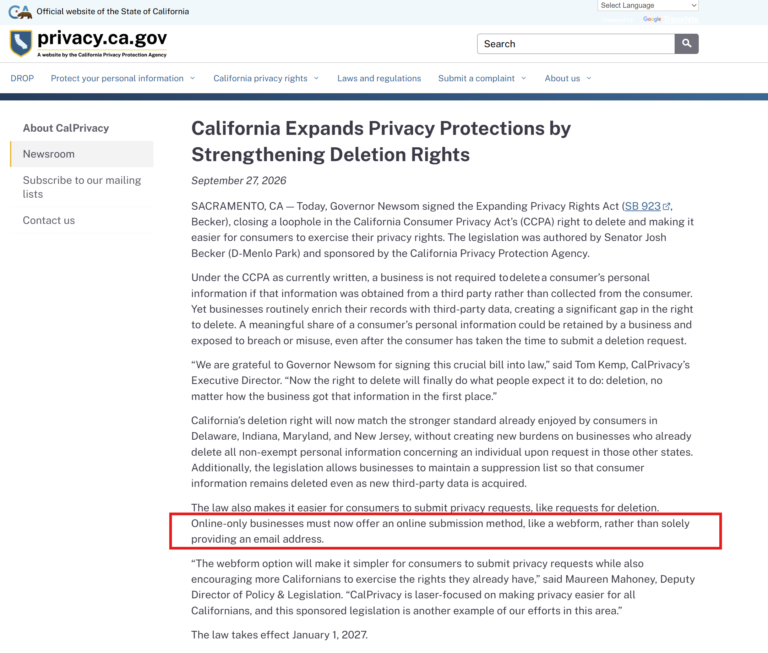
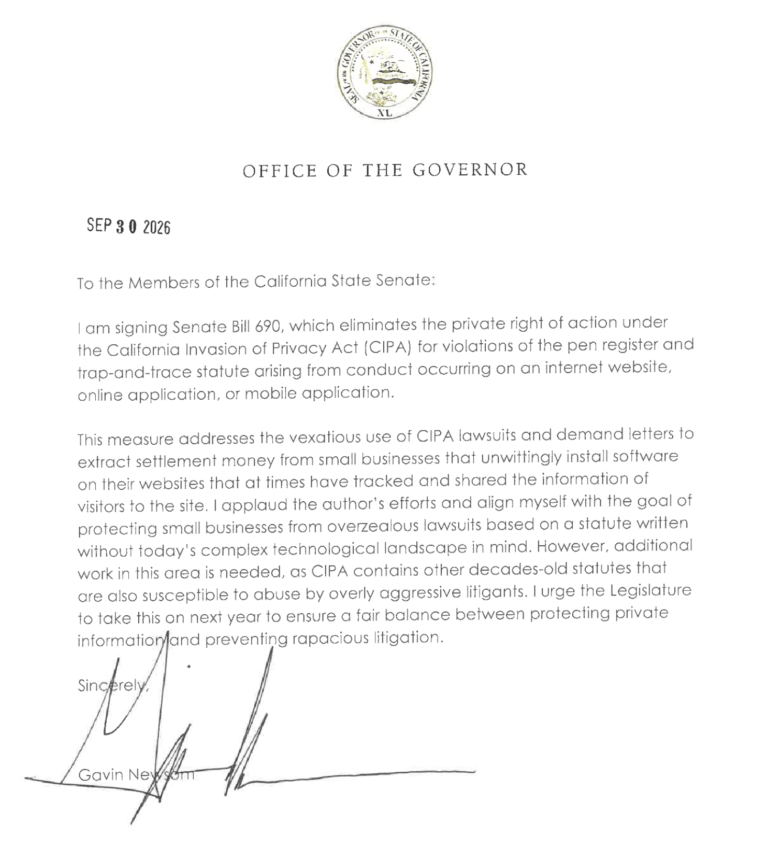
Looking ahead to 2027, the concerns we hear most often are audit readiness, AI governance maturity, ongoing exposure to private lawsuits such as CIPA wiretapping claims, and new risk assessment duties under the CCPA regulations. More rules, more oversight and more board attention are coming. Companies that assess their programs now will handle all of it with far more confidence.
Regulatory Pulse: What Is Changing
State Privacy Laws Keep Filling the Federal Gap
What changed: Congress debated a federal privacy law again and again failed to pass one. The states kept moving instead. Comprehensive privacy laws in Indiana, Kentucky and Rhode Island took effect on January 1, 2026, and newer laws are now shaping 2027 planning. More than twenty states now have comprehensive privacy statutes on the books.
Most of these laws borrow from the California, Virginia, Colorado and Connecticut models. They still differ in important ways, including consumer rights, sensitive data, consent, profiling, data protection assessments and enforcement. You need a strong common baseline plus attention to each state’s specific requirements.
Why it matters: U.S. privacy compliance is now a state-by-state problem, with some federal rules layered on top. Leadership needs to agree on a risk posture and turn it into a working compliance program. Regulators expect operational capability in these areas:
- Handling access, correction, deletion and portability requests
- Transparency about automated decision-making technology (ADMT)
- Controls for sensitive personal information
- Consent and preference management
- Vendor and third-party risk governance
- Documented data inventories and processing records
- Data protection assessments for both new and modified products
Key upcoming deadlines:
- Oklahoma Consumer Data Privacy Act: January 1, 2027
- Louisiana Consumer Privacy Act: January 1, 2027
- Alabama Data Privacy Act: May 1, 2027
- Vermont Data Privacy Act: January 1, 2028
Takeaway: Build on core privacy principles, then add the obligations specific to each state you operate in.
State AI Rules Shift from Experimentation to Accountability
What changed: States kept advancing laws on AI, automated decision-making, algorithmic accountability, disclosures and discrimination. There is still no comprehensive federal AI law, but regulators expect governance around AI systems anyway. The EU AI Act’s phased deadlines are also setting expectations worldwide, so multinational companies need to document use cases, keep inventories and run risk assessments wherever they operate.
Why it matters: Many companies rolled out generative AI faster than their governance could keep up. Boards, customers, auditors and regulators are now asking basic questions:
- Which AI systems are in use, and what data do they process?
- Who approved each deployment?
- How are risks, bias and discrimination monitored?
- What human oversight is in place?
- Can you explain how the system reaches its outputs?
- Are your disclosures accurate and timely?
- Can you honor consumer opt-out choices?
What to put in place: Privacy, legal, risk and security teams should work together to build an enterprise AI inventory (tied into your data maps), an AI governance policy and committee, acceptable use standards, risk assessment procedures, vendor and procurement reviews, and model monitoring with clear escalation paths.
Takeaway: In 2027, expect regulators and auditors to ask for evidence of AI governance, not just your word that it exists.
Children’s Online Safety Becomes a Top Enforcement Priority
What changed: Protecting kids and teens online stayed one of the most bipartisan issues of 2026. States expanded age-appropriate design rules, limits on targeted ads and profiling of minors, and restrictions on selling or sharing minors’ data. Federal regulators also stepped up scrutiny of social media, gaming, edtech and AI-driven experiences.
Why it matters: Children’s safety now reaches beyond privacy notices into product design, engagement features, recommendation algorithms and advertising. Regulators want to know whether you thought about harms to minors before launch, not just whether you collected consent.
What to review: age assurance and age-gating, teen privacy defaults, behavioral advertising, recommendation systems, how you collect children’s data, your consent management setup and product design governance.
Takeaway: If kids or teens can reasonably reach your site, app or AI product, build children’s privacy into your assessments and product reviews.
Health Data Faces Scrutiny Well Beyond HIPAA
What changed: HIPAA is still the foundation, but regulators now look at the whole picture of sensitive health data. Areas of particular concern include:
- Tracking pixels and other web tracking technologies on healthcare websites
- Sharing health-related data with advertising platforms
- Privacy practices in mobile health apps
- Reproductive health information
- Oversight of vendors and business associates
- Security safeguards for electronic protected health information (ePHI)
Many state privacy laws also treat health information as sensitive data, which brings consent and processing requirements on top of HIPAA.
Why it matters: Assuming HIPAA compliance covers everything is a common and costly mistake. Providers, health plans, digital health companies, wellness apps, employers, data brokers and tech vendors may face HIPAA, state privacy laws, consumer health data laws, children’s privacy rules, AI expectations and cybersecurity regulations all at once.
What to review: data classification, third-party pixels and trackers, vendor risk management, retention schedules, Business Associate Agreements, consent mechanisms, AI use involving health data, and security monitoring and incident response. Privacy, security, legal, marketing and product teams should share one clear view of where health data lives and how it is used.
Takeaway: Expect regulators to treat privacy, cybersecurity, AI governance and health data protection as one connected discipline in 2027.
Enforcement Watch: Where Regulators Are Looking in Q4 2026
The biggest enforcement story of 2026 is not the size of the fines. It is that regulators now test whether governance actually works.
Pattern 1: “Show Us the Evidence”
The question has moved from “Do you have a policy?” to “Can you prove it is working?” Areas under the most scrutiny include:
- Consumer rights and DSAR response processes
- Vendor and third-party oversight
- Data retention and deletion controls
- Tracking technologies and consent management
- Incident response readiness
- Board and executive oversight
- Ongoing monitoring and review of controls
For many organizations, the biggest risk is not missing controls. It is being unable to quickly show that those controls are running. Gaps we often see include:
- Data maps that are incomplete or out of date
- DSAR processes that depend on manual work
- Little documentation of vendor reviews
- Inconsistent control testing
- Privacy impact assessments done once and never revisited
- Governance meetings with no recorded decisions or follow-up
Organizations with mature evidence practices do better in audits and regulatory inquiries. The work you put in up front costs far less than fines, reputational damage and lost customers.
Pattern 2: AI Governance Centers on Ownership and Risk
The core enforcement question is becoming: who is responsible for each AI deployment, and how is the risk managed? Regulators are looking at AI inventories, risk and impact assessments, human oversight, procurement and third-party AI vendors, disclosures, bias controls and documentation for high-risk decisions.
Many companies still cannot find every AI use case in the business, including shadow AI. Many also lack central approval processes and consistent assessment methods. The teams making the most progress treat AI governance as part of enterprise risk management, not as a standalone tech project.
Pattern 3: Sensitive Data and Vulnerable Groups Get Extra Attention
Regulators are watching health, children’s, biometric, precise geolocation and financial data closely, along with any data used for profiling and targeted ads. Be ready to show data minimization, proper consent, stronger controls for sensitive data, vendor oversight, clear reasons for collecting and sharing data, and governance over tracking and marketing technologies.
Common problems include incomplete health data inventories, unclear ownership of website trackers, and weak oversight of marketing and analytics vendors. The strongest programs manage privacy, security, AI and sensitive-data risk together.
Market Notes
2026 brought a wave of platforms promising to monitor, gatekeep and report on enterprise AI tool usage from one dashboard. Consent management platforms keep adding AI governance features and racing to keep up with new laws, and the space has started to consolidate through mergers. CIPA lawsuits have also driven demand for website scanning tools that catch misconfigured or miscategorized trackers before plaintiffs’ firms do.
The Bottom Line for 2027
The defining theme heading into 2027 is accountability you can prove. Regulators expect governance programs that work in practice, AI systems that are actively managed, and sensitive data handled with extra care. Organizations that can show ownership, monitoring, review and documented decisions will be in a much stronger position than those relying on policies alone.
Captain Compliance helps you build that evidence trail. Our consent management platform, automated DSAR workflows, Global Privacy Control support, dynamic privacy policies and Patrol continuous website monitoring give you the records and visibility regulators and auditors ask for. Use the rest of 2026 to prepare. Talk to Captain Compliance about getting audit-ready for 2027.
Put this into practice
Turn privacy guidance into working controls.
Captain Compliance helps teams discover tracking technologies, enforce consent, manage privacy requests and document the evidence behind every decision.