Know what’s on your site before a plaintiff’s firm does
A free privacy audit shows which cookies, pixels and trackers are running — and which ones commonly appear in privacy claims.
For years, the cookie consent banner was treated as a legal formality — a checkbox exercise to satisfy privacy regulators and move on. That era is over. A mounting wave of litigation is now targeting the banners themselves, turning what was once a compliance solution into a fresh source of legal exposure for website operators across every industry and one company Captain Compliance has been at the forefront defending and fixing these faulty cookie banners and replacing them with a solution that works built by the privacy experts here at Captain Compliance.
From Safeguard to Liability: How We Got Here
Cookie banners emerged as a practical response to growing scrutiny over online data collection. The logic was simple: give users a visible choice about whether to allow tracking, document that choice, and stay on the right side of privacy law. For a while, it worked — or at least, it kept the lawsuits pointed elsewhere.
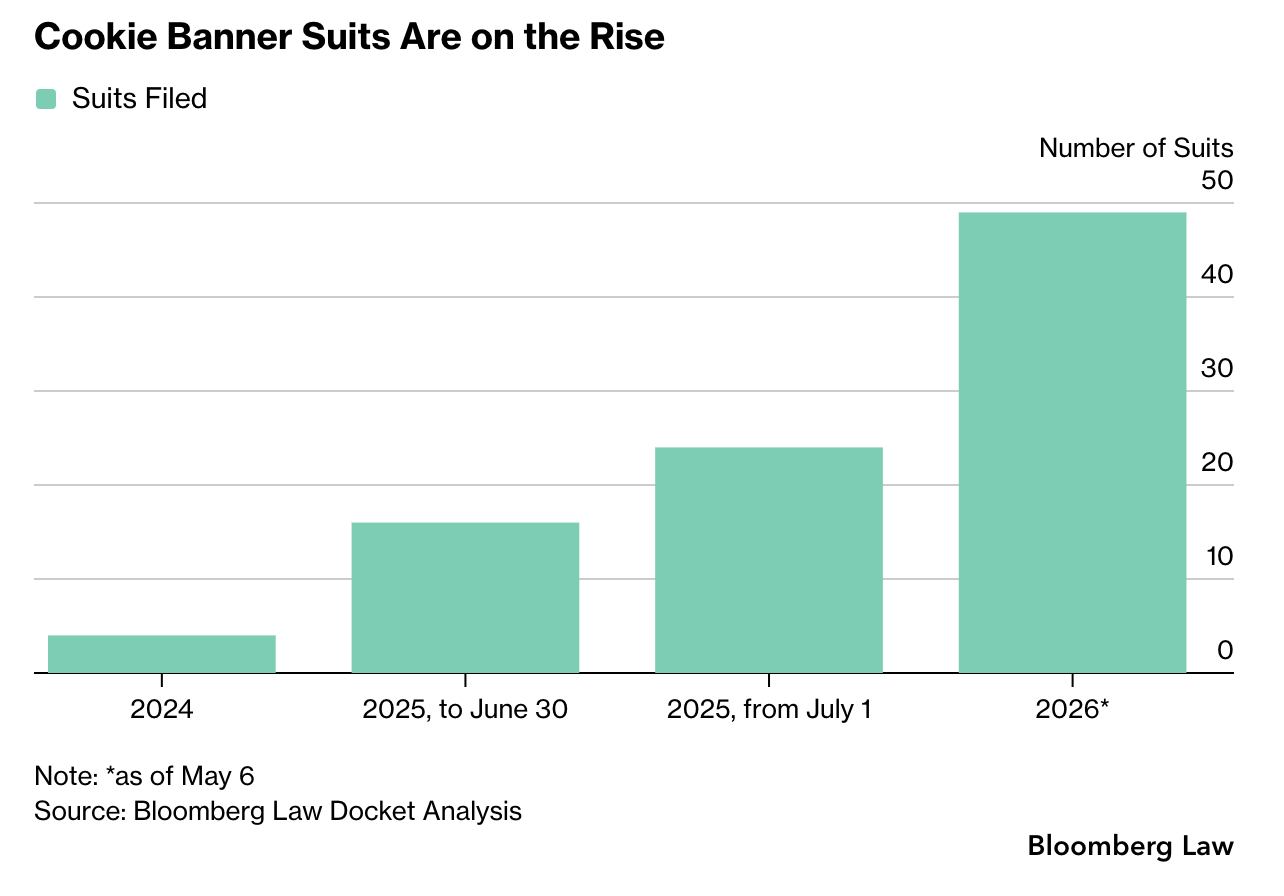
But courts and plaintiff attorneys have caught up. Since late 2024, the number of federal lawsuits specifically targeting cookie banner functionality has exploded. A handful of cases filed in late 2024 swelled to 40 in 2025 and nearly 50 in the first portion of 2026 alone. The complaints share a common allegation: websites are continuing to collect and share user data with third parties even after users have clicked “Reject All.”
That gap between what a banner promises and what actually happens on the backend is the core of the problem — and it’s opening companies up to serious legal risk.
The CIPA Problem Nobody Saw Coming
Most of the new lawsuits rely on the California Invasion of Privacy Act (CIPA), a decades-old wiretapping statute that was never written with the internet in mind. CIPA allows for statutory damages of $5,000 per violation — and when you multiply that across a class of thousands or millions of website visitors, the financial exposure becomes enormous.
Here’s where it gets complicated for compliance teams: many of these companies genuinely believed they were doing everything right. They implemented cookie banners specifically to comply with the California Consumer Privacy Act (CCPA), which provides a well-defined regulatory framework for how consent must be captured and honored. The CCPA rules are clear, detailed, and relatively easy to follow.
CIPA is a different animal. It operates from the California Penal Code, it was never designed with digital advertising in mind, and it can apply to situations that fall perfectly within CCPA compliance. In other words, you can follow every CCPA rule to the letter and still face a CIPA wiretapping claim if data continues to flow after a user opts out.
This legal mismatch has become so disruptive that companies are now pushing the California Legislature to clarify how CIPA should apply to online tracking scenarios. Suits are on the rise exactly as we’ve been warning and Bloomberg Law has covered a piece on the rise of these suits.
The “Reject All” Button Problem
Much of the litigation zeroes in on a feature that was actually introduced as a consumer-friendly improvement: the prominent “Reject All” button.
California regulators pushed hard for this button as part of a broader effort to eliminate “dark patterns” in cookie banners — those intentionally confusing design choices that nudge users toward accepting more data collection than they intended. The goal was to make opting out just as easy and visible as opting in.
But the name “Reject All” is misleading in ways that are now creating legal problems. In practice, clicking “Reject All” doesn’t prevent every cookie from loading — some cookies are technically essential for a website to function at all, such as those that keep you logged in or remember items in your cart. A more accurate label would be “Reject Non-Essential Cookies,” but “Reject All” became the industry standard because it sounds cleaner and more decisive to users.
The real compliance question isn’t about labels, though. It’s about what’s happening under the hood. Are advertising and targeting cookies truly being blocked when a user opts out? Or have companies quietly categorized those cookies as “essential” in their systems, allowing data collection to continue regardless of the user’s stated preference? That kind of misclassification is exactly what regulators and plaintiff attorneys are looking for, and it’s the kind of thing that can turn a minor technical oversight into a class action.
Mechanics of a Cookie Banner
The mechanics of cookie banner litigation are less technically demanding than other privacy lawsuits, which makes it an attractive area for plaintiff firms. An attorney with the right technical support can simply visit a website, click “Reject All,” and then observe whether tracking pixels and third-party data calls continue to fire in the background. No deep code review required.
That accessibility raises the risk for everyone — not just large enterprises with sophisticated data stacks, but small and mid-sized e-commerce companies that rely on behavioral advertising and may not have scrutinized their tag management setups carefully.
The fundamental principle that privacy attorneys keep coming back to is straightforward: say what you’re doing, and do what you say. If your banner promises users that rejecting cookies will stop data collection, that promise needs to be technically true. A gap between the stated policy and the actual system behavior isn’t just a regulatory concern — it can constitute fraud under common law, in addition to CIPA exposure.
Three Steps to Reduce Your Cookie Banner Risk
- Audit your actual data flows, not just your policy language. Your privacy policy and cookie banner may be perfectly written, but if your tag management system or third-party scripts continue firing after an opt-out, you have a technical compliance gap. Work with your development team or a third-party auditor to verify that opting out actually stops the relevant data collection.
- Review how you’ve categorized your cookies. The line between “essential” and “non-essential” cookies is where a lot of risk lives. Advertising cookies, retargeting pixels, and behavioral analytics tools should not be classified as essential. If they are, and a regulator or plaintiff attorney looks closely, it will look like a deliberate misrepresentation.
- Watch the regulatory horizon. The California Privacy Protection Agency has already issued guidance on dark patterns in cookie banners, and CIPA’s application to online tracking is an active area of legal development. Compliance requirements in this space are not static, and what was acceptable practice 18 months ago may not protect you today.
Cookie banner compliance isn’t glamorous, but right now it’s one of the highest-risk areas in digital privacy law. The good news is that the core obligation is straightforward: build systems that honor the choices your users actually make, and make sure your banner language accurately describes what those choices will do. Get that right, and you’re in a far stronger position than most of your competitors.
Have questions about your website’s cookie compliance posture? The Captain Compliance team can help you assess your current setup and close any gaps before they become legal problems. Book a demo below and speak with one of our experts and get a free privacy audit.
Put this into practice
Turn privacy guidance into working controls.
Captain Compliance helps teams discover tracking technologies, enforce consent, manage privacy requests and document the evidence behind every decision.


