Know what’s on your site before a plaintiff’s firm does
A free privacy audit shows which cookies, pixels and trackers are running — and which ones commonly appear in privacy claims.
The global average cost of a data breach just hit $4.99 million — a 12% jump and a record high, according to IBM’s newly released 2026 Cost of a Data Breach Report. Regulators aren’t slowing down either: European authorities issued roughly €1.2 billion in GDPR fines in 2025 alone, and as of this month, businesses handling California consumer data are now required to connect to the CPPA’s Delete Request and Opt-out Platform (DROP) under the Delete Act’s August 2026 processing mandate.
If your organization is still treating data risk management as a once-a-year checklist item, this is the year that stops working. This guide gives you an actual operating framework — not just a definition — that you can put to work this quarter, along with the risk assessment tools, common failure points, and a 90-day implementation roadmap.
Data risk management at a glance
- Data risk management is the ongoing process of discovering, classifying, assessing, and controlling the risks tied to the data your organization collects, stores, and shares.
- The average data breach now costs $4.99 million globally (up 12% year-over-year) and $10.22 million+ in the U.S. — the highest of any country, largely driven by regulatory fines and litigation exposure.
- Shadow AI — employees feeding sensitive data into unsanctioned AI tools — is now a factor in roughly 1 in 5 breaches and adds hundreds of thousands of dollars in cost when it is.
- This guide walks through the SHIELD framework: Survey, Heat-map, Implement, Engage third parties, Lay out response plans, and Drive continuous monitoring.
- Below, you’ll find a risk heat-map you can copy for your own team, a breach-cost trend chart, and a 30/60/90-day rollout plan.
What is data risk management?
Data risk management is the discipline of identifying what could go wrong with the data your organization touches — unauthorized access, corruption, loss, misuse, non-compliant processing — and systematically reducing the likelihood and impact of those outcomes. It sits at the intersection of privacy, security, and compliance, but it isn’t a synonym for any one of them.
That distinction trips a lot of teams up, so it’s worth spelling out where the boundaries actually sit:
| Discipline | Core question it answers | Primary output |
|---|---|---|
| Data governance | Who owns this data, and what are the rules for using it? | Policies, ownership assignments, stewardship structure |
| Data security | How do we stop unauthorized access to this data? | Encryption, access controls, network defenses |
| Data risk management | What could go wrong, how bad would it be, and what do we do about it? | Risk register, heat map, prioritized remediation plan |
| Privacy compliance | Are we processing this data lawfully under applicable regulations? | DPIAs, DSAR workflows, consent records, regulatory filings |
In practice, data risk management is the connective layer: it takes governance policy, security controls, and compliance obligations, and turns them into a prioritized, measurable program. Get this layer wrong and you end up with security tools nobody’s watching, policies nobody’s enforcing, and compliance gaps nobody caught until a regulator did.
Why data risk management matters more in 2026 than it did a year ago
Three forces converged in the last 12 months to make this a board-level conversation instead of an IT ticket:
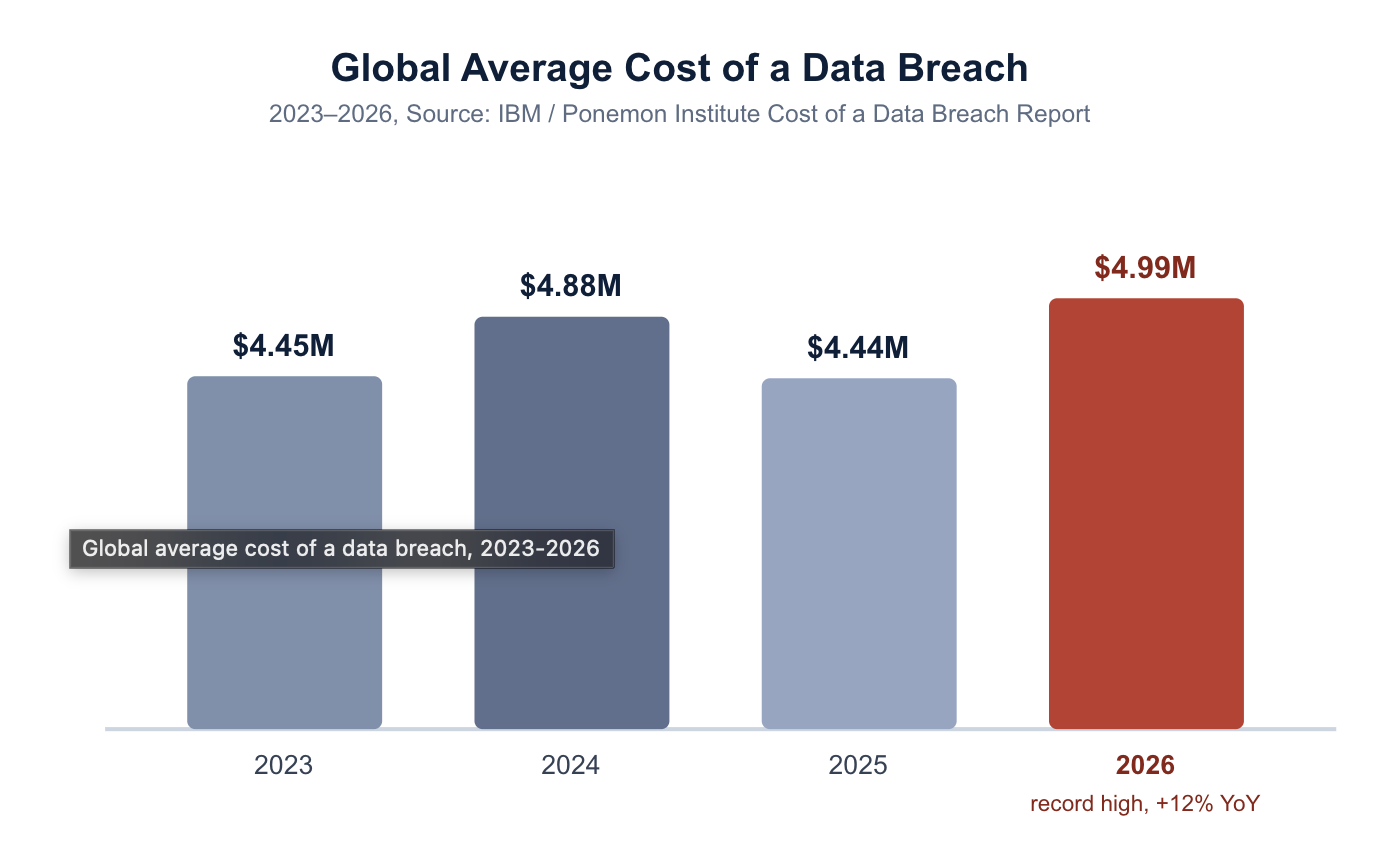
- Breach costs reversed course and hit a record high. After a brief dip in 2025 ($4.44 million, down from $4.88 million the year before), IBM’s 2026 report shows costs jumped 12% to $4.99 million globally — the highest figure the report has ever recorded, driven by higher detection, escalation, and lost-business costs tied to AI-era attacks.
- Regulatory enforcement kept compounding. European regulators issued roughly €1.2 billion in GDPR fines in 2025, including a €530 million penalty against TikTok over international transfer violations, pushing cumulative GDPR fines past €7.1 billion since 2018. In the U.S., the CPPA and state attorneys general have continued enforcement sweeps against data brokers and ad-tech vendors over deficient disclosures and unauthorized data sharing.
- AI quietly became a new data risk surface. Shadow AI — unsanctioned employee use of tools like public chatbots — was a contributing factor in roughly 1 in 5 breaches and added an average of $670,000 to the cost when it was involved. The majority of organizations still have no formal AI governance policy at all.
Here’s what the breach-cost trend actually looks like — the dip in 2025 was real, but it was a blip, not a turnaround:
The SHIELD framework for data risk management
Most data risk frameworks stop at “discover, assess, mitigate, monitor.” That’s a fine skeleton, but it leaves out the two areas that actually generate the most exposure is: third-party/vendor data sharing and the response plan for when controls fail anyway. SHIELD builds those in as first-class steps, not afterthoughts.
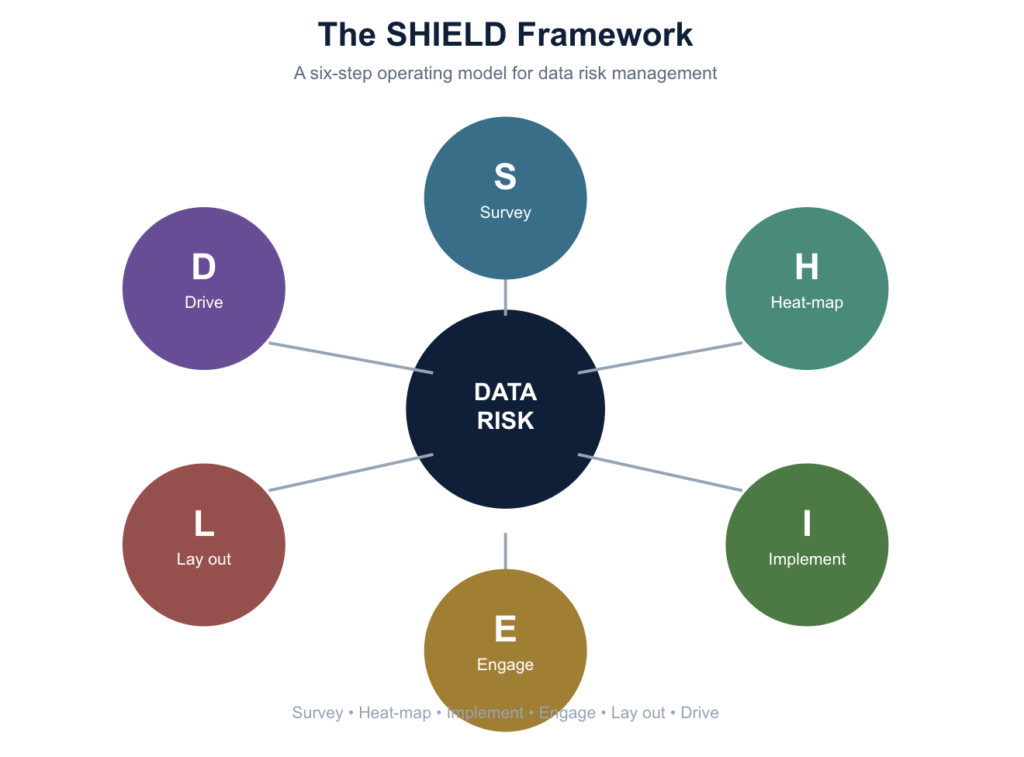
S — Survey: find and classify every store of sensitive data
You cannot manage risk in data you don’t know exists. Start with automated discovery across structured databases, cloud storage, SaaS applications, and endpoint devices — then classify each store by sensitivity tier (e.g., Public, Internal, Confidential, Restricted) and by regulatory category (PII, PHI, payment data, biometric data, employee data).
- Run a full structured and unstructured data discovery scan, not just a survey of “known” systems — most organizations find sensitive data in places they didn’t expect.
- Map data flows: where it enters, where it’s stored, who touches it, where it exits (including to vendors and subprocessors).
- Tag each store with its applicable regulatory regimes — GDPR, CCPA/CPRA, HIPAA, GLBA — since that determines downstream obligations, not just security posture.
H — Heat-map: score risks by likelihood and impact
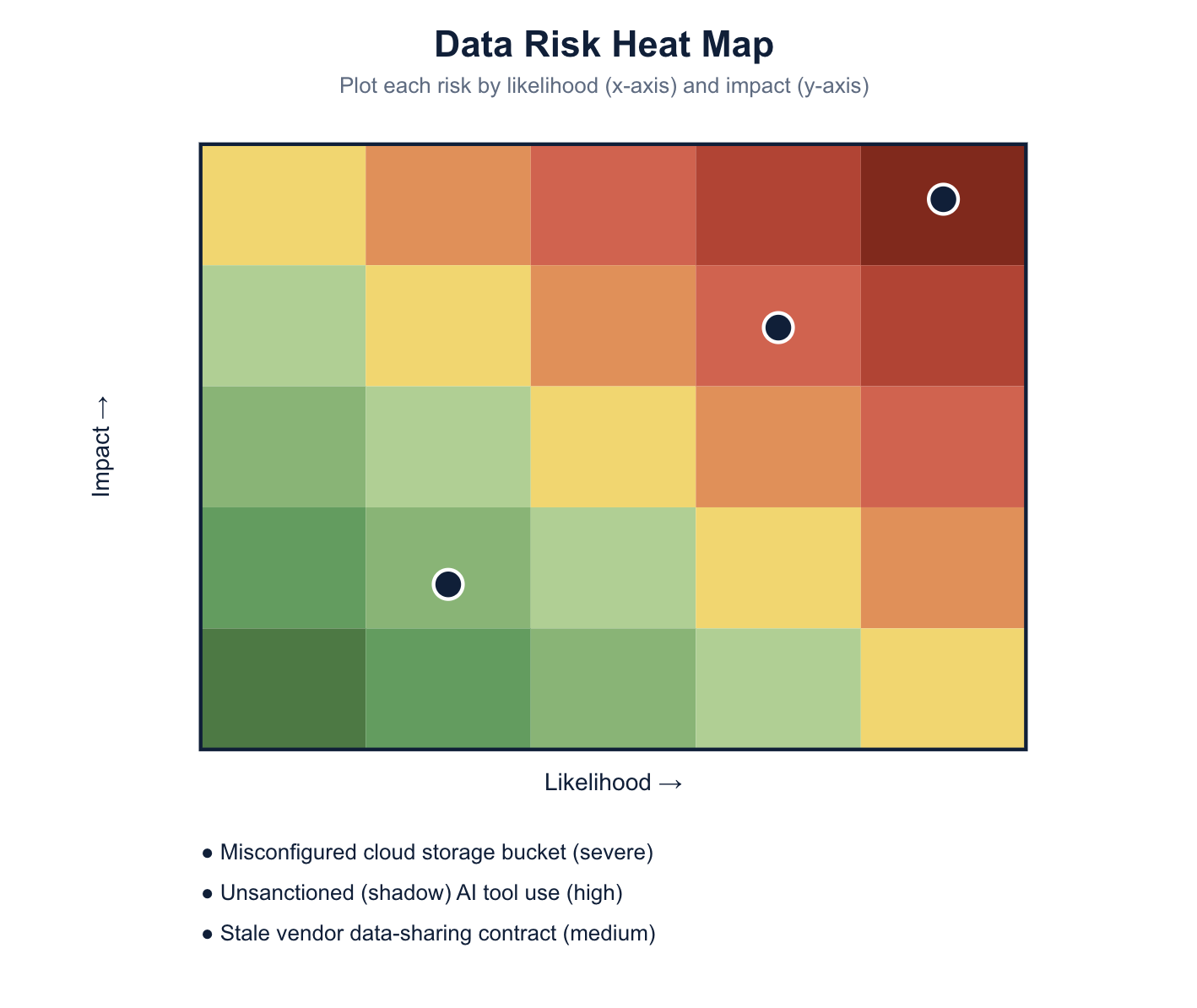
Once you know what you have, plot each risk on a likelihood-versus-impact matrix. This is where most teams either overcomplicate things (20-factor scoring models nobody maintains) or undercomplicate them (a gut-feel “high/medium/low” tag with no rigor behind it). A simple 5×5 matrix, scored consistently, beats both.
- Score likelihood and impact independently on a 1–5 scale, using both quantitative inputs (potential financial exposure, number of records) and qualitative ones (reputational damage, regulatory scrutiny).
- Anything landing in the top-right red zone gets remediated first — full stop, regardless of how much effort it takes.
- Re-score quarterly. A risk that was medium six months ago (e.g., an unmonitored vendor integration) can migrate into the red zone fast once that vendor changes hands or suffers its own breach.
I — Implement controls proportional to the risk
This is where risk scoring becomes action. Match the control investment to where the risk actually lives — don’t spend enterprise-grade budget hardening a low-risk system while a red-zone risk sits untouched.
- Access management: role-based access control (RBAC) built on least privilege, plus multi-factor authentication on anything touching Restricted or Confidential data.
- Encryption and masking: encrypt sensitive data at rest and in transit; mask or tokenize it wherever full visibility isn’t operationally necessary.
- AI governance controls: a written policy on which AI tools are approved, what data classes may never be pasted into a prompt, and technical controls (DLP rules, approved-tool allowlists) to enforce it. Given that most breached organizations still have no AI governance policy at all, this single control closes one of the widest gaps in the room.
- Change management: misconfigurations remain one of the leading causes of major breaches, so every new cloud resource or permission change should run through a review gate, not just a monitoring dashboard after the fact.
E — Engage and vet third parties
Vendor and subprocessor risk is the step most generic frameworks fold into “assessment” and then quietly forget about. It shouldn’t be an afterthought: every vendor, ad-tech partner, and AI subprocessor that touches your data expands your attack surface and your regulatory exposure — you remain accountable for what they do with it, even under a signed data processing agreement.
- Maintain a live inventory of every vendor and subprocessor with access to Confidential or Restricted data, including what data they touch and why.
- Vet new vendors against a standard security and privacy questionnaire before contracts are signed — not after data starts flowing.
- Re-verify subprocessor disclosures on a fixed cadence. Under GDPR, CCPA/CPRA, and most state privacy laws, you’re required to keep this current and disclose it — and enforcement actions against ad-tech and data-broker relationships have repeatedly turned on exactly this gap.
- Build vendor offboarding into the process: when a contract ends, confirm data deletion or return, don’t assume it happens automatically.
L — Lay out your incident response plan before you need it
Even mature programs get breached. What separates a $2 million incident from a $10 million one is usually how fast the organization identifies, contains, and communicates — and that speed comes entirely from a plan rehearsed in advance, not one written during the incident itself.
- Document clear roles: who declares an incident, who leads containment, who handles regulatory notification, who handles customer communication.
- Pre-draft notification templates for the jurisdictions you operate in — breach notification timelines are as short as 72 hours under GDPR and vary by state under U.S. law.
- Run a tabletop exercise at least annually. Organizations that involve law enforcement and rehearse response consistently see meaningfully lower breach costs than those improvising in real time.
D — Drive continuous monitoring and regulatory mapping
Data risk management isn’t a project with an end date — it’s a standing operating rhythm. The final step is building the cadence that keeps everything above current.
- Stand up dashboards tracking key risk indicators: unresolved red-zone risks, vendor reassessment status, days since last access review, AI tool approval requests.
- Map your data inventory against every regulatory regime you’re subject to and re-check it whenever you enter a new state, launch a new product, or a law changes — state privacy laws and data broker registration requirements in particular shift often enough that an annual check isn’t sufficient.
- Schedule recurring audits — internal reviews at minimum quarterly, third-party assessments annually — and treat findings as inputs back into the Heat-map step, not a one-off report that sits in a drive folder.
The most common data risks in the age of AI
- Shadow AI usage. Employees pasting customer data, contracts, or source code into unapproved AI tools, with no logging, no DLP, and no way to know where that data ends up.
- Misconfigured cloud storage. Still one of the single leading causes of large-scale exposure — a storage bucket left public or a database with default credentials can expose records in minutes.
- Vendor and subprocessor sprawl. Ad-tech pixels, analytics scripts, and SaaS integrations that quietly share data downstream without a current disclosure or a valid legal basis.
- Cross-border transfer exposure. International data transfers remain one of the most heavily enforced categories under GDPR, with the largest 2025 fine (€530 million) tied directly to this issue.
- Data broker and disclosure gaps. With state Delete Act frameworks now requiring active platform connections and processing, an outdated or missing broker registration is no longer a paperwork risk — it’s an active enforcement target.
- Insider risk. Both malicious and accidental — a departing employee exporting a customer list, or a well-meaning staffer emailing the wrong spreadsheet to the wrong address.
A 30/60/90-day rollout plan
If you’re building this from scratch (or rebuilding a stalled program), here’s a realistic sequence:
| Timeframe | Focus | Deliverable |
|---|---|---|
| Days 1–30 | Survey + Heat-map | Complete data inventory, classification tiers assigned, first risk heat map drafted |
| Days 31–60 | Implement + Engage | Red-zone controls deployed, vendor inventory built, AI governance policy published |
| Days 61–90 | Lay out + Drive | Incident response plan drafted and tabletop-tested, monitoring dashboard live, quarterly review cadence scheduled |
Common mistakes that quietly sink data risk programs
- Treating it as an annual audit instead of a live process. Risk registers that only get touched once a year are already stale by month three.
- Scoring risk without cross-functional input. A security team alone will miss the business-impact and regulatory dimensions that legal, privacy, and product teams can see immediately.
- Ignoring vendor and subprocessor relationships. The riskiest data flows are frequently the ones leaving your environment entirely, not the ones sitting in your own database.
- No AI usage policy. The majority of breached organizations still have none — and shadow AI is one of the costliest contributing factors when a breach happens.
- Writing an incident response plan and never testing it. A plan that hasn’t been rehearsed tends to fall apart within the first hour of an actual incident.
How Captain Compliance helps you operationalize this
Building the SHIELD framework manually with spreadsheets is possible — but most teams don’t have the bandwidth to keep a live data inventory, vendor disclosure log, consent records, and DSAR workflow all current at once. Captain Compliance’s platform handles continuous website and data-flow monitoring, vendor and cookie/tag disclosure tracking, DSAR automation, and dynamic privacy policy updates in one place, backed by IAB TCF validator certification and an Article 27 EU representative partnerships.
See how Captain Compliance can operationalize your data risk management program →
Data risk management FAQs
What’s the difference between data risk management and data governance?
Data governance sets the rules — ownership, classification standards, retention policy. Data risk management applies those rules against real threats, scoring what could go wrong and prioritizing what to fix first. Governance defines the map; risk management is what you do when the map shows a cliff.
How often should a data risk assessment be performed?
Continuously, in practice, with formal reassessment at least quarterly. High-change environments — new cloud deployments, new vendor integrations, expansion into a new state or country — warrant an immediate reassessment rather than waiting for the next scheduled cycle.
What frameworks or standards does data risk management draw on?
Most organizations align their program with NIST’s Privacy Framework and Cybersecurity Framework, ISO 27701, and SOC 2 for security controls, while mapping specific obligations to the regulations that apply — GDPR, CCPA/CPRA, HIPAA, GLBA, and applicable state privacy and data broker laws.
Who owns data risk management inside a company?
Ownership is typically shared: a CISO or risk officer leads strategy and control implementation, a privacy or legal function owns regulatory mapping and disclosure obligations, and business-unit leaders are accountable for the risk decisions made about the data their teams generate and use.
Does shadow AI use actually increase data breach costs?
Yes. IBM’s 2025 and 2026 research found shadow AI usage was a contributing factor in roughly 1 in 5 breaches, adding hundreds of thousands of dollars to the average cost and correlating with higher rates of customer PII exposure — largely because sensitive data leaves the organization’s monitored environment entirely once it’s pasted into an unapproved tool.
Put this into practice
Turn privacy guidance into working controls.
Captain Compliance helps teams discover tracking technologies, enforce consent, manage privacy requests and document the evidence behind every decision.