Alex Proctor
Alex Proctor is a privacy and data protection professional with 15 years of experience spanning healthcare, critical infrastructure, and other highly regulated industries. With a strong foundation in cybersecurity, Alex brings a unique perspective to privacy and AI leadership. He led a cybersecurity consulting practice for half a decade and has led cybersecurity and privacy governance, risk, and compliance programs at a prominent EPC firm. He has also developed AI governance training resources used by cyber governance professionals globally. Alex serves as the Chief Trust & Privacy Officer at Captain Compliance—a privacy technology startup dedicated to simplifying complex privacy challenges and reducing privacy risk. The company’s streamlined platform addresses cookie consent management, dynamic privacy notices, data subject request processing, and more. Alex graduated from Oakland University with a bachelor’s degree in Management Information Systems (MIS). He holds numerous industry certifications, including the ISC2 CISSP and CCSP, as well as the IAPP CIPM, CIPP/E, CIPP/US, CIPT, and AIGP. Recognized by the IAPP as a Fellow of Information Privacy (FIP), Alex also chairs the IAPP Detroit KnowledgeNet chapter. He fosters dialogue and knowledge-sharing within the privacy community.
Posted articles 77 TOTAL
 CALIFORNIA PRIVACY – CPRA
 The Evidence Clock: Why the First CCPA Audit Year Is the One You Can’t Redo
California’s privacy regulator can ask a covered business to hand over its required audit reports and expect an answer within 30 days.
 GDPR
GDPR Explicit GDPR Lawful Basis Statements: What Articles 13 and 14 Require in Your Privacy Notice
In January 2023, Ireland’s Data Protection Commission fined Meta a combined 390 million euros over how Facebook and Instagram handled personal data…
The FRIA Is Coming: Why AI Governance Must Assess Connectors, Permissions and Data Access — Not Just the Model
Most companies preparing for the EU AI Act’s Fundamental Rights Impact Assessment requirements are asking familiar questions.
Song-Beverly Credit Card Act: When Checkout Data Collection Becomes a Privacy Lawsuit
A cashier asks for a ZIP code. A payment screen asks for a phone number. An electronic receipt requires an email address,…
Cantwell’s Six-Point AI Governance Plan Would Replace Voluntary Guardrails With Continuous Oversight
The next major fight over U.S. artificial intelligence regulation may not be about whether AI should be tested before deployment. Increasingly, policymakers…
AI Governance Is Becoming a Real Profession — and Companies Need to Decide Who Actually Owns It
Companies have spent the last two years creating AI committees, appointing “responsible AI” leads, adding artificial intelligence to privacy programs and asking…
AI Governance: Know What Your AI Does, Who Approved It, and What Data It Uses
Your marketing team uses AI to write campaigns. Customer service has an AI chatbot. HR is evaluating a tool that ranks applicants.…
Your AI Agent Is Still Your Problem: The FTC’s Message to Businesses Deploying Autonomous AI
AI agents can browse websites, send emails, modify files, query databases, interact with customers, call APIs and increasingly perform work without waiting…
Illinois Just Made Model Weights a Security Asset. Encryption at Rest Will Not Cover It.
Illinois did not regulate a chatbot. It regulated the file that is the model. In early July 2026, Governor JB Pritzker signed…
 CALIFORNIA PRIVACY – CPRA
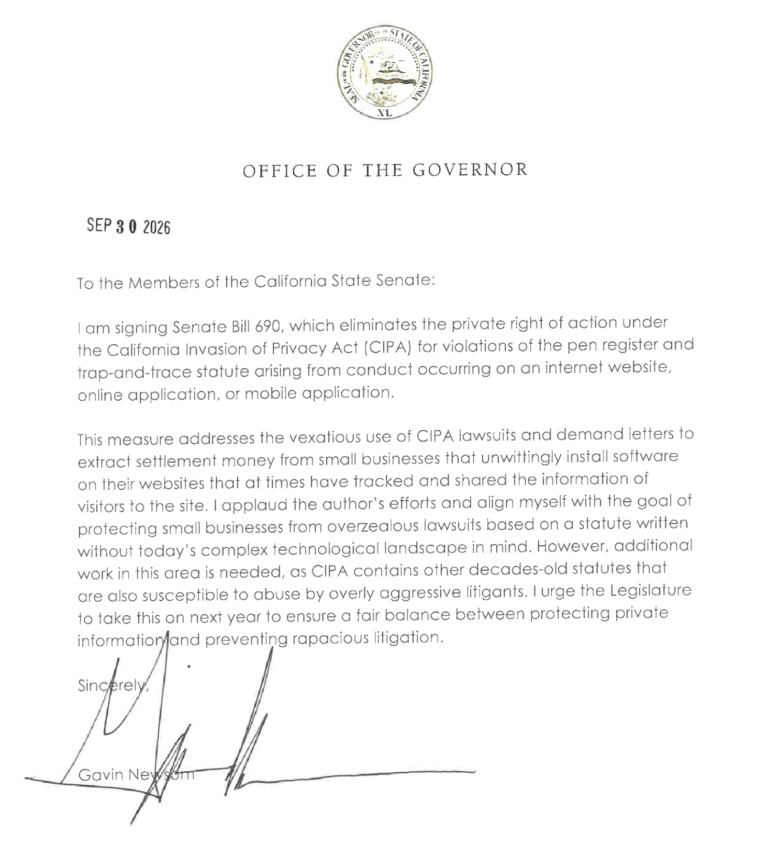
 California Closes the CIPA Pen Register Loophole. The Wiretap Cases Are Still Coming.
California just cut the private right of action out of the most-used theory in website-tracking litigation.
Is Your Customer Service Call a Biometric Event? Lowe’s Voiceprint Lawsuit Signals a New BIPA Risk for AI
A routine call to customer service may be becoming something very different under Illinois privacy law.
 GDPR
GDPR Agentic AI Was Built to Improvise. Privacy Law Was Built for Predictability.
Most privacy laws were written around a relatively understandable model of computing.
Check your own site
See what your website is actually sending.
Run a free privacy audit and find the cookies, pixels, session-replay tools, and trackers running right now — plus the ones that commonly show up in privacy claims. A real review of your site, not just a scan.