Know what’s on your site before a plaintiff’s firm does
A free privacy audit shows which cookies, pixels and trackers are running — and which ones commonly appear in privacy claims.
With CIPA penalties hitting $5,000 per violation and ADA website lawsuits up 300% over five years, a California-based compliance firm is offering something the market has lacked: forensic-grade proof that your website is actually clean.
Most business owners assume their website is compliant. They installed a cookie banner. Their developer added a privacy policy. They’ve never received a complaint. That assumption, increasingly, is costing them.
APFCompliant — operating as APFC — is an independent website compliance assessment and remediation firm built around a straightforward premise: 85% of business websites have at least one trackable privacy violation, and most of those businesses have no idea. The firm’s work sits at the intersection of three specific federal and California statutes — CIPA, the ADA, and the VPPA — and its methodology is designed to produce documentation that holds up not just internally, but under legal scrutiny.
The Problem with Generic Compliance
There’s no shortage of cookie consent plugins, accessibility overlay widgets, and privacy policy generators on the market. The compliance industry has produced an entire ecosystem of tools that create the appearance of compliance without necessarily delivering the substance of it.
APFCompliant draws a clear line between what it does and that category of solution. Where a generic web developer can install a cookie banner, APFC verifies that the banner actually meets CIPA requirements — that consent is obtained before trackers fire, that the implementation is technically accurate, and that the fix is documented with scan-verified evidence. That distinction matters enormously when a demand notice or lawsuit is on the table.
The firm works with businesses across healthcare, hospitality, retail, professional services, and more — from single-location operators to multi-site enterprises. The range reflects the fact that compliance exposure doesn’t scale with company size. A regional restaurant chain with an embedded YouTube video and a Facebook Pixel carries the same VPPA exposure as a Fortune 500 media company.
Three Statutes, One Assessment
APFC’s scope covers the three areas of law generating the most litigation activity for business websites right now.
CIPA compliance addresses the California Invasion of Privacy Act, which prohibits intercepting or recording private communications without consent. On the modern web, that translates primarily to tracking pixels and advertising cookies that fire before a visitor has had the opportunity to opt in. APFC’s scanning engine checks for pixels from more than eleven advertising and analytics providers, evaluating whether they activate prior to consent capture. With statutory penalties reaching $5,000 per violation, a single misconfigured tag manager can create exposure that dwarfs the cost of remediation.
ADA accessibility is assessed against WCAG 2.1 Level AA standards — the benchmark that courts and regulators reference when evaluating whether a website meets Title III obligations. The audit examines missing alt text on images, color contrast ratios, keyboard navigation functionality, form label associations, and heading structure, among other criteria. ADA website lawsuits have increased by 300% over the past five years, driven in significant part by the same kind of systematic scanning that APFC itself employs.
VPPA video privacy is perhaps the least intuitive of the three for most business owners. The Video Privacy Protection Act, passed in 1988, prohibits disclosing video viewing records to third parties without consent. The modern application: when a tracking pixel — particularly a Meta Pixel — is active on a page that also embeds video content, it can transmit data about what a visitor watched to Facebook, creating VPPA liability at $2,500 per violation. APFC detects these pixel-on-video combinations automatically, flagging exposure that most standard privacy audits miss entirely.
The Forensic-Grade Difference
What distinguishes APFCompliant’s methodology from a compliance checkbox exercise is the evidence architecture behind every assessment. Findings aren’t generated from manual reviews or self-reported questionnaires. They come from automated scanning that captures full-page screenshots, network request logs, complete cookie inventories, and source code snapshots at the time of the scan.
Every piece of evidence is hashed using SHA-256 cryptographic verification, with chain-of-custody documentation maintained for legal admissibility. The result is a compliance record that doesn’t just describe what was found — it proves it, in a format that’s useful for legal review and defensible if challenged.
That evidentiary standard runs through the entire engagement. After remediation is complete, APFC re-scans the site to verify that every identified issue has been resolved. Clients receive a before-and-after comparison report that documents the original violations, the remediation steps taken, and the verified post-fix state. For businesses that have received a demand notice or are anticipating legal scrutiny, that documentation provides something genuinely valuable: good-faith compliance efforts, on paper, with timestamps.
Services and Pricing Structure
APFCompliant offers three remediation tiers, each structured as a one-time engagement:
The Privacy Shield package at $999 addresses CIPA compliance — consent banner installation and configuration, tracker audit and cleanup, privacy policy update, and cookie policy page — followed by a before-and-after verification scan.
The Accessibility Shield at $1,799 covers WCAG 2.1 AA remediation for up to ten pages, including code-level fixes for alt text, forms, color contrast, keyboard navigation, and heading structure, plus an accessibility statement page.
The Full Compliance package at $2,499 combines both of the above with VPPA video privacy fixes, an RCP Compliance Certificate, and a comprehensive before-and-after comparison report. It’s the firm’s most popular tier and the one recommended for businesses with compound exposure across all three statutes.
Every remediation engagement includes a period of free Compliance Monitoring — one month for the single-statute packages, three months for Full Compliance.
For ongoing protection after the free period, continuous monitoring is available at $49 per month or $539 annually. The monitoring system runs daily automated scans and alerts clients when new violations appear — a meaningful safeguard given how easily compliance can be broken by routine website changes. A CMS update, a new marketing tag added by an agency, a plugin change pushed by a developer — any of these can reintroduce violations that didn’t exist the day before.
The Trust Badge Program
Clients who complete remediation earn an embeddable APFCompliant trust badge, providing a visible, verifiable signal to website visitors that the site has been independently assessed and verified for CIPA, ADA, and VPPA compliance. In a digital environment where consumer trust around data handling is under increasing pressure, that kind of third-party verification carries real communicative value — particularly for businesses in industries where privacy expectations are high.
Starting with a Free Assessment
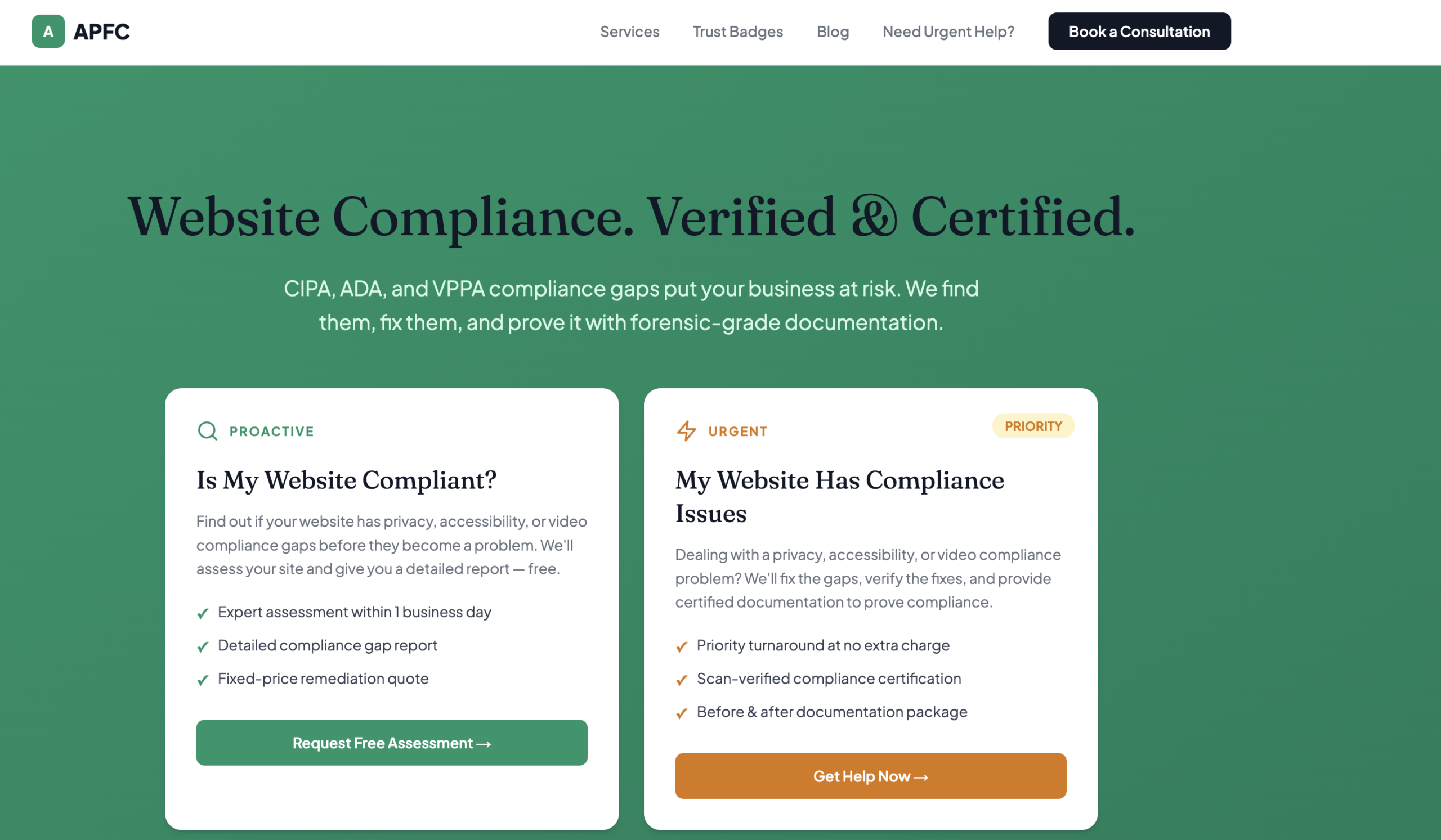
For businesses uncertain about their current exposure, APFC offers a free compliance assessment with a turnaround of one business day. The assessment delivers a detailed compliance gap report and a fixed-price remediation quote — no obligation, no account required.
For businesses that have already received a demand notice, priority turnaround is available at no extra charge. The firm’s position is explicit: a business that responds quickly and demonstrates good-faith remediation is in a fundamentally different legal position than one that ignores the issue or delays.
Given that the three statutes APFC covers between them allow for $5,000 per CIPA tracking violation, $4,000 per documented ADA-barrier visit under California’s Unruh Act, and $2,500 per VPPA disclosure — per plaintiff — the math on proactive compliance is not complicated.
The question most businesses face isn’t whether they have exposure. It’s whether they’ll find out from an assessment or from an attorney.
APF Compliant is listed along with Accessibee and other compliance companies as well as Captain on the Veritas Law Firms website. We have no working relationship nor have we ever spoken with APF Compliance as of this writing. If you have a story to share with us about your experience please let us know.
Put this into practice
Turn privacy guidance into working controls.
Captain Compliance helps teams discover tracking technologies, enforce consent, manage privacy requests and document the evidence behind every decision.