Know what’s on your site before a plaintiff’s firm does
A free privacy audit shows which cookies, pixels and trackers are running — and which ones commonly appear in privacy claims.
Pro Veritas is a new law firm that is working to protect consumers against privacy and ADA compliance violations. If you are a business who has received a letter, legal complaint, and or lawsuit from Veritas or another consumer protection law firm contact us right away for help defending against these claims.
CIPA, ADA, and VPPA are becoming the most common compliance violations and law firms like Pro Veritas are taking notice of companies violating these laws and sending out privacy violations on behalf of plaintiffs. This wave of privacy and accessibility enforcement is absolutely catching the average business owner off guard as many state they didn’t even realize they were tracking visitors whether it’s a Google Analytics code on their site, Facebook’s retargeting ads known as the Meta Pixel, TikTok Pixel, or Linkedin Insight tags. This new generation of digital privacy firms are leading the charge.
For most small and mid-sized businesses, the compliance notice arrives without warning. A letter — or increasingly, a formal legal demand — arrives identifying potential violations on their website. Tracking pixels deployed without consent even in emails are causing mass issues. Third-party advertising cookies firing before visitors have had a chance to opt in or out. Accessibility barriers that prevent users with disabilities from navigating core site functionality. The statutes cited may be unfamiliar. The penalties listed are not.
On the Pro Veritas blog there is a James Chung listed as the author so we can assume that James Chung is a member of the Pro Veritas law firm handling the consumer protection lawsuits over data protection and ADA compliance violations. There is also an Erica Wang listed under The Veritas Law website but we believe the two law firms are not affiliated.
This is the emerging reality of digital compliance enforcement and firms like Pro Veritas Law LLP are at the center of it along with about 22 other plaintiffs firms that will be on the Pro Veritas trail to sue your business if you’re not in compliance. We also just found out that Pro Veritas has listed Captain Compliance as a suggested remediation company to protect against future privacy lawsuits. We believe this is a result of our software being known as one of the few that truly works to avoid these suits and we have no affiliation with the law firm but are glad to help with a response to these types of firms once we help remediate and showcase that your business is no longer in violation.
Who Is Pro Veritas Law?
Pro Veritas Law LLP is a digital privacy and accessibility law firm operating across California, New York, and federal jurisdictions — three of the most consequential legal environments for businesses with an online presence. The firm’s name draws from the Latin veritas, meaning truth or truthfulness, and the phrase pro veritas — “for the truth” or “on behalf of truth” — reflects the firm’s stated orientation: representing individuals whose digital privacy and accessibility rights have been violated, while prioritizing remediation over litigation wherever possible.
That framing distinguishes Pro Veritas from firms that pursue enforcement as the primary outcome. Their position is explicit: fixing the problem matters more than litigating it. Every business they contact receives a clear path to compliance. But the window to take that path is finite, and the statutory exposure on the other side of inaction is real.
The Three Statutes Driving Enforcement
CIPA — California’s Wiretapping Law, Modernized
The California Invasion of Privacy Act was written decades before tracking pixels existed. But courts and plaintiffs’ attorneys have increasingly applied it to the modern web with significant effect. CIPA prohibits the unauthorized interception or recording of confidential communications — and website session replay tools, embedded chat widgets, and third-party data collection scripts have all become targets for claims that they effectively “eavesdrop” on user interactions without consent.
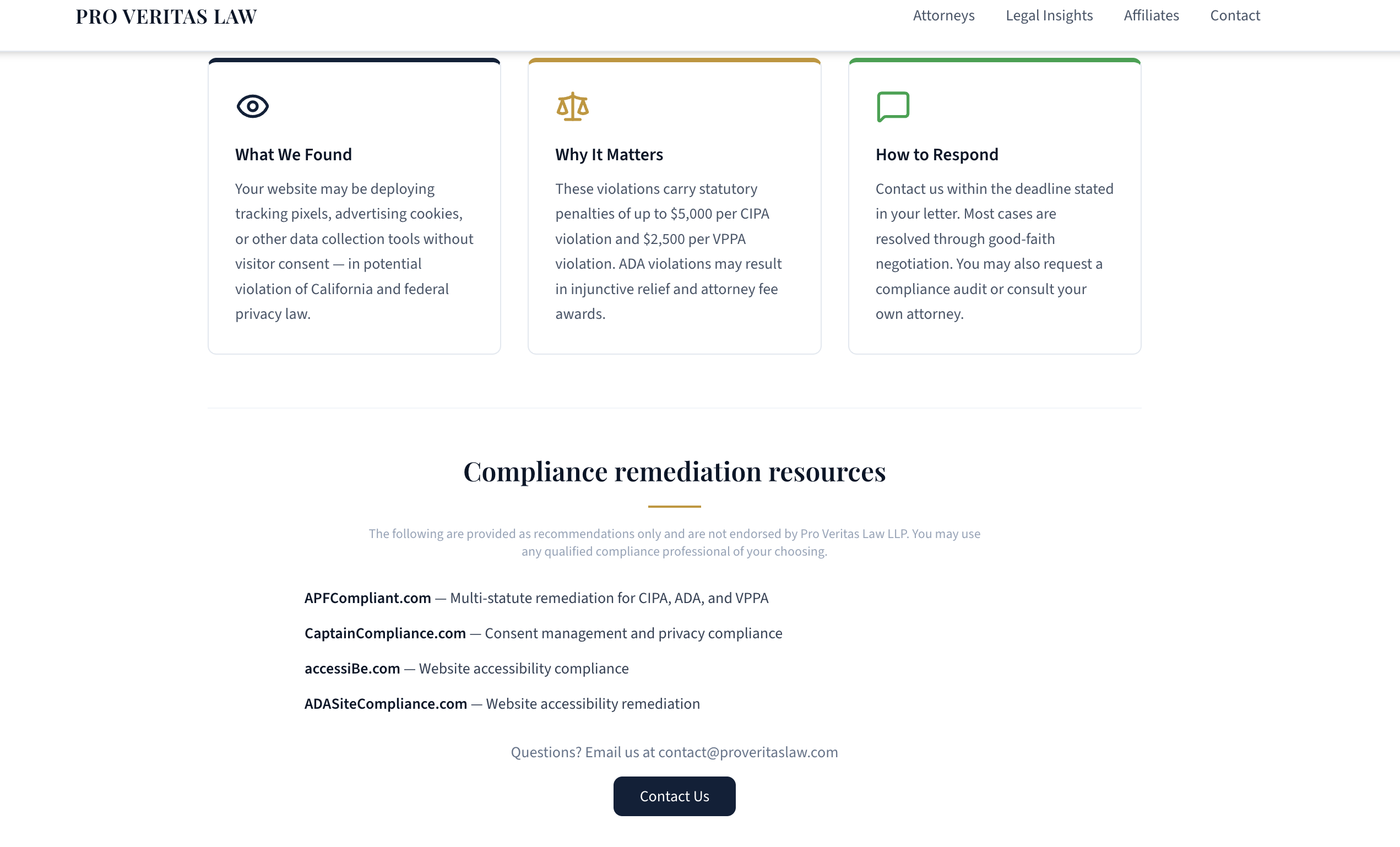
The stakes are meaningful: CIPA carries statutory penalties of up to $5,000 per violation with cases typically settled for $50,000+ for CIPA claims recently. In a class-action context, where a single website may serve thousands of California visitors, that exposure compounds quickly. Notably, CIPA violations don’t require proof of actual harm — the statutory structure allows plaintiffs to pursue damages based on the violation itself, which makes it an attractive vehicle for litigation.
ADA — Website Accessibility and Title III
Title III of the Americans with Disabilities Act prohibits discrimination against individuals with disabilities in places of public accommodation. Courts across the country — particularly in California and New York — have extended that obligation to websites, finding that inaccessible digital experiences constitute a form of discrimination against users who rely on screen readers, keyboard navigation, or other assistive technologies.
For businesses that haven’t audited their sites against WCAG 2.1 standards, common failure points include missing alt text on images, non-keyboard-navigable menus, insufficient color contrast, and form fields that assistive technologies can’t properly interpret. ADA website cases typically seek injunctive relief — meaning a court order to fix the violations — along with attorney fee awards, which create meaningful incentives for plaintiffs’ counsel even in cases where cash damages are limited.
VPPA — A 1988 Federal Law Reshaping Modern Advertising
The Video Privacy Protection Act was passed in 1988 after a Washington D.C. newspaper published Supreme Court nominee Robert Bork’s video rental history. The law prohibits “video tape service providers” from knowingly disclosing personally identifiable information about consumers’ video viewing activity to third parties without consent.
What makes VPPA suddenly relevant to today’s web? The Facebook Pixel and similar advertising trackers. When a website embeds a video player alongside a Meta Pixel — and that pixel transmits information about what a user watched to Facebook — plaintiffs have argued that transmission constitutes an unlawful disclosure of video viewing data under the VPPA. The statutory damages under the VPPA reach $2,500 per violation, and class actions have been filed against publishers, media companies, retailers, and healthcare providers alike.
The Camplisson v. Adidas case, cited in Pro Veritas Law’s recent insights, reflects the evolving judicial landscape around exactly these questions — and signals that enforcement in this space is still developing, not contracting.
The Business Reality: Most Violations Aren’t Intentional
One of the underappreciated dimensions of this enforcement wave is how many violations occur without any awareness on the part of the business being cited. A marketing team embeds a Facebook Pixel to measure ad performance. A developer installs a live chat plugin. A third-party analytics service is connected through a tag manager. Each of these decisions — individually mundane, collectively routine — can create CIPA or VPPA exposure that the business never contemplated.
Similarly, accessibility failures frequently reflect technical debt or template limitations rather than deliberate exclusion. A business that launched its website on a popular CMS five years ago may never have audited whether its current theme meets WCAG standards.
Pro Veritas Law’s approach acknowledges this directly. The firm’s stated mission isn’t to punish businesses for a problem they didn’t create — it’s to accelerate the compliance response that consumer protection law ultimately exists to achieve. For businesses that respond in good faith within the deadline stated in their demand notice, most cases are resolved through negotiation rather than litigation.
What Remediation Actually Looks Like
For businesses that receive a demand notice, or those proactively trying to close their exposure before one arrives, the remediation landscape has matured considerably. Pro Veritas Law provides a reference list of compliance resources for businesses navigating multi-statute exposure:
APFCompliant.com addresses the intersection of all three statutes — CIPA, ADA, and VPPA — making it suited for businesses dealing with compound exposure rather than a single isolated violation.
CaptainCompliance.com focuses on consent management and privacy compliance, which is particularly relevant for businesses whose primary exposure relates to cookie consent architecture and the tracking pixel issues that drive CIPA and VPPA claims.
accessiBe.com and ADASiteCompliance.com both address the accessibility side of the equation, helping businesses bring their websites into alignment with WCAG standards and Title III obligations.
The firm is explicit that these are provided as informational recommendations only — businesses are free to work with any qualified compliance professional. But the list reflects a practical acknowledgment: demand notices require concrete remediation steps, not just legal counsel.
The Acceleration Nobody Is Talking About
Pro Veritas Law’s website makes a point that’s easy to overlook in the noise around specific statutes and penalties: automated enforcement is accelerating. AI-driven scanning tools can now systematically audit websites for privacy and accessibility violations at a scale that would have required armies of human reviewers just a few years ago. What that means in practice is that the detection problem — historically the limiting factor in enforcement volume — is largely solved.
The businesses that move toward compliance now do so in an environment where violations are still being caught and resolved case by case. The ones that delay may find themselves navigating a landscape where every violation is already documented before any conversation begins.
The name Pro Veritas Law — for the truth — signals something about the firm’s orientation. The truth is that most business websites were built with marketing performance in mind, not privacy compliance. The gap between those two objectives has produced a litigation wave that shows no signs of receding. Closing that gap, firmly and verifiably, is now a business continuity question as much as a legal one.
Put this into practice
Turn privacy guidance into working controls.
Captain Compliance helps teams discover tracking technologies, enforce consent, manage privacy requests and document the evidence behind every decision.