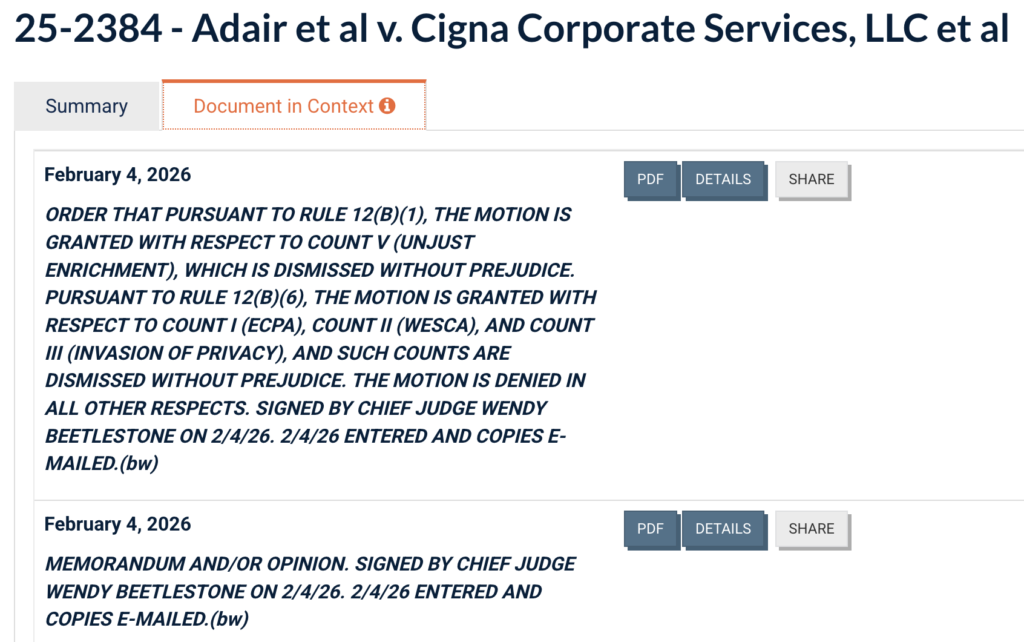
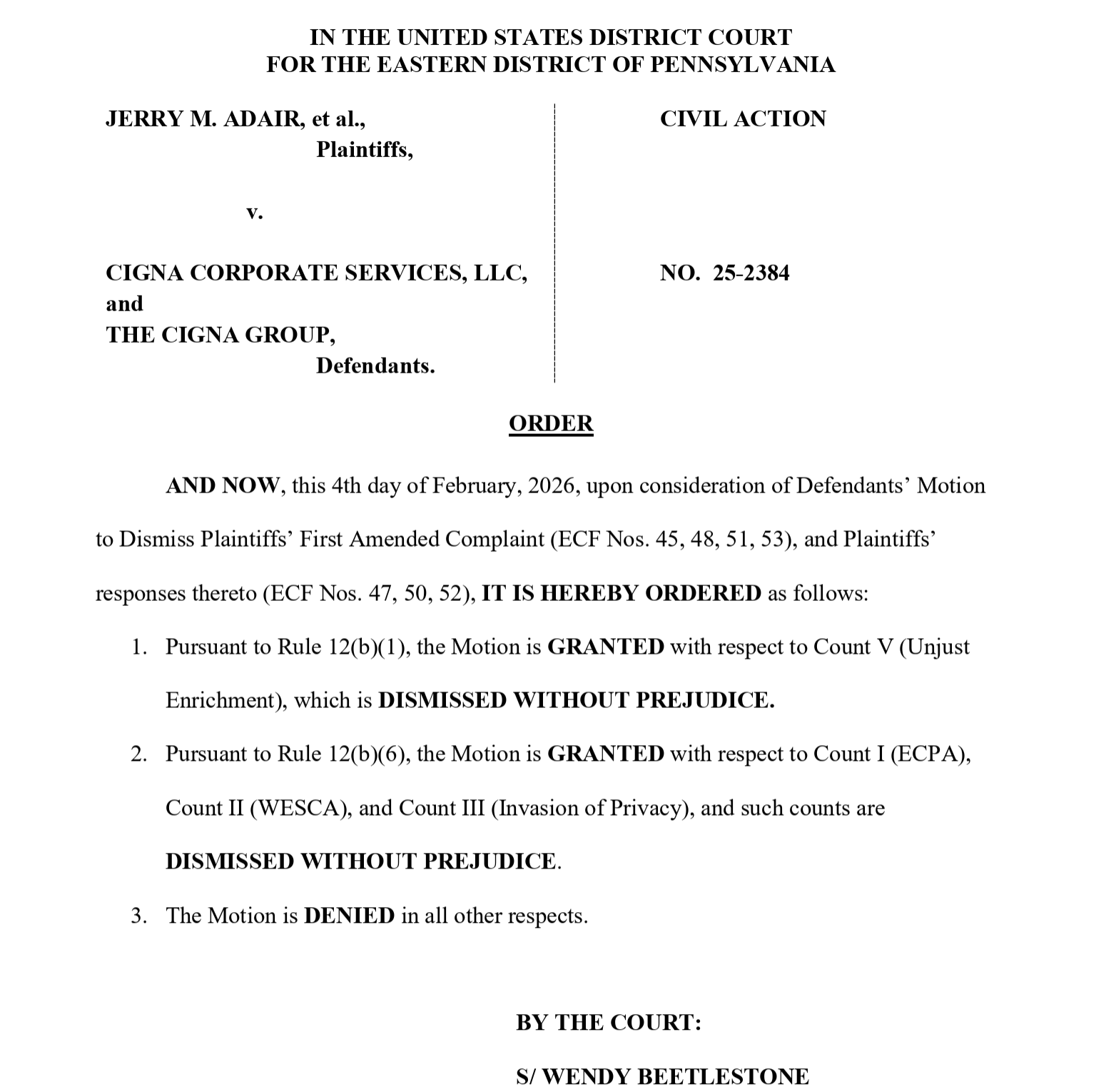
Undoubtedly this sets a risky precedent in wiretapping law in the age of the internet. A recent Pennsylvania federal court decision has added another layer of complexity to the already murky legal landscape surrounding website tracking technologies. In Adair v. Cigna Corporate Services, a judge dismissed wiretapping claims against a major health insurer, ruling that consent obtained after tracking began was sufficient to defeat allegations under Pennsylvania’s wiretapping law. While this ruling may appear to offer relief for businesses, it actually underscores the precarious legal position companies face when deploying tracking technologies. The key here is having great terms and privacy notices something that the Captain Compliance software automatically does for their clients to prevent these expensive lawsuits from ever happening and if they do we help get them dismissed with our proven audits that send the plaintiffs elsewhere to ambulance chase.
The Cigna Case: What Happened
Plaintiffs alleged that Cigna employed third-party tracking software to capture website visitor information in real time, including mouse movements, clicks, keystrokes, and page-specific URLs. The central issue was timing: tracking began immediately when consumers landed on the website, before they had any opportunity to review or consent to Cigna’s privacy disclosures.
Despite this sequence of events, the court found that because plaintiffs eventually agreed to Cigna’s Terms of Use, which incorporated the company’s Privacy Notice disclosing the tracking practices, they had given valid consent. The court dismissed claims under both the federal Electronic Communications Privacy Act and Pennsylvania’s Wiretapping and Electronic Surveillance Act.
Understanding WESCA and Similar State Laws
Pennsylvania’s Wiretapping and Electronic Surveillance Act represents one of several state laws originally designed to prevent telephone eavesdropping that have been repurposed by plaintiffs to challenge modern web tracking. These statutes typically prohibit the intentional interception of electronic communications without the consent of at least one party to the communication.
When applied to website tracking technologies, these laws create thorny questions: Is a website visitor “communicating” with the site owner when their mouse movements are recorded? Does sending data to a third-party analytics platform constitute an “interception” of that communication? Can consent provided after tracking begins retroactively validate the earlier data collection?
The Judicial Split on Internet Based Wiretapping Legal Decisions
The Cigna decision is notable precisely because it contradicts the approach taken by other courts. Other courts have refused to dismiss wiretapping claims where consent was obtained after the alleged interception began. This inconsistency reveals three fundamental problems facing businesses today.
First, antiquated laws don’t fit modern technology. State wiretapping statutes were enacted decades ago to address telephone surveillance and physical recording devices. Applying these laws to pixels, cookies, and session replay tools requires judicial interpretation that stretches the statutory language far beyond its original intent. Courts are essentially retrofitting 1970s-era wiretap concepts onto 2020s-era digital tracking, and the results are predictably inconsistent.
Second, there’s no judicial consensus. When courts across different jurisdictions—and even within the same jurisdiction—reach opposite conclusions on materially similar facts, businesses cannot reliably predict whether their practices will withstand legal scrutiny. One court finds after-the-fact consent acceptable; another demands prior consent. One court views tracking pixels as communication interception; another questions whether wiretapping claims are viable at all in the web tracking context.
Third, litigation continues unabated. Despite courts trending toward questioning whether using tracking software is sufficient to plausibly plead wiretapping claims, the volume of lawsuits shows no signs of decreasing. Opportunistic plaintiffs’ firms continue filing these cases because settlements often prove less costly for defendants than fighting through motion practice and discovery, even when legal theories are questionable.
Why Businesses Cannot Rely on This Decision
While the Cigna ruling might seem like good news, treating it as a roadmap would be dangerous for several reasons:
It’s an outlier. When one court reaches a conclusion that contradicts the trend in other jurisdictions, that decision provides minimal protection to businesses operating nationally or in other states. A favorable ruling in Pennsylvania doesn’t prevent claims in California, Florida, or Washington, where courts may take different approaches.
It invites litigation risk. Even if a business ultimately prevails on a motion to dismiss by arguing post-hoc consent, defending that motion requires significant legal expenses. The complaint must be answered, briefing must be prepared, and court appearances may be necessary. For many businesses, these costs alone make settlement attractive, which is precisely why plaintiffs’ firms continue filing these cases.
The legal standard remains uncertain. Future courts may distinguish the Cigna case or find its reasoning unpersuasive. Judicial trends can shift, particularly as courts grapple with how privacy expectations evolve in the digital age. Relying on any single favorable decision is a gamble when the broader legal framework remains unsettled.
The Growing Demand for Stronger Privacy Protections
The persistent wave of wiretapping lawsuits reflects something deeper than opportunistic litigation. These cases signal a fundamental disconnect between consumer expectations about digital privacy and the legal protections currently available.
Existing privacy laws often lag far behind technological capabilities and as we’re seeing with the VPPA which is around video tape rental histories being litigated against unknowing defendants (yes I said video tapes, not DVDs, or Streaming histories). While businesses can track remarkably granular user behavior—down to individual keystrokes and cursor movements—legal frameworks designed for an analog era struggle to address when such tracking crosses ethical or legal lines. When legislative solutions move slowly, consumers and their attorneys turn to creative litigation theories, stretching existing statutes to fill perceived gaps.
This dynamic means businesses face legal exposure not just from violating clear statutory rules, but from falling short of evolving privacy norms that courts may eventually recognize, even if current law doesn’t explicitly mandate them.
How Businesses Should Protect Themselves
First is to get a free privacy audit from Captain Compliance to understand your risks and setup our privacy software tools to prevent against a WESCA or ECPA lawsuit. We’ve saved businesses hundreds of million of dollars from lawsuits that are prevented or dismissed when using industry leading software like the tools built by Captain compliance. Given the unpredictable legal landscape, businesses cannot afford to rely on favorable outlier decisions or hope that their particular jurisdiction will be lenient. The most prudent approach requires implementing robust consent mechanisms that would satisfy even the strictest judicial interpretation.
Implement opt-in consent as the standard. Rather than starting tracking immediately and relying on users to later accept terms of service, businesses should obtain affirmative consent before any tracking begins. This means presenting a clear consent mechanism—such as a cookie banner with genuine choice—before tracking technologies activate. While this approach may reduce data collection in the short term, it substantially reduces legal risk.
Make privacy disclosures prominent and clear. Burying tracking disclosures in lengthy terms of service that users must hunt down doesn’t constitute meaningful notice. Privacy information should be conspicuous, written in plain language, and presented at the point where tracking decisions are made.
Regularly audit tracking technologies. Many businesses don’t have a complete inventory of what tracking tools are deployed on their websites, particularly when different teams implement various marketing and analytics platforms independently. Conducting regular audits ensures businesses can actually disclose what tracking occurs and obtain appropriate consent.
Review and update privacy policies. Online businesses must carefully review and update their privacy policies to ensure they adequately inform consumers about data collection, use, and sharing practices. Policies should specifically identify the types of tracking technologies used and explain how data collected through these tools is processed and shared.
Document consent mechanisms. When litigation arises, businesses need to demonstrate not just that a privacy policy existed, but that users actually consented to it in a meaningful way. This requires maintaining records of consent flows, testing to confirm they function as intended, and preserving evidence of user interactions with consent mechanisms.
Consider geographic differences. A consent mechanism that might satisfy a Pennsylvania court may not suffice in California, Illinois, or Washington. Businesses operating nationally should design their consent practices to meet the most stringent standards they might face, rather than tailoring approaches to individual state standards.
The Path Forward
The Cigna decision illustrates both the opportunities and perils businesses face in the current legal environment. While some courts may accept consent obtained after tracking begins, the lack of consensus means businesses cannot count on such leniency.
More importantly, the underlying trend is clear: courts and regulators are increasingly skeptical of tracking practices that occur without meaningful user knowledge or control. As privacy expectations continue to evolve, businesses that take a minimalist approach to consent—implementing only what they believe they can legally defend will find themselves continuously exposed to litigation risk.
The better strategy is implementing privacy practices that go beyond the bare minimum legal requirements. This means obtaining genuine, informed consent before tracking begins, providing clear and comprehensive privacy disclosures, and giving users meaningful control over their data. While these practices may require operational changes and potentially reduce data collection, they provide far more durable protection than hoping for favorable judicial rulings in an unpredictable legal landscape.
The tide of wiretapping litigation shows no signs of receding. As long as the gap persists between what technology enables and what privacy laws clearly permit, creative plaintiffs’ attorneys will continue finding ways to challenge business practices. The businesses that will best weather this environment are those that recognize favorable outlier decisions for what they are lucky breaks for specific defendants rather than reliable templates for compliance. Proactive privacy practices, robust consent mechanisms, and genuine respect for user privacy expectations remain the most effective defense against the next wave of wiretapping claims.
