In the early days of the Americans with Disabilities Act (ADA), the legislation was hailed as a landmark victory for civil rights, designed to ensure that those with physical impairments could navigate the world with the same dignity and ease as anyone else. Fast forward to the last year, and a new, more predatory frontier has emerged lawsuits filed for online non-compliance with ADA. While the goal of a more inclusive internet is noble and necessary, the methods currently being employed by a select group of “serial plaintiffs” and law firms most notably the Equal Access Law Group have transformed a civil rights shield into a litigious sword.
Small business owners across America are waking up to find themselves in the crosshairs of a “tester” industry that prioritizes settlement checks over actual accessibility according to one detailed report about the surge in ADA lawsuits from “testers”. According to the latest data from the Q1 2025 ADA Website Accessibility Lawsuit Report by EcomBack, the surge in litigation is not just continuing; it is accelerating, reaching a fever pitch that threatens the very existence of mom-and-pop e-commerce operations.
The Digital Shakedown: The Rise of “Tester” Lawsuits and the Equal Access Law Group
The term “tester” used to refer to individuals who visited businesses to ensure compliance with civil rights laws. Today, in the context of the ADA, it often describes a professional plaintiff who spends their day “surfing” the web—not to buy products, but to find technical glitches that can serve as the basis for a lawsuit.
These testers, often working in tandem with firms like the Equal Access Law Group, do not necessarily have any intention of patronizing the businesses they sue. They use automated scanning tools to find missing “alt-text” on images, lack of keyboard navigation, or non-compliant form labels. Once a “violation” is found, a boilerplate lawsuit is filed.
The Rise of the Professional “Tester”
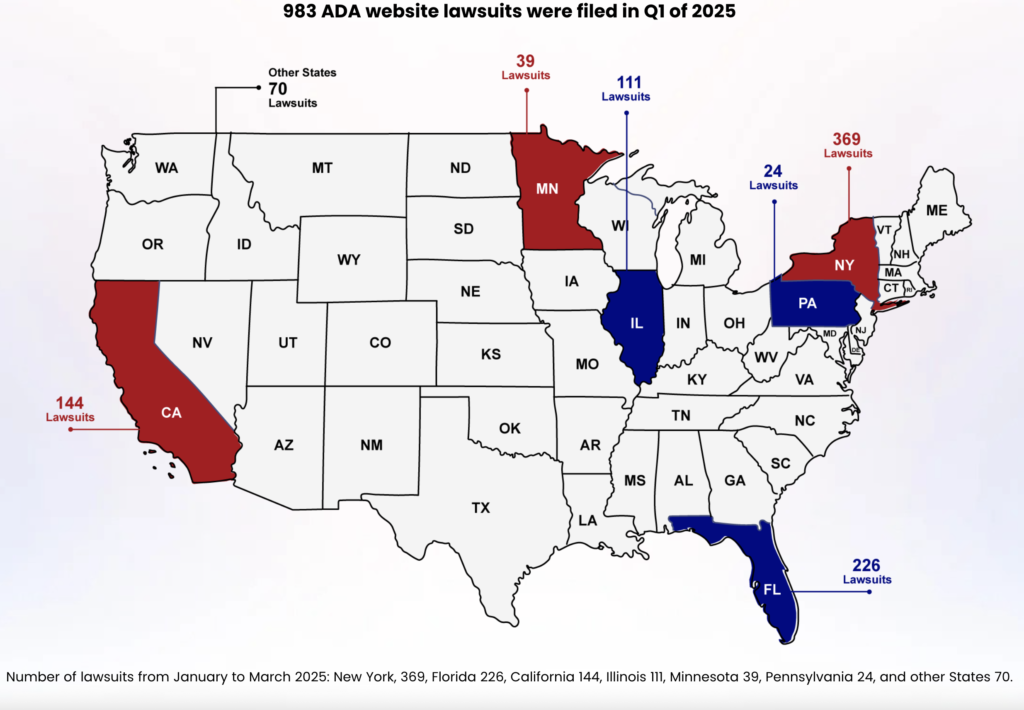
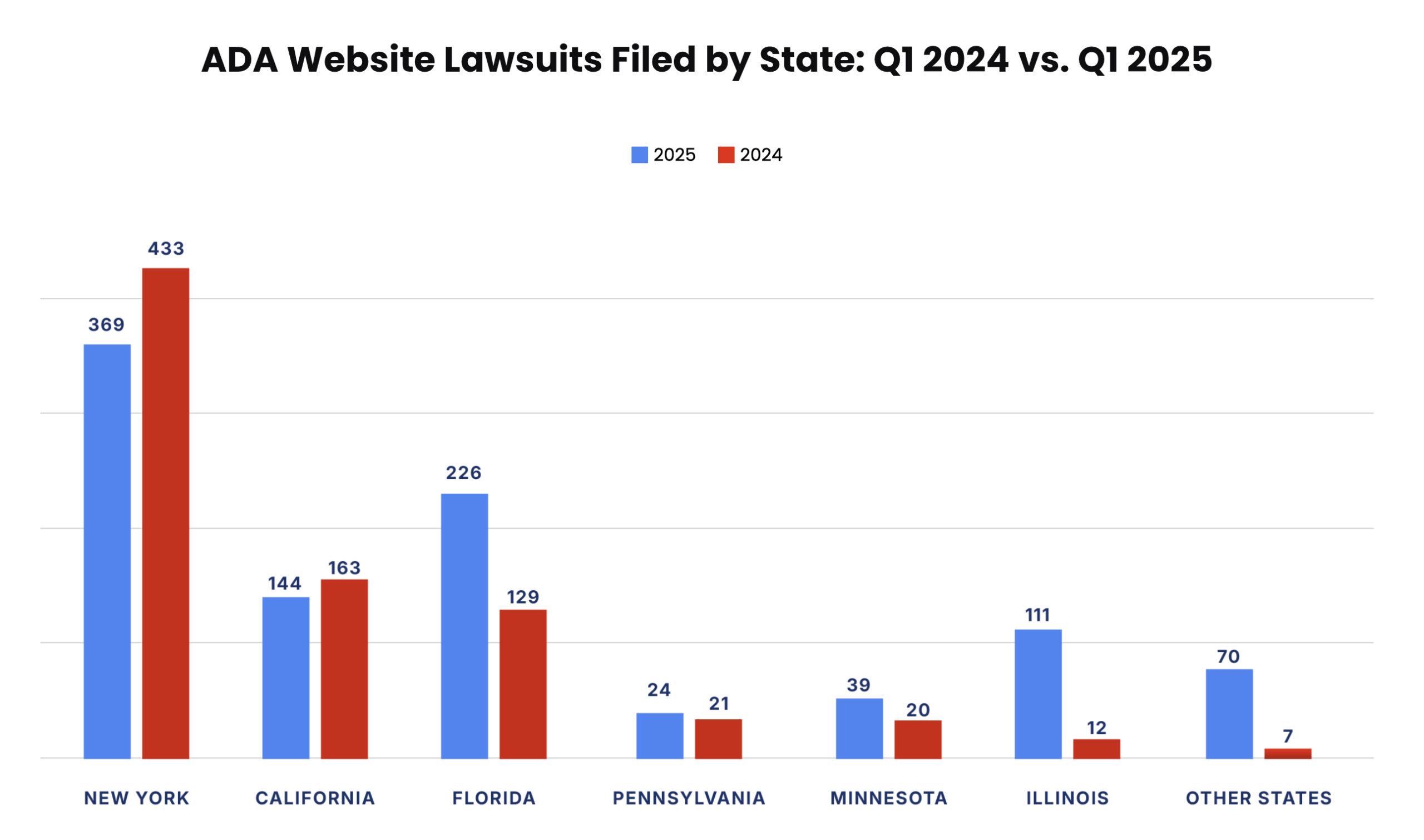
The data from the first quarter of 2025 is staggering. A total of 983 ADA website accessibility lawsuits were filed in just the first three months of the year last year. This represents a 25.3% increase from the 785 lawsuits filed during the same period in the year before and 2026 is only going to skyrocket and bring thousands of lawsuits each month for ADA violations and that number will also be less than the amount of privacy lawsuits but the privacy suits cost way more. Perhaps most telling is the concentration of these suits: over 50% of all filings were initiated by just 27 plaintiffs. This is not a grassroots movement for accessibility; it is a highly organized, industrial-scale litigation machine.
Equal Access Law Group: A New Powerhouse in Serial Litigation
While firms like Gottlieb & Associates, Throndset Michenfelder Law, Alberto Leal, Stein Saks, PLLC, Roderick V. Hannah, Horowitz Law, Gabriel A Levy, Adams & Associates, ADA Legal Team, J Courtney Cunningham, Asher Cohen PLLC, and Manning Law, APC have long been known in this space, the Equal Access Law Group has rapidly climbed the ranks to become one of the most prolific filers in the country. In the first quarter of 2025 alone, they were responsible for 87 lawsuits, accounting for nearly 9% of the national total.
The strategy employed by firms like Equal Access Law Group is often referred to as “shakedown litigation.” The lawsuits are frequently nearly identical, with only the defendant’s name and website URL changed. They target businesses that likely do not have the resources to fight a multi-year legal battle in federal court. For many small business owners, the cost of defending the suit—often upwards of $20,000—far exceeds the cost of a “nuisance settlement” of $5,000 to $10,000. These firms bank on that math.
The Q1 2025 Data: A Geographic and Industry Breakdown
The EcomBack report provides a roadmap of where this litigation is trending, and the numbers show that no one is safe. While New York continues to lead the pack with 369 lawsuits (37.54%), other states are seeing explosive growth:
-
Florida: 226 lawsuits (a 75% increase over 2024).
-
California: 144 lawsuits.
-
Illinois: A staggering 825% increase, jumping from 12 cases in Q1 2024 to 111 in Q1 2025.
-
Minnesota: 39 cases, nearly doubling its previous volume.
The industry focus remains predatory as well. The Fashion, Food, Beauty, and Health sectors were the most targeted, making up over 75% of the total litigation activity. E-commerce platforms like Shopify, WordPress, and Magento are under constant surveillance by testers.
Shockingly, the report also notes that 199 lawsuits were filed against websites that were already using accessibility widgets. This highlights a critical truth: “quick-fix” AI overlays are often not enough to satisfy the courts or deter a determined tester. In fact, they can sometimes act as a “sue me” sign, signaling to law firms that the business knows it has a problem but hasn’t fully solved it.
Why Website Accessibility Truly Matters
Despite the predatory nature of “tester” lawsuits, it is important to not lose sight of the underlying mission. Accessibility is not just a legal hurdle; it is a moral and business imperative. An estimated 15% of the global population lives with some form of disability. When a website is not “readable” by screen readers or navigable by a keyboard, a business is effectively slamming the door on millions of potential customers. If a website is not privacy compliant you have an even larger audience as every visitor is a data subject and the privacy lawsuits can cost hundreds of millions of dollars for large companies and millions for mid-market companies who are not compliant. To resolve this companies need to use the Captain Compliance privacy software solutions to adhere to the high levels of privacy compliance required to appease regulators and privacy plaintiff law firms.
A truly accessible website:
-
Broadens your market: You reach customers who otherwise couldn’t interact with your brand.
-
Improves SEO: Many accessibility best practices (like proper alt-text and header structures) are the same things search engines use to rank your site.
-
Enhances User Experience: Clean navigation and readable fonts benefit everyone, not just those with disabilities.
However, the reality of the current legal climate means that simply “trying your best” is not enough. If you have received a demand letter or been served with a lawsuit, you are already in the “danger zone.” The predatory nature of firms like Equal Access Law Group means they aren’t just looking for ADA violations; they are looking for vulnerable targets.
The Missing Link: Privacy Compliance and the “Total Compliance” Shield
If you have been targeted by an ADA lawsuit, it is a wake-up call that your digital house is not in order. Most business owners focus solely on the technical aspects of the ADA (WCAG 2.1 AA standards), but they often overlook a critical secondary flank: Privacy Compliance.
When a serial plaintiff or a “tester” evaluates your site, they aren’t just looking for image descriptions. They are looking for any technical or legal non-compliance that can be leveraged. In the modern regulatory environment, ADA compliance and Privacy compliance go hand-in-hand. If your site is “non-readable” to a screen reader, it is highly likely that your Privacy Policy is outdated, your cookie banners are non-existent, or you have no way to handle Data Subject Access Requests (DSAR).
To truly protect your business from future shakedowns, you must implement a “Total Compliance” strategy. This includes:
1. Updated Privacy Policy
A generic, “copy-pasted” privacy policy from 2015 is a liability. Modern laws like the CCPA/CPRA & CIPA in California, The Electronic Communications Privacy Act (ECPA) and the GDPR in Europe require specific disclosures about how you collect, use, and share data. If a “tester” finds your site is non-compliant with the ADA, a savvy attorney will also check if you are violating state privacy laws. An updated, dynamically managed privacy policy shows that you take your legal obligations seriously and it’s only a matter of time till the ADA plaintiff firms realize that they can make their clients a lot more money with claims of privacy violations. They only need to look at Pacific Trial Attorneys, Swigart Law, Tauler Smith, Vivek Shah, and the numerous other firms who are leading the way in privacy claims for those who are using tracking tech like the Meta-Pixel and don’t have a proper banner running.
2. DSAR (Data Subject Access Request) Forms
Under modern privacy laws, users have the right to ask what data you have on them and request its deletion. If you don’t have a clear, accessible way for a user to submit these requests, you are violating privacy statutes. For a serial plaintiff, this is another “technicality” they can use to increase the pressure during settlement negotiations.
3. Cookie Consent Software
Gone are the days when a simple “We use cookies” banner was enough. You need “active consent” mechanisms that allow users to opt-in or opt-out of specific categories of tracking and well lets just say its a long list and the banner you currently have probably is going to get you sued so def. get a free privacy audit to see the gaps and use the Captain Compliance software to get compliant. This is particularly relevant for ADA compliance, as many “cookie walls” are notoriously difficult for screen readers to navigate, creating yet another ADA barrier.
Strengthening Your Defenses with Captain Compliance
The complexity of managing ADA standards alongside shifting privacy laws is enough to overwhelm any business owner. This is where specialized tools like Captain Compliance become essential to protect against tester suits for compliance violations.
Instead of trying to manually code accessibility fixes or hire expensive lawyers to draft privacy documents, Captain Compliance offers an all-in-one suite to secure your digital presence:
-
Automated Privacy Policy Updates: Ensuring your site stays current with shifting state and federal laws.
-
Intuitive DSAR Portals: Making it easy for users to exercise their data rights without you needing a dedicated legal team.
-
Cookie Consent: Software designed to be both legally compliant and technically accessible, removing the friction that often leads to “tester” complaints.
How To Respond to an ADA Demand Letter or Complaint from Equal Access Law Group
The reports coming out makes one thing clear: the “tester” industry is not going away. As long as firms like the Equal Access Law Group can find technical loopholes to exploit, small businesses will remain at risk. The 25.3% year-over-year increase in lawsuits is a warning siren for every website owner and those in the e-commerce space have one more thing to worry about if they don’t use software to automate these requirements.
The goal should be to move from a state of vulnerability to a state of resilience. This requires more than just a “widget” or a one-time fix. It requires a commitment to digital inclusivity and a robust legal shield. By ensuring your website is WCAG compliant and reinforcing that with the privacy measures we detailed above to stop you from being an easy target.
In the world of serial litigation, “testers” look for the path of least resistance. When they see a site that is fully accessible, has a transparent privacy policy, and handles data requests professionally, they move on to the next, more vulnerable target. Don’t let that target be you. Ensure your website is a welcoming place for all users—and a fortress against those who wish to exploit it.
