Know what’s on your site before a plaintiff’s firm does
A free privacy audit shows which cookies, pixels and trackers are running — and which ones commonly appear in privacy claims.
The reported DentaQuest exposure is not just another cybersecurity headline. For dental groups, DSOs, benefits administrators and healthcare-adjacent vendors, it is another warning that sensitive personal data, patient-adjacent identifiers, web tracking practices and breach response obligations are now creating real regulatory, litigation and settlement exposure.
The reported data categories are exactly the kind of information that creates long-tail privacy risk: names, email addresses, phone numbers, addresses and healthcare-enrollment-related information.
Even when an organization says operations remain available, the legal and privacy impact does not end when systems come back online. Exposed identity data can be reused for phishing, credential attacks, social engineering, account takeover attempts and fraud.
For dental organizations, the point is not whether DentaQuest is a dental benefits administrator rather than a dental practice. The point is that the dental ecosystem now holds and transmits a large volume of sensitive personal information across websites, appointment forms, vendor portals, insurance workflows, payment systems, analytics platforms, call centers, cloud tools and third-party processors.
Why the DentaQuest Incident Matters to Dental Groups
The DentaQuest incident reflects a broader shift in privacy and cybersecurity risk. Dental organizations are no longer being judged only by whether they provide care, process claims or keep systems online. They are increasingly being judged by how they collect, disclose, secure, retain, track and respond to sensitive
information.
That includes traditional cybersecurity controls, but it also includes privacy operations: what personal data is collected, which third parties receive it, what scripts fire on patient-facing pages, whether proper consent is captured, how opt-outs are honored, whether consumer requests are handled on time and whether the
organization can prove what happened when regulators, plaintiffs or insurers ask.
This is where many dental groups are exposed. A breach may begin with a network intrusion, compromised credentials, vendor failure or exploited software vulnerability. But the legal aftermath often expands into broader questions: Was the organization collecting too much data? Were vendors properly governed? Were
patients or consumers given accurate disclosures? Were tracking technologies transmitting sensitive information? Were DSAR and privacy request workflows operational? Were consent records preserved?
Captain Compliance helps dental groups reduce this exposure by giving them tools to operationalize privacy controls before a claim arrives, including consent management, website scanning, cookie and tracker governance, privacy request intake, DSAR workflows and records that help demonstrate how consumer privacy choices were handled.
The Aspen Dental Settlement Changed the Cost Calculation
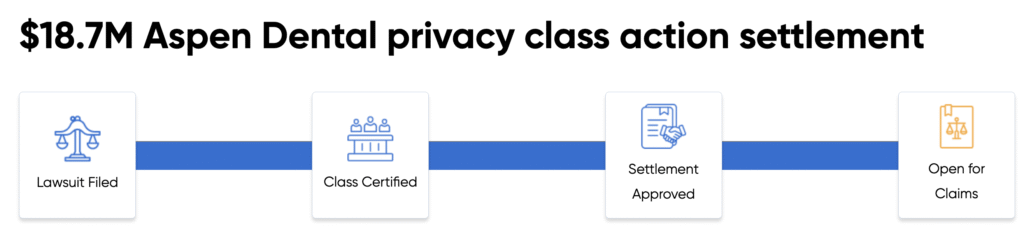
The DentaQuest breach also lands in a legal environment where dental privacy cases are no longer theoretical. Aspen Dental agreed to an $18.7 million settlement over allegations that it transmitted website user data to Meta and Google through tracking technologies without users’ knowledge or consent. The claims focused on web tracking and alleged third-party disclosures, not a traditional ransomware-style outage.
That distinction matters. Dental groups often think of privacy risk as something that starts with a hacker. But Aspen Dental shows that privacy litigation can also start with pixels, tags, analytics tools, appointment pages, form flows and consent failures. A website that appears to be functioning normally can still create expensive data privacy exposure if it is sending sensitive user interactions to advertising or analytics vendors without the proper disclosures, consent architecture or governance.
For a DSO, the risk is multiplied across locations, brands, landing pages and campaigns. One misconfigured tag manager container, one tracking pixel on an appointment page, or one undisclosed vendor integration can become a class-action theory. The alleged harm is not always that a dental practice was hacked. The alleged harm may be that the practice disclosed or allowed collection of sensitive consumer activity in a way users did not expect.
This is why Captain Compliance’s consent management platform and website scanning tools matter for dental groups. A CMP cannot stop every cybersecurity incident. But it can help prevent a separate category of privacy litigation by identifying cookies and trackers, controlling consent behavior, preserving consent logs,
supporting opt-out signals and helping organizations avoid the kind of silent tracking exposure that has become a major plaintiffs’ bar target.
New York’s Delta Dental Settlement Shows Regulators Are Watching Cybersecurity Controls Too
The regulatory side is also accelerating. In April 2026, the New York Department of Financial Services announced a $2.25 million cybersecurity settlement with Delta Dental Insurance Company and Delta Dental of New York. The agency said its investigation found cybersecurity failures that contributed to the exposure of sensitive personal data in connection with the MOVEit Transfer vulnerability.
That enforcement action is important for dental organizations because it shows that regulators are not only focused on hospitals, major health systems and traditional insurers. Dental benefits companies, dental insurers and dental-adjacent organizations can face direct scrutiny when sensitive information is exposed and
regulators believe cybersecurity governance fell short.
The practical lesson for dental groups is that privacy and cybersecurity can no longer be separated. A regulator, plaintiff, insurer or business partner may ask the same set of questions after any incident:
What data did you hold? Why did you hold it? Who accessed it? Which vendors touched it? Which systems were involved? Which notices were provided? Which consumer requests were received? Which controls were documented?
DentaQuest Is the Latest Warning, Not an Isolated Event
The DentaQuest incident should be treated as part of a broader pattern. Dental organizations are attractive targets because they sit at the intersection of identity data, health-related data, insurance data, payment data and consumer communications. That combination is valuable to attackers and legally sensitive for the organization holding it.
A dental record or benefits record can be more useful for fraud than a basic email-and-password breach. It may include identity details, family relationships, insurance information, contact information, dates of birth, enrollment data or other information that makes phishing more believable. Once that information is public, the affected individual may face risk long after the initial announcement.
For dental groups, the brand impact can also be severe. Patients may not distinguish between a practice, DSO, benefits administrator, insurer, software vendor or marketing platform. If their data was collected in connection with dental care or dental benefits, they will often view it as a dental privacy failure.
The Litigation Risk Is Bigger Than Breach Notification
Many organizations still treat a data incident as a notification exercise: investigate the event, determine the impacted population, send notices, offer monitoring and move on. That approach is no longer enough.
Data breach litigation increasingly examines the entire privacy program. Plaintiffs may question whether the organization used reasonable security, minimized data collection, limited vendor access, maintained adequate retention policies, honored privacy rights, avoided unnecessary tracking and gave consumers accurate disclosures. Regulators may ask whether the organization had written policies, technical controls, vendor oversight, incident response procedures and evidence that those controls were actually operating.
That is why dental groups need privacy infrastructure before an event occurs. After a breach, it is difficult to reconstruct consent records, vendor inventories, DSAR logs, cookie behavior, opt-out workflows and consumer disclosures. The better position is to have those controls running continuously and documented before the
demand letter, regulator inquiry, insurance review or class-action complaint arrives.
What Dental Groups Should Do Now
Dental groups should treat the DentaQuest breach, the Aspen Dental settlement and the New York Delta Dental enforcement action as a combined warning. The risk is no longer limited to one category of failure. A dental organization can face exposure from a cyberattack, a vendor vulnerability, an unmanaged tracking pixel, an
inaccurate privacy disclosure, an incomplete consent workflow or a delayed privacy request response.
Dental groups should immediately evaluate whether they can answer the following questions:
- What personal information, patient-adjacent data and insurance-related data do we collect across our websites, forms and portals?
- Which cookies, pixels, analytics tools, chat widgets and marketing tags are active on appointment and intake pages?
- Can we prove when a user accepted, rejected or customized consent?
- Do we honor opt-out signals and privacy choices across our website and vendor stack?
- Do we have a DSAR workflow that can intake, verify, track and complete consumer privacy requests?
- Do our privacy notices accurately describe what data we collect, use, disclose and share?
- Can we quickly identify which vendors receive personal information and under what legal basis?
- Do we have records that would help us defend our privacy program if a regulator, insurer or plaintiff asks?
Captain Compliance helps dental groups put those controls into practice through consent management, tracker scanning, cookie governance, privacy request workflows and compliance records designed to reduce the risk of costly privacy disputes and lawsuits that cost millions of dollars.
The Bottom Line for Dental Groups
DentaQuest is the latest example of how quickly a dental-sector data incident can become a public privacy event. Aspen Dental shows how website tracking can create multimillion-dollar litigation risk even without a traditional breach. New York’s Delta Dental settlement shows that regulators are willing to impose penalties
when cybersecurity controls are viewed as insufficient.
For dental groups, the lesson is direct: privacy risk is now operational risk, litigation risk, regulatory risk and brand risk. It lives in databases, portals, websites, vendor tools, pixels, intake forms, consent banners and DSAR inboxes.
The organizations that will be in the strongest position are not the ones that wait for a breach notice, demand letter or regulator inquiry. They are the ones that continuously monitor their websites, control tracking technologies, document consent, honor privacy requests and maintain proof that their privacy program
is operating.
Captain Compliance gives dental organizations the tools to do exactly that.
Reduce Dental Privacy Risk Before It Becomes a Claim
Captain Compliance helps dental groups, DSOs and healthcare-adjacent businesses manage consent, scan for risky tracking technologies, maintain privacy disclosures and process DSAR requests before small privacy gaps become expensive litigation. Book a demo below to lower your risk to help avoid expensive multi-million dollar lawsuits.
Put this into practice
Turn privacy guidance into working controls.
Captain Compliance helps teams discover tracking technologies, enforce consent, manage privacy requests and document the evidence behind every decision.