Privacy technology is becoming more sophisticated, more automated and more deeply embedded in how companies manage compliance.
That does not mean privacy teams are close to automating themselves out of the picture.
The International Association of Privacy Professionals’ RegTech Report 2026: Privacy, AI Governance and Digital Responsibility paints a much more complicated picture of the compliance technology market.
Organizations are buying more tools. Larger compliance teams are automating more of their programs. AI is beginning to change how privacy and governance work gets performed.
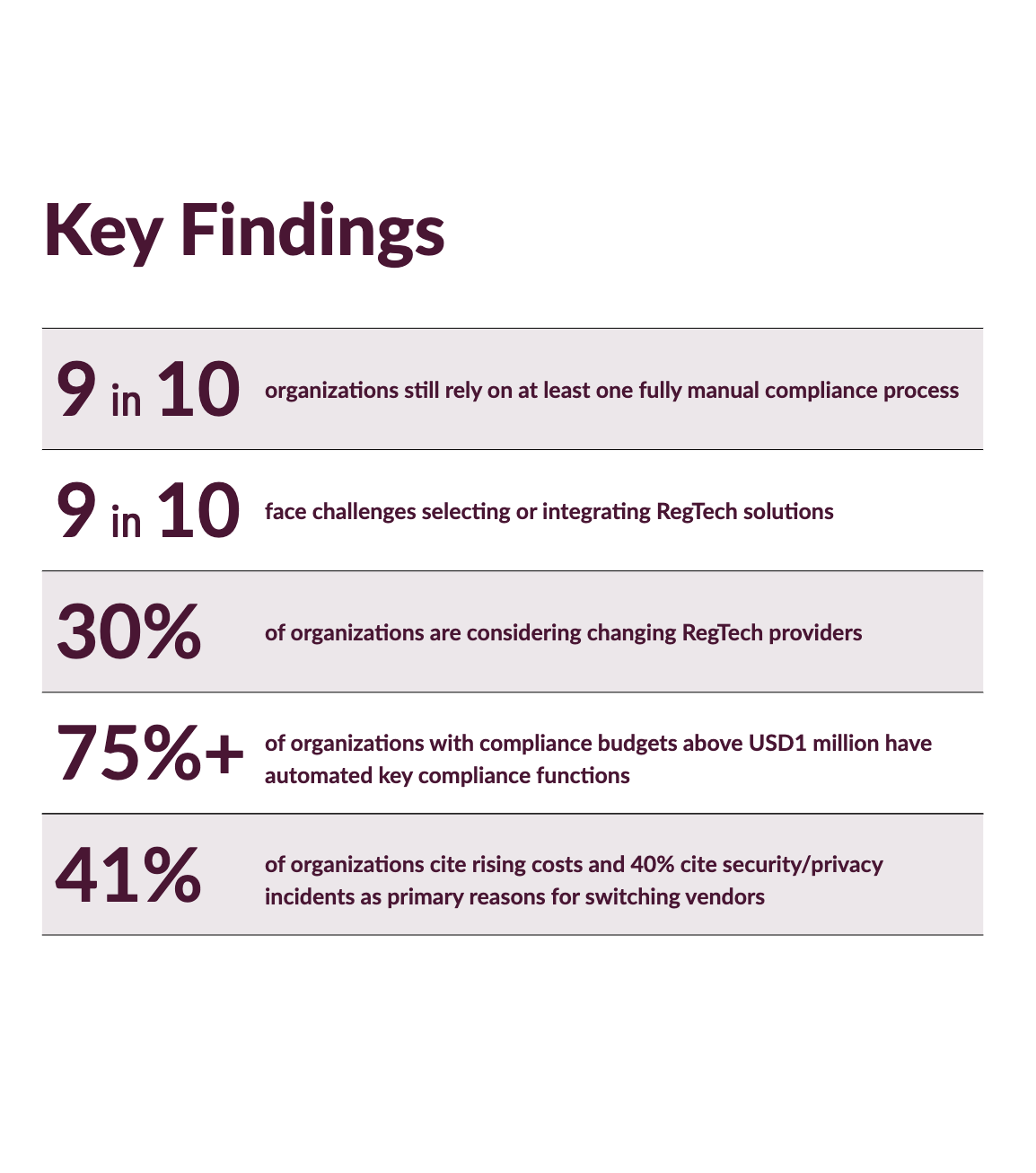
At the same time, nine out of 10 organizations still rely on at least one completely manual compliance process, and roughly nine out of 10 report challenges when selecting or integrating RegTech technology.
Perhaps most tellingly, 30% of organizations surveyed said they were either likely to move to another RegTech vendor in the next 12 months or already had migration plans underway.
The message from the IAPP report is not that compliance technology is failing.
It is that buying compliance software and successfully operating a technology-enabled compliance program are two very different things.
More Than 600 Privacy and Governance Professionals Participated
The IAPP surveyed more than 600 individuals across 50 countries and territories over seven weeks between February and April 2026.
The study looked beyond traditional privacy management software. It examined technology supporting privacy, AI governance, cybersecurity-related controls, digital responsibility and broader governance, risk and compliance activities.
The report also examined the entire RegTech lifecycle: choosing a vendor, integrating the technology, operating it, renewing the contract and eventually migrating away from it.
That lifecycle approach produces a more realistic view of compliance software than simply asking companies which features they use.
A platform might look impressive during procurement and still fail during implementation.
It might technically support dozens of compliance workflows but receive poor adoption from business teams.
It might work perfectly for three years and then become prohibitively expensive at renewal.
Or it might become so deeply connected to internal systems that replacing it becomes almost as difficult as keeping it.
Privacy Automation Is Growing, but Full Automation Is Still Unusual
One of the clearest findings involves the distinction between manual, semiautomated and fully automated compliance.
Most organizations are somewhere in the middle.
The IAPP found that companies tend to automate processes that are structured, repetitive and capable of producing consistent outputs. Processes requiring interpretation, judgment or negotiation still depend heavily on people.
The difference becomes obvious when looking at specific privacy functions.
Online tracker management had the highest proportion of fully automated implementations in the survey, at 32%.
Consent and preference management followed at 24%.
Data security controls reached 18% full automation.
Compare that with privacy policies, standards and procedures management, which remained 72% manual.
AI governance policy and compliance remained 71% manual.
AI assurance and auditing came in at 66% manual, privacy compliance and maturity assessments at 65%, and privacy law and regulatory change management at 64%.
The pattern makes sense.
A consent platform can automatically record whether a visitor accepted or rejected tracking.
A scanner can repeatedly examine a website for cookies and tracking technologies.
An automated workflow can route a data subject request to the correct systems.
But determining whether a novel AI deployment creates an unacceptable privacy risk is different.
So is interpreting an ambiguous new regulation or deciding whether a particular vendor’s processing arrangement is acceptable.
Those problems require context.
The IAPP Calls This the Last Mile of Automation
The report describes governance-heavy work as the “last mile of automation.”
Manual processes have drawbacks. They can be slow, difficult to scale and highly dependent on particular employees. They can also be difficult to audit.
But they remain useful when an organization has to address unusual facts, evolving legal requirements or highly contextual decisions.
The IAPP’s findings suggest that semiautomation may increasingly become the preferred model for much of privacy operations.
Instead of removing humans completely, technology handles structured portions of the workflow while subject matter experts make final decisions.
The report found that data discovery and classification, data retention, data-use management, privacy training and records of processing activities frequently fall into this middle category.
That may ultimately be a more realistic objective than trying to build completely autonomous compliance programs.
Online Tracking and Consent Are Among the Most Automated Privacy Functions
For organizations involved in website privacy, one of the report’s more interesting findings is how far consent and tracker management have moved toward automation.
These are among the privacy functions most likely to be automated even at organizations with comparatively smaller compliance budgets.
The IAPP attributes part of this to the nature of the work. Online tracking and consent involve structured technical systems that can often be governed through repeatable rules.
A system can scan a site.
It can identify a cookie.
It can determine whether a tag loads before consent.
It can store a visitor’s preference.
It can automatically apply different consent experiences based on geography.
Those operations lend themselves to technology much more readily than interpreting whether a complicated business practice satisfies a new regulatory requirement.
The survey found that nearly 90% of organizations across all budget levels use some form of automated data security controls. Tracker management, consent management and data discovery also showed relatively high automation even among organizations with smaller budgets.
Big Compliance Budgets Produce Much More Automation
Money still matters.
Organizations with larger compliance budgets consistently reported higher levels of automation.
More than 75% of organizations with compliance budgets exceeding $1 million use automation for important privacy and data governance controls.
For example, among organizations with privacy budgets under $100,000, 53% reported automation of third-party risk management. Among those with privacy budgets above $1 million, that figure rose to 78%.
For data discovery and classification, the difference was 59% versus 82%.
For data retention and deletion, it was 59% versus 82%.
Organization size has a similar effect.
Very large businesses automate records of processing activities, privacy impact assessments and individual rights management at substantially higher rates than smaller organizations.
The report suggests there may be a threshold where complexity itself forces organizations to automate.
A small company can sometimes manage a privacy program using spreadsheets, email and a handful of employees.
A multinational business handling thousands of vendors, systems and data subject requests usually cannot.
Consumer-Facing Compliance Gets Automated First
The survey also identified a noticeable imbalance in where companies spend their automation resources.
Customer-facing privacy controls are heavily automated.
Backend governance frequently is not.
In advertising and marketing organizations, 89% reported some level of automation for consent and preference management, while just 44% reported automation for privacy risk and control governance.
Consumer goods and retail showed almost the same split: 88% for consent versus 44% for risk and control governance.
Telecommunications companies reported 100% automation of consent and preference management but just 44% for risk and control governance.
There is an understandable operational reason for this.
A cookie banner may interact with millions of website visitors. Trying to operate that manually would be impossible.
A privacy risk review may involve only a small number of projects each month.
But the disparity can create what the report describes as uneven program maturity.
A company may have sophisticated automated consumer privacy controls while relying on email, spreadsheets and manual questionnaires behind the scenes.
Buying the Technology Is Often the Easy Part
One of the strongest themes throughout the report is that implementation problems frequently have less to do with the software itself than with the organization attempting to deploy it.
The most commonly cited challenge when integrating RegTech was data governance.
Fifty-one percent of respondents pointed to issues such as data silos, inaccurate information, unclear ownership or inadequate documentation.
Forty-five percent cited integration with legacy systems.
Thirty-seven percent pointed to interoperability with existing technology.
Another 36% said they lacked sufficient internal resources to implement the tool.
This creates a problem that software vendors cannot solve with more features.
If an organization does not know which systems contain personal information, adding a privacy platform does not automatically fix the underlying data problem.
If nobody owns a particular dataset, connecting a compliance workflow to it becomes difficult.
If the company has fifteen legacy applications that do not expose usable APIs, automation becomes expensive.
The report repeatedly returns to the same conclusion: RegTech cannot compensate for weak organizational foundations.
The Global Platform Problem
One case study in the report illustrates another common failure.
A global manufacturer purchased a centralized privacy platform intended to standardize compliance across markets.
In practice, the technology had been designed around a strongly GDPR-oriented framework.
Employees in local markets struggled with concepts and questionnaires that did not fit their operations.
Attempts to customize the platform for one region sometimes changed the global configuration. Employees ignored or incorrectly completed questionnaires. Compliance teams became overloaded with clarification requests and notifications.
Eventually, local teams created manual workarounds.
The organization ultimately ruled the incumbent vendor out as a provider for its future AI governance and digital governance requirements.
It is a good example of why “enterprise platform” does not automatically mean “enterprise adoption.”
Almost One in Five Organizations Has Built Its Own Compliance Technology
Commercial platforms are not the only option.
Approximately one in five surveyed organizations had at least one internally developed solution supporting compliance.
The most commonly supported function was privacy training management, followed by data retention and deletion, records of processing activities, consent and preference management, and online tracking management.
The attraction is control.
An internally developed application can follow the company’s exact workflow rather than forcing employees to adapt to a vendor’s model.
Organizations with strong engineering teams may also believe they can build better interfaces or integrate more deeply with internal systems.
But the report warns that internally developed RegTech creates its own long-term obligations.
Someone has to maintain it.
Someone has to update it when laws change.
Security updates, technical debt, user support, documentation and feature requests do not disappear simply because the organization does not pay a SaaS license fee.
The responsibility simply moves inside the company.
AI Is Beginning to Create a Third Option
The build-versus-buy discussion becomes more interesting when AI enters the picture.
One IAPP case study describes a privacy and AI compliance lead who did not purchase another specialist platform.
Instead, the organization configured an enterprise AI assistant using its internal privacy principles, AI governance requirements, contractual standards and previous review outputs.
The assistant began by helping review vendors.
It could analyze documentation, identify potential concerns, draft findings and recommend controls.
Human experts still made the final decisions.
The approach later expanded to privacy impact assessments, product governance reviews, AI assessments, contract reviews, transfer impact assessments and responses to internal privacy questions.
The report compares the AI assistant to an intern.
That may be one of the more useful ways to think about AI in privacy operations today.
It can perform significant amounts of initial research and processing.
It still needs supervision.
RegTech Can Become an Expensive Box-Ticking System
One of the report’s most critical sections examines what happens when compliance platforms technically exist but stop creating meaningful operational value.
The IAPP interviewed organizations where privacy technology was originally expected to become the central operating system for compliance.
Business users were supposed to enter information directly into the platform. Privacy teams would review the results and provide specialized guidance.
Instead, employees found the workflows difficult.
They continued using spreadsheets, forms, email and interviews because those tools were easier.
Compliance teams then manually entered the information into the expensive platform afterward so the company still had a centralized compliance record.
At that point, the software was no longer driving the compliance process.
It was documenting a process that happened somewhere else.
That distinction is important.
A compliance platform has limited operational value if employees only interact with it because an audit requires evidence that a control exists.
Thirty Percent of Organizations May Switch Vendors
The RegTech market may also be entering a period of unusually high vendor movement.
Twenty-two percent of respondents said they were likely to migrate to another vendor within the next 12 months.
Another 8% said plans to migrate were already in place.
Twenty-four percent were neutral, 24% considered a migration unlikely and only 22% expected no change.
The IAPP notes that these numbers may actually understate dissatisfaction because almost four in 10 respondents reported feeling locked into their existing vendor.
The biggest reason for considering a move was not missing functionality.
It was cost.
Forty-one percent cited unexpected or disproportionate pricing increases among their top reasons for switching.
Security or privacy incidents involving the vendor were almost as significant at 40%.
Poor customer service followed at 26%, failure to keep up with regulatory changes at 25%, and integration problems at 24%.
Only 16% identified platform bloat or excessive complexity as a top migration driver.
That suggests companies will tolerate an imperfect interface longer than they will tolerate rapidly increasing prices or losing trust in the vendor’s security.
Vendor Lock-In Is Becoming a Bigger Compliance Problem
Privacy software becomes difficult to replace when it sits at the center of multiple internal workflows.
The company may have years of assessment data stored inside it.
APIs may connect it to HR, CRM, security and customer support systems.
Employees may depend on it for privacy requests, assessments, records of processing and incident management.
Moving away requires new licenses, new integrations, data migration, employee training and potentially a period where both systems operate simultaneously.
The report found that 38% of respondents identified vendor dependence and lock-in as a problem during contract renewal. At the offboarding stage, 36% cited data migration as a significant challenge and 34% again cited lock-in.
For compliance leaders, this means exit strategy should probably be discussed when the contract is signed rather than five years later.
The RegTech Market Is Extremely Fragmented
The report also offers an interesting snapshot of the vendor environment.
Respondents named established privacy and governance vendors, large enterprise technology providers, security products and specialized compliance companies.
The survey included names such as OneTrust, Microsoft, ServiceNow, TrustArc, Osano, BigID, Cookiebot, DataGrail, Securiti, Ketch, Transcend and more.
The IAPP also recorded more than 100 additional vendors with smaller shares among respondents.
Importantly, the report explicitly says the vendor chart is not intended to represent overall market share or rank vendors.
The sheer number of vendors does reveal something else.
Privacy teams now have a lot of choices.
That can be good for buyers, but it can also make procurement substantially more difficult.
The IAPP argues that many baseline compliance features have become commoditized, particularly as AI-enabled functionality spreads across the market.
The challenge increasingly becomes determining which solution fits the organization’s actual operating model rather than simply finding software that checks a list of features.
AI May Change What a RegTech Product Even Is
The final sections of the report raise a more fundamental question.
Does the future privacy team need one giant compliance platform?
Or will companies increasingly combine specialist tools, internal workflows and AI assistants?
One organization profiled by the IAPP was already considering whether to abandon the traditional compliance platform model during its next renewal cycle.
Its privacy, legal, AI governance and risk functions increasingly shared similar workflows.
At the same time, newer AI systems were becoming capable of legal research, document review, regulatory intelligence, workflow orchestration and knowledge management.
The company was therefore exploring whether its next compliance investment should even be another platform.
The report summarizes the emerging question as whether organizations should invest in a platform, a workflow or an AI agent.
The IAPP’s View of the Future: AI Assists, Humans Decide
The report does not predict that AI will replace privacy professionals.
Its conclusion is almost the opposite.
The IAPP expects AI to become useful for evidence gathering, repetitive analysis and compliance workflows while subject matter experts remain responsible for deeper analysis and decisions.
It also expects organizations to reconsider the traditional build-versus-buy question.
The emerging model may be build, buy or augment.
Companies might buy specialized software for repeatable technical controls, build internal tools where their business processes are unusually specific, and augment both with enterprise AI.
That creates a more modular privacy technology stack.
It may also create more pressure on vendors.
If baseline features become easy to reproduce and AI makes customized workflows cheaper to build, large compliance platforms will have to justify their cost through integration, reliability, specialized capabilities, support and measurable operational value.
The IAPP ultimately argues that technology alone will not determine which compliance programs succeed.
Strong data foundations still matter.
Implementation still matters.
Vendor management still matters.
And human judgment remains central in areas where legal interpretation and risk cannot be reduced to a predictable set of rules.
What the 2026 RegTech Report Means for Privacy Teams
The most interesting finding in the report may be the apparent contradiction running through it.
Compliance technology has never been more capable.
Yet organizations continue to struggle with implementation, adoption and manual work.
That is not necessarily evidence that RegTech has failed.
It may simply show where technology works best.
Highly repetitive, technical and externally visible privacy functions such as consent management, online tracker monitoring, security controls and data discovery are increasingly automated.
Interpretive work remains human.
The organizations that appear furthest along are not necessarily trying to automate everything.
They are deciding what should be automated, what should be assisted by technology and what still requires a privacy professional to make the call.
That may be the clearest takeaway from the IAPP’s 2026 report.
The next generation of privacy programs is unlikely to be completely manual.
It is also unlikely to be completely automated.
The more realistic future is a compliance operation where technology continuously handles the parts machines are good at, while privacy, legal and governance professionals spend more of their time on the decisions that actually require judgment.