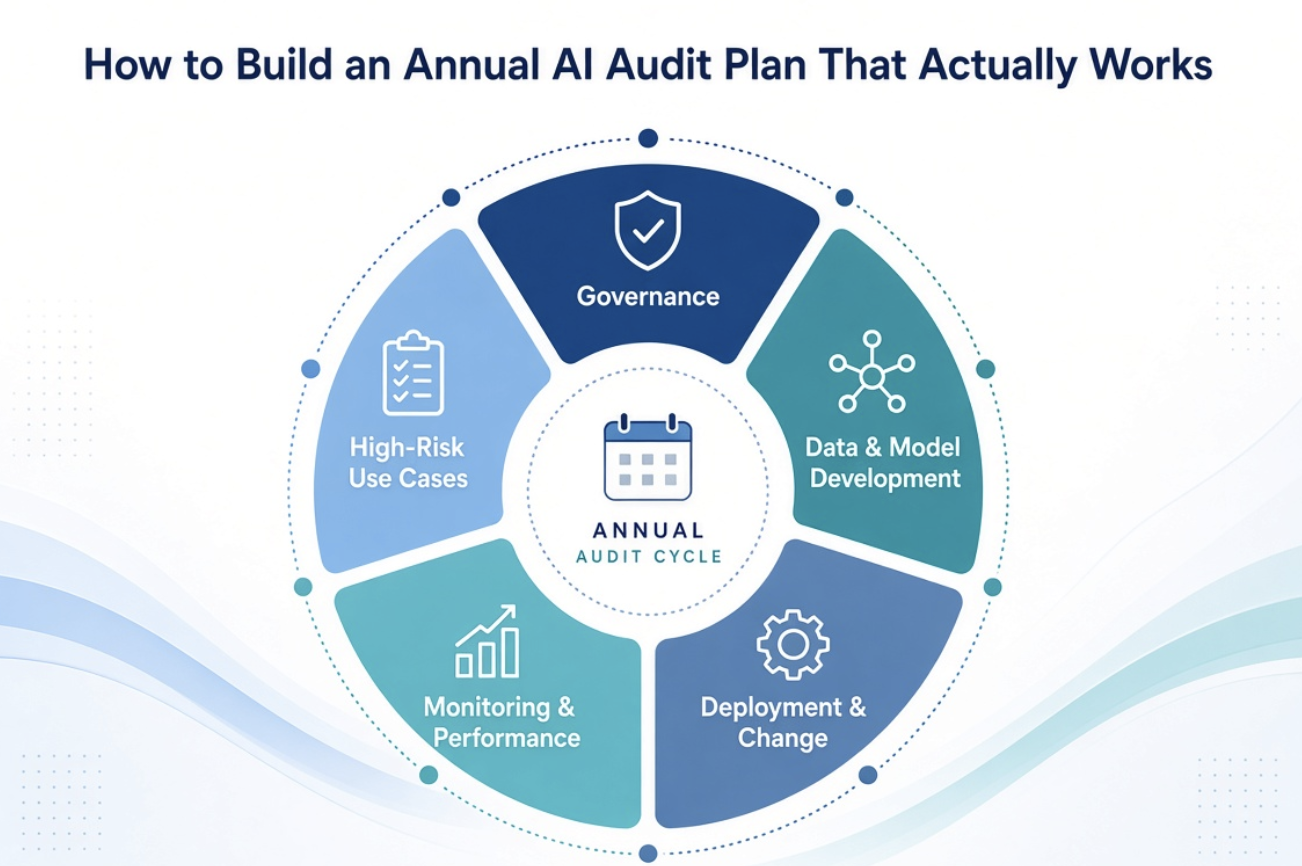
A more durable model is an annual portfolio of targeted AI audits. Instead of one broad assessment, the plan includes several focused reviews that cover different stages of the AI lifecycle and different categories of risk. Together they produce continuous, meaningful assurance that a single point-in-time engagement cannot deliver.
This 5 step guide on building an annual AI Audit plan outlines that portfolio approach: why it is necessary, the five core audit types that should appear in a mature plan, how to sequence coverage when starting from limited maturity, and how the pieces fit together with existing framework crosswalks.
Why a Single AI Audit Is Not Enough
AI systems are not static. Data distributions shift. Models drift. New use cases are deployed. Vendors update algorithms or change model behavior without formal notice. Governance structures that were adequate six months earlier may no longer match how systems are actually being used.
A one-time audit captures a snapshot. It cannot provide reliable assurance over something that continues to change after the fieldwork ends. A portfolio approach solves this by distributing coverage across the lifecycle. Different risk domains are examined at appropriate intervals. No single review is treated as a complete picture of AI risk.
The portfolio model also allows audit functions to build capability incrementally. Coverage begins where residual risk is highest and expands as technical fluency, organizational relationships, and inventory quality improve. This is far more realistic than attempting comprehensive AI assurance in the first year.
The Five Core Audit Types
A well-structured annual AI audit plan rests on five distinct review types. Each has a clear scope, a defined purpose, and a specific place in the overall assurance strategy.
1. AI Governance Audit
This is the highest-leverage starting point for most organizations and the foundation for everything that follows.
Scope: Policies, standards, and oversight structures for AI development and use. Completeness and accuracy of the AI system inventory. Ownership and accountability assignments. Alignment between AI governance and enterprise risk management. Approval processes for new systems and material changes.
Why it matters: Governance weaknesses are the most common root cause of later AI problems. They rarely appear as dramatic model failures. They surface as incidents, regulatory findings, shadow systems, and control gaps that could have been prevented. Strong governance also creates leverage—it reduces residual risk across every other audit type.
Year-one priority: If no formal AI governance audit has been performed, begin here. The inventory, ownership clarity, and policy findings produced by this review directly shape the scoping and prioritization of subsequent work.
2. Data and Model Development Audit
Scope: Data sourcing, quality controls, and data governance practices that feed AI systems. Model design, testing, validation, and documentation. Reproducibility, version history, and change records for models under review.
Why it matters: AI performance is constrained by the quality and appropriateness of the data used to train and operate the system. Biased, incomplete, or poorly governed data does not always produce obviously broken outputs. It produces results that look plausible while embedding distortions. This audit type surfaces those risks before they become material business or regulatory issues. It also reaches technical and procedural controls that a pure governance review will not examine.
3. AI Deployment and Change Management Audit
Scope: Approval workflows for new deployments and material model or system changes. Version control and change-tracking practices. Integration of AI systems into business processes and the controls that operate at those integration points.
Why it matters: A significant share of AI-related control failures occur after development is complete. Systems move into production without adequate review. Updates are released without triggering re-validation. Integration points introduce risks that neither the technical team nor the business fully owns. This audit type addresses the transition risk that sits between development and live operation.
4. Monitoring and Performance Audit
Scope: Ongoing model monitoring practices. Drift detection and retraining triggers. Incident management for AI-related issues, including how anomalies are identified, escalated, and resolved. Logging and alerting effectiveness.
Why it matters: Even a well-designed and carefully deployed system can degrade. Data distributions shift. Business context changes. A model trained on older data operates in a new environment. Without active monitoring, these changes remain invisible until consequences appear in decisions, customer outcomes, or regulatory scrutiny. This audit type covers the continuous risk that static reviews miss by design.
5. High-Risk Use Case Audits
Scope: Deep-dive examinations of specific AI applications that carry elevated regulatory, financial, or reputational exposure. Typical candidates include credit decisioning models, hiring and promotion tools, fraud detection systems, pricing algorithms, and customer-facing generative applications. Focus areas include fairness, explainability, regulatory compliance, and the application-specific controls that govern each system.
Why it matters: Not all AI systems present the same level of risk. A back-office scheduling tool and a credit underwriting model may both use machine learning, but the assurance expectations differ sharply. High-risk use case audits ensure that the applications with the greatest potential impact receive proportionate attention. These reviews are also where regulatory exposure is often most concrete—obligations under laws such as New York City Local Law 144, Colorado’s algorithmic discrimination provisions, or sector-specific disclosure rules attach to particular use cases rather than to “AI” in the abstract.
Sequencing Coverage When Starting from Limited Maturity
Few audit functions can execute all five audit types effectively in the first year. Attempting to do so usually produces thin coverage and exhausted teams. A sequenced approach based on risk and organizational readiness is more effective.
Year one: Conduct a thorough AI Governance Audit. Establish or validate the inventory, clarify ownership, assess policy coverage, and identify the highest-risk systems. The outputs of this work become the foundation for everything else.
Year two: Add a Data and Model Development Audit for priority systems and perform at least one High-Risk Use Case Audit focused on the application with the greatest regulatory or financial exposure.
Year three and beyond: Integrate Deployment and Change Management reviews and Monitoring and Performance audits as technical capability and cross-functional relationships mature. Maintain a rotating schedule of high-risk use case deep dives so that the most sensitive applications receive regular attention.
The objective is a plan that is ambitious enough to close the assurance gap yet realistic enough to execute with available resources and skills.
How the Portfolio Connects to Framework Crosswalks
Individual AI audits still need a clear methodology. A practical approach is to apply a crosswalk of recognized frameworks—such as the NIST AI Risk Management Framework for lifecycle risk management, internal-audit-oriented guidance for control rigor and reporting, and OWASP resources for LLM and agentic technical risks—inside each of the five audit types.
The annual portfolio defines the shape and sequencing of coverage. The framework crosswalk supplies the detailed procedures, testing approaches, and reporting structure for each engagement. Used together, they give the audit function both strategic structure and tactical executability.
Practical Considerations for the Annual Plan
Several implementation details determine whether the portfolio succeeds in practice.
First, the AI inventory must be treated as a living artifact. It should be updated when new systems are approved, when existing systems change purpose or data sources, and at regular intervals even if no formal changes are reported. An outdated inventory undermines prioritization.
Second, risk scoring should remain simple and consistent. Overly complex scoring models slow decision-making and create false precision. A transparent set of dimensions—business impact, data sensitivity, regulatory exposure, deployment status, and known control gaps—is usually sufficient.
Third, technical skills must be developed deliberately. Not every auditor needs to become a model developer, but the function needs access to people who understand data pipelines, model validation concepts, prompt and output risks, and basic security testing for AI systems. This can be built internally, obtained through co-sourcing, or developed through targeted training.
Fourth, findings should be framed in business and risk language rather than purely technical jargon. Boards and senior management respond more effectively when issues are linked to decision quality, customer impact, regulatory exposure, or operational resilience.
Fifth, the plan should remain flexible. New high-risk use cases will appear. Regulatory expectations will evolve. Vendor models will change. The annual plan is a living document that should be adjusted as the risk landscape shifts.
Moving from One-Off Reviews to Continuous Assurance
AI is not a one-audit topic. Functions that continue to treat it that way will remain reactive—responding to incidents, regulatory inquiries, or external audit findings rather than providing forward-looking assurance. Functions that build even an imperfect annual portfolio now will be better positioned as AI becomes more deeply embedded and scrutiny intensifies.
The five audit types described here—Governance, Data and Model Development, Deployment and Change Management, Monitoring and Performance, and High-Risk Use Cases—provide a practical structure. Sequencing them according to risk and maturity keeps the plan executable. Linking each engagement to a clear framework crosswalk keeps the work rigorous and defensible.
The organizations that close the AI assurance gap will be those that stop asking whether they have “done an AI audit” and start asking whether their annual plan provides continuous, risk-based coverage across the full lifecycle of the systems that increasingly shape decisions, customer experiences, and regulatory exposure. Building that plan is the work that matters now.