Vivek Shah is no longer merely a “serial plaintiff” in the vocabulary of defense lawyers and demand-letter recipients. On July 20, 2026, U.S. District Judge R. Gary Klausner entered a formal prefiling order declaring Shah a vexatious litigant in Vivek Shah v. Crain Communications, Inc., No. 2:26-cv-03070-RGK-CTS (C.D. Cal.). The court found a pattern of repetitive filings and dismissals that, in its words, strongly indicated an effort to “harass defendants into coercive settlements” instead of seeking judicial redress in good faith. The court’s order is available here, and the Crain docket is available here. This is going to be the most comprehensive put together piece around Vivek Shah and the CIPA privacy demand letters. If you’ve received a letter or your client has please book time with us below so we can discuss working together to get your clients website compliant and avoid the 50+ other Viveks that we know of in the market.

Contact our data privacy expert team if you’ve received a demand from serial plaintiff Vivek Shah. Captain Compliance is a privacy software solution that can provide you a free privacy audit for your website and get you an audit to help get the case dismissed vs other defendants who did not reach out to use first and ended up settling with a big pay out.
There are hundreds of businesses receiving these demands for privacy violations and we work with a lot of law firms to help you fix the websites in question. Book a time above with our International Association of Privacy Professional team members.
That order above is a major development. It is not, however, the end of website privacy litigation, the invalidation of every demand Shah has sent, or a nationwide injunction against him. It does not automatically govern California state court, another federal district, an arbitration, a case already pending, a claim outside the order’s subject matter, or a demand letter that never becomes a lawsuit. It also does not resolve the central statutory fight: whether ordinary website technologies can violate the California Invasion of Privacy Act, or CIPA.
That distinction is the starting point for a responsible analysis. A business should neither panic and pay simply because a thick packet arrives, nor assume that the vexatious-litigant order makes the packet disappear. The correct response is evidence-driven: preserve the site as it existed on the alleged date, identify the exact CIPA theory, inspect what code actually fired, determine what data actually left the browser, test consent behavior, and let qualified counsel assess standing, jurisdiction, statutory coverage, arbitration, limitations, damages, and litigation strategy.
Captain Compliance sits at the center of that technical response. Our privacy software company works with hundreds of law firms handling website privacy demands and litigation to protect their clients from privacy litigation claims. Our role is not to replace counsel or promise immunity. It is to give counsel and the business what these disputes so often lack: an accurate inventory, reproducible network evidence, working consent controls, vendor-flow documentation, consent records, and proof of remediation. A legal theory is easier to challenge when the technical facts are known. A real defect is easier to correct before another claimant tests it.
This dossier builds on Captain Compliance’s prior reporting, including our warning before anybody else with our initial privacy-counsel alert about Vivek Shah, search-bar litigation analysis, coverage of the Crain vexatious-litigant order, analysis of Lofty’s declaratory action, and our booking platform to help with a response for Shah demand recipients.
Executive Findings
- “Vexatious litigant” is now a judicial designation, not editorial name-calling. Judge Klausner formally applied it to Vivek Shah after reviewing at least 29 proceedings initiated from 2021 through 2026 and a cluster of materially similar CIPA complaints. The phrase should still be used with its scope and source attached.
- The order is narrow but consequential. Shah must obtain permission before filing a new CIPA or related digital-privacy case in the Central District of California. The order does not erase pending cases, stop demand letters, directly bind other courts or arbitrators, or adjudicate whether a particular tracker violates CIPA.
- The representative demand packet reviewed for this article advances a Section 631(a) “contents” theory. It alleges that a website search term was sent contemporaneously to multiple analytics or advertising vendors after the visitor selected “Decline.” It is not the same as the later Section 638.51 pen-register theory involving IP addresses, device identifiers, browser information, and other routing or signaling data.
- The packet is structured to multiply alleged exposure. It treats each search and each transmission to each third party as a separate $5,000 violation. That multiplication is an advocacy position, not an automatically established measure of damages.
- The law is genuinely divided. Some federal courts have allowed website CIPA claims to survive dismissal, particularly where search terms, form inputs, detailed browsing activity, persistent identifiers, or alleged pre-consent transmissions are involved. Several California trial courts have rejected Section 638.51 claims against routine website tools. No California appellate opinion has yet supplied a controlling answer to the central website-pen-register question.
- Standing is increasingly fact-specific. The federal dismissal in Shah v. TalentBridge treated generic job-search queries, IP information, and basic metadata as insufficient to establish a concrete privacy injury. Other courts have found standing where the alleged dataset was specific, personal, sensitive, persistent, or collected contrary to an express opt-out choice.
- “We have a cookie banner” is not a defense by itself. In some pleadings, the banner becomes evidence for the claimant: it allegedly creates an expectation that “Reject” will work, while network traffic shows nonessential vendors continuing to receive data. The decisive issue is implementation, timing, scope, and proof.
- Captain Compliance is most valuable as a coordinated legal-technical layer. Counsel decides legal posture. Captain Compliance and the website team establish what happened, control what happens next, and maintain the records needed for a regulator, insurer, court, arbitrator, vendor dispute, or future claimant.
Who Is Vivek Shah, and Why Does the Court’s Label Matter?
Shah is a California-based self-represented litigant who has filed or threatened a large number of claims involving websites, analytics, search functions, pixels, cookies, and other digital technologies. Major defense firms describe his campaign as national and cross-industry. Our highly respected legal friends at Fisher Phillips reported that recipients have included manufacturers, schools, auto dealers, mining companies, retailers, nonprofits, B2B businesses, and consumer-facing businesses. Another top law firm that we love working with Lathrop GPM reported hundreds of CIPA-related suits in 2026 and described Shah’s packets as draft lawsuits accompanied by screenshots of website traffic.
Public totals should be attributed rather than repeated as settled fact. Fisher Phillips estimated in July that Shah had sent thousands of demands from fall 2025 through June 2026. Lathrop GPM reported 21 filed lawsuits in 2026 as of June 30. The federal court itself made the more defensible finding that Shah had initiated at least 29 proceedings from 2021 through 2026 across several subject areas. Those figures measure different things—letters, lawsuits in a period, and proceedings across years—so they should not be blended into one supposed exact count.
The July 20, 2026 Crain Order
In Crain, Judge Klausner examined the record required by Ninth Circuit law before imposing a prefiling restriction: notice and an opportunity to be heard, an adequate record, substantive findings of frivolousness or harassment, and a narrowly tailored order. According to the Duane Morris analysis, the court observed seven materially similar CIPA complaints filed against seven different defendants in the seven months preceding the Crain action. In the broader record, most cases ended at the pleading stage, often through dismissal or Shah’s voluntary dismissal after a defense motion.
The court did not treat voluntary dismissal as neutral simply because it avoided an adverse merits judgment. Relying on vexatious-litigant precedent, it reasoned that repeatedly bringing baseless actions and withdrawing them when challenged can burden defendants and courts just as surely as pursuing them to final judgment. The court found an “extensive record of harassment,” formally declared Shah vexatious, and imposed a prefiling review requirement for new CIPA and related digital-privacy actions in the Central District.
The Baker Donelson report, Shumaker report, Pillsbury analysis, and Duane Morris alert agree on the core practical point: this is meaningful leverage, not complete immunity from future claims.
What the Order Does
The order requires Shah to obtain leave before filing a new action in the Central District of California that alleges CIPA or related digital-privacy claims. A business served with a new Shah complaint in that district should immediately check the docket for an order granting leave. If leave was not obtained, the prefiling order supplies a direct procedural defense.
The court did not require Shah to post security in the pending Crain case. It left future judges free to consider security in future qualifying matters. Defense counsel may also evaluate whether the federal designation supports a motion under California Code of Civil Procedure Section 391 if Shah files a substantially similar action in California state court. That is an argument to be made, not an automatic statewide bar.
What the Order Does Not Do
The order does not:
- prohibit Shah from sending demand letters;
- automatically dismiss Crain or another case already pending;
- bind the Los Angeles Superior Court, another state, another federal district, JAMS, or AAA;
- cover every kind of claim Shah might assert;
- restrict other plaintiffs or plaintiffs’ firms;
- decide whether a search bar, pixel, analytics SDK, chat tool, or cookie is a wiretap or pen register;
- decide whether a particular business obtained effective consent; or
- establish that every prior or future Shah allegation is false.
This scope matters because careless headlines can create dangerous business advice. “Shah is vexatious, so ignore the letter” is not a legal strategy. The better conclusion is: the court’s findings materially alter leverage, and the recipient should use that leverage with a preserved technical record and counsel-led response.
A Separate, Public Criminal Record—and the Line This Article Will Not Cross
Shah’s criminal history is public and appears in much of the outside coverage. In 2013, the U.S. Department of Justice announced that Shah had been sentenced to seven years and three months in federal prison after an extortion case involving mailed threats and demands totaling more than $122 million. The DOJ release describes threats against family members of seven targets.
That conviction is historical fact. It does not prove that sending a present civil demand or filing a CIPA action is criminal extortion. This article does not call Shah’s current demands crimes, does not infer liability from his past, and does not use “extortion” as a loose synonym for an aggressive settlement demand. The legally relevant criticism of the current litigation pattern comes from Judge Klausner’s 2026 order and its findings—not from guilt by biography.
Inside a Representative Vivek Shah Demand Packet
The packet reviewed for this dossier is a 28-page mailed package dated November 13, 2025. To protect the recipient, this article does not identify the company, reproduce its website, or name any employee. The packet contains a short cover letter, a draft Los Angeles Superior Court complaint, technical screenshots, and exhibits. Its wording tracks the structure that Jeffer Mangels Butler & Mitchell described in its April 2026 alert and that other firms have reported receiving.
The Cover Letter: Short, Direct, and Backed by a Ready Complaint
The cover letter alleges a violation of California Penal Code Section 631(a), asserts that the website sent Shah’s data to third parties without consent, and says he seeks injunctive, declaratory, and monetary relief. It states that the attached complaint is ready to be filed in Los Angeles Superior Court if the dispute remains unresolved.
Whatever the sender’s subjective intent, the mismatch in length has an obvious strategic effect. The letter itself provides little legal or technical detail; the formal draft complaint increases the pressure on the recipient. A recipient holding only the first page sees a conclusory accusation. A recipient turning the page sees captioned litigation papers, statutory-damages language, multiple third-party vendors, a jury demand, and broad requested relief. That presentation can make an unresolved theory look like an adjudicated violation. It is not one. A draft complaint proves what the claimant may allege—not what actually happened or what the law ultimately requires.
The Test: Decline, Search, Inspect Network Traffic
The complaint alleges a reproducible sequence:
- Shah visits the site.
- A cookie banner appears.
- He selects “Decline.”
- He uses the website’s search bar.
- In one documented search, he types “VIVEK.”
- Browser developer tools allegedly show HTTP requests containing the query.
- Those requests allegedly go not only to the website but also to outside services.
The draft identifies alleged recipients including AdRoll, LinkedIn, HubSpot, and other unnamed “Tracking Entities.” It characterizes the third-party code as active listeners embedded into the site and alleges that the site owner chose to employ or cooperate with those vendors for analytics, advertising, or related commercial purposes.
This is important because it separates a mere cookie inventory from the actual claim. The theory is not simply “the website has HubSpot” or “the browser contacted LinkedIn.” The theory is that protected content was copied during transmission, sent to a nonparty, and processed without prior all-party consent. Each step has to be proven. The domain name, request type, payload, timing, vendor role, browser state, consent state, geographic signal, and server response all matter.
The “Contents” Theory
Section 631(a) addresses, among other things, learning the contents or meaning of a communication while it is in transit. The packet argues that a search query is not mere metadata. It is the substance of what the user communicates to the website. A query for a medical condition, legal problem, political topic, or relationship concern could reveal personal interests or circumstances. Even the apparently innocuous word “VIVEK,” the complaint argues, is identifying content.
There is case support for the general proposition that search terms can be contents. In In re Zynga Privacy Litigation, the Ninth Circuit distinguished ordinary record information from URLs that contain a search term or similar communication content. In re Facebook Internet Tracking Litigation recognized that full-string URLs can reveal detailed browsing activity. And in Heerde v. Learfield Communications, LLC, 741 F. Supp. 3d 849 (C.D. Cal. 2024), a federal court held at the pleading stage that search terms constitute contents. The Heerde decision is available here.
But “search terms can be contents” does not decide every search-bar case. The recipient can still dispute whether the identified request carried the term, whether the vendor actually received or read it, whether the transmission was contemporaneous, whether the vendor was a party or service provider, whether there was valid consent, whether the defendant acted with the required state of mind, whether Shah had a protectable privacy interest, and whether California law reaches the conduct.
The Third-Party and Aiding-and-Abetting Theory
The draft alleges two layers of liability. First, it says outside tracking vendors directly violated Section 631(a) by intercepting or reading the search. Second, it says the site owner aided, agreed with, employed, or conspired with them by intentionally embedding their code.
That pleading structure responds to CIPA’s “party exception.” A website operator is generally a party to a visitor’s communication with the site and therefore is not an eavesdropping stranger merely because it receives the message. Plaintiffs try to avoid that rule by characterizing an analytics or adtech company as an independent third party using the data for its own purposes. Defendants respond that the vendor is an extension of the website, a service provider, or an intended recipient, and that the operator cannot aid a violation that never occurred.
Labels in a privacy policy or contract help, but function matters. A vendor called a “processor” may still build its own profiles. A vendor called an “independent controller” may in fact receive only a transient technical signal. A strong response maps the actual flow and compares it to the operative contract, settings, retention rules, and downstream-use rights.
The Consent-Banner Paradox
The packet alleges tracking both before meaningful interaction and after Shah selected “Decline.” That makes the banner central evidence rather than decoration. If the banner promises a real choice but nonessential tags fire before a decision—or keep firing after rejection—the plaintiff may argue that the site created and violated an expectation of privacy.
Conversely, a working, conspicuous mechanism that blocks nonessential vendors until affirmative consent and retains a timestamped record can substantially improve the factual posture. Consent remains legally nuanced under CIPA, and different clauses and courts may analyze it differently. But technically provable consent gating is far stronger than a footer policy, passive browsewrap, or a banner whose buttons change only the interface while leaving the tag manager untouched.
This is why Captain Compliance’s cookie consent manager and cookie scanner should be deployed and tested as operational controls, not treated as cosmetic plugins. The question is not whether a banner is visible. The question is what the browser does before a choice, after “Accept,” after “Reject,” after granular settings, on a return visit, and when location or global privacy signals change.
The Damages Multiplier
The packet asks for $5,000 for every alleged violation and defines the unit aggressively: each search transmitted to each distinct outside entity is a separate violation. Two searches allegedly shared with several vendors therefore become a stack of statutory-damages units.
California Penal Code Section 637.2 permits a person injured by a CIPA violation to seek the greater of $5,000 per violation or three times actual damages, and actual damages are not a prerequisite. The statute does not, by those words alone, resolve how to count a “violation” in every website architecture. The packet’s search-by-vendor calculation is a claimant’s theory. Counsel should test it against the alleged conduct, statutory clause, causation, standing, case law, and any authority addressing duplicative recovery.
The packet also seeks declaratory and injunctive relief, removal of third-party scripts or prior-consent gating, three years of independent technical audits, an accounting, disgorgement, litigation costs, interest, and other relief. Those remedies raise separate questions of statutory authorization, equitable standing, traceability, ongoing harm, and whether the requested injunction is technically specific enough to administer.
What the Screenshots Can Prove—and What They Cannot
Network screenshots can be useful evidence. They can show that a browser made a request to a domain at a time and that a visible parameter appeared in the request. Standing alone, they may not establish:
- that the recipient was legally a third party rather than an intended or authorized service provider;
- that the recipient read, decoded, retained, joined, or used the field;
- that the field represented protected contents instead of addressing or record information;
- that the capture occurred while the communication was legally “in transit”;
- that no valid consent existed elsewhere in the interaction;
- that the defendant knew of or intended the specific transmission;
- that the claimant suffered a concrete federal injury;
- that the conduct occurred in California or is subject to California law;
- that each domain contact is a separate statutory violation; or
- that the website behaved the same way on the alleged date as it does today.
The defense should not dismiss the screenshots. It should reproduce, contextualize, and, where appropriate, rebut them. Captain Compliance can help counsel create a fuller evidence set: HAR files, request and response headers, payload interpretation, cookies and local storage, tag initiators, consent state, timestamps, vendor identity, geographic configuration, container history, and test results across scenarios.
Two Different CIPA Claims: Section 631 Wiretapping and Section 638.51 Pen Registers
Shah’s campaign has evolved. Earlier and representative packets focus on Section 631(a), search terms, and alleged interception of contents. More recent letters reported by Fisher Phillips and others invoke Section 638.51, alleging that routine analytics tools function as unauthorized pen registers or trap-and-trace devices. A recipient must identify which claim it actually faces. Treating the provisions as interchangeable can produce a technically irrelevant audit and a legally misdirected response.
Section 631(a): Contents, Transit, Authorization, and Assistance
Section 631(a) contains several clauses. In simplified terms, it addresses unauthorized tapping or connection, reading or learning contents while in transit, use of information obtained, and aiding or agreeing with others to do the prohibited acts. Website cases often focus on the second and fourth clauses: a third party allegedly reads contents in real time, and the website operator allegedly enables it.
The recurring Section 631 questions are:
- Was there a communication?
- What were its contents?
- Who were the intended parties?
- Did a nonparty acquire or read it?
- Did acquisition occur contemporaneously while it was in transit?
- Was the conduct intentional or willful as the relevant clause requires?
- Did all necessary parties consent before the alleged interception?
- Did the site owner knowingly aid an independently unlawful act?
- Is the claim timely?
- Can the claimant establish standing and territorial connection?
Javier v. Assurance IQ, LLC is regularly cited for the proposition that consent to an interception must precede it. The Ninth Circuit’s 2022 memorandum disposition was unpublished and addressed the second clause. In Gutierrez v. Converse Inc., the Ninth Circuit cautioned against treating Javier as a precedential construction of all Section 631(a). The safe operational lesson remains straightforward: if a company intends to rely on consent for nonessential tracking, collecting it before the disputed transmission creates a much stronger record.
Section 638.51: Routing and Addressing Information, Not Contents
Section 638.50 defines a pen register as a device or process that records or decodes dialing, routing, addressing, or signaling information transmitted by an instrument or facility—but not contents. Section 638.51 generally prohibits installation or use without a court order, subject to listed exceptions, including certain provider activity and user consent.
Modern complaints argue that JavaScript, pixels, SDKs, analytics libraries, or cookies are a “process”; that IP addresses, device identifiers, browser data, and similar signals are routing or addressing information; and that the website caused the process to be installed or used without the visitor’s consent. Defense arguments emphasize statutory context, telecommunications history, the ordinary operation of internet requests, provider and user exceptions, first-party use, and the absurd consequences of treating every website request as regulated surveillance.
The line between the provisions is conceptually useful:
| Issue | Section 631 search-bar theory | Section 638.51 pen-register theory |
|---|---|---|
| Alleged data | Search terms, form text, chat content, detailed URLs | IP address, device ID, browser attributes, routing/signaling fields |
| Statutory category | Contents or meaning of a communication | Addressing/routing/signaling information, excluding contents |
| Core event | Alleged contemporaneous interception or reading | Alleged installation or use of a recording/decoding process |
| Common defendant theory | Website aided an outside eavesdropper | Website or vendor used an unauthorized digital pen register |
| Key factual work | Payload, timing, recipient role, consent, initiator | Fields collected, process installed, operator, exception, consent |
| Current legal problem | Search terms can be contents, but standing and third-party status vary | State and federal trial courts are sharply divided over internet coverage |
A field cannot casually be treated as both content and non-content at the same moment simply because alternate pleading is convenient. Counsel should force precision: Which field? Which request? Which vendor? Which statutory clause? Which alleged act? Which unit of damages?
The Case-Law Map: Why Both Sides Can Quote a Judge
CIPA website law is unsettled because trial courts are answering different questions on different records. One case involves an SDK that allegedly assembles location profiles. Another involves an IP address necessary to route a page. Another involves medical search terms or chat text. Another involves a tracker that allegedly fires after the visitor expressly opts out. A holding at the motion-to-dismiss stage says only that well-pleaded allegations were sufficient, not that the plaintiff proved liability.
Section 631 Cases That Give Search-Bar Plaintiffs Traction
In re Zynga Privacy Litigation, 750 F.3d 1098 (9th Cir. 2014). The Ninth Circuit explained that ordinary header information is generally record information, but a URL containing a search term or similar communication can reveal contents. This distinction is the doctrinal hinge of many search-bar demands.
In re Facebook Internet Tracking Litigation, 956 F.3d 589 (9th Cir. 2020). The court addressed third-party tracking and the party exception, recognizing that a company is not necessarily a party to communications merely because its code receives them. The decision is often cited by plaintiffs to characterize a tracker as an eavesdropping outsider and by defendants to focus on the precise communication and recipient role.
Heerde v. Learfield Communications, LLC, 741 F. Supp. 3d 849 (C.D. Cal. 2024). The court allowed a Section 631 theory involving search terms allegedly transmitted through the Meta Pixel to proceed past dismissal. It treated search terms as contents and found the alleged absence of notice and consent significant. The full decision is essential reading for any search-bar demand.
Gabrielli v. Haleon US Inc., 815 F. Supp. 3d 852 (N.D. Cal. 2025). The court distinguished generic interaction data from search terms and descriptive URLs that convey substance. The decision reinforces why payload detail matters.
Jones v. Skullcandy, Inc., No. 3:25-cv-01759 (S.D. Cal. Mar. 12, 2026). At the pleading stage, the court rejected the proposition that a footer privacy-policy link necessarily supplied consent and allowed relevant CIPA theories to proceed. The order is available here.
These cases are a warning against overconfident dismissal of the theory. Search terms can be contents. A third-party tracker can be treated as more than a passive tool. Consent can fail if it is late, hidden, contradictory, or technically ineffective.
Section 631 Cases and Principles That Support Defense Challenges
Contemporaneous acquisition. A Section 631 reading theory generally requires acquisition while the communication is in transit, not merely later use of data already stored. Cases addressing session replay and server-side processing scrutinize the sequence. A screenshot of a stored value is not automatically proof of a wiretap.
Party and service-provider status. A website is ordinarily a party to communications directed to it. A vendor’s role may be derivative if it processes data solely to provide the site’s requested service. The analysis changes if the vendor allegedly uses the data for independent advertising, profiling, or resale.
Knowledge and intent. Aiding-and-abetting language does not create strict liability for every plug-in. Courts including Smith v. YETI Coolers, LLC, 754 F. Supp. 3d 933 (N.D. Cal. 2024), have examined whether the pleaded facts support knowledge and intentional assistance. Vendor code that behaves unexpectedly, a tag introduced by an agency, or a field added after deployment raises different questions from a deliberate configuration.
Standing. Section 637.2 says actual damages are not required under state law, but federal Article III still requires a concrete injury. Generic data, unconnected to an individual or a sensitive interest, may be insufficient. An express opt-out followed by detailed tracking may be sufficient in another case.
Limitations. CIPA claims are generally subject to a one-year limitations period. The date of visit, knowledge, demand, arbitration, filing, tolling, and amendment matter. Businesses should not assume a demand’s alleged date is accurate or that every procedural detour tolls the claim.
The Federal Pen-Register Line: Broad “Device or Process” Readings
Greenley v. Kochava, Inc., 684 F. Supp. 3d 1024 (S.D. Cal. 2023). The court allowed a Section 638.51 claim involving an SDK and alleged collection of extensive location and device data to proceed, reasoning that software can be a statutory “process.” The opinion is the launch point for much of the modern pen-register wave. GovInfo provides the case materials here.
Moody v. C2 Educational Systems Inc., 742 F. Supp. 3d 1072 (C.D. Cal. 2024). The court rejected a telephone-only reading at the pleading stage and treated software collecting browser, device, and form data as potentially within the statutory definition.
Camplisson v. Adidas America, Inc., 809 F. Supp. 3d 1095 (S.D. Cal. 2025). The court allowed claims involving a broader set of identifying and addressing information to survive and rejected passive browsewrap as conclusive consent.
Bradshaw v. Lowe’s Companies, Inc., No. 3:25-cv-00742 (S.D. Cal. 2025). The court followed the broader federal line and rejected a telephone-only limitation at dismissal. The order is available here.
Nelson v. Reddit, Inc., No. 3:25-cv-01470 (S.D. Cal. 2026). This 2026 decision reflects continued federal willingness to apply the broad text to modern tracking allegations while scrutinizing consent and who qualifies as the relevant user.
The federal cases are not uniform, and some dismiss for standing or pleading deficiencies. But they explain why a company should not rely on “pen registers are only telephone devices” as if that proposition were already binding statewide law.
The California Trial-Court Line: Routine Web Traffic Is Not a Pen Register
Several Los Angeles Superior Court judges have taken a narrower view. Decisions including Licea v. Hickory Farms, LLC, Sanchez v. Cars.com Inc., Aviles v. LiveRamp, Inc., Casillas v. Transitions Optical, Inc., Rodriguez v. Ink America, LLC, and Blaker v. NetScout Systems, Inc. have supplied defense arguments that Section 638.51 was not designed to criminalize the ordinary technical process by which websites receive and route internet communications.
The May 27, 2026 Blaker ruling is especially important. The Los Angeles Superior Court sustained a demurrer without leave to amend and concluded that the pen-register provisions apply to telephone communications, not software on a commercial website. Mintz’s analysis links the statute and describes the ruling.
These are persuasive trial-level decisions, not a California Supreme Court holding. Some are unpublished and carry different citation implications. Federal judges applying California law do not consider themselves categorically bound by a collection of state trial-court orders, especially where they predict that the California Supreme Court would follow statutory text extending to electronic communications.
The Appellate Cases That Could Change the Landscape
Variety Media, LLC v. Superior Court, No. B350578, is pending in the California Court of Appeal, Second District. It squarely asks whether standard website analytics or pixel activity can qualify as a pen register under Section 638.51. Major business groups, privacy advocates, retailers, publishers, and technology companies have filed amicus papers. The public appellate docket is available here, and the U.S. Chamber case page collects its amicus brief.
The California appellate answer will matter far beyond Variety Media. A telephone-only holding could sharply reduce private website pen-register litigation. A broad “device or process” holding could validate a major part of the plaintiffs’ theory, shifting the fight to consent, standing, statutory exceptions, causation, and damages. A narrow, fact-bound answer could preserve the present split.
Spencer Fane also identifies a second appellate proceeding, Reuters News & Media, Inc. v. Superior Court, pending in the Sixth Appellate District on a similar issue. Its July 2026 landscape analysis is a useful overview.
Vivek Shah’s 2025–2026 CIPA Timeline
This timeline is limited to matters verified as involving Vivek Shah. It intentionally excludes cases brought by other people with the surname Shah, including the published Shah v. Fandom decision involving Vishal Shah. That case may be relevant precedent, but it is not part of Vivek Shah’s personal litigation record.
| Date | Matter | Development | Why it matters |
|---|---|---|---|
| Nov. 13, 2025 | Representative demand packet reviewed here | Section 631(a) search-bar “contents” claim; “VIVEK” query; multiple alleged vendors; $5,000-per-transmission theory | Shows the earlier template and technical method |
| Jan. 5, 2026 | Shah v. TalentBridge, Inc., No. 2:26-cv-00222 | CIPA search-query suit filed in the Central District of California | Produced the strongest merits-related standing loss against Shah to date |
| Mar. 18, 2026 | Shah v. Crain Communications, Inc., No. 2:26-cv-03070 | Section 631 action filed | Became the vehicle for the vexatious-litigant order |
| May 2026 | Shah v. Pashion Footwear Inc. arbitration and No. 2:26-cv-05124 | Arbitrator dismissed CIPA and ECPA claims and denied leave to amend; Shah petitioned to vacate, then voluntarily dismissed the federal petition | A defense result, but an arbitration award is not binding precedent |
| May 28, 2026 | TalentBridge | Court dismissed the first amended complaint without leave to amend | Found diversity amount and Article III standing defects |
| June 1, 2026 | TalentBridge, Ninth Cir. No. 26-3514 | Shah appealed | The standing ruling is not the final appellate word |
| June 26, 2026 | Ovadia Law Group, P.A. v. Shah, No. 9:26-cv-80766 (S.D. Fla.) | Florida law firm filed declaratory and other claims after receiving a demand | Tests territorial reach and an offensive response strategy |
| July 8, 2026 | Lofty Inc. v. Shah, No. 2:26-cv-07425 (C.D. Cal.) | Website-platform company sought declaratory relief after a Section 638.51 threat | Directly tests pen-register theory and tester standing at platform scale |
| July 20, 2026 | Crain | Judge Klausner declared Shah a vexatious litigant and entered a prefiling order | Alters future filing procedure and settlement leverage in one federal district |
TalentBridge: Generic Queries, Article III, and Failed Damages Arithmetic
In Shah v. TalentBridge, Inc., Shah alleged that he clicked “Reject All” and searched phrases related to employment and criminal background checks. The first amended complaint treated one cause of action as multiple counts, attempting to use multiple searches and alleged recipients to satisfy the federal diversity amount.
Judge Anne Hwang dismissed without leave to amend on May 28, 2026. The court found that generic phrases such as searches for jobs open to people with felony records did not, without more, establish that Shah had a criminal history or reveal a fact personal to him. Researchers, teachers, advocates, employers, or other visitors might enter the same terms. An IP address and basic metadata did not automatically transform the queries into personally identifying information. The court also rejected conclusory multiplication of alleged statutory counts as a basis for the jurisdictional amount. The order is available here, and Glaser Weil describes the defense result.
TalentBridge is powerful but not universal. It is a federal standing decision involving particular searches and allegations. It does not hold that search terms can never be contents, that CIPA never applies to websites, or that California state court requires Article III standing. Shah appealed on June 1, 2026. The Ninth Circuit docket, No. 26-3514, shows an opening brief and an appeal that remained pending on the latest publicly retrieved docket.
For defense counsel, TalentBridge supports a disciplined standing attack: identify the exact disclosed data, determine whether it was linked to the claimant, distinguish sensitive personal content from a deliberately generic test, and resist unsupported damages multiplication. For website owners, it is not permission to keep a broken banner. A stronger plaintiff with sensitive content, an account identifier, and contrary opt-out evidence could present a different case.
Pashion Footwear: An Arbitration Win, Then a Voluntary Dismissal
In a private arbitration involving Pashion Footwear, an arbitrator reportedly dismissed Shah’s CIPA and parallel Electronic Communications Privacy Act claims, denied leave to amend, and closed the case. Shah filed a federal petition to vacate in Vivek Shah v. Pashion Footwear Inc., No. 2:26-cv-05124, then voluntarily dismissed the petition. The federal docket is available here.
That is a concrete defense outcome for the respondent. It is not published precedent and may depend on the arbitration record, contract, or procedure. Businesses should also remember that arbitration can create substantial filing-fee exposure when a claimant initiates many consumer cases. Terms of use must be evaluated as a whole, not copied from a generic template because “arbitration is safer.”
Lofty: The Platform Sues First
After a reported June 13, 2026 demand invoking Section 638.51 and analytics services, Lofty Inc. and an affiliate filed a federal declaratory-judgment action against Shah on July 8. The complaint asks the court to declare that the challenged platform does not violate CIPA and that Shah lacks standing. The Lofty complaint is available here.
Lofty is strategically important because it reportedly supports tens of thousands of real-estate websites. A platform ruling could affect a shared architecture rather than one small site. The action also forces several issues into the open: whether IP, browser, device, and analytics identifiers fit Section 638.51; who “installs” or “uses” the process; whether provider or user exceptions apply; whether a deliberate tester has a concrete injury; and whether a threatened claim creates a justiciable federal controversy.
As Captain Compliance explained in its Lofty analysis, filing first is not a guaranteed win. A court could decline declaratory jurisdiction, find the controversy moot, resolve a threshold issue, or reach the merits. The complaint is an allegation and request for relief, not a judgment.
Ovadia Law Group: A Florida Firm Tests Territorial Limits
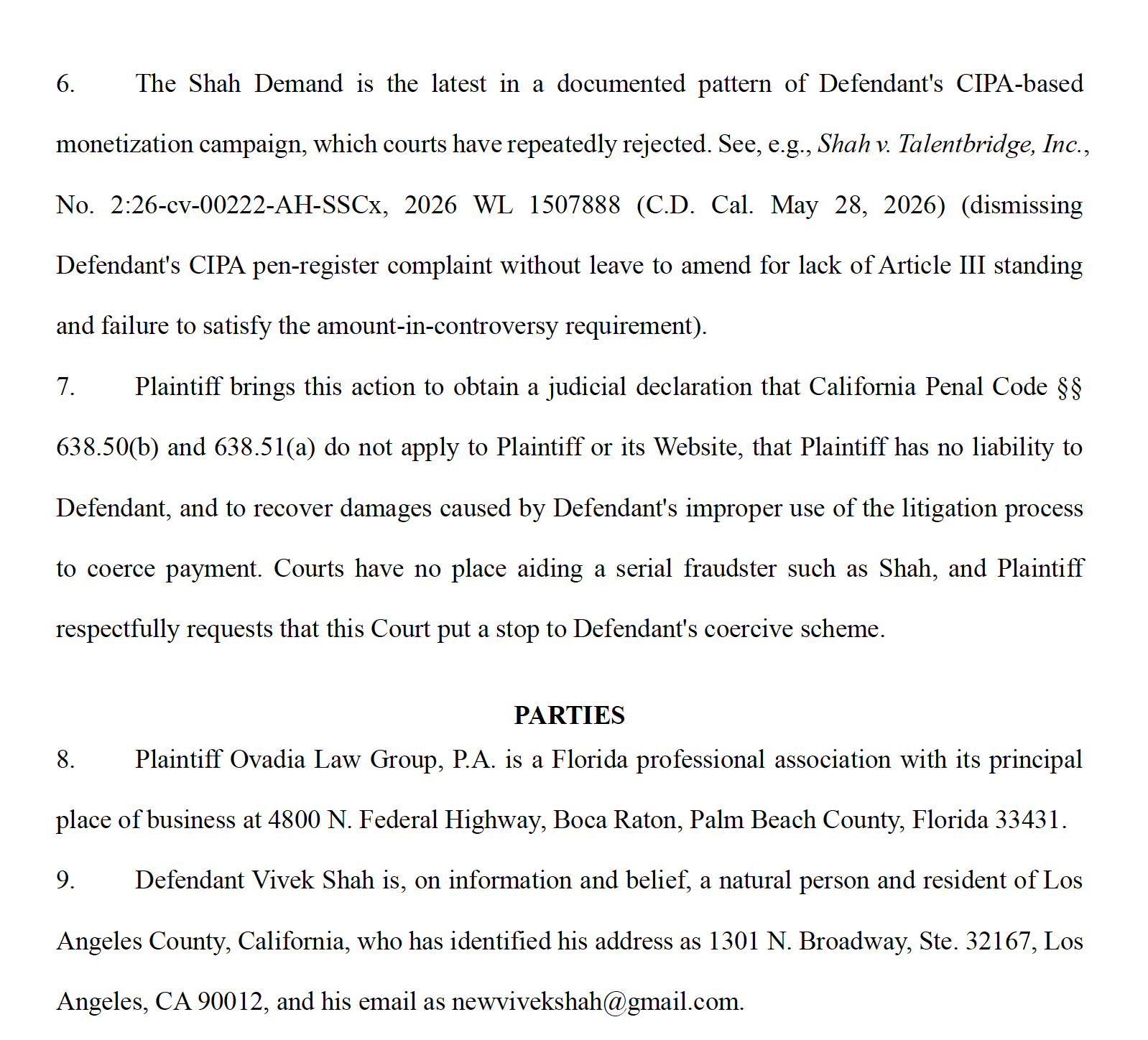
Ovadia Law Group, P.A., a Florida personal-injury law firm, sued Shah in the Southern District of Florida after receiving a CIPA demand. Its pleading alleges that it lacks California offices, employees, and clients and seeks a declaration that CIPA does not govern the challenged conduct, together with an abuse-of-process theory. The case is Ovadia Law Group, P.A. v. Shah, No. 9:26-cv-80766-AMC. The initial complaint covered that Captain Compliance did such a great job about covering Vivek Shah that the attorney initially was so pissed off about being sued that he thought there was a connection but as soon as our team reached out he amended the complaint against Vivek Shah.
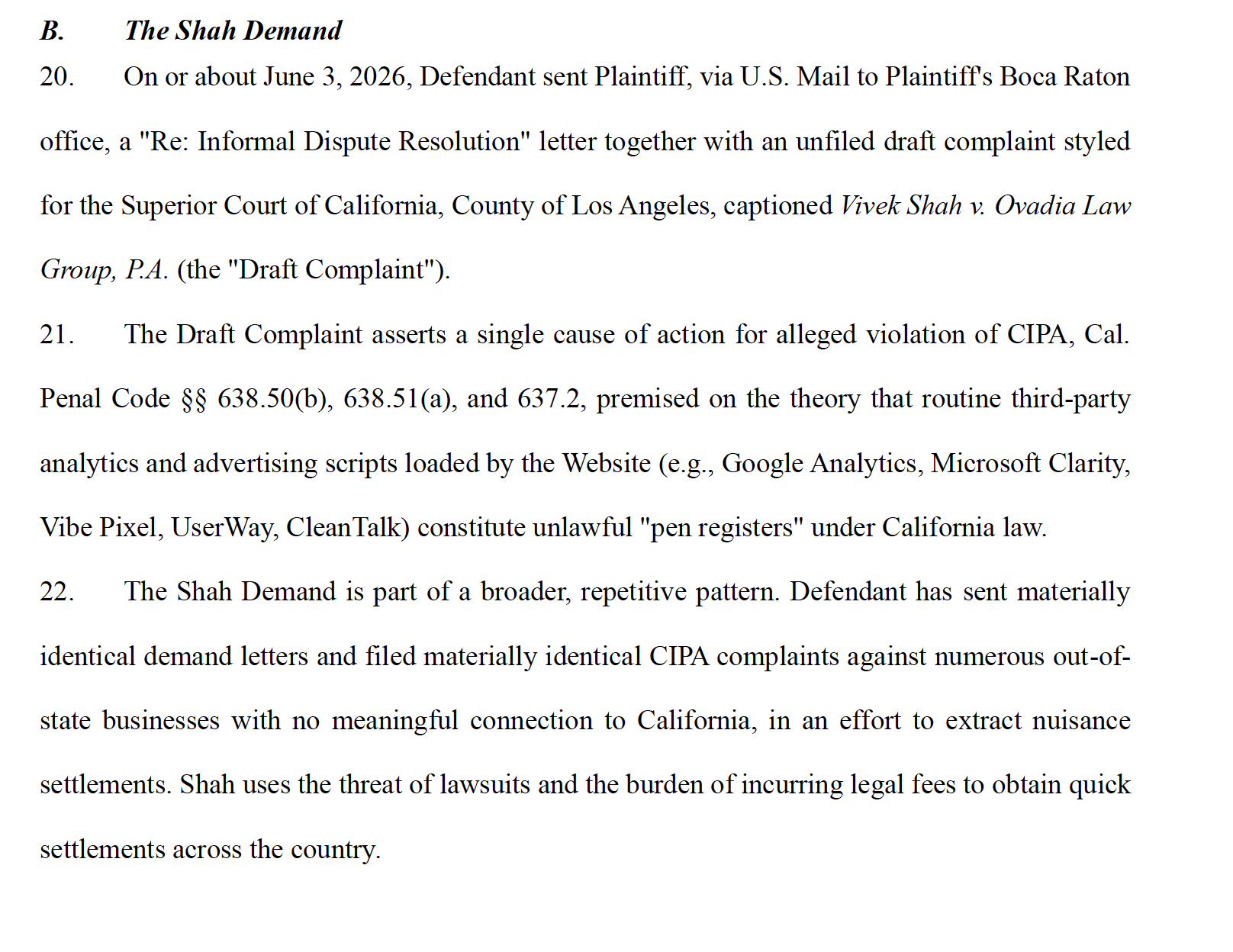
Captain Compliance’s role in helping law firms and businesses investigate, correct, and document website privacy controls comes from its own services and work with counsel—not from a judicial finding in Ovadia. A pleading is a party’s statement, not a court’s conclusion. The useful point is that a law-firm plaintiff that received a Shah demand publicly corrected the record and disclaimed the supposed connection.
Ovadia’s suit raises real strategic questions. Can a California claimant apply CIPA to a Florida-centered business simply because its site is accessible from California? Was the alleged conduct sufficiently connected to California? Is there personal jurisdiction in Florida over Shah? Is declaratory relief appropriate? Can a pre-suit demand support an abuse-of-process claim before judicial process is used? Those issues will turn on doctrine and facts, not the moral force of “fighting back.”
Crain After the Prefiling Order
The vexatious-litigant order does not dismiss the Crain case in which it was entered. The court expressly left that pending action outside the prospective filing restriction. As of this update, readers should treat the underlying merits as unresolved and monitor the docket rather than assuming that the designation itself wins the Section 631 motion.
The Defense Issues Every Recipient Should Investigate
The strongest response is rarely one argument. It is a matrix connecting threshold defenses, statutory elements, technical facts, contract terms, and business objectives.
Article III Standing and State-Court Injury
Federal court requires a concrete, particularized injury. The mere allegation that a statute was violated does not always establish Article III standing after TransUnion LLC v. Ramirez. In website cases, courts examine what information was collected, whether it was linked to the plaintiff, sensitivity, volume, persistence, downstream use, representations made by the site, and whether the plaintiff deliberately created the event.
TalentBridge supports dismissal where the search was generic and basic metadata did not make it personal. Other federal cases find standing where full browsing histories, unique IDs, form inputs, precise geolocation, health-related activity, or tracking contrary to an opt-out are plausibly alleged. “Tester” status can be relevant to expectations and injury, but it is not an automatic standing bar.
California state courts are not governed by Article III. Section 637.2 also says actual damages are not a prerequisite. Removing a case to federal court can therefore create a standing opportunity, but only if removal jurisdiction exists and the consequences have been evaluated. A plaintiff can seek remand, and a federal standing dismissal may be jurisdictional rather than a merits judgment.
Personal Jurisdiction, Choice of Law, and Extraterritoriality
A public website’s accessibility in California does not end the jurisdictional analysis. Counsel should examine where the company is organized, where decisions and servers are located, whether it targets California users, California revenue, offices and employees, relevant contracts, and the claimant’s actual interaction. The Ninth Circuit’s evolving internet-jurisdiction cases require fact-specific attention to purposeful direction and forum contacts.
Separately, California statutes generally are not presumed to regulate conduct wholly outside the state. Section 631’s text includes communications sent from or received within California, which plaintiffs use to establish a territorial link. The defense should verify geolocation and whether the claimant was actually in California during the test. IP evidence is not infallible; VPNs, proxies, mobile routing, and remote testing can complicate it.
Contents Versus Metadata
The defense should classify each field, not the vendor as a whole. A request may contain:
- an IP address used to route the connection;
- a full URL containing a search query;
- a page title;
- an opaque client ID;
- a hashed email;
- a click event;
- a form-field value;
- a consent-state string;
- a referrer;
- a device or browser attribute; and
- a vendor-specific event name.
Some are more likely to be “contents,” some “record” information, and some fact-dependent. The same URL can be harmless on a homepage and revealing on a patient portal. A screenshot that highlights “VIVEK” in a request says more than a list of cookies, but counsel should still determine whether the field was sent to the vendor’s server, only generated locally, truncated, redacted, encrypted, ignored, or discarded.
Defense Groups Protecting CIPA Amendments Citing Immigration and ICE Civil Rights Issues
Like anything in life there is going to be opposition. While a litigator like Vivek has overdone and ruined parts of the privacy rights that data subjects need to have the Stop CIPA Shakedown group and our friend attorney Usama from Fisher Phillips has covered how there are lobbying groups and those that are out in opposition of amendments. Those groups on their own sites he points out also use and have some of the same trackers that are being discussed in the wiretapping claims. For reference those websites and some of the cookies & pixels running on those sites are as follows:
Tech Equity (https://techequity.us/)
Third Party Tech
Google Analytics
Facebook Pixel
DoubleClick
Hotjar
Summary
7 Ad Trackers
Tracking that evades blockers
Monitoring keystrokes and mouse clicks
Dolores Huerta Foundation (https://doloreshuerta.org/)
Third Party Tech
Google Analytics (remarketing)
Fund Raise Up
DoubleClick
HS Forms
Oakland Privacy (https://oaklandprivacy.org/)
Third Party Tech
Google Analytics
Facebook Pixel
PayPal
Mastofeed (embeds Mastodon Social Network)
ACLU (https://www.aclu.org/)
Third Party Tech
Online-Metrix.net
Summary
1 Third party cookie
Tracking that may be designed to evade blockers
Interception in Transit
For Section 631, timing matters. Use the browser’s initiator chain and timestamps to determine whether the third-party call occurred simultaneously with the visitor’s submission, after the site received and processed it, or after it was stored. Examine client-side JavaScript, server-side tagging, content-security rules, redirects, and caching. “Real time” is not a self-proving legal conclusion.
Party Exception and Vendor Independence
Determine the intended communication. A visitor using an embedded service may intend to communicate with both the site and the provider, or only with the site. Review interface branding, disclosure, vendor terms, data-use addenda, controller/processor roles, product settings, and actual reuse. Plaintiffs focus on a vendor’s independent advertising ecosystem. Defendants focus on delegated processing necessary to provide the requested service.
Consent and Authorization
Consent requires both legal notice and technical implementation. Review:
- what the banner said on the exact date;
- whether it appeared before nonessential scripts;
- whether “Reject” was as usable as “Accept”;
- whether granular settings matched actual tag categories;
- whether a footer policy was the only notice;
- whether the claimant had an existing account or prior choice;
- whether a global privacy signal was detected;
- whether geolocation selected the correct regional rule;
- whether the tag manager respected consent mode; and
- whether a subsequent deployment silently broke the configuration.
A banner cannot retroactively authorize a transmission that happened first. Conversely, a claimant who affirmatively consented and later reproduces a test in a stale session may face a factual problem. Preserve the consent cookie, logs, version number, and UI state.
Intent, Willfulness, and Aiding
Section 631’s clauses do not all use identical mental-state language. The complaint’s statement that the company made an “affirmative business decision” to install a vendor is not necessarily proof that it intended the disputed interception or knew a search term would populate a particular parameter. Investigate who installed the code, the vendor documentation, configuration, testing, agency access, change approvals, and any notice of unexpected behavior.
At the same time, once a company receives a detailed demand, continued unexamined operation can worsen future optics. Preserve first; then remediate under counsel’s direction. Do not destroy or overwrite the historical configuration in the rush to fix it.
Statute of Limitations
Identify the alleged visit, the first demand, any arbitration filing, dismissal, tolling agreement, and complaint date. Do not assume that a claimant can revive a stale CIPA claim by repeating the test or changing forums. Do not assume the claim is late without reviewing accrual, discovery, tolling, and procedural history.
Damages and Duplicative Counts
Challenge the unit of violation. Is it one visit, one communication, one interception, one recipient, one statutory clause, or every request? Did several vendor domains belong to the same service? Were retries or redirects counted as new communications? Did a tag make duplicate network calls without new user input? Does one alleged act support both direct and aiding liability without duplicative recovery?
TalentBridge shows that re-labeling a cause of action as many counts does not automatically create federal jurisdiction. Damages analysis should be tied to proven events and controlling authority, not the number of colored boxes in an exhibit.
Arbitration and Terms of Use
An arbitration clause can compel a one-off claim into a private forum, but mass-arbitration fee structures can create leverage against the business. Review delegation, small-claims carve-outs, informal-dispute procedures, batch mechanisms, fee allocation, governing law, assent, and version history. A late or hidden browsewrap clause may be unenforceable. Updating terms after a demand does not retroactively bind the prior visit.
Insurance, Notice, and Vendor Indemnity
Notify the appropriate broker or carrier promptly under cyber, media, technology errors and omissions, general liability, or other potentially responsive coverage. Late notice, voluntary payments, or admissions can prejudice coverage. Review vendor indemnities, defense obligations, caps, exclusions, additional-insured language, and tender requirements. Preserve communications with the web agency, CMP vendor, analytics vendor, and marketing contractor.
What the Major Law-Firm Coverage Says—and Where It Converges
The outside coverage varies in tone, but it converges on several operational conclusions.
| Source | Emphasis | Law Firm Advice for Vivek Shah Demand |
|---|---|---|
| Fisher Phillips | National scale, broad industry targets, shift from Section 631 to Section 638.51 | Do not assume every demand must settle; preserve and audit before changing the site |
| Jeffer Mangels | DevTools screenshots, search terms, third-party domains, $5,000 theory | Reconstruct the exact request and analyze every element |
| Lathrop GPM | Large 2026 filing volume and realistic demand-packet format | Audit pixels, cookies, analytics, chat, search, and AI data collection |
| Ward and Smith | Demand wave, nationwide businesses, proposed legislation | Avoid reflexive settlement; coordinate legal and technical response |
| Danna McKitrick | Out-of-state recipients and territorial questions | Do not ignore or immediately alter the site; obtain counsel and preserve evidence |
| Spencer Fane | Federal/state split and appellate uncertainty | Outcomes remain hard to predict; compliance is cheaper than litigating in the dark |
| Baker Donelson | Crain’s harassment findings and order limits | Use the order as leverage without overstating it |
| Duane Morris | At least 29 proceedings; state-court vexatious options | Check for federal leave and consider California Section 391 strategy |
| Shumaker | TalentBridge, Pashion, Crain, and continuing risk | Recent losses do not eliminate appeals, arbitration, or other venues |
| Glaser Weil | Lofty and Ovadia filing affirmative suits | Declaratory relief is emerging but must fit the client’s risk and economics |
| Mintz | Blaker’s telephone-only Section 638.51 ruling | State trial authority provides a substantial pen-register defense |
| Bubeck Law | Judicial resistance to repetitive complaints | Template allegations should be tested against the actual site and actual injury |
The consensus is not “all demands are invalid.” It is that the economics of statutory damages and defense cost reward early technical ambiguity. The remedy is to remove ambiguity before the claim, preserve it after the claim, and give counsel evidence strong enough to separate a real compliance problem from a template allegation.
Captain Compliance as the Central Defense Infrastructure Against Vivek Shah
Captain Compliance is not a law firm and does not make a motion to dismiss. Most of these cases are demand letters and Captain Compliance has gotten so good at working with law firms and clients to provide audits and discovery requests. In addition the privacy software remediates and fixes these alleged issues so it is not a repeat issue.
The best engagement model is tri-partite:
- Counsel controls legal strategy, privilege, preservation, communications, and filings.
- Captain Compliance inventories, tests, documents, and helps remediate the website’s privacy behavior.
- The business and its developers implement approved changes, manage vendors, and maintain governance.
Phase One: Preserve the Alleged Event
Before changing the site, preserve what can still be preserved:
- the demand packet and envelope;
- all screenshots and exhibits at native resolution;
- the claimant’s alleged dates, URLs, searches, browser, and consent choice;
- current HAR files and screen recordings reproducing the test;
- source code, tag-manager container, versions, and publish history;
- consent-platform configuration and logs;
- cookies, local storage, session storage, and consent strings;
- privacy notice, cookie notice, terms, and archived versions;
- vendor settings, contracts, data-processing addenda, and retention rules;
- agency and developer access logs;
- server and CDN logs, where available; and
- a written chain of custody for the collection.
Captain Compliance’s scanning infrastructure can quickly identify live cookies, scripts, pixels, and third-party domains. For litigation, the quick scan should be followed by a scoped, reproducible forensic protocol approved by counsel. “We ran a free scanner today” does not, by itself, establish what happened months ago.
Phase Two: Reproduce Every Consent State
Test at least four states:
- new visitor, no action;
- explicit acceptance;
- explicit rejection;
- granular selection.
Repeat across relevant geography, desktop and mobile, common browsers, private browsing, logged-in and logged-out states, and any page named in the packet. Test search bars, forms, chat, video, scheduling, payment, job applications, patient or client portals, and AI features. If the site uses Google Tag Manager or another container, capture the initiator chain showing exactly which tag caused the request.
This is where a real consent-management platform differs from an overlay. Captain Compliance can help enforce category-based auto-blocking, regional rules, consent signals, and consent logging. The cookie consent manager software should be configured so that the user’s choice changes network behavior—not merely the color of the toggle. The team here at Captain Compliance handles the full integration pro-bono.
Phase Three: Map the Data, Not Just the Cookies
A cookie list is not a data-flow map. For each disputed request, document:
- source page and user action;
- script or tag initiator;
- destination domain and legal entity;
- exact request method and timestamp;
- query string, headers, body, and identifiers;
- whether the search or form value is present;
- whether the value is plaintext, encoded, hashed, truncated, or absent;
- purpose and vendor product;
- first-party or third-party status;
- retention and independent-use rights;
- consent category and actual consent state; and
- whether the request was blocked, allowed, or stripped after remediation.
The result should be a table counsel can use, not a developer’s verbal assurance. It should also feed the company’s dynamic cookie and privacy disclosures so the public notice matches deployed technology.
Phase Four: Remediate Without Spoliating
Once counsel confirms preservation, prioritize:
- blocking nonessential scripts until the required consent state;
- making “Reject” actually stop nonessential tags;
- preventing search terms, form values, chat text, and full URLs from entering analytics parameters unless needed and legally approved;
- removing unnecessary vendors;
- redacting or suppressing URL query strings;
- correcting tag-manager triggers;
- using server-side controls carefully rather than assuming they eliminate disclosure;
- configuring consent mode and regional defaults;
- aligning vendor contracts with actual use;
- updating privacy and cookie notices; and
- documenting the before state, change ticket, approval, deployment, and after state.
Remediation is not an admission. A business can contest a demand and still reduce future exposure. The documentation should explain that changes were made as part of ongoing risk management, not concede that prior conduct violated CIPA.
Phase Five: Build an Audit-Ready Evidence Package
The final package should allow a new lawyer, carrier, expert, or judge to understand the event without recreating it from memory. A strong package includes:
- executive summary and issue list;
- test protocol;
- date, time zone, device, browser, IP/region, and account state;
- screenshots and video;
- HAR and structured network table;
- cookie and storage inventory;
- tag and initiator map;
- consent-state evidence;
- vendor-role and contract matrix;
- historical policy and terms;
- remediation record;
- post-remediation validation;
- continuing-monitoring schedule; and
- known limitations.
Captain Compliance can maintain scanning, consent logs, dynamic disclosures, and change evidence over time. That continuing record matters because marketing teams add tags, agencies publish containers, vendors change endpoints, and a working banner can break after an ordinary site update.
Compliance Shield: Understand the Contract, Not the Slogan
Captain Compliance offers Compliance Shield for qualifying customers and configurations. It should not be described as blanket immunity or a guarantee that no one will send a letter. Eligibility, covered claims, deployment requirements, recommended settings, exclusions, notice duties, and contractual limits matter. A business should review the operative terms with counsel and confirm that its implementation remains within the program requirements.
The responsible promise is narrower and more useful: properly deployed privacy controls and preserved evidence reduce avoidable exposure, make unsupported allegations easier to rebut, and give counsel a stronger platform from which to negotiate or litigate.
A 24-Hour, 72-Hour, and 30-Day Response Plan
The First 24 Hours
- Do not ignore the packet and do not contact Shah directly without counsel.
- Scan and preserve every page, exhibit, envelope, postmark, and communication.
- Calendar any stated deadline, limitations issue, arbitration notice period, and insurer notice deadline.
- Route the matter to privacy litigation counsel.
- Notify the broker or carrier as counsel recommends.
- Issue a focused preservation notice to legal, marketing, IT, web development, and relevant vendors.
- Freeze automatic deletion of tag-manager history, consent logs, relevant server logs, and web releases.
- Do not hurriedly uninstall the identified tool before collecting evidence.
The First 72 Hours
- Identify whether the claim is Section 631, Section 638.51, or both.
- Reproduce the alleged user flow under counsel’s test protocol.
- Use Captain Compliance to inventory the site and identify pre-consent and post-rejection traffic.
- Compare the claimant’s screenshots with the site’s actual domains, parameters, and consent state.
- Confirm the legal entity, jurisdictional contacts, terms version, arbitration procedure, and California targeting.
- Review vendor contracts, independent data use, indemnity, and tender rights.
- Evaluate standing, contents, transit, party status, consent, intent, limitations, and damages counting.
- Decide whether immediate temporary blocking is needed after preservation.
The First 30 Days
- Complete the evidence package.
- Send a counsel-led response calibrated to the facts and current cases.
- Remediate search, forms, chat, pixels, full URLs, and consent gating.
- Validate every consent state after deployment.
- Update notices and cookie tables to match reality.
- Tender to vendors or carriers where appropriate.
- Decide whether to negotiate, reject, seek declaratory relief, compel arbitration, remove, move to dismiss, or pursue another forum strategy.
- Extend the audit beyond the one page or one tracker named in the letter.
- Establish continuous monitoring and change approval.
- Brief executives on repeat-claim risk and the fact that the same technical defect can attract other plaintiffs.
How Law Firms Can Use Captain Compliance in CIPA Matters
Law firms do not need another generic cookie report. They need a litigation work product that maps evidence to elements. Captain Compliance can support counsel in four distinct roles.
Early Case Assessment
Within the first phase, counsel needs to know whether the demand screenshot is accurate, incomplete, stale, or misleading. A structured scan and traffic capture can identify the actual vendor, field, timing, and consent state. That allows counsel to budget the matter and decide whether the strongest route is a factual rebuttal, standing challenge, jurisdiction motion, contract defense, settlement, or remediation-first response.
Technical Translation
Legal briefs often misuse “cookie,” “pixel,” “script,” “SDK,” “request,” and “interception” as if they were synonyms. They are not. Captain Compliance can translate the browser flow into a sequence the legal team can test against each statutory element. Its team can also help lawyers ask vendors the right questions about independent use, product configuration, consent mode, data retention, and parameter suppression.
Discovery and Expert Support
If a case proceeds, the same map can guide document requests, interrogatories, Rule 30(b)(6) topics, third-party subpoenas, declarations, and expert analysis. Captain Compliance also covers the role of technical specialists in its privacy expert-witness guide. Any testifying role should be separately scoped for independence, methodology, disclosure, and admissibility.
Portfolio Defense
Firms representing franchises, platforms, agencies, multi-brand groups, or insurers need repeatable assessment. A standard protocol allows matters to be compared without assuming they are identical. The portfolio view can identify one shared tag, plugin, CMP configuration, or agency practice generating risk across many sites. Fixing the shared source is more valuable than settling the same alleged defect brand by brand.
Governance After the Emergency
The most expensive privacy program is one built only after each letter. Continuous governance should include:
- a monthly or release-triggered tracker scan;
- approval before any marketing tag, chat widget, video player, or AI tool is deployed;
- prohibited-field rules for search, forms, URLs, and data layers;
- consent regression tests;
- tag-manager role controls and version retention;
- vendor due diligence and contract review;
- dynamic cookie and privacy disclosures;
- regional rules for California and other jurisdictions;
- global privacy signal handling;
- incident and demand-letter playbooks;
- annual tabletop exercises with counsel; and
- executive reporting on high-risk trackers and unresolved exceptions.
We pride ourselves in providing privacy defense counsel and business owners a wealth of free information regarding these litigation cases. Captain Compliance’s broader CIPA overview, CIPA defense guide, and analysis of cookie-banner litigation failures provide additional background for teams building this program.
SB 690: A Potential Legislative Reset, but Not Current Law
California Senate Bill 690 has changed substantially during the legislative process. Earlier versions proposed broad commercial-business-purpose amendments touching several CIPA provisions. The July 2, 2026 version is narrower. It would amend Section 637.2 so that only the California Attorney General could bring a private-actor Section 638.51 action arising from conduct on an internet website, online application, or mobile application. It also includes retroactive language for certain pending claims commenced within two years before the law’s operative date.
As of August 1, 2026, SB 690 is an active bill in the Assembly Appropriations Committee, with a hearing listed for August 5. It is not law. The official bill status is here, and the July 2 text is here.
Three cautions follow:
- A business cannot rely on an unpassed bill as a present defense.
- The current text targets private website/app claims under Section 638.51; it does not enact the earlier broad commercial-purpose exemption for Section 631 search-bar claims.
- Retroactivity, operative date, constitutional challenges, severability, amendments, and final enactment all require monitoring.
If SB 690 becomes law in its current form, it could substantially weaken the later pen-register demand model, including some pending claims. It would not automatically eliminate Section 631 contents claims, federal wiretap claims, state consumer-protection theories, other privacy statutes, or regulator scrutiny. Businesses still need working consent and data governance.
Frequently Asked Questions
Is Vivek Shah officially a vexatious litigant?
Yes. On July 20, 2026, Judge R. Gary Klausner formally declared Vivek Shah a vexatious litigant in Shah v. Crain Communications, Inc., No. 2:26-cv-03070-RGK-CTS, in the Central District of California. The designation and prefiling order are matters of public court record.
Does the order stop Shah from sending CIPA demand letters?
No. It governs new qualifying court filings in one federal district. It does not prohibit pre-suit letters.
Does the order prevent Shah from suing in California state court?
Not automatically. A state-court defendant may ask for relief under California’s vexatious-litigant statutes and cite the federal designation, but the state court must apply its own law and enter its own order.
Does the order cover arbitration?
No. JAMS or AAA proceedings are not filings in the Central District of California. The findings may be relevant to strategy, fees, credibility, or sanctions depending on the forum’s rules, but they are not an automatic arbitration bar.
Is every Shah demand meritless now?
No. The Crain order examined litigation history and imposed a filing screen. It did not adjudicate every website, tracker, consent flow, or prior demand. Each claim still requires factual and legal analysis.
What does the typical Section 631 demand allege?
It commonly alleges that a visitor typed a search term—often “VIVEK”—after declining optional tracking and that third-party analytics or advertising services received the term in real time. The claimant characterizes the term as communication contents and the site owner as aiding the interception.
What is the newer Section 638.51 theory?
It alleges that software collecting IP addresses, device identifiers, browser attributes, or similar routing and signaling data is a pen register or trap-and-trace process installed or used without a court order or valid exception.
Is an IP address enough for a CIPA claim?
Courts disagree. Several California trial courts have rejected routine-IP-address claims under Section 638.51, while several federal courts have allowed broader tracker allegations to proceed. Federal standing may also fail if the IP address and metadata do not implicate a concrete personal privacy interest.
Are search terms legally protected contents?
They can be. Heerde and Ninth Circuit precedent distinguish search terms and revealing URLs from ordinary record information. The sensitivity, context, recipient, timing, consent, and connection to the plaintiff remain important.
Does clicking “Reject All” eliminate liability?
Only if the site honors it—and even then, the legal analysis may include traffic that occurred before the click. The browser’s actual behavior must be tested. A button that says “Reject” while tags continue firing can increase risk.
Should a business immediately remove the tracker after receiving a letter?
Preserve evidence first under counsel’s direction. Then remediate promptly. Unrecorded changes can create spoliation disputes and destroy evidence that might disprove the claim.
Should the company respond to Shah directly?
Usually not without counsel. A response can make admissions, waive defenses, affect insurance, create discoverable evidence, or mishandle settlement rules. Route the matter through experienced privacy litigation counsel.
Can Captain Compliance provide the lawyer?
Captain Compliance is not a law firm. It can work with the company’s chosen counsel and reports working with hundreds of law firms on privacy matters. Its core role is technical assessment, consent implementation, data-flow documentation, monitoring, and litigation-support evidence. If you are not currently represented we can suggest law firms that we have relationships with that you can speak to but have no financial connection with any of these firms.
Can Captain Compliance guarantee that no demand will arrive?
No technology can prevent someone from mailing an accusation. Proper controls can reduce underlying risk and create evidence to rebut unsupported claims. Any Compliance Shield protection is governed by eligibility and contract terms.
What should a law firm ask Captain Compliance to deliver?
Ask for a counsel-approved test protocol, HAR files, network table, initiator map, cookie and storage inventory, consent-state testing, vendor-role matrix, historical configuration evidence, remediation record, and post-change validation.
What happened in TalentBridge?
The Central District dismissed Shah’s first amended complaint without leave to amend, finding defects in the federal amount in controversy and Article III standing. Shah appealed to the Ninth Circuit, so the appellate outcome remains pending.
Did Vivek Shah lose the Pashion arbitration?
An arbitrator reportedly dismissed his CIPA and ECPA claims and denied leave to amend. Shah petitioned to vacate the award and then voluntarily dismissed that federal petition. The private award is a defense result, not precedential case law.
What are Lofty and Ovadia trying to do?
They filed affirmative suits after demands. Lofty seeks federal declarations concerning a Section 638.51 analytics theory and standing. Ovadia seeks relief in Florida concerning territorial reach and related claims. Neither case should be reported as a final merits win unless and until a court rules.
Will SB 690 end website CIPA claims?
Not by itself, and it has not yet passed. The July 2 version would limit private Section 638.51 website/app claims, but it does not enact the earlier proposed broad exemption for Section 631. Other privacy causes of action would remain.
Will The Vivek Shah Demand Letters Ever Stop?
The July 20 order changes the posture of the Vivek Shah campaign because a federal judge has now done what defense commentary alone could not: examined the record, made express findings, declared Shah a vexatious litigant, and required advance permission for new digital-privacy filings in the Central District of California.
The order also demonstrates why precision matters. It is a filing restriction, not a universal merits judgment. TalentBridge is a significant standing victory, but it is on appeal and fact-bound. Pashion is an arbitration result, not precedent. Lofty and Ovadia are offensive complaints, not final judgments. The California trial courts have produced powerful Section 638.51 defenses, while federal courts have produced plaintiff-friendly readings. Variety Media may change the map, but has not yet done so. SB 690 may change the statute, but is not yet law.
Meanwhile, the representative packet shows exactly how the pressure is built: a one-page accusation, a ready-to-file complaint, a test query, DevTools screenshots, a list of familiar vendors, and a damages theory that multiplies searches by recipients. The best answer is not a slogan. It is a record.
For law firms, that means connecting each legal element to verified browser evidence. For business owners, it means making consent real, minimizing unnecessary data flows, preventing search and form content from leaking into analytics, keeping notices aligned with deployed technology, and preserving proof. For both, it means responding to the current letter without leaving the same vulnerability open to the next claimant.
Captain Compliance provides the central operational layer for that work: rapid tracker discovery, consent-based blocking, regional configuration, consent logs, dynamic disclosures, vendor mapping, remediation support, continuing monitoring, and evidence that counsel can actually use. The company reports that it already collaborates with hundreds of law firms confronting these claims. That experience matters because CIPA defense is no longer only a statutory interpretation exercise. It is a technical-fact contest conducted under litigation deadlines.
Businesses that received a Shah packet can start with Captain Compliance’s dedicated response page and book a technical review. Counsel seeking a broader framework can also review Captain Compliance’s Section 631 litigation guide and CIPA defense strategies.
The practical objective is not to make litigation impossible. No company can control who sends a demand. The objective is to make the website’s behavior lawful, proportionate, transparent, and provable—and to ensure that when an allegation arrives, counsel is defending facts instead of guessing at them.
Related Captain Compliance Coverage and Tools
For our readers who want to move from this dossier to a specific issue, Captain Compliance’s related coverage includes more authoritative information about Vivek Shah, Wiretapping Lawsuits, and Data Privacy Software Solutions for CIPA coverage than anywhere else online:
- Alert for Privacy Counsel: Vivek Shah and the Rising Tide of Website CIPA Claims
- Search Bar Privacy Lawsuit Protection
- Vivek Shah Declared a Vexatious Litigant
- Lofty Sues Vivek Shah First
- Help With a Vivek Shah Privacy Demand or Lawsuit
- CIPA and Data Privacy Lawsuits Explained
- CIPA Defense Strategies
- CIPA Section 631 Privacy Litigation Help
- Cookie Consent Gone Wrong
- CIPA Plaintiffs Target Cookie Consent Banners
- Cookie Consent Manager
- Cookie Scanner
- Compliance Shield
- Book a Technical and Compliance Review
Selected Primary and Secondary Sources
Statutes and Legislation
- California Invasion of Privacy Act, Penal Code Sections 630–638.55
- California Code of Civil Procedure Section 391
- SB 690 official status
- SB 690 July 2, 2026 text
Vivek Shah Matters
- Shah v. Crain Communications, Inc., July 20, 2026 prefiling order
- Shah v. TalentBridge, Inc., May 28, 2026 dismissal order
- Shah v. TalentBridge, Inc., Ninth Circuit No. 26-3514
- Vivek Shah v. Pashion Footwear Inc. docket
- Lofty Inc. v. Shah complaint
- Ovadia Law Group, P.A. v. Shah amended complaint
- DOJ 2013 sentencing release
Key CIPA Decisions and Appellate Proceedings
- Javier v. Assurance IQ, LLC (9th Cir. 2022)
- Gutierrez v. Converse Inc. (9th Cir. 2025)
- In re Zynga Privacy Litigation (9th Cir. 2014)
- In re Facebook Internet Tracking Litigation (9th Cir. 2020)
- Heerde v. Learfield Communications, LLC (C.D. Cal. 2024)
- Gabrielli v. Haleon US Inc. (N.D. Cal. 2025)
- Nelson v. Reddit, Inc. (S.D. Cal. 2026)
- Jones v. Skullcandy, Inc. (S.D. Cal. 2026)
- Variety Media, LLC v. Superior Court, No. B350578 docket
Law-Firm and Industry Analysis
- Baker Donelson: California Federal Court Declares Shah a Vexatious Litigant
- Duane Morris: Central District Declares Serial CIPA Plaintiff Vexatious
- Fisher Phillips: Did Your Business Get a Shah Demand Letter?
- Glaser Weil: Businesses Go on the Offensive
- Jeffer Mangels: Shah CIPA Demand Letters Against Business Websites
- Lathrop GPM: A New Wave of CIPA Website Claims
- Spencer Fane: Where CIPA Website Tracking Law Stands
- Shumaker: What the Vexatious-Litigant Order Means
- Ward and Smith: The CIPA Demand-Letter Wave
- Danna McKitrick: What a Shah Demand Means for an Out-of-State Business
- Mintz: Blaker Pen-Register Defense Ruling
- Coalition: Privacy Claims in H1 2026