AI chatbots are now handling customer complaints, offering health guidance, screening applicants and building personal relationships with users. The law has not settled on one way to regulate them, leaving companies to navigate a growing mix of AI, privacy, consumer protection and child safety rules. Luckily there’s a team of compliance software experts who can help you mitigate and protect agains the surge of new privacy litigation and regulations around artificial intelligence.
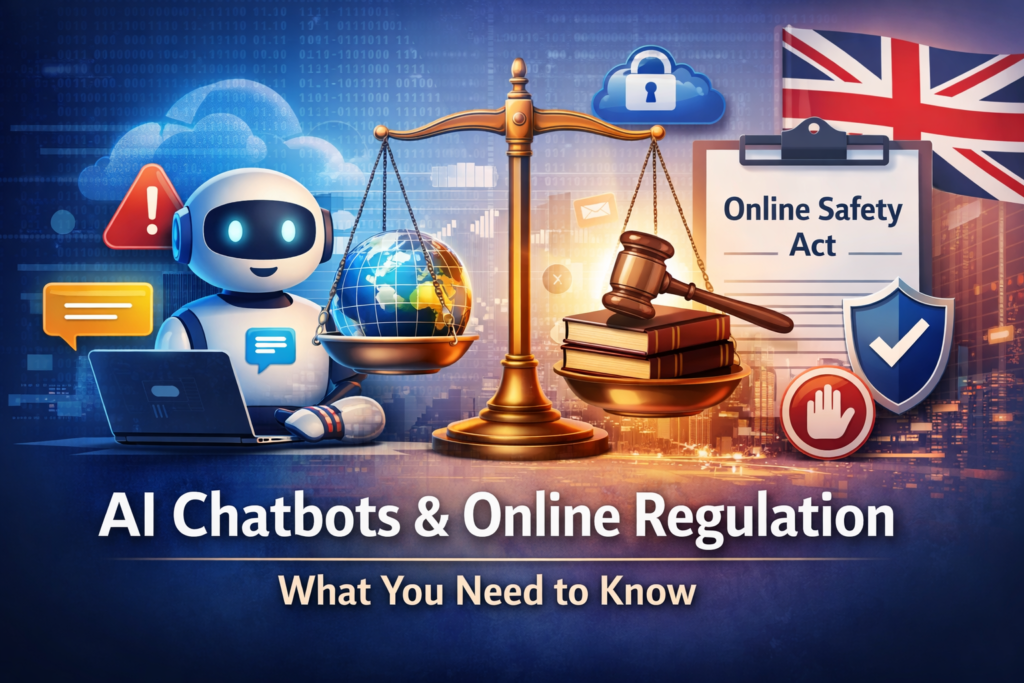
AI chatbots are no longer governed by a single category of law.
A company deploying a conversational AI system may need to comply simultaneously with chatbot disclosure requirements, privacy legislation, consumer protection laws, children’s safety rules, artificial intelligence regulations, cybersecurity obligations and industry-specific restrictions.
Each legal layer addresses a different part of the same deployment.
One law may require the company to disclose that a person is communicating with artificial intelligence. Another may regulate the personal information collected during the conversation. A third may restrict the advice the chatbot can provide. Additional requirements may apply if the user is a child, the chatbot contributes to a consequential decision or the system generates synthetic content.
This is becoming particularly difficult for businesses operating across the United States, European Union and United Kingdom.
The three markets share several fundamental expectations, especially around transparency, privacy and consumer protection. Their legal structures, however, differ significantly.
The United States is developing a fragmented collection of state, federal and sector-specific requirements. The European Union has adopted a broad horizontal framework through the EU AI Act alongside the General Data Protection Regulation. The United Kingdom continues to regulate AI primarily through existing data protection, consumer protection and sectoral laws.
Companies developing or deploying AI chatbots must understand where these regimes overlap, where they diverge and how to build a compliance program that can operate across all three.
AI Chatbot Laws Are Expanding Rapidly
AI chatbots are being deployed across an increasingly wide range of activities.
Common use cases include:
- Customer service
- Sales and product recommendations
- Healthcare and mental health support
- Recruiting and employment screening
- Financial services
- Education
- Legal information
- Internal employee assistance
- Personal companionship
- Content generation
The risks differ considerably between these applications.
A chatbot that answers questions about store hours does not present the same risk as one that discusses self-harm with a teenager, recommends medical treatment or gathers information used to approve a loan.
Regulators are responding by creating both broadly applicable rules and specialized requirements for particular chatbot uses.
In the United States, chatbot-related laws have been enacted or developed in states including California, Colorado, Connecticut, Georgia, Hawaii, Idaho, Iowa, Maine, Nebraska, New Hampshire, New York, Oregon, Rhode Island, Utah and Washington.
Some regulate conversational AI generally. Others focus on commercial chatbots, mental health systems, companion chatbots, automated decision tools or services used by children.
Federal lawmakers have also introduced proposals addressing AI companions, customer service chatbots, age verification, family accounts, parental consent, transparency and safety-by-design.
The volume of proposed legislation shows that lawmakers do not view chatbots as a single technology category. They see different risks depending on how a chatbot is designed, marketed and used.
What Is an AI Chatbot?
There is no universal legal definition of an AI chatbot.
Some laws define chatbots broadly as automated systems that communicate with users through natural language. Other laws define them according to a particular commercial activity, professional service or type of relationship.
For practical compliance purposes, an AI chatbot can generally be understood as a software application or AI-enabled service that allows a person to submit conversational input and receive dynamic responses.
The interaction may involve:
- Written text
- Spoken language
- Audio
- Images
- Video
- Virtual avatars
- Multimodal combinations of these formats
The system may simply answer questions, or it may connect to other tools and take actions on the user’s behalf.
A chatbot may also serve as the visible interface for a larger automated decision system. For example, a recruiting chatbot may collect information from an applicant while another system evaluates the answers and determines whether the applicant advances.
Companies should therefore assess the entire system behind the conversation, not merely the interface presented to the user.
AI Chatbot Regulation in the United States
The United States currently lacks a single comprehensive federal statute regulating all AI chatbots.
Instead, businesses face a combination of state chatbot laws, state privacy statutes, federal consumer protection authority, children’s privacy rules, industry-specific requirements and private litigation.
This fragmented approach often focuses on the chatbot’s deployment and the harm that may result after the system is released.
Common U.S. requirements include:
- Disclosing that the user is interacting with AI
- Restricting deceptive impersonation
- Providing special protections for minors
- Obtaining consent before processing sensitive information
- Offering consumer privacy rights
- Providing human escalation
- Preventing unfair or deceptive conduct
- Protecting conversation data
California has been particularly active.
California law already restricts the use of bots to mislead people about their artificial identity in certain commercial and electoral contexts. Additional legislation addresses companion chatbots, AI transparency and technical marking of AI-generated content.
Other states have taken narrower approaches. Utah has addressed AI used in regulated occupations and mental health contexts. Maine has adopted requirements affecting chatbots used in commercial interactions. Colorado, Iowa and Idaho have used broader definitions that can apply to conversational AI systems generally.
The differences mean a nationally available chatbot may be governed differently depending on where the user is located and what service the bot provides.
Federal Chatbot Proposals Focus on Children and Consumer Protection
Congress has introduced several proposals addressing chatbot safety and transparency.
These proposals have focused on subjects such as:
- Mandatory AI disclosures
- User accounts
- Age verification
- Parental consent
- Family account features
- Restrictions on AI companions for minors
- Customer service chatbot standards
- Privacy and data security
- Safety-by-design
The proposed People-First Chatbot Act, for example, is directed toward customer service chatbots and emphasizes disclosure, privacy, security and consumer safety.
Other congressional proposals have focused more heavily on children and teenagers, including restrictions on companion chatbots and requirements for parental involvement.
Even where these proposals have not become law, they show the likely direction of federal policy.
Lawmakers are increasingly concerned about systems that create emotional relationships, collect intimate information or influence vulnerable users without adequate safeguards.
AI Chatbot Regulation in the European Union
The European Union follows a different regulatory model.
Instead of relying primarily on a collection of chatbot-specific laws, the EU regulates AI systems horizontally through the EU AI Act.
The AI Act applies alongside other European laws, including:
- The General Data Protection Regulation
- The Digital Services Act
- Consumer protection laws
- Product safety rules
- Sector-specific financial and health regulations
- National laws governing professional services
The EU AI Act classifies obligations according to the characteristics and intended use of an AI system.
A basic customer service chatbot may be subject primarily to transparency requirements.
A chatbot used as part of an employment, education, healthcare, credit or essential-services decision may fall within a high-risk AI system and trigger substantially more demanding obligations.
These can include:
- A documented risk management system
- Data governance controls
- Technical documentation
- Recordkeeping
- Human oversight
- Accuracy and cybersecurity requirements
- Instructions for use
- Conformity assessment
- Fundamental rights impact assessments in certain circumstances
The EU approach places significant emphasis on identifying and controlling risk before a system enters the market or is placed into service.
The GDPR Remains a Separate Compliance Layer
Compliance with the EU AI Act does not replace compliance with the GDPR.
Most chatbot interactions involve the processing of personal data.
A chatbot may collect obvious identifiers such as a name, email address or account number. It may also collect personal information through the substance of the conversation.
Users may disclose:
- Health conditions
- Financial circumstances
- Employment information
- Religious beliefs
- Political opinions
- Sexual orientation
- Precise location
- Family information
- Emotional or psychological concerns
Under the GDPR, the provider or deployer may need to address:
- Lawful basis
- Transparency
- Purpose limitation
- Data minimization
- Retention
- Security
- International data transfers
- Data subject rights
- Automated decision-making
- Special-category information
- Data protection impact assessments
These obligations can have extraterritorial reach. A company located outside the EU may still be subject to the GDPR or AI Act when offering services to individuals in the European Union or monitoring their behavior.
AI Chatbot Regulation in the United Kingdom
The United Kingdom has not adopted a single AI statute equivalent to the EU AI Act.
Chatbots are instead regulated through existing laws and regulator guidance.
Relevant frameworks may include:
- The U.K. GDPR
- The Data Protection Act 2018
- Consumer protection law
- The Online Safety Act
- Financial services regulation
- Healthcare requirements
- Professional licensing rules
The U.K. Competition and Markets Authority has emphasized that businesses using AI agents and chatbots must remain clear and honest with customers.
A company should not create the misleading impression that a service is being provided by a human when it is actually automated.
The U.K. Information Commissioner’s Office has also issued guidance concerning AI transparency, fairness, accountability and data protection.
The absence of a dedicated chatbot law does not mean chatbots are unregulated. It means businesses must apply established legal principles to a new technology.
Where the U.S., EU and U.K. Approaches Converge
Despite structural differences, the three legal regimes share several core expectations.
Users Should Know They Are Communicating With AI
The most visible area of convergence is the requirement for AI disclosure.
Across many U.S. state laws and the EU AI Act, users must generally be informed that they are communicating with an artificial intelligence system rather than a person.
The U.K. reaches a similar result through consumer protection and data protection principles.
The disclosure should be clear, conspicuous and presented early enough to affect the user’s understanding of the interaction.
A practical disclosure may state:
You are communicating with an AI-powered assistant, not a human representative.
A statement hidden in a privacy policy may not be sufficient when the design of the service creates the impression of a human conversation.
Some Laws Recognize an Obvious-Context Exception
Certain U.S. laws and the EU AI Act recognize that an express disclosure may not be required when it is obvious to a reasonable person that the system is artificial intelligence.
Businesses should apply this exception cautiously.
The assessment should consider:
- The chatbot’s name
- The use of a human-looking avatar
- The conversational style
- How the chatbot is marketed
- Whether emotional language is used
- Whether the interface resembles human messaging
- What the user has been told in prior interactions
A company may consider the automated nature obvious while a user reasonably believes they are interacting with a human agent.
Privacy Transparency Remains Essential
All three jurisdictions require some form of transparency concerning the collection and use of personal information.
Users may need to be told:
- What information is collected
- Why it is collected
- How long conversations are retained
- Whether humans review the messages
- Whether data is used for model training
- Which third parties receive the information
- How privacy rights can be exercised
The AI disclosure and privacy notice serve different functions.
One tells the user they are communicating with artificial intelligence. The other explains what happens to the information generated during that interaction.
AI-Generated Content May Require Identification
The EU and certain U.S. states also require technical or visible identification of AI-generated content.
Depending on the law and content type, compliance measures may include:
- Visible labels
- Machine-readable identifiers
- Metadata
- Watermarks
- Deepfake disclosures
- Synthetic content notices
This becomes particularly important when chatbots generate images, audio, video or avatars that could reasonably be mistaken for authentic human content.
Consumer Protection Law Applies to Chatbot Representations
Businesses remain responsible for statements made through their chatbots.
A customer service chatbot can create consumer protection exposure if it provides inaccurate information about:
- Prices
- Refunds
- Warranties
- Cancellation rights
- Product capabilities
- Contract terms
- Fees
A company should not assume that an incorrect response becomes legally irrelevant because it was generated automatically.
Where the Three Regulatory Models Diverge
The most important differences concern how and when compliance obligations are imposed.
The EU Emphasizes Predeployment Risk Management
The EU AI Act places substantial responsibility on providers and deployers before certain systems are released or used.
For high-risk systems, compliance may require formal testing, documentation, governance and conformity procedures before deployment.
The organization must evaluate the system’s intended purpose, foreseeable misuse, data quality, human oversight, security and effect on fundamental rights.
This structure encourages companies to build compliance into development and procurement.
The U.S. Relies More Heavily on Deployment Rules and Enforcement
The United States has no equivalent horizontal predeployment regime covering all high-risk AI systems.
Instead, requirements are distributed across states, industries and specific use cases.
Compliance is often shaped by:
- State attorney general investigations
- Federal Trade Commission enforcement
- Private litigation
- Class actions
- Statutory damages
- Industry regulator actions
This causes many U.S. companies to structure documentation around enforcement and litigation defense rather than a single conformity process.
The U.K. Uses Existing Regulators and Legal Duties
The U.K. approach is more principles-based and regulator-led.
Instead of creating a new central AI regulator, the government has relied on existing authorities to apply established rules within their areas of responsibility.
This can offer flexibility, but it may also require companies to interpret several sets of regulator guidance for one chatbot deployment.
Enforcement Risk Also Differs Across Markets
The consequences of chatbot noncompliance vary significantly.
European Union Enforcement
Under the GDPR, serious violations can result in penalties of up to 20 million euros or 4% of annual worldwide revenue, whichever is higher.
Individuals may also bring compensation claims for damage resulting from GDPR violations.
The EU AI Act provides for even larger maximum penalties for certain violations, including fines of up to 35 million euros or 7% of annual worldwide turnover, depending on the violation and organization.
Different national and EU-level authorities may participate depending on the system and legal issue.
United Kingdom Enforcement
Serious U.K. data protection violations can result in penalties of up to 17.5 million GBP or 4% of annual global turnover, whichever is higher.
Additional consequences may arise under consumer protection, financial services or online safety laws.
United States Enforcement and Litigation
U.S. chatbot providers may face investigations from several regulators at once.
Potential enforcers include:
- State attorneys general
- The Federal Trade Commission
- State privacy regulators
- Financial regulators
- Healthcare regulators
- Employment agencies
The U.S. also presents greater exposure to private lawsuits and class actions.
Some chatbot laws provide private rights of action or statutory damages. Claims may also be brought under wiretapping statutes, biometric privacy laws, consumer protection statutes and common-law theories.
Children and Companion Chatbots Create Heightened Exposure
Children’s access to AI chatbots has become one of the fastest-growing areas of regulation.
Lawmakers are particularly concerned about companion chatbots designed to create personal, emotional or romantic relationships.
These systems may encourage users to return frequently, share intimate information and develop emotional dependence.
Potential harms include:
- Inappropriate sexual interactions
- Manipulative responses
- Reinforcement of harmful beliefs
- Unsafe advice
- Emotional dependency
- Failure to respond appropriately to self-harm signals
- Collection of highly sensitive information
A chatbot does not need to request a child’s name to collect sensitive data.
Conversation content may reveal the child’s age, school, location, health, family circumstances, sexuality or emotional condition.
Companies should assess whether children are likely to use the service, even when the terms state that the product is limited to adults.
Age Verification Can Create Its Own Privacy Risks
Age assurance is becoming a common part of chatbot legislation, but the verification process must be proportionate.
Possible methods include:
- Age declarations
- Account information
- Parental confirmation
- Payment information
- Document verification
- Third-party age estimation
Collecting government identification or biometric data can create more privacy risk than the chatbot interaction itself.
Companies should determine what level of assurance is required and avoid retaining identity information longer than necessary.
Health and Mental Health Chatbots Require Special Review
Chatbots used for healthcare or mental health support may be subject to additional legal requirements.
Even when a service states that it does not provide medical advice, users may rely on its recommendations.
The chatbot may collect information about:
- Symptoms
- Diagnoses
- Medications
- Disabilities
- Emotional conditions
- Suicidal thoughts
- Treatment history
That information may be regulated under state consumer health laws even when the business is not covered by HIPAA.
Companies should assess whether the chatbot:
- Provides general information or personalized advice
- Creates a diagnosis
- Recommends treatment
- Recognizes crisis situations
- Escalates users to qualified professionals
- Uses health information for advertising
- Uses conversations for model training
A disclaimer is not a substitute for appropriate technical and operational safeguards.
Professional Services Restrictions May Apply
A chatbot should not improperly perform services reserved for licensed professionals.
This can include legal, medical, therapeutic, financial and other regulated advice.
The legal analysis depends on what the system actually does rather than how the company labels it.
A chatbot may move from general education into regulated advice when it:
- Evaluates an individual’s specific circumstances
- Diagnoses a condition
- Recommends a treatment
- Provides individualized legal strategy
- Directs an investment decision
- Claims professional qualifications
Companies should define the permitted scope of the system and create escalation procedures for issues requiring a licensed professional.
Automated Decision-Making Rules May Apply Behind the Chatbot
A chatbot may gather information that is later used to make a decision affecting the user.
Examples include:
- Employment screening
- Credit decisions
- Insurance eligibility
- Healthcare access
- Educational admissions
- Housing decisions
- Fraud detection
These uses may trigger requirements beyond chatbot disclosure.
The organization may need to provide notice, conduct an impact assessment, test for discrimination, provide human review or allow an appeal.
The chatbot interface may therefore be the least significant part of the regulatory analysis. The system making or supporting the decision may create the greater risk.
Chatbot Data Must Be Included in Privacy Governance
Chatbot conversations should be included in the organization’s data inventory.
The company should understand:
- What information users provide
- What information the chatbot infers
- How conversations are linked to accounts
- How long messages are retained
- Whether employees review them
- Whether vendors receive them
- Whether they are used for model training
- Whether they are used for advertising
A company should also be prepared to locate chatbot records when responding to privacy requests.
Access, deletion and correction processes may need to reach the chatbot provider, model vendor, analytics tools and connected internal databases.
Model Training Requires Clear Disclosure
The use of chatbot conversations for training or product improvement requires separate analysis.
A user may expect their message to be processed to receive an answer. They may not expect it to be retained for years, reviewed by contractors or incorporated into future model development.
Companies should distinguish among:
- Providing the requested service
- Temporary quality assurance
- Security monitoring
- Product analytics
- Human review
- Model training
- Development of unrelated services
General language stating that data may be used to improve services may not adequately explain the use of private conversations for AI training.
Cookies, Tracking Technologies and Wiretapping Laws Still Matter
The chatbot may be only one part of the data collection occurring on a website or application.
Cookies, analytics scripts, pixels and session recording technologies may collect chatbot activity or conversation content.
This can create exposure under:
- State privacy laws
- Cookie consent requirements
- Consumer protection laws
- Wiretapping and interception statutes
Businesses should determine whether third-party technologies receive:
- Message content
- Conversation metadata
- Account identifiers
- Device information
- IP addresses
- Advertising identifiers
Chatbot messages may contain far more sensitive information than ordinary website browsing data.
Vendor Governance Is Essential
Most businesses do not build every part of a chatbot internally.
A deployment may involve:
- A model provider
- A chatbot interface vendor
- A cloud host
- A retrieval database
- An analytics provider
- A content moderation service
- A speech or voice provider
Contracts should address:
- Ownership of prompts and outputs
- Use of data for training
- Retention periods
- Human access to conversations
- Security incidents
- Subprocessors
- International transfers
- Model changes
- Regulatory cooperation
- Deletion at the end of the relationship
The business deploying the chatbot should not assume the vendor’s standard terms satisfy every applicable law.
A Practical Cross-Border Chatbot Compliance Framework
Companies need a governance structure that can scale across jurisdictions and use cases.
Map Every Chatbot Deployment
Create an inventory identifying:
- The chatbot and underlying model
- The intended purpose
- The business owner
- The users
- The jurisdictions where it operates
- The information processed
- The connected systems
- The decisions it influences
Classify the Use According to Risk
Determine whether the chatbot is used for ordinary customer support, companionship, healthcare, employment, financial services, education or another regulated activity.
Higher-risk uses should receive more extensive review before deployment.
Identify Applicable Legal Layers
Evaluate chatbot-specific laws together with:
- Privacy laws
- AI regulations
- Children’s safety requirements
- Consumer protection laws
- Automated decision-making rules
- Professional licensing laws
- Cybersecurity requirements
- Tracking technology and wiretapping laws
Design the AI Disclosure
Determine when, where and how users will be told they are interacting with AI.
The organization should consider whether the disclosure must be repeated and how the system distinguishes between AI and human representatives.
Build Privacy Notice Into the Interaction
Use layered notices to explain data collection, retention, human review, training and third-party disclosures.
Address Children and Vulnerable Users
Determine whether age assurance, parental consent, content restrictions, crisis escalation or additional monitoring is required.
Create Human Escalation
Users should be able to reach a qualified person when the chatbot cannot resolve the issue, when legal rights are affected or when the conversation involves safety concerns.
Test the Chatbot
Testing should address:
- Accuracy
- Bias
- Harmful content
- Security
- Prompt injection
- Privacy leakage
- Age-inappropriate responses
- Failure to escalate
- Misleading statements
Maintain Compliance Evidence
Retain risk assessments, vendor reviews, testing records, disclosure designs, privacy notices, approval records and incident documentation.
Monitor Regulatory Change
Chatbot legislation is developing quickly, particularly at the U.S. state level.
A system approved today may require changes as new laws take effect or regulators publish guidance.
Chatbot Compliance Must Be Designed Into the Product
Businesses cannot solve chatbot regulation by adding an AI disclaimer after development is complete.
The relevant legal requirements affect the entire design of the system.
They determine:
- Who can access the chatbot
- What the chatbot may discuss
- What information can be collected
- How long information may be retained
- When a human must intervene
- Whether an automated decision can be challenged
- How synthetic content must be labeled
- Which vendors can receive conversation data
Legal, privacy, product, engineering, trust and safety, security and compliance teams should therefore participate before deployment.
Captain Compliance Helps Organizations Govern AI Chatbots
Captain Compliance helps organizations assess and operationalize the privacy, artificial intelligence and data governance requirements affecting chatbot deployments.
Our work can support:
- Chatbot and AI system inventories
- Cross-border regulatory assessments
- AI risk and impact assessments
- Data protection impact assessments
- Privacy notices and AI disclosures
- Vendor and model reviews
- Children’s privacy assessments
- Automated decision-making governance
- Cookie and tracking technology scanning
- Consumer privacy request workflows
- AI incident-response procedures
Chatbot regulation is becoming more layered, not less.
Companies that begin with the user-facing disclosure but continue through privacy, safety, security and decision governance will be better positioned to operate across jurisdictions.
Companies that treat the chatbot as a simple website feature may overlook the systems, data and legal responsibilities operating behind the conversation.
Frequently Asked Questions
Is there one law governing AI chatbots?
No. Chatbots may be governed by AI-specific laws, privacy statutes, consumer protection rules, children’s safety requirements, cybersecurity laws and sector-specific regulations.
Do companies have to disclose that a chatbot is AI?
Many U.S. state laws and the EU AI Act require clear disclosure that a user is interacting with artificial intelligence. Similar expectations can arise under U.K. consumer protection law.
Does the GDPR apply to chatbot conversations?
Yes, when conversations contain or can be linked to personal data. Organizations must address lawful basis, transparency, retention, security, data subject rights and other GDPR requirements.
Are U.S. chatbot laws consistent between states?
No. State laws differ according to the chatbot definition, intended use, users and required safeguards. A nationally available service may face several overlapping state requirements.
Can children use AI chatbots?
That depends on the service and applicable law. Some proposals and enacted laws impose age assurance, parental consent or restrictions on particular chatbot uses involving minors.
Can chatbot conversations be used for AI training?
Potentially, but the company must assess applicable privacy laws, disclosures, consent requirements, contractual restrictions and user expectations. Training should not be hidden within vague product-improvement language.
Do customer service chatbots create legal liability?
Yes. Companies can face consumer protection claims when chatbots provide misleading information about prices, refunds, warranties, cancellation rights or other material terms.
Can a chatbot provide medical or legal advice?
Chatbots may provide general information, but personalized recommendations can trigger health, legal, licensing and professional practice restrictions. The permitted scope depends on the jurisdiction and service.
What is the biggest difference between U.S. and EU chatbot regulation?
The EU uses a broader predeployment risk-management framework through the AI Act. The U.S. relies more heavily on fragmented state rules, sector-specific requirements, regulatory enforcement and private litigation.
How can Captain Compliance help?
Captain Compliance can help businesses inventory chatbot systems, determine applicable requirements, conduct risk assessments, review vendors, create disclosures and develop operational privacy and AI governance controls.