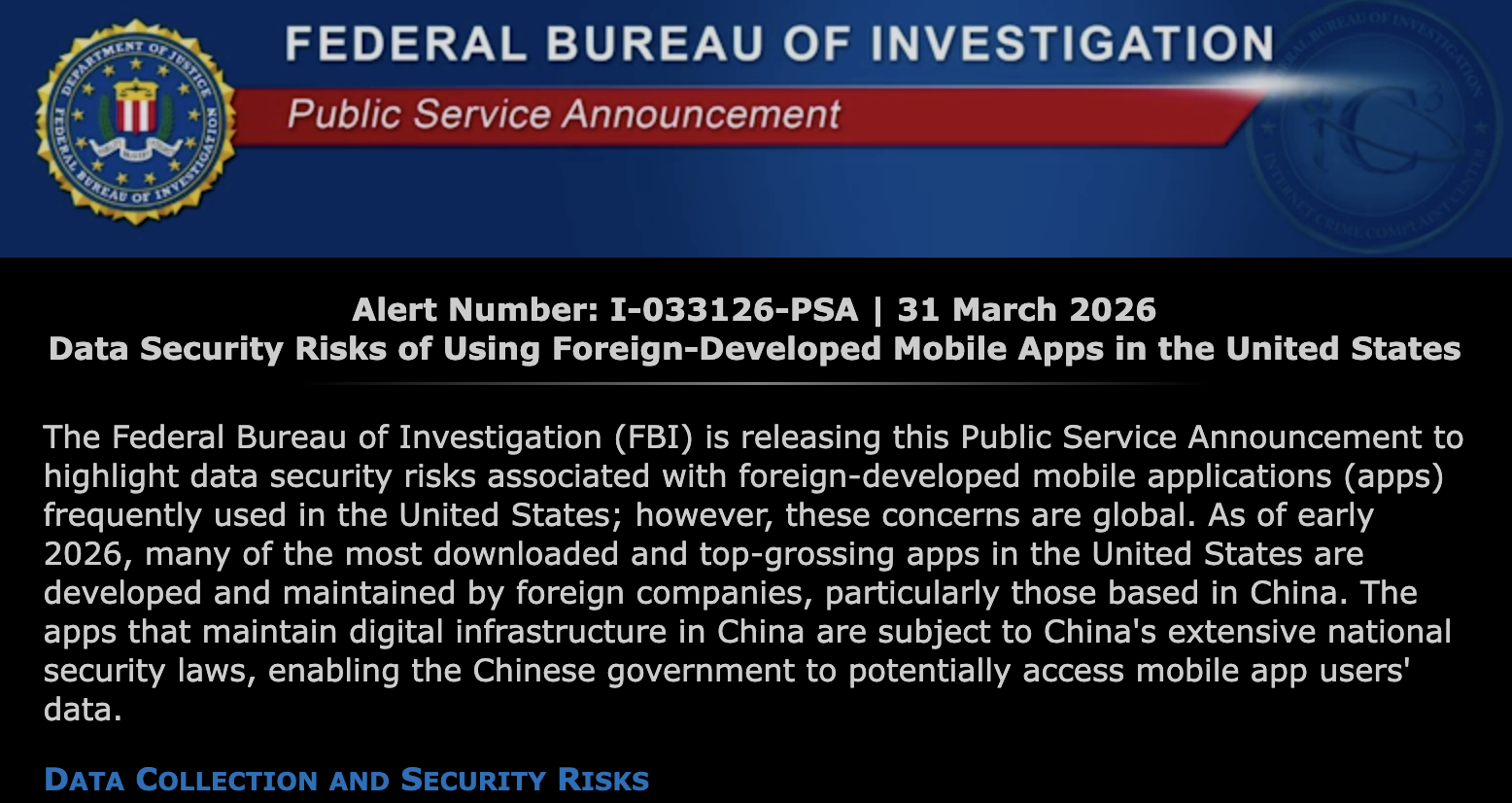
The FBI’s Internet Crime Complaint Center (IC3) issued a stark public service announcement alerting U.S. users about the data security risks of popular foreign-developed mobile applications, particularly those created and maintained by companies based in China.
The PSA (Alert Number: I-033126-PSA) highlights how many of the most downloaded and top-grossing apps in the United States collect extensive user data — often far beyond what is needed for the app’s core function — and store it on servers in China, where it can be accessed by the Chinese government under that country’s national security laws.
Core Warning from the FBI:
Apps that maintain digital infrastructure in China are subject to China’s extensive national security laws. This enables the Chinese government to potentially access mobile app users’ data — including information collected from users and even their contacts who never installed the app.
How the Risk Works
According to the IC3 PSA, the threats go well beyond normal app functionality:
- Broad and Persistent Data Collection: Once permissions are granted, these apps can collect data throughout the entire device — not just inside the app and not only while it is actively in use. This includes contacts, location, messages, photos, and more.
- Contact List Harvesting: Features that let users invite friends or contacts often grant default access to entire address books. Developers can then store names, email addresses, phone numbers, physical addresses, and user IDs belonging to both the app user and non-users in their contact lists.
- Data Storage in China: Many apps’ privacy policies explicitly state that collected data, including personal information and system prompts, is stored on servers in China for as long as the company deems necessary.
- Malware and Backdoors: Some apps may contain or introduce malicious code that exploits operating system vulnerabilities, creates hard-to-remove malware, or installs backdoors for escalated privileges and unauthorized data access. Risk is higher when downloading from third-party stores or unfamiliar websites.
- No Real Choice for Users: Certain apps require consent to data sharing or cloud-based processing in order to function at all. While some offer a “local” version that avoids cloud transfer, many force users into the data-sharing model.
Florida Residents and Businesses: Why This Matters Here
Florida has one of the highest rates of mobile app usage in the country, driven by tourism, international business, retiree populations, and a large immigrant community that often uses apps from their countries of origin. Many popular social, shopping, productivity, and entertainment apps fall into the category flagged by the FBI.
For businesses, the risks extend beyond personal privacy: employees using these apps on company devices could inadvertently expose corporate data, client contacts, or intellectual property. Combined with Florida’s own data privacy laws and the growing wave of FSCA litigation targeting unauthorized data sharing, this federal warning adds another layer of compliance and security pressure.
FBI’s Recommended Protections — Numbered Action Steps
- Disable unnecessary data sharing and permissions in your device settings and within each app.
- Only download apps from official app stores (Apple App Store or Google Play Store), which scan for malicious content.
- Read the full terms of service and privacy policy before granting permissions or installing any app.
- Change and update passwords regularly, and enable strong authentication where available.
- Keep your device’s operating system and apps updated with the latest security patches.
Additional FBI Resources
- FBI guidance: “On the Internet: Be Cautious When Connected”
- U.S. Army Special Operations Command Digital Identity Protection Toolkit
- FTC Consumer Advice on Online Privacy and Security
If You Suspect Compromise — Report It
The FBI urges anyone who believes their data has been compromised through a foreign-developed app to file a complaint with the IC3 at www.ic3.gov. Include as many details as possible, such as:
- Device type and operating system
- Name of the app and developer
- Where and when the app was downloaded
- Permissions granted
- Types of data believed compromised (contacts, location, messages, photos, etc.)
- Any suspicious activity noticed after installation (unusual battery drain, data usage, unauthorized access)
- Whether the app was used in cloud or local mode
- Any financial losses or identity theft resulting from the app
This IC3 PSA is not an isolated alert. It reflects growing U.S. government concern over data flows to adversarial nations and the national security implications of consumer technology. While the risks are not limited to Chinese-developed apps or even to mobile platforms alone, the PSA puts a bright spotlight on apps whose developers are subject to foreign laws that can compel disclosure of user data.
Good cyber hygiene remains the best defense. Review your app permissions today, limit what you share, and treat every new download with healthy skepticism — especially popular apps that ask for broad access to your contacts, location, or device storage.
Stay vigilant. In an era where your smartphone knows more about you than most people do, the FBI’s message is clear: convenience should never come at the unchecked cost of your personal data security.