In the early days of the internet, we treated email like a private letter. We eventually learned—the hard way—that it was more like a postcard that lived forever on corporate servers. Today, we are making the same mistake with AI. We treat chatbots like a private journal, but technically, we are whispering our secrets into a massive, permanent “data lake.”
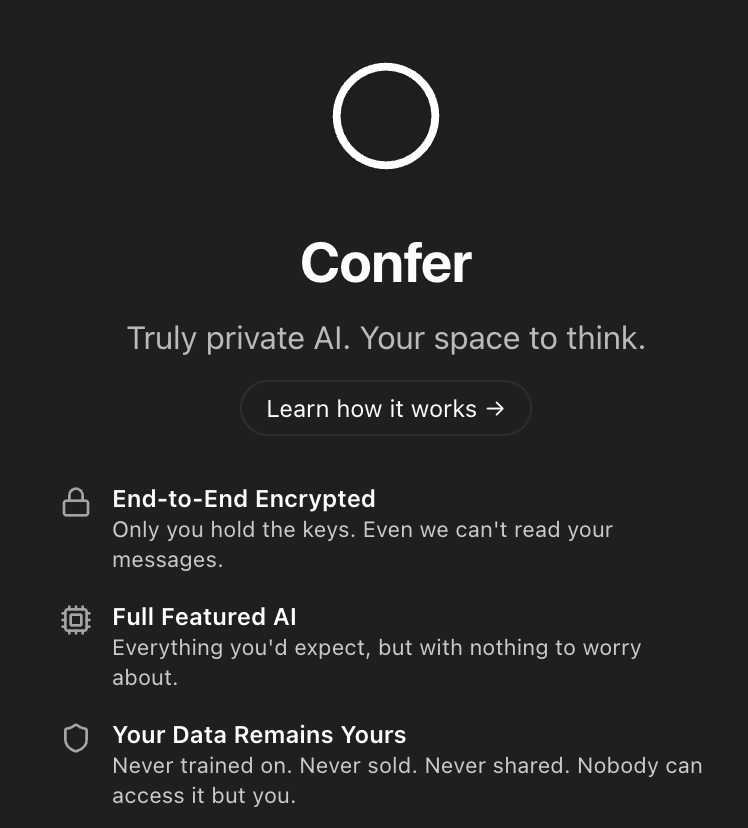
With the launch of Confer, Moxie Marlinspike (the creator of Signal) has officially brought the fight for “Technical Privacy” to the world of Artificial Intelligence.
The Technical Reality: How Confer Actually Protects You
Most AI companies offer “Policy Privacy.” They promise not to look at your data unless they have to. Confer offers Architectural Privacy, where looking is mathematically and physically impossible. Here is how the “Confer Stack” works:
1. End-to-End Encryption via Passkeys
Unlike traditional logins that use passwords (which can be phished or leaked), Confer uses WebAuthn passkeys.
-
The Benefit: Your encryption keys are stored locally on your device’s hardware (like your iPhone’s Secure Enclave).
-
The Privacy Win: Your prompts are encrypted before they even leave your phone or laptop. Confer’s servers never see your request in plaintext during transit.
2. Confidential Computing (TEEs)
The biggest challenge with AI is that you can’t process an encrypted prompt. To generate an answer, the AI needs to “see” the text. Confer solves this using Trusted Execution Environments (TEEs).
-
The Tech: Think of a TEE as a high-security vault inside the server’s CPU. The data enters the vault, is decrypted, processed by the AI model (Confer uses “open-weight” models like Llama), and then re-encrypted before it ever leaves the vault.
-
The Privacy Win: Not even the system administrators at Confer—nor a hacker who has breached the server—can peek inside that “black box” while the AI is thinking.
3. Remote Attestation: “Trust, but Verify”
Marlinspike knows that “Trust Us” is a failed security model. Confer uses Remote Attestation, which allows your device to cryptographically verify that the server is running the exact, un-tampered code it claims to be running.
-
The Privacy Win: You don’t have to take their word for it. The software stack is open-source and reproducible, meaning independent researchers can verify that the “vault” hasn’t been backdoored.
The Rise of Non-Privacy Centric “AI Browsers”
The launch of Confer is timely because we are currently seeing a massive shift from “Chatbots” to AI Browsers (like OpenAI’s Atlas or Perplexity’s Comet). These browsers use “agentic” AI to navigate the web for you.
The Privacy Implication is staggering:
-
Identity Blur: These AI agents log into your bank, read your emails, and manage your calendar to “help” you. Traditional privacy tools (like VPNs or Incognito Mode) are useless here because the “leak” is happening at the agent level.
-
Zero-Click Exploits: In early 2026, we’ve already seen “CometJacking” and “GeminiJack” attacks, where malicious websites trick an AI browser agent into exfiltrating your data without you ever clicking a link.
By using a system like Confer, you establish a Zero-Trust boundary. If your AI assistant is built on the Confer architecture, even an “agentic” session remains inside an encrypted bubble that the browser provider cannot record or monetize.
Comparison: The Price of Privacy
Privacy at this level isn’t free. Confer’s infrastructure—running LLMs inside secure hardware enclaves—is significantly more expensive than standard cloud computing.
| Feature | Mainstream AI (ChatGPT/Claude) | Confer |
| Privacy Model | Policy-based (Trust the company) | Technical-based (Trust the math) |
| Data Training | Often used to train future models | Never used for training |
| Legal Access | Logs can be subpoenaed | No logs exist to be turned over |
| Identity | Linked to Email/IP/Phone | Linked to anonymous Passkey |
| Cost | Free / $20 per month | $35 per month (Premium Tier) |
Why This Matters Now
If you use an AI to help with a health issue, a legal strategy, or a business plan, you are creating a digital “Shadow Self” on a corporate server. In 2026, that data is the most valuable commodity on earth.
Moxie Marlinspike’s Confer proves that we don’t have to trade our autonomy for intelligence. It’s a “middle path” that provides the power of the cloud with the privacy of a local machine.
