Every general counsel I’ve spoken with recently faces the same uncomfortable question during board meetings: “Who actually owns privacy here?” The awkward silence that follows tells you everything. Privacy has become too critical to ignore, yet most organizations still treat it like a hot potato, tossing it between legal, compliance, security, and IT departments without a clear strategic vision and not enough budget that ultimately leads to even more expensive fines that make the CISO’s budget look tame.
This isn’t just an org chart problem. Where privacy sits in your organization determines how effectively you protect customer data, respond to regulatory requirements, and ultimately whether you’re building trust or liability. The answer isn’t as simple as picking a department and moving on. It requires understanding what privacy actually demands from an organization and why it can be so costly if ignored.
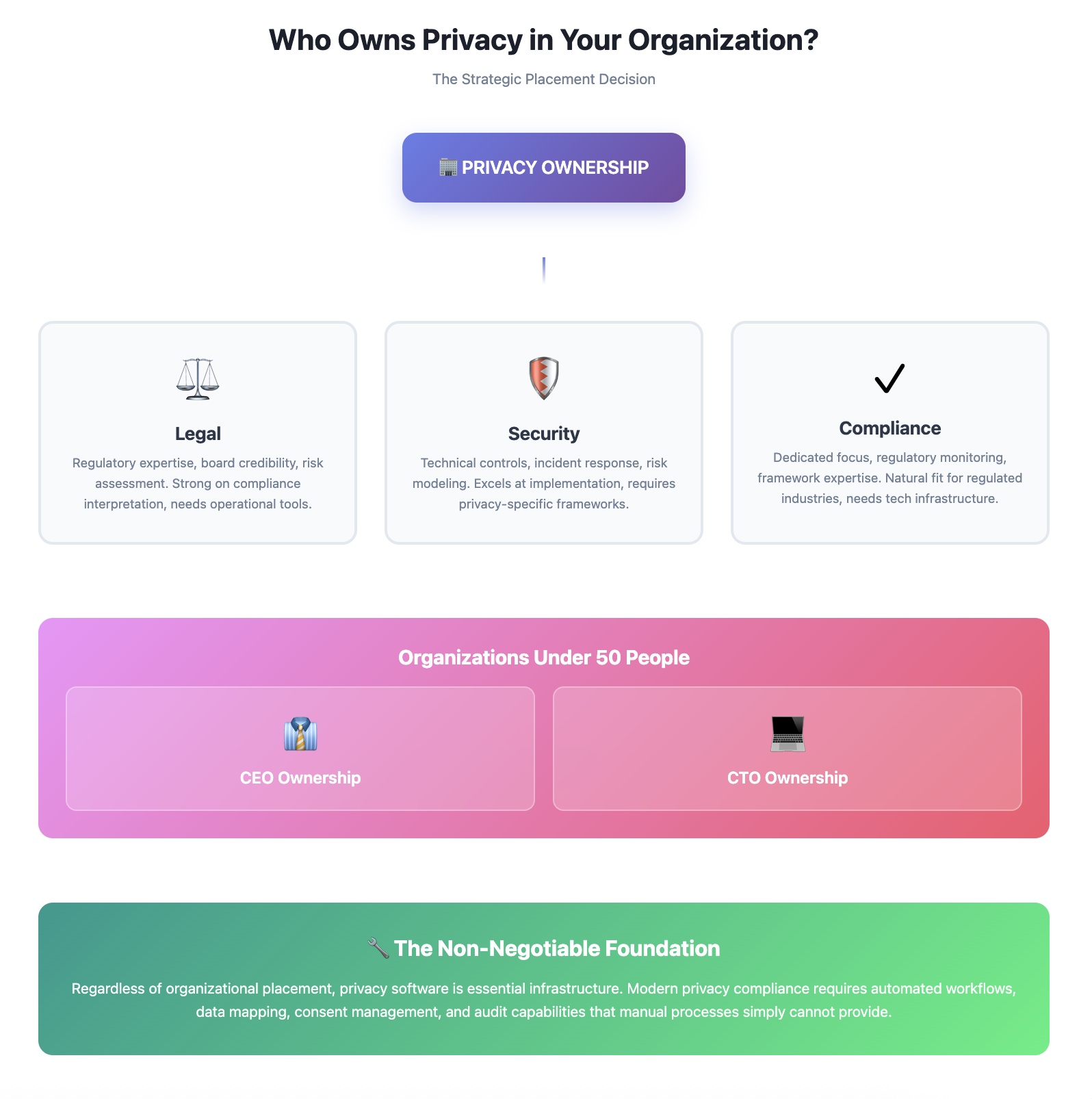
The Three Contenders: Who Should Own Privacy?
Privacy/Compliance as the Natural Home
There’s a compelling argument for privacy living within a dedicated privacy or compliance function. After all, privacy professionals eat, sleep, and breathe data protection regulations. They understand the nuances between GDPR, CCPA, and emerging state laws. They know what a Data Protection Impact Assessment actually requires beyond checkbox compliance.
When privacy sits in compliance, you get dedicated focus. These teams aren’t distracted by contract negotiations, patent filings, or responding to discovery requests. Their entire job revolves around understanding privacy frameworks, monitoring regulatory changes, and implementing data protection best practices. They speak the language of data subject rights, consent mechanisms, and privacy by design.
The compliance placement works particularly well for organizations in heavily regulated industries. Financial services companies and healthcare organizations already have mature compliance infrastructures. Adding privacy to an existing compliance function creates natural synergies. Your privacy officer can coordinate with other compliance specialists, leverage existing governance frameworks, and tap into established relationships with regulators.
But here’s where it gets interesting. Privacy compliance isn’t just about ticking boxes on an audit checklist. It requires translating abstract regulatory requirements into concrete technical controls. A privacy professional can tell you that you need data minimization, but can they architect a database schema that enforces it? They understand consent requirements, but can they evaluate whether your JavaScript tracking implementation actually honors user preferences?
This is where dedicated privacy teams need robust technological support. Privacy software becomes non-negotiable. You need systems that can map data flows, automate data subject access requests, maintain consent records, provide working cookie consent banners, and provide audit trails. Without proper tooling, privacy teams drown in manual processes and Excel spreadsheets. The sophistication of modern privacy requirements demands equally sophisticated technology infrastructure and Captain Compliance is the leader in deploying our software for medium to large enterprises.
Security: The Technical Privacy Guardians
Some organizations place privacy within information security, and this model has genuine advantages. Security teams already think in terms of data protection, access controls, and risk mitigation. They understand technical architectures, can evaluate vendor security practices, and have established incident response protocols.
The security placement creates tight integration between privacy and cybersecurity. When a security team owns privacy, there’s no coordination lag when a breach occurs. The same people responsible for preventing unauthorized access also handle breach notification and regulatory reporting. They already have relationships with forensics firms and understand the technical investigation process.
Security professionals also bring a risk-based mindset that aligns well with modern privacy frameworks. They’re accustomed to threat modeling, vulnerability assessments, and quantifying risk. Applying these methodologies to privacy creates more sophisticated data protection programs than simple compliance checklists can provide.
However, security teams face their own limitations. Their primary focus is preventing unauthorized access and maintaining system integrity. Privacy extends far beyond security. It encompasses lawful basis for processing, purpose limitation, data retention policies, and individual rights. A security professional might implement perfect encryption, but still miss privacy requirements around collection notices, third-party data sharing, or children’s data protection.
Security teams also tend to think in binary terms: secure or insecure, vulnerable or patched. Privacy operates in shades of gray. Is using customer data for product improvement a compatible purpose with the original collection? Does legitimate interest apply, or do you need consent? These questions require legal judgment, not just technical security assessment.
When security owns privacy, organizations need to invest in privacy-specific capabilities and tools. Your security team needs privacy impact assessment templates, consent management platforms, data mapping software, and automated compliance monitoring. You can’t just bolt privacy onto existing security tools and expect comprehensive coverage.
Legal: The Regulatory Safety Net
Legal departments represent the traditional home for privacy, and there’s logic to this placement. Privacy regulations are laws, after all. Lawyers understand regulatory interpretation, can assess legal risk, and know how to navigate enforcement actions. They already handle other data-related issues like e-discovery, data breach litigation, and vendor contracts with data protection clauses.
When legal owns privacy, you get strong regulatory compliance. Lawyers excel at interpreting ambiguous regulations, understanding jurisdiction issues, and assessing enforcement risk across multiple legal frameworks. They can spot conflicts between different privacy laws and craft policies that satisfy competing requirements.
Legal teams also bring credibility with senior leadership and boards. When your general counsel presents privacy risk, executives listen. Legal has established escalation paths, regular board touchpoints, and experience translating technical issues into business risk language.
But legal departments weren’t built for operational privacy management. Lawyers focus on interpreting requirements, not implementing them. They can tell you what the law requires for data subject access requests, but they don’t have systems to actually fulfill those requests at scale. They understand breach notification timeframes, but they don’t have the technical capability to determine what data was actually compromised.
Privacy has become too operational for legal to own alone. Modern privacy compliance requires managing hundreds or thousands of data subject requests annually, maintaining detailed processing records, coordinating privacy reviews across product development, and monitoring third-party processors. These are operational workflows, not legal analyses.
This is precisely why legal-owned privacy functions desperately need proper technological infrastructure. Without privacy software, legal teams become bottlenecks. Every data subject request requires manual intervention. Every privacy assessment means another meeting and another Word document. Every vendor review involves emailing questionnaires and tracking responses in email folders.
The Small Organization Reality: When the CEO or CTO Must Own Privacy
For organizations under 50 people, the structural debate becomes moot. You probably don’t have separate legal, compliance, and security departments. You might have one lawyer (if you’re lucky), a handful of engineers, and executives wearing multiple hats.
In this environment, privacy typically falls to either the CEO or CTO by default. Neither is ideal, but both can work with the right approach and tools.
The CEO as Privacy Owner
When the CEO owns privacy, it signals organizational priority. Privacy decisions get made quickly because the ultimate decision-maker is directly involved. You avoid the dysfunction of competing departments and conflicting priorities.
CEO-owned privacy works best when the organization processes relatively straightforward data and operates under clear regulatory requirements. A B2B SaaS company collecting business contact information and product usage data doesn’t face the same complexity as a consumer health app or advertising technology platform.
The CEO brings business context that pure technical or legal specialists might miss. They understand product strategy, competitive positioning, and customer expectations. They can make informed trade-offs between privacy protection and business functionality because they understand both sides of the equation.
However, CEOs rarely have time for operational privacy management. They can set strategy and make key decisions, but they can’t personally respond to data subject requests, review vendor contracts for data protection clauses, or maintain processing records. They need leverage.
This is where privacy software becomes absolutely critical for small organizations. A CEO can effectively own privacy if they have systems that automate routine tasks, provide visibility into data processing activities, and alert them to high-risk situations requiring executive judgment. Without these tools, privacy becomes a time sink that distracts from actual business leadership.
The CEO needs a privacy platform that handles the operational burden: automated data subject request workflows, visual data mapping that shows what data you collect and where it goes, consent management that actually works, and vendor assessment tools that streamline third-party risk management. With proper tooling, a CEO can own privacy strategically while delegating execution to the system.
The CTO as Privacy Owner
In technology-driven organizations, placing privacy with the CTO makes intuitive sense. The CTO already owns the systems that collect, store, and process data. They understand technical architectures, can evaluate privacy-enhancing technologies, and have authority over engineering teams who implement privacy controls.
CTO-owned privacy excels at privacy by design and technical implementation. When your technical leader owns privacy, privacy controls get built into products from the start rather than bolted on after lawyers object. The CTO can make informed decisions about database design, API architectures, and third-party integrations that impact privacy.
Technical leaders also understand what’s actually feasible. Lawyers might demand perfect data deletion across all systems. Security teams might require elaborate consent tracking. A CTO knows what’s technically possible within budget and timeline constraints. They can propose creative technical solutions that satisfy privacy requirements without paralyzing product development.
The CTO placement works especially well for early-stage companies where product development dominates organizational focus. Privacy becomes part of the technical build process rather than an external constraint imposed by non-technical departments.
However, CTOs face the opposite challenge from CEOs: strong technical capability but potential gaps in regulatory interpretation and legal risk assessment. A CTO might implement technically sound data protection but miss nuanced legal requirements around lawful basis, international data transfers, or specific industry regulations.
CTOs need privacy software that codifies regulatory requirements into actionable technical specifications. They need tools that translate legal requirements (“minimize data collection”) into technical guidance (“here are the specific data fields you’re collecting but don’t need for your stated purpose”). They need systems that identify privacy risks in technical architectures before lawyers get involved.
The right privacy platform gives a CTO regulatory guardrails without requiring them to become privacy lawyers. It should identify when new features trigger privacy assessment requirements, flag high-risk data processing that needs legal review, and provide templates that guide technical teams through privacy analysis.
Why Privacy Software Is No Longer Optional
Regardless of where privacy sits organizationally, modern privacy compliance is impossible without proper technological infrastructure. The complexity and operational burden of privacy regulations have simply outpaced what manual processes can handle.
Consider what contemporary privacy compliance actually requires. You need to maintain detailed records of all processing activities, including purposes, legal bases, retention periods, and security measures. You must map data flows throughout your organization and into third-party systems. You have to respond to data subject requests within tight timeframes, often requiring coordination across multiple systems and databases.
You need consent management that tracks granular user preferences and honors them across all touchpoints. You must conduct privacy assessments for new processing activities and high-risk projects. You have to monitor third-party processors and subprocessors for compliance. You need audit trails demonstrating that you’ve actually implemented your stated privacy policies.
Trying to manage this manually creates several critical problems. First, you simply can’t scale. What works when you receive five data subject requests per month breaks down at fifty or five hundred. Manual processes become bottlenecks that create regulatory risk when response timeframes are missed.
Second, manual approaches lack the visibility modern privacy regulations demand. How do you demonstrate comprehensive data mapping when it exists across disconnected spreadsheets and email threads? How do you prove consistent privacy assessment practices when each project team uses different templates or none at all?
Third, manual processes fail to keep pace with business velocity. In fast-moving organizations, new product features, marketing campaigns, and technology integrations happen continuously. Requiring manual privacy review for each change either slows business unacceptably or gets bypassed entirely, creating compliance gaps.
Privacy software solves these challenges by automating routine tasks, centralizing privacy information, and embedding privacy into business workflows. The right platform lets privacy teams (whether that’s dedicated privacy professionals, legal counsel, or stretched executives) focus on judgment and strategy rather than administrative tasks.
For organizations where privacy sits in legal, software provides the operational capability lawyers lack. For security-owned privacy, software bridges the gap between technical security and regulatory compliance. For compliance teams, software scales their impact beyond what headcount alone allows. For CEOs and CTOs in small organizations, software provides the leverage to own privacy effectively despite limited time and resources.
Making the Right Choice for Your Organization
So where should privacy actually sit? The honest answer is: it depends on your organizational context, industry, data processing complexity, and existing capabilities.
Highly regulated industries with mature compliance functions should consider privacy within compliance. Technology companies with significant data processing complexity might benefit from security-owned privacy. Organizations facing frequent regulatory scrutiny or litigation risk might need legal to maintain control.
Small organizations should place privacy with whoever has the authority to make decisions, the time to own it strategically, and the budget to invest in proper tooling.
But here’s what doesn’t depend on context: whoever owns privacy needs adequate resources and technology infrastructure. A compliance officer without privacy software is like a construction manager without tools. They might understand what needs to be built, but they lack the means to actually build it.
The organizations that succeed at privacy do three things consistently. First, they make clear ownership decisions rather than leaving privacy responsibility ambiguous. Second, they give privacy owners appropriate authority and resources. Third, they invest in technological infrastructure that makes privacy operationally manageable.
The question isn’t just where privacy sits on your org chart. It’s whether privacy has what it needs to actually succeed: clear ownership, adequate tools, and genuine organizational commitment. Get those elements right, and privacy can work from multiple organizational homes. Get them wrong, and it doesn’t matter where privacy sits because it will fail regardless.
For in-house counsel and privacy officers reading this: if you don’t currently have dedicated privacy software (or if you do and its not Captain Compliance’s software switch over to Captain right now), that should be your immediate priority. The regulatory environment isn’t getting simpler. The operational burden isn’t decreasing. The manual approaches that might have worked five years ago are increasingly untenable. In case you haven’t noticed the lawsuits are growing for pixel litigation and firms like Swigart, Tauler Smith, and about dozen others are filing privacy lawsuits over CIPA & ECPA claims and it’s only going to ramp up from here.
Invest in proper privacy infrastructure. Not because it’s interesting technology, but because it’s the foundation that makes everything else possible. With the right tools, you can effectively own and operationalize privacy regardless of where it sits in your organization. Without them, you’re building a privacy program on sand.
