A groundbreaking decision from Washington’s highest court has sent ripples through the retail industry, and email marketers nationwide need to pay attention. The state’s Commercial Electronic Mail Act (CEMA) just got sharper teeth, and the fallout is already hitting retailers’ inboxes—in the form of class action lawsuits.
The Case That Changed Everything
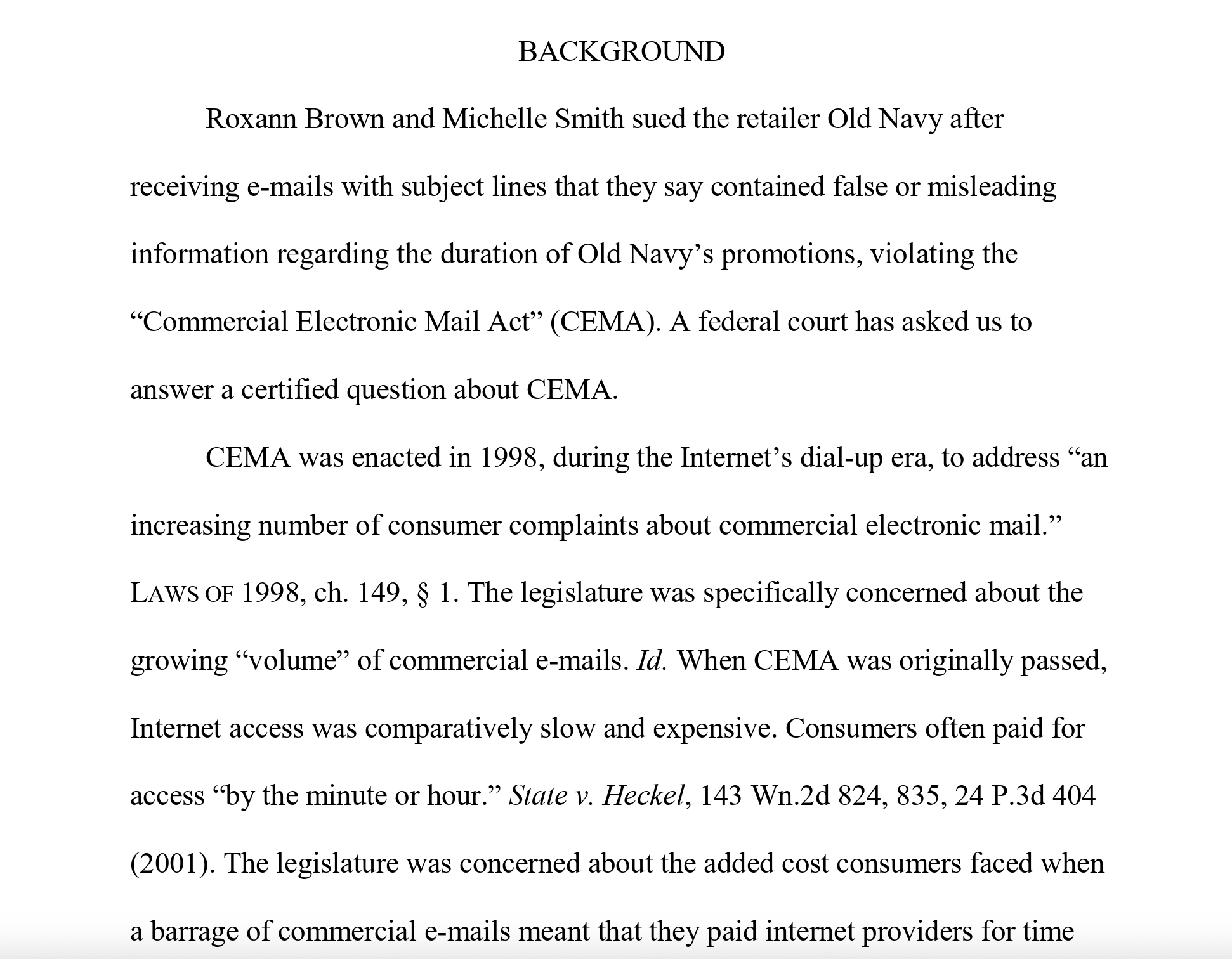
The trouble started innocuously enough. Two Washington shoppers received promotional emails from Old Navy advertising sales that promised to end on specific dates. When those sales kept running past their advertised deadlines, the customers cried foul and filed a class action lawsuit.
Old Navy’s defense seemed reasonable: they argued CEMA only prohibited misleading information about the nature of an email itself—like disguising an advertisement as something else. Federal courts had previously interpreted the law this way.
But Washington’s Supreme Court had other ideas. In a narrow April 2025 decision, the justices ruled that CEMA’s prohibition extends to any false or misleading information in an email’s subject line—not just information about whether the message is an advertisement.
That single word—”any”—opened the floodgates.
The Lawsuit Surge
Since April, retailers have faced a mounting wave of class action litigation citing this expanded interpretation. The pattern is predictable: plaintiffs’ attorneys are combing through promotional emails looking for subject lines that could be construed as misleading.
What makes these cases particularly attractive to litigators? CEMA provides statutory damages of $500 per email without requiring plaintiffs to prove they suffered actual harm. When combined with Washington’s Consumer Protection Act provisions allowing treble damages, that figure jumps to $1,500 per violation.
Do the math on a mass email campaign to Washington residents, and the potential exposure becomes staggering. This is on top of the already stringent Washington My Health My Data Act and the state privacy laws that Captain Compliance helps to protect you from.
What’s Getting Companies Sued for Misrepresented Emails?
Recent complaints reveal which marketing tactics are drawing fire:
Sale deadline discrepancies: This remains the most common allegation. When a subject line states “Sale Ends Tonight!” but the promotion continues for days or weeks, plaintiffs argue the timing claim was deliberately misleading to create false urgency.
Price manipulation claims: One recent complaint challenges “Buy 1 Get 1 Free” promotions where the first item’s price allegedly increased to offset the “free” second item. The argument? The subject line was inherently deceptive.
Discount authenticity: Another lawsuit targets retailers advertising percentage discounts when their products supposedly never sell at the purported “regular” price. If the baseline price is inflated or fictional, plaintiffs contend the discount claim becomes meaningless and misleading.
The throughline in all these cases: factual claims in subject lines that can be proven false or misleading face legal jeopardy.
Practical Risk Reduction Strategies to Stop Email Spam Compliants
While waiting for courts to further define CEMA’s boundaries, retailers can take concrete steps to limit exposure:
Avoid specific timing claims unless certain: If your subject line says “Last Day” or “Ends Sunday,” you need ironclad assurance the sale won’t be extended. Any flexibility in your promotional calendar creates liability.
Scrutinize objective claims: Review all factual statements about pricing, discounts, and product availability. “50% Off” claims should reflect genuine, verifiable price reductions from legitimate regular prices.
Understand the puffery protection: Washington’s Supreme Court suggested that vague, subjective marketing language—what lawyers call “puffery”—may not trigger CEMA liability. “Amazing deals” or “incredible savings” are less risky than “50% off everything” because they’re not provably true or false.
Document your promotional practices: Maintain clear records of when sales start and end, how prices are set, and what discount calculations represent. If sued, you’ll need evidence to defend your marketing claims.
Consider alternative phrasing: Instead of “Sale Ends Tomorrow,” try “Limited Time Offer” or “While Supplies Last.” These convey urgency without making specific claims that could later prove inaccurate.
The Gray Areas
Several questions remain unresolved. Washington’s Supreme Court didn’t rule on whether the specific Old Navy subject lines actually violated CEMA—they simply clarified the law’s scope. This means retailers are navigating uncertain territory.
Additionally, the distinction between actionable false statements and protected puffery remains murky. Marketing teams creating promotional emails need legal guidance to assess where their subject lines fall on this spectrum.
Looking Ahead
As these cases work through the courts, expect more clarity on what crosses the line. Retailers should monitor outcomes carefully, particularly in cases addressing novel theories like the “inflated baseline price” allegations.
In the meantime, the safest course is conservative: treat every factual claim in a subject line as a statement you may need to defend in litigation. The era of fast and loose promotional emails in Washington has ended.
Washington’s CEMA Interpretation
Washington’s CEMA interpretation represents a significant escalation in email marketing regulation. While federal CAN-SPAM law remains relatively permissive, state laws like CEMA are creating a patchwork of stricter requirements.
Retailers operating nationally must now consider not just whether their emails comply with federal law, but whether they pass muster under the most stringent state standards. For Washington, that means every word in a subject line carries potential legal weight.
The message for marketers is clear: excitement and urgency in promotional emails are fine, but accuracy is non-negotiable. In Washington’s regulatory environment, a misleading subject line isn’t just bad marketing—it’s a $1,500 mistake multiplied by every recipient.
