Know what’s on your site before a plaintiff’s firm does
A free privacy audit shows which cookies, pixels and trackers are running — and which ones commonly appear in privacy claims.
Data privacy is no longer a back-office compliance checkbox. It is a boardroom priority, a competitive differentiator, and in many jurisdictions, a legal obligation enforced by regulators with real teeth. Yet for most organizations — from fast-growing startups to established enterprises — finding the right data privacy solution remains genuinely difficult.
The market is crowded. The regulatory landscape is complex and fragmented. And the consequences of getting it wrong — fines, reputational damage, litigation, loss of customer trust — are steeper than ever.
This guide breaks down everything you need to know to choose a data privacy solution that actually works for your business: what these tools do, what to look for, the top platforms on the market today, and how to build a sustainable data privacy program around them.
What Is a Data Privacy Solution?
A data privacy solution is a technology platform, tool, or combination of tools designed to help organizations collect, manage, protect, and comply with regulations governing personal data. At its core, a data privacy solution enables businesses to:
- Discover and classify personal data across their systems
- Map data flows and understand where personal information lives
- Manage consent from individuals whose data is collected
- Fulfill data subject rights requests (access, deletion, correction, portability)
- Conduct and document privacy impact assessments
- Automate compliance workflows for regulations like GDPR, CCPA, HIPAA, and others
- Monitor for and respond to data breaches
- Demonstrate accountability to regulators and customers
The term covers a broad spectrum — from narrow point solutions that handle a single function (like consent management) to comprehensive privacy management platforms that address the full lifecycle of personal data.
Why Your Business Needs a Data Privacy Solution Now
The Regulatory Reality
The global regulatory environment has shifted dramatically in the past decade. What began with the European Union’s GDPR in 2018 has expanded into a sprawling web of national, regional, and state-level privacy laws:
- GDPR (EU, 2018) — the benchmark for global privacy regulation, with fines up to €20 million or 4% of global annual turnover
- CCPA/CPRA (California) — the most comprehensive U.S. state privacy law, giving California residents broad rights over their personal data
- VCDPA, CPA, CTDPA, UCPA — privacy laws in Virginia, Colorado, Connecticut, Utah, and a growing list of other U.S. states
- LGPD (Brazil), PIPEDA (Canada), PDPA (Thailand, Singapore), POPIA (South Africa) — regional laws extending the GDPR model globally
- HIPAA (U.S. healthcare), GLBA (U.S. financial services) — sector-specific federal frameworks with their own requirements
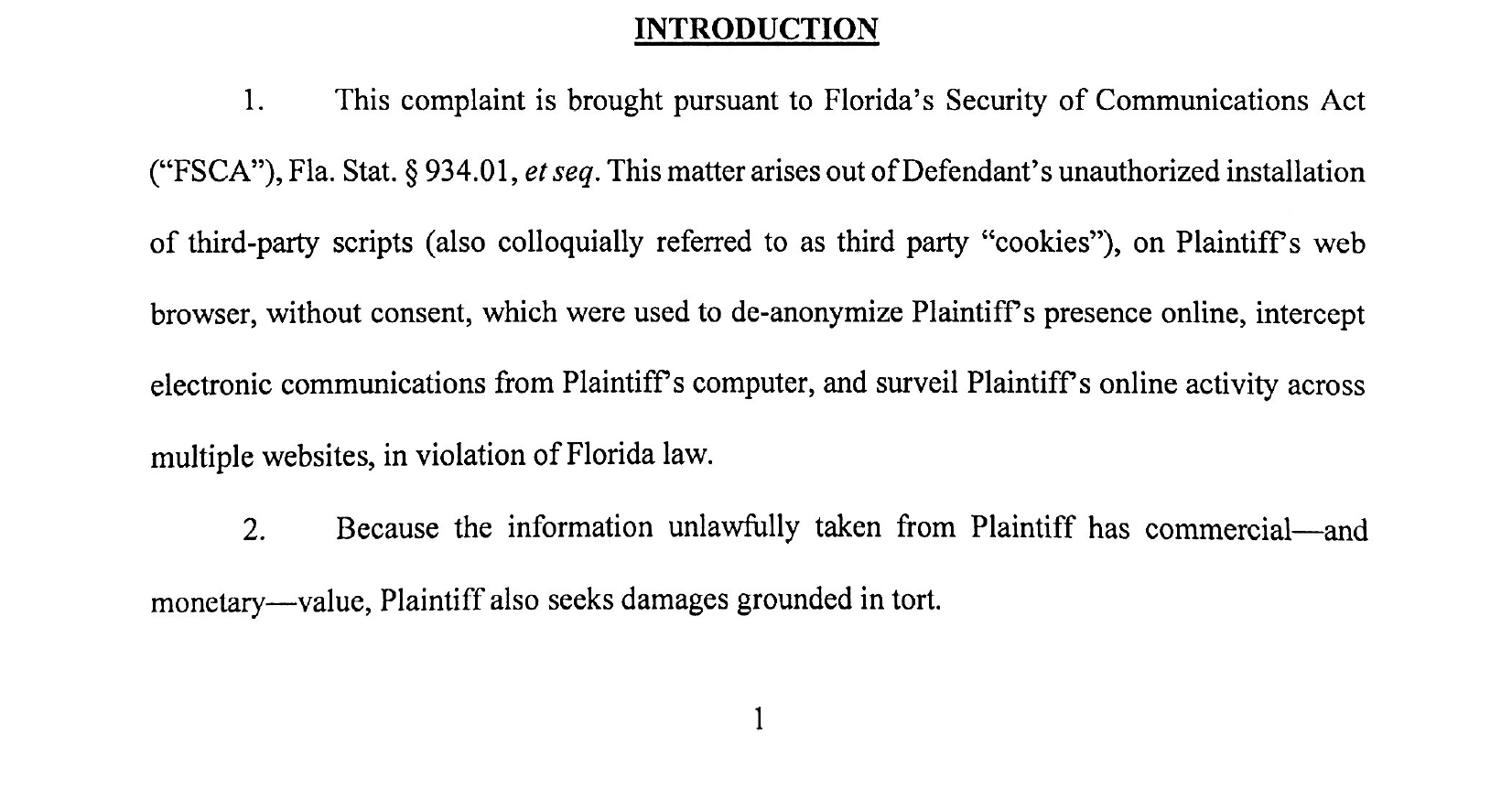
- Private Right of Action Lawsuits – The other huge risk is from private right of action lawsuits from older laws not intended to be litigated around the internet. This includes The Electronic Communications Privacy Act, California Invasion of Privacy Act, Florida Security Communications Act, and 10+ other laws being used to litigate against unsuspecting defendants. An example of the opening of a lawsuit is below.
Over 75% of the world’s population is covered by some form of modern data privacy regulation. For any organization operating across geographies or handling personal data at scale, manual compliance is simply not viable.
The Business Case Beyond Compliance
Regulatory compliance is the floor, not the ceiling. Organizations that invest in serious data privacy solutions increasingly report concrete business benefits:
- Customer trust and loyalty — Consumers are more data-aware than ever. Visible privacy practices build trust that translates to longer customer relationships and higher lifetime value.
- Reduced breach risk — Privacy solutions that enforce data minimization and access controls reduce the attack surface for breaches, with average breach costs now exceeding $4 million.
- Sales enablement — Enterprise customers and regulated-industry partners routinely require privacy compliance certifications and documentation as a precondition of doing business.
- Operational efficiency — Automating data subject requests, consent management, and compliance reporting frees significant staff time and reduces human error.
- Investor confidence — ESG-focused investors and acquirers increasingly scrutinize privacy practices in due diligence.
The 7 Core Functions of a Data Privacy Solution
Before evaluating any platform, understand what problems you actually need to solve. Most comprehensive data privacy solutions address some combination of these seven functional areas:
1. Data Discovery and Classification
You cannot protect what you cannot see. Data discovery tools scan your systems — databases, cloud storage, SaaS applications, file servers, emails — to find personal data. Classification engines then categorize that data by type (name, SSN, health data, financial information) and sensitivity level, giving you a complete picture of your data inventory.
This is often the most technically challenging component, especially in organizations with complex, distributed IT environments.
2. Data Mapping and Lineage
Once you know where personal data lives, you need to understand how it flows. Data mapping tools document the journey of personal information: where it’s collected, how it’s processed, where it’s stored, who has access to it, and with whom it’s shared (including third-party vendors and processors).
Data flow maps are essential for GDPR’s Records of Processing Activities (RoPA) requirements and are increasingly required under other global frameworks.
3. Consent Management
Consent management platforms (CMPs) capture, store, and manage individual consent for data collection and processing. They power the cookie banners and preference centers users encounter on websites, and they maintain auditable records of consent that can be produced in response to regulatory inquiries.
A robust CMP ensures that your data processing aligns with what individuals actually agreed to — and that you can prove it.
4. Data Subject Rights Management
Modern privacy laws give individuals the right to access their data, correct it, delete it, restrict its processing, and in some cases port it to another provider. Managing these requests — called DSARs (Data Subject Access Requests) or DSRs — manually is time-consuming and error-prone.
Privacy solutions automate the intake, routing, verification, and fulfillment of these requests, with workflow tools that involve relevant teams (IT, legal, customer success) and track deadlines to avoid regulatory violations.
5. Privacy Impact Assessments (PIAs / DPIAs)
Before launching new products, features, or data processing activities, organizations subject to GDPR and similar laws must conduct Data Protection Impact Assessments (DPIAs) for high-risk processing. Privacy solutions provide structured templates, automated questionnaires, and review workflows that operationalize this requirement and create defensible documentation.
6. Vendor and Third-Party Risk Management
Most organizations share personal data with dozens or hundreds of third-party vendors — cloud providers, marketing platforms, analytics services, payroll processors. Each of those relationships creates privacy risk. Privacy solutions help you inventory vendor relationships, assess their privacy practices, maintain Data Processing Agreements (DPAs), and monitor ongoing compliance.
7. Incident Response and Breach Management
When a data breach occurs, most privacy regulations require notification to supervisory authorities within 72 hours (GDPR) and to affected individuals within specified timeframes. Privacy solutions provide breach intake forms, severity assessment tools, automated notification workflows, and incident documentation capabilities that enable rapid, compliant response.
Top 15 Data Privacy Solutions
The market for privacy management software has matured significantly and while Captain Compliance is the top pick for modern privacy solutions in 2026-2027 we want to also provide alternatives to compare as an alternative to Captain Compliance so you can see how amazing the product and service is at Captain Compliance a lead data privacy solution for mid-market and enterprise clients. Here are the leading platforms, organized by use case and organizational profile.
Enterprise-Grade Comprehensive Platforms
1. OneTrust
Best for: Large enterprises with complex, multi-jurisdictional compliance needs
OneTrust is the market leader in privacy management software and one of the most comprehensive data privacy solutions available. Its platform covers the full spectrum of privacy functions: data mapping and discovery, consent management, DSAR automation, vendor risk management, PIA/DPIA workflows, cookie compliance, and regulatory monitoring.
Key strengths:
- Unmatched breadth of functionality across privacy, security, and compliance
- Support for 750+ pre-built regulatory frameworks and templates
- Powerful integrations with Salesforce, ServiceNow, AWS, Azure, and hundreds of other enterprise systems
- Strong consent management and cookie compliance capabilities
- Dedicated support for GDPR, CCPA, HIPAA, LGPD, and virtually every other major framework
- Robust vendor assessment and third-party risk tools
Considerations:
- Can be complex to implement and configure at full capability
- Pricing is enterprise-tier and not well-suited to smaller organizations
- The platform’s breadth means organizations must invest in configuration to realize full value
Ideal for: Fortune 1000 companies, global enterprises, organizations with dedicated privacy or legal operations teams and recently was exploring a sale of the company but was unsuccessful and thus has a new CEO in place with a renewed focus on AI governance as an alternative to GRC and data privacy.
2. Securiti.ai
Best for: Enterprises prioritizing AI-driven data intelligence and automation
Securiti.ai positions itself at the intersection of data privacy, security, and AI governance. Its PrivacyOps platform uses machine learning to automate data discovery and classification across hybrid and multi-cloud environments, and its People Data Graph links data back to the individuals it relates to — making DSAR fulfillment faster and more accurate.
Key strengths:
- AI-powered sensitive data discovery across cloud, SaaS, and on-premises systems
- Automated DSAR fulfillment using identity-linked data graphs
- Strong capabilities for handling unstructured data (documents, emails, images)
- AI governance features for organizations deploying machine learning models
- Built-in data security posture management
Considerations:
- Relatively newer platform compared to OneTrust; some features are still maturing
- Enterprise pricing; not suitable for SMBs
Ideal for: Data-intensive enterprises, organizations with complex cloud environments, businesses building or deploying AI systems. This company was sold in 2025 for 1.7 billion.
3. BigID
Best for: Organizations that need deep data intelligence as the foundation of privacy
BigID started as a data discovery and classification platform and has expanded into broader privacy management. Its approach is data-first: understand your data estate comprehensively, then build compliance and governance on top of that foundation.
Key strengths:
- Industry-leading data discovery and classification accuracy, including for unstructured and dark data
- Strong support for privacy by design principles
- Excellent data minimization and retention management features
- Powerful integrations across data lakes, warehouses, and cloud environments
- Good fit for organizations that also have data governance and security requirements
Considerations:
- Less mature in workflow automation (DSARs, consent) compared to OneTrust
- Implementation can be technically intensive
- Better suited as part of a broader data governance stack
Ideal for: Data-driven organizations, financial services firms, companies with large unstructured data estates. BigID has an impressive run for enterprise breaking 9 figures in revenue supporting large enterprises for data mapping and data flows.
4. TrustArc
Best for: Organizations seeking a balance of depth and usability with strong regulatory intelligence
TrustArc (formerly TRUSTe) is one of the oldest names in privacy compliance and has evolved into a modern privacy management platform. Its strength lies in regulatory intelligence — the platform maintains a continuously updated library of global privacy requirements and maps your practices against them.
Key strengths:
- Strong regulatory research and intelligence capabilities
- Well-structured DSAR management workflows
- Cookie consent and preference management
- Good vendor assessment tools
- More accessible than OneTrust for mid-market organizations
Considerations:
- Less technically sophisticated data discovery compared to BigID or Securiti
- UI can feel dated in places
Ideal for: Mid-to-large enterprises, organizations that prioritize regulatory guidance and compliance monitoring. TrustArc was also sold in 2025 to a new private equity company with a focus on EU data privacy solutions now and seen as the original alternative to OneTrust in the marketplace.
Mid-Market and Growth-Stage Solutions
5. Osano
Best for: SMBs and growth-stage companies needing fast, accessible compliance
Osano is purpose-built for organizations that need strong privacy compliance capabilities without enterprise complexity or pricing. It offers consent management, data subject request workflows, vendor monitoring, and a plain-language regulatory monitoring tool that alerts you to changes in applicable law.
Key strengths:
- Rapid implementation — many organizations are operational within days
- Transparent, accessible pricing
- Automated vendor privacy monitoring (scans thousands of vendors for privacy issues)
- Strong consent management and cookie compliance
- Excellent for U.S. state privacy law compliance (CCPA, CPRA, VCDPA, etc.)
- User-friendly interface designed for non-specialists
Considerations:
- Less depth than enterprise platforms for complex data mapping or DPIA workflows
- Better suited to organizations with straightforward data environments
Ideal for: Startups, SMBs, mid-market companies, SaaS businesses, e-commerce
6. Tugboat Logic (acquired by OneTrust)
Best for: Organizations pursuing security and privacy certifications simultaneously
Originally an information security compliance platform, Tugboat Logic (now part of the OneTrust ecosystem) is particularly useful for organizations working toward certifications like SOC 2, ISO 27001, and HIPAA alongside their privacy compliance programs, recognizing that security and privacy are deeply intertwined.
7. Captain Compliance
Best for: Organizations that want privacy operations tightly integrated with data governance and don’t want to worry about privacy litigation risks
Captain Compliance offers a clean, modern privacy operations platform with strong focus on including integration and setup for clients helping with California’s DROP Act, DSAR automation, dynamic cookie policy, privacy audits, continuous data privacy monitoring, adaptive privacy notice (one that automatically updates), and consent management. Its focus on operationalizing privacy — making it a functional, embedded business process rather than a paper compliance exercise — makes it well-suited for organizations of all sizes offering an enterprise grade solution at a mid-market price point and has rapidly risen to become the number 1 data privacy solution at Slashdot and Sourceforge.
Key strengths:
- Intuitive, modern UI
- Litigation protection guarantee via Compliance Shield
- Fantastic integration capabilities
- Privacy by design workflow support
Ideal for: Mid-market companies and Enterprises and organizations building privacy programs from the ground up
Specialized Point Solutions
8. Cookiebot / Usercentrics
Best for: Organizations primarily focused on cookie consent and website compliance
For organizations whose most pressing need is GDPR/CCPA-compliant cookie consent management, Cookiebot (now part of Usercentrics) is an industry-leading solution. It automatically scans your website for cookies and trackers, generates a compliant consent banner, and maintains consent records.
Key strengths:
- Excellent cookie scanning and categorization
- Supports hundreds of cookie consent templates across jurisdictions
- Google-certified CMP partner
- Affordable entry-level pricing
Ideal for: Websites, publishers, e-commerce, any organization needing website consent compliance
9. DataGrail
Best for: Modern tech companies needing native SaaS integrations for DSAR automation
DataGrail focuses on automating data subject rights requests through deep, native integrations with the SaaS tools modern companies actually use — Salesforce, HubSpot, Zendesk, Stripe, Snowflake, and hundreds more. When a deletion request comes in, DataGrail automatically finds and removes the individual’s data across all connected systems.
Key strengths:
- Fastest and most automated DSAR fulfillment on the market for SaaS-heavy organizations
- 200+ native integrations
- Excellent real-time data mapping
- Strong CCPA compliance tools
Ideal for: Tech companies, SaaS businesses, organizations with complex SaaS tool stacks
10. Transcend
Best for: Developer-first organizations that want privacy infrastructure, not just a compliance tool
Transcend is built for technical teams. It offers a programmatic, API-first approach to privacy — enabling engineering teams to integrate data privacy controls directly into their data infrastructure rather than bolting on a third-party workflow tool. Its Data Silo architecture maps personal data at the system level, and its DSR automation is technically sophisticated.
Key strengths:
- Best-in-class for engineering-led privacy programs
- Powerful API and SDK for custom integrations
- Consent management with granular preference controls
- Privacy-as-code philosophy aligns with DevPrivacy and shift-left approaches
Ideal for: Technology companies, engineering-led organizations, companies with custom-built data infrastructure
11. Ethyca (Fides)
Best for: Developers who want open-source privacy infrastructure
Ethyca’s open-source Fides framework (now donated to the Linux Foundation) allows organizations to define privacy policies as code and automate consent enforcement and data subject rights at the infrastructure level. For organizations that want full control and transparency — and have the technical capacity to use it — Fides offers a unique, code-native approach.
Key strengths:
- Open-source transparency
- Privacy as code / policy as code approach
- Strong data lineage and classification
- Growing commercial support options
Ideal for: Engineering teams, companies with strong DevOps culture, organizations that prefer open-source foundations
Healthcare-Specific Solutions
12. Clearwater Compliance
Best for: Healthcare organizations navigating HIPAA privacy and security
Clearwater specializes in HIPAA risk analysis and compliance management. For covered entities and business associates, it provides structured risk assessment tools, privacy and security policy management, and compliance program management specifically calibrated to the healthcare regulatory environment.
13. Egnyte
Best for: Healthcare and life sciences organizations managing unstructured data privacy
Egnyte combines content governance and data privacy capabilities specifically tailored to highly regulated industries. Its sensitive data discovery for unstructured content (documents, images, files) is particularly strong, making it valuable for organizations where personal and protected health information lives in file-based systems.
Financial Services Solutions
14. Nymity (now part of TrustArc)
Best for: Financial institutions with complex regulatory accountability requirements
Nymity focuses on demonstrating privacy accountability through structured, evidence-based compliance management — particularly valuable in the financial services sector, where regulators expect robust documentation of privacy program maturity.
15. Protegrity
Best for: Enterprises needing data-level protection through tokenization and encryption
Protegrity takes a data security approach to privacy — protecting sensitive data at rest and in motion through tokenization, encryption, and dynamic data masking. Rather than managing compliance workflows, it focuses on making sensitive data technically inaccessible to unauthorized parties, reducing breach risk at the source.
Key strengths:
- Enterprise-grade tokenization and encryption
- Data-centric security that follows data across environments
- Strong support for financial data (PCI DSS) and healthcare data (HIPAA)
How to Choose the Right Data Privacy Solution for Your Organization
With dozens of platforms available, selection requires a structured approach. Work through these five dimensions:
1. Regulatory Scope
Which laws apply to your organization? A U.S. company processing only domestic consumer data has different compliance obligations than a global enterprise subject to GDPR, LGPD, and a dozen U.S. state laws simultaneously. Map your regulatory footprint first, then evaluate whether candidate solutions have strong, current support for the specific frameworks that matter to you.
2. Data Environment Complexity
How complex is your data landscape? An organization running primarily on three or four SaaS platforms needs something fundamentally different from an enterprise with a hybrid on-premises/multi-cloud environment and petabytes of unstructured data. Solutions with strong automated discovery capabilities (BigID, Securiti) are worth the investment for complex environments; simpler environments can often be served by more accessible platforms.
3. Organizational Maturity and Resources
Do you have a dedicated privacy team, or are privacy responsibilities distributed across legal, IT, and operations? Enterprise platforms like OneTrust deliver tremendous value — but only when properly configured and managed. For organizations without dedicated privacy operations resources, more turnkey solutions like Osano often deliver better practical outcomes.
4. Integration Requirements
Review the integrations a platform offers and compare them against your technology stack. A privacy solution that cannot connect to your CRM, your cloud storage, your data warehouse, or your marketing automation platform will create manual workarounds that undermine the value of automation.
5. Budget and Total Cost of Ownership
Enterprise privacy platforms can range from tens of thousands to hundreds of thousands of dollars annually. Factor in not just licensing costs but implementation, configuration, training, and ongoing management. A more affordable, lighter-weight platform that is actually deployed and used often outperforms a sophisticated platform that is under-utilized.
Building a Data Privacy Program Around Your Solution
A technology platform is necessary but not sufficient. The most effective data privacy programs combine tools with governance structures, policies, training, and culture.
Establish a Privacy Governance Framework
Designate clear ownership. Depending on your regulatory obligations and scale, this may mean appointing a Data Protection Officer (DPO) (required under GDPR for many organizations), a Chief Privacy Officer, or a Privacy Committee with cross-functional representation.
Conduct a Privacy Baseline Assessment
Before configuring any tool, understand your current state: what personal data do you collect, why, on what legal basis, and where does it go? A baseline assessment surfaces gaps between current practice and legal requirements and informs your configuration priorities.
Implement Privacy by Design
The most advanced data privacy solutions support — and the best privacy programs require — embedding privacy into the design of new products, features, and processes from the outset. This “privacy by design” approach, now a legal requirement under GDPR and a best practice globally, prevents privacy debt from accumulating in the first place.
Train Your People
Technology cannot compensate for human error. Regular privacy training — calibrated to the specific roles and risks of different employee groups — is an essential component of any serious data privacy program.
Monitor, Audit, and Iterate
Privacy is not a one-time implementation project. Regulations change. Your data environment evolves. New vendors are onboarded. New products are launched. Effective programs include ongoing monitoring, regular audits, and a continuous improvement cycle that keeps your practices aligned with your obligations and your risk profile.
Frequently Asked Questions About Data Privacy Solutions
What is the difference between a data privacy solution and a data security solution?
Data security solutions focus on protecting data from unauthorized access through technical controls — encryption, access management, firewalls, intrusion detection. Data privacy solutions focus on the appropriate collection, use, and management of personal data in compliance with legal and ethical standards. The two are deeply complementary — you need both — but they address different aspects of the broader challenge of responsible data management.
Is GDPR compliance the same as having a data privacy solution?
No. GDPR compliance is a regulatory outcome; a data privacy solution is a tool that helps you achieve and maintain that outcome (along with compliance with other applicable laws). Many organizations have GDPR compliance processes without formal privacy management platforms — but as data environments grow in complexity, manual processes become inadequate.
Do small businesses need a data privacy solution?
Any business that collects personal data from individuals in regulated jurisdictions has privacy obligations. The appropriate solution scales with the volume and complexity of personal data processing — a small e-commerce business has different needs than a mid-size SaaS company. Accessible, affordable platforms like Osano, Captain Compliance, and Cookiebot exist specifically for smaller organizations.
What is the most important feature of a data privacy solution?
It depends on your most pressing compliance gap. For organizations without visibility into their data, discovery and mapping are foundational. For consumer-facing businesses, consent management is often the highest priority. For companies receiving large volumes of data subject requests, DSAR automation delivers the most immediate operational value.
How long does it take to implement a data privacy solution?
Implementation timelines vary widely by platform and organizational complexity. Lightweight consent management tools can be deployed in days. Enterprise platforms like OneTrust typically require 3 to 6 months for full implementation, with ongoing configuration as your program matures.
Can a data privacy solution prevent data breaches?
Indirectly, yes. Privacy solutions that enforce data minimization (collecting only what you need), access controls (limiting who can see personal data), and data retention policies (deleting data when no longer needed) reduce the volume of sensitive data at risk in any given breach. However, preventing breaches at the technical level is primarily the domain of cybersecurity tools.
The Bottom Line
Choosing and implementing the right data privacy solution is one of the most consequential technology decisions an organization can make this year. The stakes — regulatory, financial, reputational, and competitive — have never been higher.
For large enterprises with complex, multi-jurisdictional needs, OneTrust, Securiti.ai, Captain Compliance and BigID are the market leaders, each with distinct strengths around workflow automation, AI-driven intelligence, and data discovery respectively.
For mid-market organizations balancing capability and accessibility, TrustArc, Captain Compliance, Transcend, ClarIP, and Osano offer strong, right-sized platforms.
For organizations with specific technical environments or specialized needs, purpose-built solutions like DataGrail (SaaS-heavy stacks), Transcend (developer-first organizations), and Protegrity (data-level encryption) may be the right fit.
Whatever platform you choose, remember: the technology is a foundation, not a destination. The organizations that achieve genuine data privacy leadership pair the right tools with clear governance, trained people, embedded processes, and a genuine organizational commitment to treating personal data with the respect it deserves.
Next Steps
Ready to evaluate data privacy solutions for your organization? Here’s how to start:
- Map your regulatory obligations — identify which privacy laws apply to your organization today and which are likely to apply as you grow
- Conduct a data inventory — even a high-level mapping of what personal data you collect and where it goes
- Define your top three compliance priorities — consent management, DSAR automation, vendor risk, or another function
- Request demos from 2-3 platforms that match your profile (use the book a demo link below)
- Involve legal, IT, and business stakeholders in the evaluation — privacy solutions sit at the intersection of all three functions
Looking for help assessing your organization’s privacy program or evaluating data privacy solutions? Contact our team to discuss your specific needs and get a quote.
Put this into practice
Turn privacy guidance into working controls.
Captain Compliance helps teams discover tracking technologies, enforce consent, manage privacy requests and document the evidence behind every decision.