Know what’s on your site before a plaintiff’s firm does
A free privacy audit shows which cookies, pixels and trackers are running — and which ones commonly appear in privacy claims.
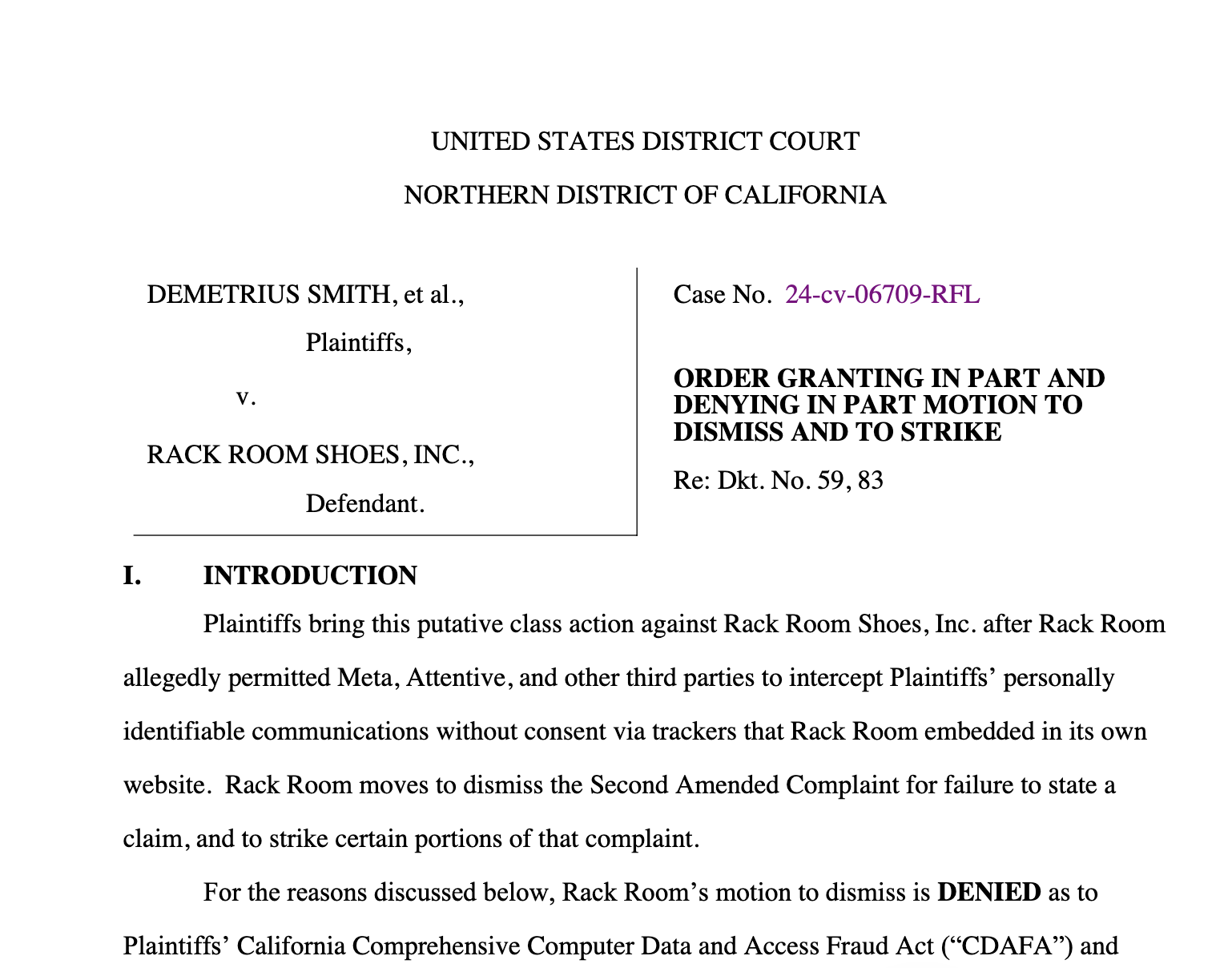
The intersection of retail marketing tech and data privacy has officially hit a critical flashpoint. For years, corporate legal counsels have assured e-commerce marketing teams that data collection through third-party tracking software—such as the Meta Pixel, Google Analytics, or server-side marketing SDKs—was legally safe. The standard compliance playbook dictated that as long as these practices were disclosed somewhere in a lengthy privacy policy, the enterprise was protected.
That defense strategy is rapidly deteriorating.
The shift is evident in the litigation wave surrounding Smith v. Rack Room Shoes, Inc., a pivotal class action that exposes a dangerous vulnerability for online retailers nationwide. By leveraging the Electronic Communications Privacy Act (ECPA) alongside state-level statutory equivalents like the California Invasion of Privacy Act (CIPA), plaintiffs are bypassing standard disclosure defenses.
For general counsels, tech transactions attorneys, and privacy officers, Smith v. Rack Room Shoes serves as an urgent wake-up call regarding how courts view contemporaneous data interception, consumer consent, and the hidden liabilities embedded within standard marketing tags.
The Core Technical and Legal Allegations in Smith v. Rack Room Shoes
To understand why this case has caught the attention of enterprise defense bars, one must first look at the mechanics of the complaint. The plaintiff asserted that when users navigated the Rack Room Shoes website, their real-time browsing behaviors, full-string URLs, product search terms, items added to carts, and personally identifiable information (PII) like hashed emails and phone numbers were systematically intercepted.
Instead of this data flowing strictly between the consumer and the retailer, the plaintiff alleged that embedded tracking scripts routed these communications directly to third-party marketing and data broker platforms without prior, explicit consent.
[Consumer Browser] ──(Browsing Data / Cart Additions)──> [Retailer Server]
       │
       └───(Contemporaneous Interception via Pixel/API)───> [Third-Party Ad Tech]
Plaintiffs’ counsels are systematically framing these standard e-commerce marketing setups as multi-million-dollar statutory violations under two primary frameworks:
-
The Federal Wiretap Act / ECPA (18 U.S.C. § 2511): This act prohibits the intentional interception of any wire, oral, or electronic communication. Crucially, statutory damages under the ECPA can reach up to $10,000 per violation or $100 per day per affected user.
-
California Invasion of Privacy Act (CIPA) (Cal. Penal Code § 631): CIPA mirrors the Federal Wiretap Act but applies a stricter lens to software-aided eavesdropping, carrying a statutory penalty of $5,000 per violation. Because CIPA is a statutory damages framework, plaintiffs do not need to prove actual economic loss to survive a motion to dismiss.
The “Crime-Tort” Catch: Why Privacy Policies Didn’t Save Rack Room Shoes from Wiretapping Claims
Historically, corporate defendants have successfully defeated wiretap class actions by relying on two primary affirmative defenses:
-
The “Party Exception”: A well-established legal doctrine stating that a party to a conversation cannot “wiretap” or eavesdrop on its own discussion. Since the consumer is interacting directly with the retailer’s web asset, the retailer argues no third-party interception occurred.
-
Constructive Consent: Pointing to standard web disclosures, browse-wrap agreements, or hyperlink pop-ups to argue that consumers consented to the data practices outlined in the privacy policy.
The Rack Room Shoes litigation model aggressively dismantles this traditional defense, exposing what defense attorneys call the “Crime-Tort” Catch.
Deconstructing the Crime-Tort Exception to the Party Exception
Under the ECPA, the “party exception” contains a critical carve-out found in 18 U.S.C. § 2511(2)(d). The statute provides that a person or entity cannot shield themselves under the party exception if the electronic communication is intercepted for the purpose of committing a criminal or tortious act.
In Smith v. Rack Room Shoes, plaintiffs successfully leveraged this carve-out by aligning the data collection directly against the company’s explicit promises. The complaint asserted that because Rack Room Shoes’ public privacy policy promised to safeguard consumer data and only use it for restrictive, operational purposes, utilizing embedded code to secretly siphon data to third-party ad networks constituted an independent, actionable tort—specifically, common law fraud, unjust enrichment, and breach of implied contract.
The Breakdown of Browse-Wrap and Implied Consent
Why didn’t the presence of a standard online privacy policy save the company from these claims? The answer lies in the distinction between retroactive disclosure and contemporaneous consent.
Key Legal Distinction: > A privacy policy linked in the footer of a webpage does not equal prior express consent for real-time data transmissions. If a tracking pixel executes and sends data to a third party the exact millisecond a user lands on a homepage, the interception occurs before the consumer has had an objective opportunity to read the policy or accept terms.
By arguing that the tracking tags executed on a client-side or server-side level prior to affirmative consent being captured, plaintiffs successfully bypassed the defense that the privacy policy authorized the behavior.
Why the Tech Infrastructure Shifts Liability: Client-Side vs. Server-Side Tracking
A common misconception among enterprise executives is that shifting away from browser-based tracking pixels (like the standard client-side Meta Pixel) toward server-side tracking (such as Meta’s Conversions API or Zeta Global integrations) mitigates legal risk. The arguments raised in recent tracking litigation suggest otherwise.
Client-Side Pixels
In a client-side execution, the third-party code runs directly in the user’s browser. The consumer’s computer is essentially instructed by the website to send a duplicate stream of data straight to the third-party ad server. Plaintiffs frame this as a direct, unauthorized third-party tap on the line.
Server-Side APIs
In a server-side setup, data travels from the user to the retailer’s server first. The retailer’s server then packages that data and forwards it to the third-party marketing vendor via a server-to-server API call.
While defense teams argue this is merely a backend business practice (and thus immune to wiretapping claims), plaintiffs’ bars are shifting their pleadings. They argue that if the server-side forwarding occurs contemporaneously and without an explicit consumer-directed trigger, the retailer is acting as an un-consented intermediary duct, routing protected electronic communications directly into the hands of analytical data brokers.
The Expanding Horizon: CDAFA and Data as a Property Right
Beyond wiretapping, Smith v. Rack Room Shoes highlights an increasingly dangerous weapon in the plaintiffs’ data privacy arsenal: the Comprehensive Computer Data Access and Fraud Act (CDAFA) (California Penal Code § 502).
Traditionally used to prosecute malicious hackers who breach network firewalls, plaintiffs are turning CDAFA on its head to target commercial enterprises. The statutory text penalizes anyone who “knowingly accesses and without permission takes, copies, or uses any data from a computer, computer system, or computer network.”
[Traditional CDAFA Intent] ──> External Hacker Breaching a Corporate Firewall
[Modern Class Action Intent] ──> Marketing Script Extracting User Data "Without Permission"
In modern e-commerce class actions, plaintiffs argue that when standard tracking scripts extract browser configurations, keystrokes, or unique device identifiers without highly explicit, affirmative opt-in consent, the script is executing code “without permission.”
Furthermore, courts are showing increased willingness to accept the theory that consumer data has an intrinsic market value. When a brand leverages that data to optimize ad spending, create lookalike audiences, or boost retention metrics, it is deriving an “unjust profit” from a property right belonging to the consumer—opening the door to hefty claims for restitution and disgorgement of marketing profits.
The Compliance Checklist: Action Items for Corporate Counsel
Leaving data compliance solely in the hands of marketing or IT departments is a recipe for a catastrophic class-action lawsuit. To shield your enterprise from the fallout of the Rack Room Shoes precedent, corporate legal teams must implement a rigorous, cross-functional compliance protocol.
1. Audit the Ad Tech and Script Stack immediately
Do not rely on your marketing team’s inventory of web assets. Instruct your security or engineering team to run a full network packet analysis on your primary digital storefronts. Identify every single tracking tag, pixel, SDK, and server-side API integration currently firing on your domains.
2. Implement True “Prior Consent” Architecture
If your website operates in jurisdictions with stringent privacy laws (such as California, Europe, or states with active wiretap litigation), your cookie management platform (CMP) must be configured defensively. Tracking scripts—including analytics, session replays, and advertising pixels—must remain completely dormant until the consumer affirmatively clicks “Accept All” or customizes their settings to allow marketing cookies.
3. Re-Evaluate Privacy Policy Language for Symmetry
Review your public-facing privacy statements alongside your technical operations. If your privacy policy states that you “do not sell or share personal data without consent,” but your website utilizes third-party tracking pixels that optimize ad targeting based on user behavior, you are creating immediate exposure to the “crime-tort” exception. Ensure your disclosures perfectly track your technical data flows.
4. Fortify Vendor Indemnification Clauses
When negotiating SaaS, CRM, or ad-tech agreements, pay close attention to the data privacy indemnification provisions. If a third-party tracking script triggers an ECPA or CIPA class action against your brand, your vendor contracts should ideally feature robust defense and indemnification clauses that hold the vendor liable for regulatory or statutory non-compliance arising from their script’s architecture.
Concluding Takeaways for Corporate Leadership
The lesson of Smith v. Rack Room Shoes is clear: data privacy compliance is no longer a matter of simply drafting defensive boilerplate text for a footnote on your homepage. As plaintiffs’ attorneys continue to secure victories against standard web-tracking scripts by converting decades-old anti-wiretapping and anti-hacking statutes into corporate privacy traps, enterprise risk profiles have completely changed.
Corporate legal counsels must take an assertive, hands-on role in governing company ad-tech infrastructure. Mitigating risk requires moving past the assumption that commercial convenience protects consumer tracking. True operational compliance requires building technical guardrails that respect contemporary consent, ensuring that no electronic communication is transmitted to third parties until the consumer has explicitly granted permission.
Recommended Internal Links & Meta Data for WordPress SEO Setup
-
Primary Focus Keyword: Smith v. Rack Room Shoes
-
Secondary Keywords: ECPA class action, CIPA website tracking, corporate privacy compliance, Federal Wiretap Act e-commerce, Crime-Tort exception privacy.
-
Meta Description: Discover how Smith v. Rack Room Shoes rewrites the rules for website tracking compliance. Learn how the ECPA, CIPA, and the Crime-Tort exception expose e-commerce brands to severe statutory wiretapping claims.
-
Slug:
smith-v-rack-room-shoes-ecpa-cipa-tracking-class-actions -
Suggested Categories: Data Privacy Law, Corporate Compliance, Class Action Defense, E-Commerce Law.
Put this into practice
Turn privacy guidance into working controls.
Captain Compliance helps teams discover tracking technologies, enforce consent, manage privacy requests and document the evidence behind every decision.