Know what’s on your site before a plaintiff’s firm does
A free privacy audit shows which cookies, pixels and trackers are running — and which ones commonly appear in privacy claims.
Privacy risk monitoring is a compliance discipline, not a tool category. It is the systematic, ongoing practice of detecting whether an organization’s data collection and consent infrastructure is operating within the boundaries established by applicable privacy law — in real traffic, across real user sessions, against the specific technical conditions that regulators and plaintiffs’ counsel examine when they investigate. It is distinct from privacy policy drafting, CMP deployment, consent framework design, and data inventory maintenance — all of which describe what an organization intends its privacy practices to be. Privacy risk monitoring answers a different and harder question: what are those practices actually doing, right now, on a live production environment, when a real user in California hits your site with a GPC signal enabled, or when a user in Colorado clicks reject and eight third-party cookies fire anyway.
The discipline has become non-negotiable for enterprise compliance programs for a straightforward reason: regulators and litigants have stopped taking documentation at face value. The French CNIL’s cookie enforcement wave, the California Privacy Protection Agency’s stated GPC audit priorities, the Irish DPC’s technical investigations into ad tech consent implementation, and the discovery requests embedded in CIPA wiretapping and healthcare pixel litigation have all followed the same investigative logic — produce the technical record showing what your tracking infrastructure did, not the policy document describing what it was supposed to do. Those are different records, and organizations that can only produce the latter are in a materially weaker position than those who have been monitoring the former continuously. Privacy risk monitoring is the compliance function that generates the technical record regulators are asking for before they ask for it.
A privacy risk monitoring program must cover several distinct detection domains to be defensible: dark pattern identification in consent interfaces, which regulators across the US and EU have made a primary enforcement target; IAB TCF and GPP signal validation, which determines whether consent is actually being communicated to downstream ad tech vendors or existing only as a local record with no downstream effect; Global Privacy Control signal honoring, which is now a statutory obligation in California, Colorado, Connecticut, and growing; pre-consent tracker and cookie detection, which surfaces the technical condition most likely to appear in litigation discovery as evidence of consent violations; and jurisdictional mapping that translates technical findings into the specific statutory frameworks they implicate — because a dark pattern on a national consumer-facing property is not a California problem, it is a 20-state problem simultaneously. Captain Compliance Patrol is built to execute this full detection stack against any URL on demand, returning a verified, evidence-linked report that covers every domain in a single scan.
Privacy compliance programs at most mid-to-large enterprises share a common structural weakness: they are built on documentation rather than detection. A privacy policy is drafted. A consent management platform is deployed. A data inventory is maintained. Legal signs off. And then the assumption quietly takes hold that because the framework exists, the technical implementation is working as designed.
It usually isn’t. Not completely. Not across every page, every region, every browser configuration, every tag deployment cycle. The gap between documented intent and live technical behavior is where regulatory exposure accumulates — invisibly, continuously, until a regulator’s technical audit or a plaintiff’s expert witness surfaces what the compliance program never saw.
Privacy Risk Monitoring Tool from Captain Compliance: Patrol
Captain Compliance Patrol was built to close that gap. It is an on-demand privacy risk scanner that submits any URL to a structured battery of compliance checks — IAB TCF validation, Global Privacy Control signal detection, dark pattern identification, cookie and tracker inventory, and jurisdictional mapping across 20 US state privacy laws and GDPR — and returns a verdict report with findings linked to specific statutory provisions and literal scan evidence. This article explains what Patrol checks, how each detection category maps to real regulatory and litigation risk, and what the report output tells a compliance officer that a policy audit cannot.
The Compliance Monitoring Problem Patrol Solves
Enterprise privacy programs invest heavily in the front end of compliance — policy drafting, CMP selection, consent framework design, vendor due diligence. The investment in ongoing technical verification is typically far smaller, and in many organizations it does not exist at all in any systematic form. Manual cookie audits are conducted periodically, often annually, often by the same team that built the consent implementation and has strong incentives to find it working correctly.
The technical environment that manual audits evaluate is not static. Tag management containers are updated by marketing teams without privacy review. CMP configurations drift after platform updates. Third-party scripts loaded by vendors fire independently of the consent layer. Front-end deploys alter tag load order in ways that cause tracking calls to execute before consent is recorded. Any of these conditions can produce a technical record of consent violations that persists for weeks or months before anyone in the compliance function knows it happened.
Patrol addresses this by making a full-stack privacy scan available on demand, for any URL, without requiring instrumentation of the target site. Submit a URL. Patrol simulates real user sessions across consent states — before consent, after reject, after accept — inventories every cookie and tracker in each phase, executes a GPC pass, tests the consent banner for dark patterns, validates IAB framework signals, and maps every finding to the specific statutes it implicates. The report is available in minutes. The evidence underlying each finding — screenshots, HAR archives, SHA-256 verified scan hashes — is preserved for audit and, where relevant, litigation hold purposes.
What Patrol Checks: The Full Detection Grid
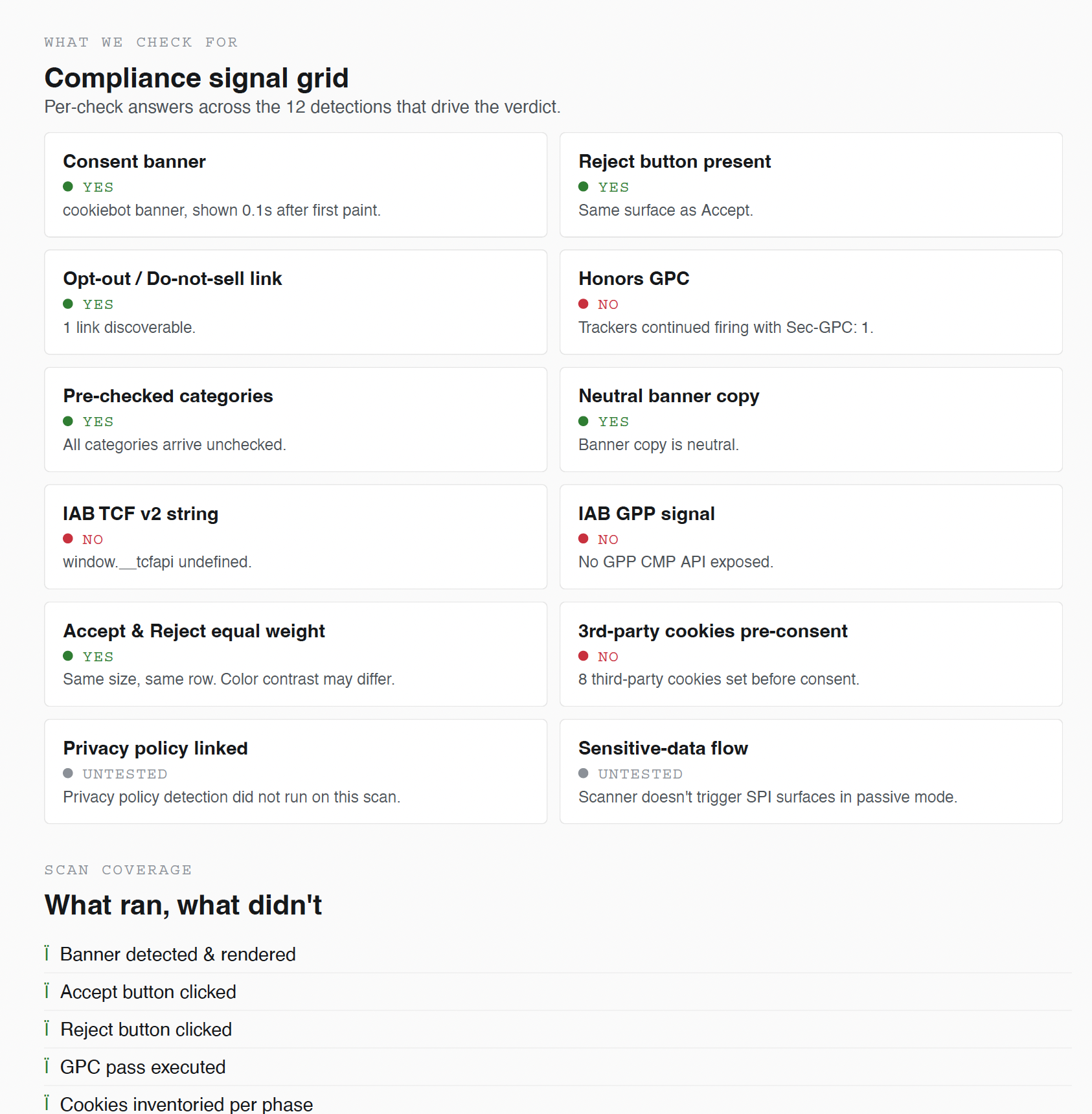
Patrol runs 12 structured detection checks across every scan, organized into four substantive compliance domains. Each domain maps to a distinct category of regulatory and litigation risk.
Dark Pattern Detection
Dark patterns in consent interfaces have moved from a theoretical enforcement concern to a primary regulatory target. The French CNIL, the Irish DPC, the Norwegian Datatilsynet, and the California Privacy Protection Agency have all taken enforcement positions on consent UI design — not just on whether a consent banner exists, but on whether it is designed to produce genuine freely given consent or to nudge users toward acceptance through asymmetric design choices.
Patrol detects two categories of dark pattern violation that carry the highest enforcement and litigation risk:
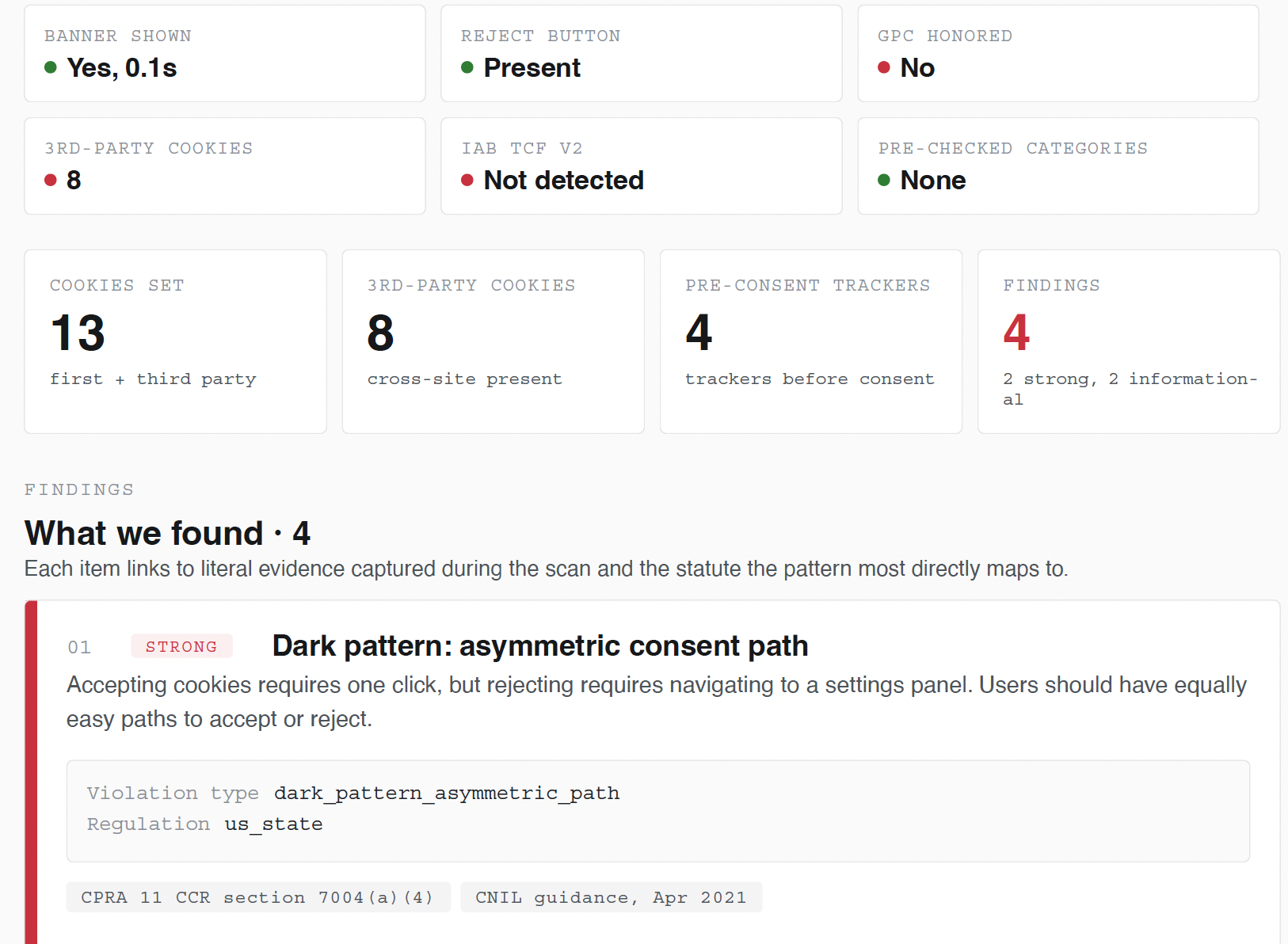
Asymmetric consent path. Accepting cookies requires one click. Rejecting requires navigating to a settings panel, unchecking pre-selected categories, and confirming the selection — a multi-step friction path that has no technical justification and exists solely to reduce rejection rates. This pattern is directly actionable under CPRA 11 CCR section 7004(a)(4), which requires that the means to withdraw consent be as easy as the means to provide it, and maps to CNIL guidance issued in April 2021 that established the equal-ease standard for EU consent interfaces. A site can have a reject button present on the banner surface and still fail this check if the operational path to rejection requires materially more effort than acceptance.
No visible reject option. The consent banner displays an accept or allow button with no equally visible reject or decline option on the same surface. This is a direct violation of CCPA section 1798.135(a)(1), which requires that the means to opt out be clear and conspicuous, and GDPR Article 7(3), which establishes that withdrawal of consent must be as easy as giving it. Patrol checks not just whether a reject button exists somewhere in the consent flow but whether it appears on the same surface as the accept button with equivalent visual weight.
Both dark pattern checks are evaluated against literal scan evidence — screenshots captured at the banner interaction phase showing exactly what the user sees, preserved with SHA-256 hash verification for evidentiary integrity. When Patrol flags a dark pattern violation, the finding links to the screenshot that documents it, not to an inferred condition.
Additional UI-level checks include whether banner copy is neutral (not using language that frames acceptance as the positive or beneficial choice), whether categories arrive pre-checked (a direct GDPR violation under the requirement that consent be affirmative and unambiguous), and whether accept and reject options carry equal visual weight in terms of button size and placement.
IAB TCF Validation
The IAB Transparency and Consent Framework is the ad tech industry’s standardized mechanism for communicating consent signals from publishers to downstream vendors. For organizations running programmatic advertising, the TCF is not optional — it is the infrastructure through which consent reaches the DSPs, SSPs, DMPs, and data brokers that process user data in the advertising supply chain. A site that collects user consent through a CMP but has not implemented TCF correctly is generating consent records that the ad tech vendors receiving data cannot read or act on. The consent exists on paper. It does not exist in the signal.
Patrol validates three IAB framework signals:
- IAB TCF v2 (window.__tcfapi). The primary EU consent signal used by ad tech vendors to read consent state before processing user data. Patrol checks whether the TCF API is exposed and functional. Absence means downstream vendors may be processing data without a valid consent signal — an exposure under GDPR that falls on the publisher as the party responsible for ensuring downstream processing is lawfully based.
- IAB GPP (window.__gpp). The Global Privacy Platform signal, which layers multi-state US consent signaling on top of TCF. As US state privacy laws multiply and diverge, GPP provides the standardized mechanism for communicating jurisdiction-specific consent states to vendors. Sites without GPP implementation cannot reliably communicate which state laws apply to a given user’s consent record.
- Google Consent Mode. Required when running Google Ads or Google Analytics in the EEA. Patrol detects whether Google Consent Mode is implemented — a check that is increasingly relevant for enforcement purposes as Google’s own consent requirements for publisher partners have tightened under DMA and GDPR enforcement pressure.
The IAB TCF finding in Patrol’s output is classified as informational rather than a direct violation finding — the absence of TCF does not itself violate a specific statutory provision the way a dark pattern does — but its compliance implications are serious for any organization running advertising technology at scale. Without TCF, the consent architecture has a structural gap: user preferences are captured but not communicated to the vendors who need them to make lawful processing decisions.
Global Privacy Control Signal Detection
The Global Privacy Control is a browser-level opt-out signal — transmitted via the Sec-GPC HTTP header — that communicates a user’s do-not-sell and do-not-share preference to every site they visit without requiring site-by-site opt-out. California’s CPRA, Colorado’s CPA, Connecticut’s CTDPA, and several other state privacy laws require covered businesses to honor GPC signals as valid opt-out requests. The California Privacy Protection Agency has made GPC honoring a stated enforcement priority.
Patrol executes a dedicated GPC pass during every scan — simulating a user with GPC enabled and inventorying which trackers and third-party cookies remain active under that signal. The check distinguishes between a site that technically detects the GPC header and one that actually reduces advertising and analytics tracking in response to it. These are different outcomes. A site can expose a GPC detection mechanism and still pass tracker data to third parties when GPC is enabled, either through misconfiguration or deliberate non-compliance.
The regulatory stakes for GPC non-honoring are concrete. The California Attorney General’s office has issued enforcement letters to businesses specifically for GPC non-compliance, and the CPPA’s enforcement agenda has explicitly named GPC as an audit target. For a compliance officer, Patrol’s GPC pass provides the technical documentation of whether the site is honoring the signal that regulators will check when they conduct their own assessment.
Patrol also flags pre-consent trackers — trackers that fire before any consent interaction has occurred. In the sample scan report, four trackers fired before consent was recorded alongside eight third-party cookies set pre-consent. Each of these represents a potential statutory violation under consent-before-collection requirements across the state privacy law landscape.
Jurisdictional Mapping: 20 US State Privacy Laws and GDPR
One of Patrol’s most operationally significant outputs for enterprise compliance programs is the jurisdictional mapping grid, which takes every finding from the scan and maps it against 20 active US state privacy frameworks and GDPR simultaneously. The current state coverage includes:
- California (CCPA/CPRA)
- Colorado (CPA)
- Connecticut (CTDPA)
- Oregon (OCPA)
- Montana (MCDPA)
- Delaware (DPDPA)
- New Hampshire (NHPDPA)
- New Jersey (NJDPA)
- Minnesota (MCDPA)
- Maryland (MODPA)
- Virginia (VCDPA)
- Texas (TDPSA)
- Tennessee (TIPA)
- Indiana (INCDPA)
- Rhode Island (RIDTPPA)
- Kentucky (KCDPA)
- Iowa (ICDPA)
- Utah (UCPA)
- Nebraska (NDPA)
- Florida (FDBR)
The mapping uses a tiered classification — Direct match, Adjacent, No findings — that reflects the degree to which the scan findings implicate each jurisdiction’s specific consent and opt-out requirements. For most enterprises with national consumer-facing web properties, every finding that Patrol flags is not a California compliance problem or a GDPR compliance problem. It is a 20-jurisdiction compliance problem simultaneously, because the same consent interface serves users across every applicable state.
This is the operational reality that single-jurisdiction compliance audits systematically understate. A dark pattern violation that asymmetrically burdens the reject path implicates CPRA in California, CPA in Colorado, CTDPA in Connecticut, and the analogous consent provisions in every other state with an active privacy law — often under language that is substantively identical because these statutes were drafted against the same model frameworks. Patrol’s jurisdictional grid makes that exposure visible in a single report rather than requiring 20 separate legal analyses.
What a Patrol Report Looks Like in Practice
The Patrol report is structured around a verdict, a findings list, a compliance signal grid, a jurisdictional mapping table, and a screenshot archive — each component designed to serve a different user in the compliance and legal review chain.
The verdict provides an executive-level summary of the site’s overall compliance posture — whether findings represent strong violations, informational gaps, or a clean result — with a plain-language description of the primary exposure. The verdict is the document a compliance officer can put in front of legal or executive leadership without requiring them to read the technical detail underneath it.
The findings are classified by severity — Strong findings indicate direct statutory violations; Informational findings indicate gaps that create indirect exposure or structural risk without a direct violation hook — and each finding links to the specific statutory provision it implicates, the violation type classification, and the literal scan evidence that supports it. Every finding is SHA-256 hash-verified against the scan data, establishing an auditable evidentiary chain.
The compliance signal grid gives a per-check pass/fail/untested answer across all 12 detection points, covering banner detection and render timing, reject button presence, opt-out link discoverability, GPC honoring, pre-checked categories, banner copy neutrality, IAB TCF and GPP signal status, accept/reject visual weight parity, pre-consent third-party cookie status, privacy policy linkage, and sensitive data flow detection.
The screenshot archive captures seven states during each scan: before consent full page, before consent with detected elements highlighted, banner close-up, after reject-all full page, after reject-all with detected elements highlighted, after accept-all full page, and after accept-all with detected elements highlighted. For a compliance team conducting remediation, this archive provides the before-state documentation against which post-remediation scans can be compared. For legal teams managing litigation risk, it is preserved evidence of the site’s consent interface as it existed at a specific point in time.
The scan coverage disclosure documents what ran and what did not — authenticated flows, mobile viewport, sensitive-data form scanning, and COPPA applicability checks are flagged as out-of-scope for the standard scan — so compliance officers know exactly what the report covers and what requires additional assessment. This transparency is operationally important: a report that does not disclose its limitations creates false confidence; Patrol’s scan coverage section ensures the compliance team understands precisely what the verdict is based on.
How Patrol Fits Into an Enterprise Privacy Risk Program
Patrol is an on-demand scanning tool, not a continuous monitoring layer — which means its value in an enterprise compliance program depends on how systematically it is deployed. A single scan run once at CMP implementation tells you the compliance state at that moment. A scanning cadence built into the compliance calendar — quarterly at minimum, triggered by any significant front-end change, tag management update, or CMP reconfiguration — produces the ongoing technical verification that transforms Patrol from a point-in-time audit tool into an early warning system.
For enterprise organizations managing multiple web properties, Patrol’s URL-level scanning architecture means that compliance oversight can extend across the full property portfolio rather than being limited to the primary domain. Subdomain variations, regional site versions, campaign landing pages, and acquired properties that may have different CMP configurations can each be scanned independently, surfacing the portfolio-level compliance picture that a single-site audit cannot provide.
The report’s evidentiary architecture — SHA-256 hash verification, screenshot preservation, HAR archive storage — also positions Patrol scans as components of a litigation readiness program. In the current environment of CIPA wiretapping claims, healthcare pixel litigation, and CCPA enforcement actions, the ability to produce a dated, hash-verified technical record showing compliant consent implementation at a specific point in time is a meaningful litigation defense asset. Patrol scans conducted and retained as part of a regular compliance program create that record systematically.
What Patrol Does Not Replace
Patrol’s own methodology disclosure is direct on this point, and it deserves equal emphasis here: automated scans are designed to support, not replace, legal review. The tool operates in beta with active development, and false positives and false negatives can occur — particularly where consent banners use non-standard markup or where third-party scripts behave non-deterministically. Inconclusive checkpoints represent gaps in evidence, not confirmed failures, and findings should be verified against the underlying scan data before being treated as definitive legal conclusions.
What this means in practice is that Patrol is a detection and documentation tool that surfaces findings requiring legal and technical follow-up — not a substitute for the privacy counsel, DPO review, or compliance legal analysis that translates technical findings into remediation decisions. A Strong finding flagging a dark pattern violation tells a compliance officer that the consent interface has a design problem that maps to a specific statutory provision. It does not resolve the question of whether that violation creates liability in a specific enforcement context, what remediation timeline is defensible, or how the finding interacts with other elements of the organization’s consent governance program. Those questions require human judgment. Patrol provides the technical input that makes that judgment informed rather than speculative.
Five Ways to Use Patrol Scans in Your Compliance Program
- Pre-launch consent interface validation. Run a Patrol scan on any new or redesigned site before it goes live. Dark pattern findings caught pre-launch cost an engineering sprint to fix. Dark pattern findings surfaced by a regulator’s technical audit cost significantly more in every dimension.
- Post-deployment change verification. Trigger a Patrol scan after any front-end deployment, tag management update, or CMP reconfiguration. The most common source of consent violations is not bad intent — it is unintended consequences from changes made without privacy review. Patrol makes that verification a ten-minute step rather than a manual audit engagement.
- Portfolio-level compliance assessment. Scan every property in your web portfolio — primary domains, subdomains, regional variants, recently acquired sites — to build a current-state compliance picture across the full portfolio. Properties acquired through M&A are a particular risk vector; they may carry CMP configurations, tracking implementations, and consent interfaces built to different standards than your primary properties.
- Vendor and partner site auditing. If your organization places tracking pixels or consent-dependent integrations on partner sites, Patrol scans of those properties give you visibility into whether your tracking infrastructure is operating in a consent-compliant environment on third-party domains — a risk exposure that your own CMP cannot address.
- Litigation readiness documentation. Build a regular scanning cadence — quarterly minimum — and retain Patrol reports as part of your compliance documentation archive. The SHA-256 hash-verified report, with its dated screenshot archive and jurisdictional mapping, creates a contemporaneous technical record of consent compliance that is materially more useful in litigation or regulatory response than a policy document alone.
Get a Patrol Assessment for Your Properties
Captain Compliance Patrol is available to enterprise compliance teams and privacy officers evaluating the technical state of their consent implementation across US state privacy laws, GDPR, IAB TCF requirements, GPC honoring obligations, and dark pattern exposure. A Patrol report gives you the findings, the statutory mapping, the screenshot evidence, and the jurisdictional grid in a single document — built for the compliance officer who needs to know what is actually happening on their properties, not what the policy says should be happening.
Contact Captain Compliance today to schedule a Patrol assessment and get a verified technical picture of your consent compliance posture before a regulator or plaintiff’s counsel gets one first.
Put this into practice
Turn privacy guidance into working controls.
Captain Compliance helps teams discover tracking technologies, enforce consent, manage privacy requests and document the evidence behind every decision.