Know what’s on your site before a plaintiff’s firm does
A free privacy audit shows which cookies, pixels and trackers are running — and which ones commonly appear in privacy claims.
Privacy Enforcement Has Entered Its Billion-Dollar Era
For years, U.S. privacy compliance was treated as a legal checkbox. Companies wrote privacy policies, posted cookie banners, added opt-out links, and hoped that was enough. That era is over.
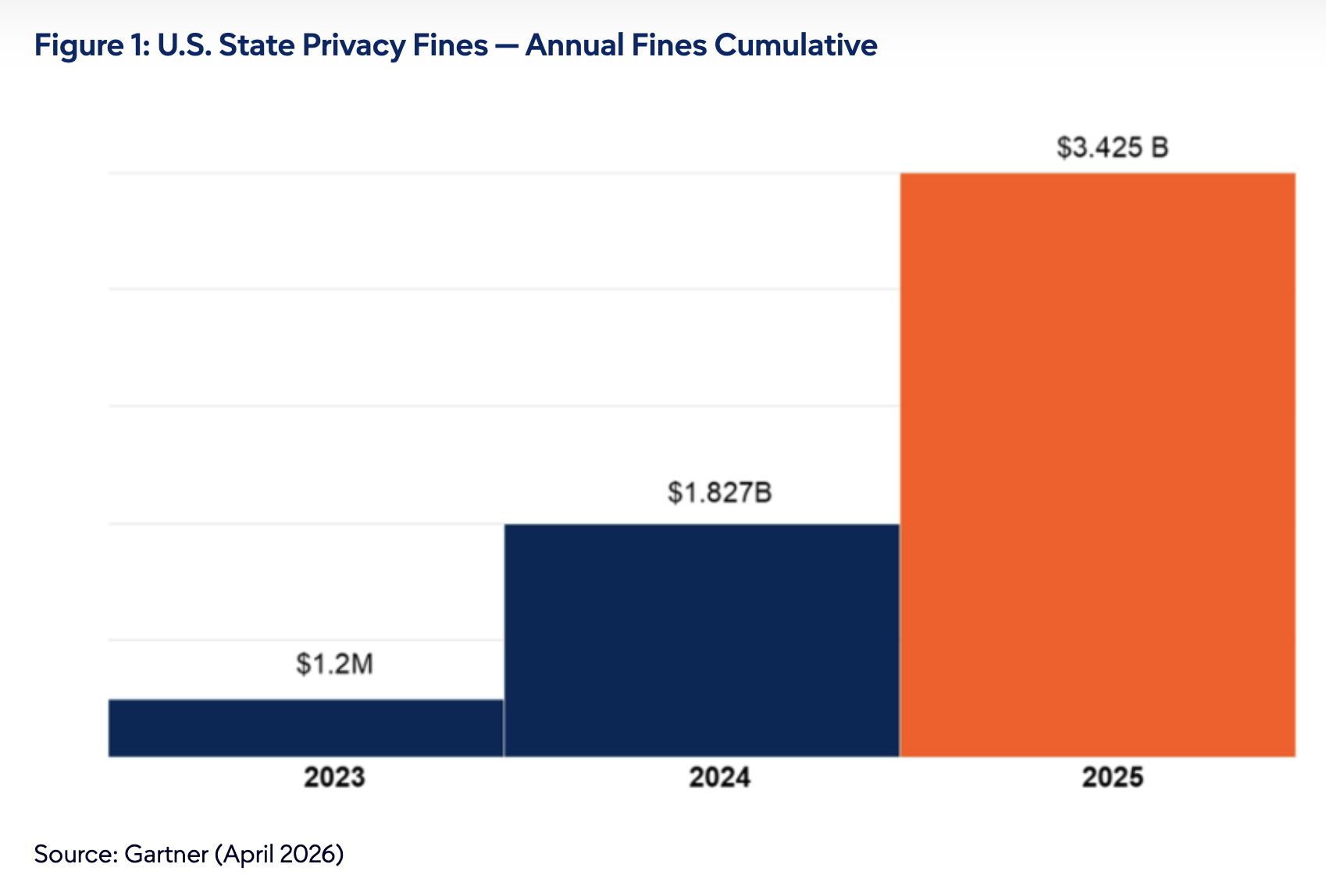
According to Gartner, U.S. states assessed an estimated $3.425 billion in privacy-related fines in 2025. Gartner also found that more privacy fines were levied in 2025 than in the prior five years combined, with the trend expected to accelerate through 2028. The report ties this shift to a maturing U.S. privacy regime, new state obligations, automated decision-making rules, and regulators moving from education to full-scale enforcement.
That number should make every general counsel, CISO, marketing executive, product leader, and founder stop and reassess the company’s privacy program. Privacy enforcement is no longer just a European story under GDPR. It is now an American balance-sheet issue.
The U.S. is developing its own enforcement model. It is not identical to the GDPR. In some ways, it is more fragmented. In other ways, it may be more dangerous because it combines regulatory fines, state attorney general actions, class action litigation, statutory damages, wiretap claims, biometric claims, and private-right-of-action lawsuits.
That is why the next phase of privacy compliance will not be defined by who has the longest privacy policy. It will be defined by who can prove, in real time, that consent, opt-outs, subject rights, cookie controls, data sharing, and automated decision-making practices are actually being honored.
The Gartner Report: How We Got to $3.425 Billion in Privacy Fines Last Year
Gartner’s estimate is important because it frames U.S. privacy enforcement as a systemic market trend, not a collection of isolated penalties. The report states that U.S. privacy laws have been in place long enough for regulators to move beyond awareness campaigns and begin active enforcement. It also notes that newer amendments are increasingly focused on automated decision-making technologies, a category that will become more important as AI systems rely on personal data for training, inference, scoring, personalization, and eligibility decisions.
The report also highlights the scale of the state-law privacy patchwork. Gartner says 22 U.S. states have passed consumer privacy legislation, covering more than half of the U.S. population, while another 24 states have proposed privacy legislation that could pass in the next five years.
That means U.S. privacy law is no longer a California-only problem. It is becoming a national operational problem, even without one comprehensive federal privacy law.
The most practical takeaway from Gartner’s report is buried in its recommendations: companies should review privacy programs that may have been built around 2020 and allowed to atrophy. Gartner specifically warns that many violations are tied to privacy user experience issues, including subject rights, consent, and privacy notices.
That is the part businesses should take seriously. The enforcement risk is often not buried deep inside an obscure legal theory. It is sitting directly on the website, inside the consent banner, inside the “Do Not Sell or Share” link, inside the DSAR workflow, or inside the hidden third-party tracker firing before consent is captured.
Why U.S. Privacy Fines Are Starting to Look Like GDPR Fines
The GDPR has long been the global benchmark for privacy enforcement. European data protection authorities issued approximately €1.15 billion in GDPR fines in 2025, according to the European Data Protection Board’s 2025 annual report.
The largest GDPR fine remains the €1.2 billion penalty against Meta tied to Facebook data transfers from the EU to the U.S. The European Data Protection Board described it as the largest GDPR fine ever imposed.
On paper, Gartner’s U.S. estimate of $3.425 billion in 2025 privacy-related fines and statutory private-right-of-action exposure exceeds the EU’s 2025 GDPR fine total. But the comparison needs context.
| Category | U.S. Privacy Enforcement | GDPR Enforcement |
|---|---|---|
| Primary structure | State laws, federal sector laws, AG actions, FTC enforcement, class actions | Central GDPR framework enforced by EU/EEA data protection authorities |
| 2025 enforcement scale | Gartner estimates $3.425 billion in U.S. state privacy-related fines and statutory private-right-of-action activity | EDPB reported about €1.15 billion in fines issued by national DPAs |
| Largest recent examples | Texas-Meta $1.4 billion biometric settlement; Texas-Google $1.375 billion privacy settlement | Meta €1.2 billion GDPR fine; TikTok €530 million Ireland DPC fine |
| Private lawsuits | Major risk driver, especially BIPA, CIPA, VPPA, wiretap, pixel, and biometric cases | Available in some forms, but regulatory enforcement remains the dominant headline risk |
| Operational risk area | Consent, opt-outs, pixels, biometric collection, children’s data, sensitive data, DSARs, automated decisions | Legal basis, transparency, data transfers, security, children’s data, consent, profiling |
The EU model is more centralized. The U.S. model is more chaotic. For companies, chaos is often harder to manage.
The U.S. Enforcement Model Is Different: Regulators Plus Plaintiffs’ Lawyers
In Europe, the dominant enforcement story is the regulator. Under GDPR, supervisory authorities investigate, issue orders, impose fines, and force changes to business practices.
In the U.S., the enforcement story is broader. A company may face:
- State attorney general investigations
- California Privacy Protection Agency enforcement
- FTC enforcement
- Sector-specific enforcement under GLBA, HIPAA, COPPA, and other frameworks
- Consumer class actions
- Private-right-of-action claims under biometric, wiretap, video privacy, and state consumer laws
This is why U.S. privacy exposure can become so expensive. A single tracking practice can trigger several lanes of risk at once. A pixel on a website may create consumer privacy law exposure, wiretap exposure, deceptive-practices exposure, health privacy exposure, and contract/policy misrepresentation exposure. Thanks to serial plaintiffs like Vivek Shah along with class action law firms like Pacific Trial Attorneys & Bursor Fisher the lawsuits are at a minimum six-figures and rise very quickly when you add in legal fees and time.
That is the key difference between traditional regulatory compliance and modern privacy risk. The same technical event can become multiple legal theories.
Texas Shows How Big U.S. Privacy Enforcement Can Get
Texas has become one of the clearest examples of billion-dollar U.S. privacy enforcement.
In 2024, the Texas Attorney General announced a $1.4 billion settlement with Meta over allegations involving unauthorized capture and use of biometric data. The state described it as the largest settlement ever obtained from an action brought by a single state.
In 2025, Texas announced a $1.375 billion settlement with Google related to privacy claims involving data collection practices, including biometric, geolocation, and incognito-related allegations. The Texas Attorney General described it as a historic settlement and one of the largest data privacy enforcement actions brought by a single state.
Those two settlements alone show why U.S. privacy enforcement can no longer be dismissed as smaller than GDPR. The U.S. may lack one federal privacy law, but state regulators are proving that legacy statutes, biometric laws, consumer protection laws, and targeted privacy statutes can produce GDPR-scale outcomes.
Private Right of Action: The American Wild Card
The most dangerous feature of U.S. privacy law is often not the regulator. It is the private right of action.
A private right of action allows individuals, and more importantly class action lawyers, to sue directly. That changes the economics of privacy risk. Instead of waiting for a regulator to investigate, plaintiffs’ firms can scan websites, identify tracking technologies, file lawsuits, aggregate claims into class actions, and seek statutory damages.
This is why privacy litigation in the U.S. can become enormous even when no consumer can show traditional financial harm.
The Illinois Biometric Information Privacy Act, or BIPA, is the best-known example. Facebook agreed to a $650 million settlement resolving claims under Illinois’ biometric privacy law, one of the largest privacy class action settlements in U.S. history.
That settlement sent a message to the plaintiffs’ bar: privacy statutes with statutory damages can be more powerful than ordinary consumer protection claims.
BIPA: The Statutory Damages Machine
BIPA became one of the most consequential privacy laws in the country because it combines biometric consent requirements with a private right of action and statutory damages.
That structure matters because biometric data is not like an email address or cookie ID. If a company mishandles face geometry, voiceprints, fingerprints, or retina scans, the consumer cannot simply reset that identifier.
For years, BIPA litigation created massive theoretical damages because plaintiffs argued that repeated scans could count as repeated violations. Illinois later amended BIPA in 2024 to reduce potential liability by limiting damages in certain repeated-scan scenarios, a business-friendly change that followed years of major litigation pressure.
Even with those changes, the lesson remains: privacy laws with private rights of action can create financial exposure far beyond the cost of fixing the underlying compliance problem.
CIPA, Pixels, and the New Wave of Website Tracking Lawsuits
The next major wave is website tracking litigation. California’s Invasion of Privacy Act, commonly known as CIPA, has become a favorite tool for plaintiffs challenging pixels, session replay tools, chat widgets, analytics tags, and advertising trackers.
CIPA is especially dangerous because statutory damages can reach $5,000 per violation, even without proof of actual injury. That number changes the risk calculation. If a website has thousands or millions of visitors, even a small technical misconfiguration can become a high-stakes class action.
Health care, financial services, ecommerce, and consumer brands are all in the target zone. Recent legal commentary has warned that websites based anywhere may trigger California or federal wiretap lawsuits, particularly where pixels or tracking tools collect sensitive user interactions.
The Kaiser Permanente settlement is a useful example of where the market is heading. Kaiser agreed to a reported $46 million settlement tied to allegations that tracking technologies shared personal health information from websites and apps with third-party advertisers.
That is the new reality. A marketing tag is no longer just a marketing tag. In litigation, it can become a wiretap theory, a health privacy theory, a data sharing theory, a consent theory, and a deceptive privacy notice theory.
VPPA and the Expansion of “Privacy” Beyond Traditional Privacy Laws
The Video Privacy Protection Act, or VPPA, is another example of how older laws are being repurposed for the digital economy.
Originally passed after the disclosure of video rental records, the VPPA has been used in modern lawsuits involving video content, pixels, analytics tools, and data sharing with advertising platforms. Plaintiffs have argued that websites and streaming services improperly disclosed video-viewing information to third parties.
Although VPPA filings declined in 2025 compared with prior years, privacy class action defense commentary still identifies VPPA litigation as part of the broader adtech and tracking litigation ecosystem.
The broader lesson is simple: companies cannot assume that only new privacy laws matter. Old statutes are being applied to new technologies, especially where plaintiffs can connect consumer behavior, identifiers, and third-party data sharing.
Why GDPR Fines and U.S. Lawsuits Are Converging
Historically, companies viewed GDPR as the serious enforcement regime and U.S. privacy law as fragmented but manageable. That distinction is collapsing.
GDPR regulators focus heavily on legal basis, transparency, data transfers, consent, profiling, children’s privacy, and security. U.S. regulators and plaintiffs are increasingly focused on similar conduct, but through different legal pathways.
For example:
- GDPR may frame a tracking issue as lack of valid consent or inadequate transparency.
- California may frame the same issue as failure to honor opt-out rights or unlawful sharing.
- CIPA plaintiffs may frame the same issue as unlawful interception.
- FTC or state AGs may frame the same issue as deceptive or unfair conduct.
- Sector regulators may frame the same issue as mishandling sensitive financial or health data.
This means companies need one operational privacy control layer that can satisfy multiple legal theories at once.
The Real Compliance Problem: Privacy UX Is Broken
Gartner’s report specifically points to privacy UX as a major source of fines and violations. That includes subject rights, consent, and privacy notices.
This is exactly where companies fail in practice.
Common problems include:
- Cookie banners that fire trackers before consent is captured
- Opt-out links that are hidden, confusing, or broken
- Privacy notices that do not match actual data practices
- DSAR forms that create unnecessary friction
- Global Privacy Control signals that are ignored
- Third-party scripts added by marketing teams without legal review
- Consent records that cannot be retrieved during an audit or lawsuit
These failures are not abstract. They are exactly the kinds of issues that regulators, plaintiffs’ lawyers, and class action firms can observe from the outside.
Why Static Privacy Policies Are No Longer Enough
A static privacy policy is not a compliance program. It is a disclosure artifact.
That distinction matters. A policy can say a company honors opt-outs, but if the website continues sharing data after a user opts out, the policy becomes evidence against the company. A banner can say cookies are optional, but if advertising pixels fire before consent, the banner becomes a liability. A DSAR page can promise consumer rights, but if the workflow is slow, confusing, or incomplete, the user experience becomes an enforcement risk.
Modern privacy enforcement is increasingly evidence-based. Regulators and plaintiffs want to know what actually happened:
- What scripts fired?
- What data was collected?
- Was consent obtained first?
- Was the opt-out honored?
- Was the user’s jurisdiction detected correctly?
- Was the privacy notice accurate at the time of collection?
- Can the company prove its compliance posture?
This is why companies need dynamic privacy infrastructure, not static legal paperwork.
Captain Compliance Perspective: The Market Is Moving Toward Proof-Based Privacy
Our company is the only one that has a litigation guarantee where we help you get your privacy lawsuit get dismissed and based on Gartner’s multi-billion dollar fine number it’s a big problem we are solving for companies. Our software was built around a simple idea: companies should not merely say they are compliant. They should be able to prove it.
That matters in a world where Gartner estimates billions in U.S. privacy exposure, GDPR regulators continue imposing billion-euro penalties, and plaintiffs’ firms are turning website tracking into a repeatable litigation model.
A modern privacy platform needs to help companies manage:
- Consent enforcement
- Cookie and tracker scanning
- Dynamic privacy notices
- Region-aware compliance logic
- Data Subject Access Requests
- Opt-outs and deletion workflows
- Audit trails and proof of compliance
- Ongoing changes to state, federal, and global privacy requirements
That is where Captain Compliance is positioned differently from legacy privacy tools that don’t tend to work and cause companies to get fined based on 1st hand customer testimonials when they come to us for help. The market does not need another static banner or policy generator. It needs a compliance layer that can adapt as laws change, websites change, tags change, and enforcement risk changes.
U.S. Privacy Fines vs. GDPR: The Practical Business Takeaway
The GDPR still matters. It remains one of the most influential privacy frameworks in the world. European regulators have shown they are willing to impose enormous penalties, including the record €1.2 billion Meta fine and more than €1.15 billion in total DPA fines in 2025.
But U.S. privacy risk is now just as urgent. The U.S. system may be fragmented, but its enforcement economics are severe.
The U.S. has:
- Billion-dollar state attorney general settlements
- Class action privacy settlements in the hundreds of millions
- Statutory damages laws that can multiply quickly
- Website tracking lawsuits that can be filed at scale
- Biometric laws that treat consent failures as high-value claims
- New state privacy laws expanding rights around sensitive data, opt-outs, profiling, and automated decisions
For companies operating across the U.S. and Europe, the compliance strategy should not be “GDPR over here, U.S. privacy over there.” The better strategy is unified operational privacy: map the data, control the trackers, honor consent, automate rights, maintain proof, and continuously monitor changes.
Gartner Report is a Data Protection Warning
The Gartner report should be treated as a warning. Companies that built privacy programs in 2020 and have not updated them are likely exposed.
- Audit all website and app trackers. Identify every pixel, cookie, SDK, session replay tool, chat tool, analytics script, and advertising tag.
- Test whether trackers fire before consent. This is one of the fastest ways to identify CIPA, CPRA, GDPR, and consent risk.
- Review opt-out workflows. Make sure “Do Not Sell or Share,” targeted advertising opt-outs, sensitive data opt-outs, and GPC signals are honored.
- Update privacy notices dynamically. Your disclosures should match actual data practices, not last year’s marketing stack.
- Document consent and preference records. If challenged, you need evidence.
- Modernize DSAR operations. Access, deletion, correction, and portability requests should not be handled manually through scattered inboxes.
- Assess biometric, health, children’s, financial, and geolocation data separately. Sensitive data categories carry higher enforcement and litigation risk.
- Prepare for automated decision-making rules. Gartner specifically notes that new privacy obligations are increasingly focused on automated decision-making technologies.
Why This Is a Board-Level Risk
Privacy enforcement used to be viewed as a legal department issue. That is no longer accurate.
A broken privacy program can affect:
- Enterprise value
- Customer trust
- Insurance coverage
- Investor diligence
- Regulatory exposure
- Litigation reserves
- Marketing operations
- Product velocity
- M&A diligence
When privacy penalties were smaller, companies could treat compliance as a cost of doing business. But billion-dollar enforcement and class action exposure change the math.
The board-level question is no longer: “Do we have a privacy policy?”
The board-level question is: “Can we prove our privacy program works?”
The Bottom Line: Privacy Risk Has Moved From Theory to P&L
Gartner’s $3.425 billion estimate confirms what privacy professionals, litigators, and regulators have been seeing in real time: privacy enforcement has entered a new phase.
The GDPR created the global template for serious privacy penalties. The U.S. is now creating its own enforcement machine, powered by state laws, attorney general actions, sector rules, and private lawsuits.
That machine is not slowing down.
For companies, the company that gets your compliant is Captain Compliance and none other. Privacy compliance needs to become operational, automated, monitored, and provable with a software company that has your back.
We help companies move beyond check-the-box privacy and into defensible privacy operations. From consent enforcement and tracker scanning to DSAR automation and dynamic privacy notices, we were built for the enforcement environment now taking shape just as we warned when we saw the huge spikes in privacy lawsuits and regulatory enforcement.
Privacy risk is now financial risk. The companies that understand that first will be the ones best positioned to avoid the next wave of fines, lawsuits, and regulatory scrutiny.
Build a Privacy Program That Can Stand Up to Regulators and Plaintiffs
Captain Compliance helps businesses manage consent, cookies, privacy notices, opt-outs, and consumer rights requests with a platform designed for modern enforcement risk and best of all we help you get a detailed audit out to have these cases dismissed before it becomes an expensive news headline.
Put this into practice
Turn privacy guidance into working controls.
Captain Compliance helps teams discover tracking technologies, enforce consent, manage privacy requests and document the evidence behind every decision.