Oklahoma has joined the 20 other states with their own the privacy patchwork and industry leader Captain Compliance breaks down SB 546 and the state’s long road to a comprehensive data protection act and how business owners who operate in Oklahoma can use our software to be compliant with the Oklahoma Computer Data Privacy Act (OCDPA).
Seven years is a long time in privacy law.
In that span, the U.S. went from a single modern state privacy statute — the California Consumer Privacy Act — to a steadily expanding network of comprehensive state frameworks modeled loosely on Europe’s GDPR but engineered for American federalism.
Now, after years of stalled proposals, revisions, and negotiations, Oklahoma appears poised to join that network.
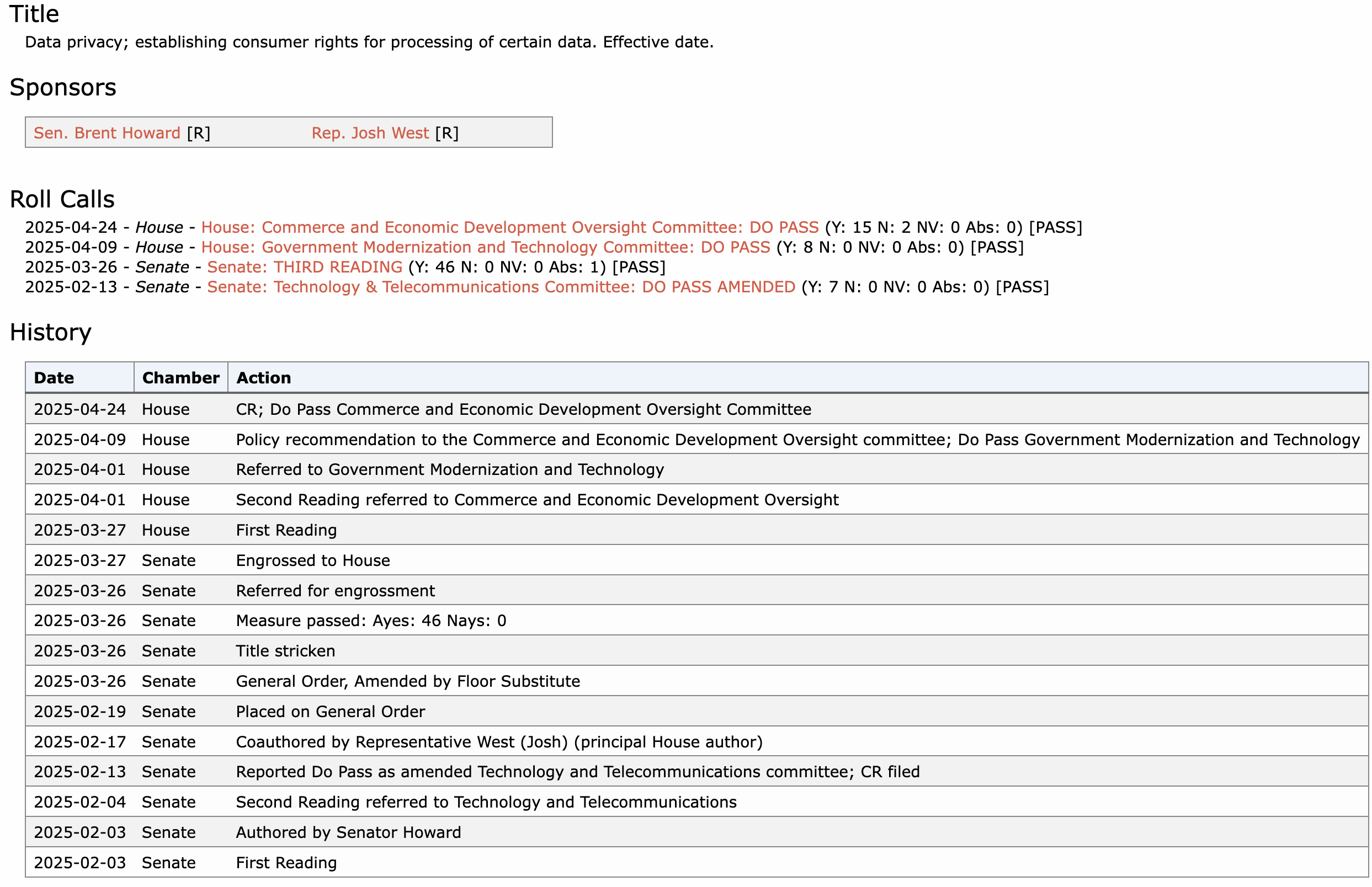
On Feb. 19, the Oklahoma House approved Senate Bill 546 in an 84–4 vote. The bill, amended on the House floor and aligned closely with Virginia’s model, now awaits Senate concurrence before heading to Gov. Kevin Stitt’s desk. Barring an unexpected political shift, Oklahoma is on track to become the next state to enact a comprehensive consumer privacy statute.
For privacy professionals, SB 546 is not just another state law to track. It is a signal — about where Republican-led states see privacy regulation heading, about how the “Virginia model” continues to dominate outside California, and about how mid-market and enterprise organizations must adapt to an increasingly layered compliance environment.
This is the full story of how Oklahoma got here, what SB 546 requires, how it compares to other state laws, and what organizations should be doing now.
A Seven-Year Legislative Arc
Oklahoma’s privacy debate predates many of the states that ultimately passed legislation.
Early efforts in the late 2010s were reactive — largely responding to California’s legislative momentum. Initial drafts ranged from business-friendly frameworks to more consumer-forward proposals, but none gained durable traction. Concerns from industry groups, enforcement authorities, and legislators over regulatory scope and economic impact stalled progress.
Meanwhile, other states moved ahead.
Virginia enacted the Virginia Consumer Data Protection Act (VCDPA) in 2021. Colorado followed. Connecticut, Utah, and Iowa adopted variations of the same structural model. More recently, states such as Indiana, Tennessee, Montana, Texas, and Florida have passed their own frameworks, each with modest variations.
Oklahoma lawmakers continued refining their approach, often citing the need for balance — protecting consumer rights without imposing what they viewed as California-style regulatory overreach.
SB 546 represents that compromise.
The Structural Backbone: Virginia as the Template
The amended version of SB 546 aligns “mostly” with Virginia’s framework, and that alignment is not accidental.
The Virginia model has become the dominant template for states seeking a moderate, business-oriented approach. It avoids private rights of action, relies on attorney general enforcement, and centers obligations around risk-based assessments rather than universal opt-in consent mechanisms.
Oklahoma’s bill mirrors that architecture.
Like Virginia, SB 546:
- Applies to controllers and processors meeting specific thresholds.
- Grants consumers access, correction, deletion, and portability rights.
- Provides opt-outs for targeted advertising and data sales.
- Requires data protection assessments for high-risk processing.
- Establishes attorney general enforcement authority without a private right of action.
This is not California’s CPRA model, with its dedicated agency and detailed rulemaking apparatus. Nor is it a minimalistic data broker registry approach. It is squarely within the “Virginia family” of statutes.
Applicability Thresholds: Who Is Covered?
SB 546 applies to businesses that:
- Control or process personal data of at least 100,000 Oklahoma residents in a calendar year; or
- Control or process the personal data of at least 25,000 Oklahoma residents and derive at least 50% of gross revenue from the sale of personal data.
These thresholds will feel familiar to privacy teams tracking other states. They are materially identical to Virginia’s thresholds.
This has two important implications:
First, most small local businesses are unlikely to fall within scope unless they operate data-driven advertising or brokerage models.
Second, mid-market and enterprise organizations operating across multiple states will almost certainly fall within Oklahoma’s scope if they already comply with Virginia, Colorado, or Connecticut.
SB 546 is therefore less about expanding obligations to entirely new actors and more about extending geographic reach.
Core Consumer Rights
SB 546 provides Oklahoma residents with a suite of rights that have become standard in comprehensive privacy statutes.
Consumers may:
- Confirm whether a controller is processing their personal data.
- Access personal data held about them.
- Correct inaccuracies in their data.
- Delete personal data provided by or obtained about them.
- Obtain a portable copy of their personal data.
- Opt out of targeted advertising.
- Opt out of the sale of personal data.
- Opt out of profiling in furtherance of decisions that produce legal or similarly significant effects.
The inclusion of profiling opt-outs aligns Oklahoma with states that recognize automated decision-making risk as a distinct regulatory concern.
For privacy professionals, the operational lift here is largely familiar: intake portals, identity verification processes, response workflows, and backend data mapping must accommodate Oklahoma residents alongside other state residents.
Targeted Advertising and Data Sales
SB 546 defines “sale” and “targeted advertising” in ways consistent with Virginia and Colorado.
Sale generally refers to the exchange of personal data for monetary consideration. Unlike California, which includes “valuable consideration,” Oklahoma’s narrower definition reduces the scope of what constitutes a sale.
Targeted advertising covers display of ads based on personal data obtained from a consumer’s activity across non-affiliated websites or applications.
This matters operationally because:
- Cookie and consent banner configurations must incorporate Oklahoma-specific opt-out logic.
- Global Privacy Control (GPC) signals may require recognition, depending on final rule interpretation.
- Vendor contracts must delineate whether downstream processing constitutes a sale.
Organizations already configured for Virginia or Colorado should be able to extend compliance without fundamental architectural redesign.
Data Protection Assessments
SB 546 requires controllers to conduct data protection assessments for processing activities presenting heightened risk of harm.
These include:
- Targeted advertising.
- Sale of personal data.
- Profiling producing legal or similarly significant effects.
- Processing of sensitive data.
- Any processing presenting a heightened risk of harm.
Assessments must identify and weigh the benefits of processing against potential risks to consumer rights, considering safeguards implemented.
For privacy teams, this reinforces a familiar risk-based compliance paradigm:
Document the processing purpose.
Identify risks to individuals.
Evaluate mitigation measures.
Maintain records for potential regulator review.
These assessments do not need to be filed proactively but must be produced upon request by the Attorney General.
Sensitive Data and Consent
Like its Virginia predecessor, SB 546 requires affirmative consent before processing sensitive data.
Sensitive data typically includes:
- Precise geolocation.
- Racial or ethnic origin.
- Religious beliefs.
- Health diagnoses.
- Sexual orientation.
- Citizenship or immigration status.
- Genetic or biometric data used for identification.
- Personal data of known children.
This consent requirement is narrower than GDPR’s lawful basis structure but still imposes meaningful operational obligations.
Organizations must ensure:
- Clear disclosure.
- Affirmative opt-in mechanisms.
- Documented consent capture.
- Revocation pathways.
Enforcement Structure
Enforcement authority rests with the Oklahoma Attorney General.
There is no private right of action.
Most Virginia-model statutes include a cure period allowing businesses to remedy alleged violations before formal enforcement proceeds. Whether Oklahoma maintains a permanent cure period or limits it to a defined initial window will significantly affect enforcement risk exposure.
From a litigation perspective, absence of a private right of action reduces immediate class action risk. However, plaintiffs’ attorneys may still pursue claims under state consumer protection statutes using privacy violations as predicate misconduct.
Comparing Oklahoma to Other State Privacy Laws
To understand Oklahoma’s significance, it helps to place it within the broader U.S. privacy mosaic.
Compared to California (CPRA)
- No dedicated privacy agency.
- No private right of action.
- Narrower definition of “sale.”
- No universal opt-out signal mandate (subject to rulemaking).
- Fewer prescriptive rule requirements.
Compared to Virginia
- Substantially aligned in structure.
- Similar thresholds.
- Comparable rights framework.
- Comparable enforcement model.
Compared to Colorado
- Colorado’s law includes more explicit rulemaking and detailed opt-out mechanism requirements.
- Oklahoma appears somewhat less prescriptive.
Compared to Texas and Florida
- Texas’s law has broader applicability thresholds.
- Florida’s law applies only to certain large entities.
- Oklahoma remains closer to Virginia’s moderate posture.
The trend is unmistakable: Republican-led states are gravitating toward the Virginia model.
Operational Implications for Businesses
Organizations operating nationally must now consider Oklahoma in their compliance matrix.
Key operational adjustments include:
- Updating privacy notices to reference Oklahoma rights.
- Expanding consumer rights intake portals to recognize Oklahoma residency.
- Updating internal data maps.
- Reviewing vendor agreements for data sale implications.
- Ensuring sensitive data consent flows meet statutory requirements.
- Conducting data protection assessments where not already performed.
The incremental lift may be manageable for companies already compliant with Virginia or Colorado. But for businesses still lagging behind comprehensive state compliance, Oklahoma adds pressure.
The Patchwork Problem Deepens
With Oklahoma joining the network, the U.S. privacy environment grows increasingly complex.
Consider:
- Different effective dates.
- Slight variations in definitions.
- Different enforcement authorities.
- Divergent rulemaking timelines.
- State-specific exemptions.
This patchwork complicates:
- Vendor onboarding.
- Marketing technology deployment.
- Customer data analytics.
- AI governance alignment.
- Cross-border data flows.
Federal preemption remains politically elusive. Until Congress passes comprehensive privacy legislation, organizations must navigate state-by-state divergence.
AI, Profiling, and Future Regulatory Pressure
Although SB 546 does not specifically brand itself as AI legislation, its profiling provisions intersect directly with AI governance.
Opt-outs for profiling in furtherance of significant decisions foreshadow broader automated decision-making scrutiny.
Privacy leaders should expect future amendments or regulatory guidance to clarify:
- Algorithmic transparency expectations.
- Impact assessment standards.
- Bias evaluation requirements.
Oklahoma’s adoption of a profiling right reinforces that automated decision-making is no longer an edge case — it is a mainstream compliance issue.
Economic and Political Context
Oklahoma’s legislature reflects a business-friendly political orientation. The lengthy debate process suggests lawmakers sought to avoid imposing regulatory burdens perceived as hostile to economic growth.
By aligning with Virginia rather than California, Oklahoma signals its intent to protect consumer rights without creating a regulatory agency ecosystem or expansive litigation exposure.
The overwhelming House vote indicates bipartisan support for a balanced approach.
What Happens Next?
The bill now requires Senate concurrence. Because the Senate previously passed a version that carried into 2026, expectations are that concurrence will proceed smoothly.
If signed into law, the statute will likely include an effective date in 2026 or 2027, allowing organizations transition time.
Privacy professionals should not wait for final signature to begin preparations.
Strategic Recommendations
For organizations operating in multiple states:
- Treat Oklahoma as an extension of Virginia compliance architecture.
- Conduct a threshold analysis to confirm applicability.
- Update privacy disclosures and rights workflows.
- Inventory sensitive data processing requiring consent.
- Align data protection assessment documentation.
- Monitor enforcement guidance from the Attorney General’s office.
For companies not yet fully compliant with other state frameworks, Oklahoma is another reminder that comprehensive privacy governance is no longer optional.
Oklahoma’s SB 546
Oklahoma’s SB 546 is not revolutionary.
It does not introduce sweeping new regulatory philosophies. It does not create a privacy agency. It does not radically redefine data ownership.
What it does do is extend the normalization of consumer data rights across the United States.
Each new state law increases the baseline expectation that:
- Consumers can access and delete their data.
- Targeted advertising must include opt-outs.
- Sensitive data requires consent.
- High-risk processing must be assessed.
- Companies must document accountability.
The longer Congress waits to enact federal legislation, the more entrenched this state-level framework becomes.
Oklahoma’s entry into the network is less about novelty and more about inevitability.
Privacy is no longer a coastal phenomenon. It is national infrastructure.
For privacy professionals, that means the compliance map just grew — again.
And the direction of travel remains unmistakable.
