North Carolina has consistently advanced comprehensive privacy legislation, with bills like the Consumer Privacy Act (NC-CPA) establishing a regulatory framework that is broadly aligned with the majority of US state laws. For businesses operating in the Tar Heel State, this means preparing for a standardized set of consumer rights and clear obligations regarding data processing, security, and transparency.
While the North Carolina proposals generally mirror the “Virginia-style” opt-out model, every state introduces subtle yet crucial differences in applicability, enforcement, and specific rights. Understanding these nuances—especially regarding the treatment of sensitive data and the scope of exemptions—is essential for corporate compliance teams implementing multi-state privacy solutions.
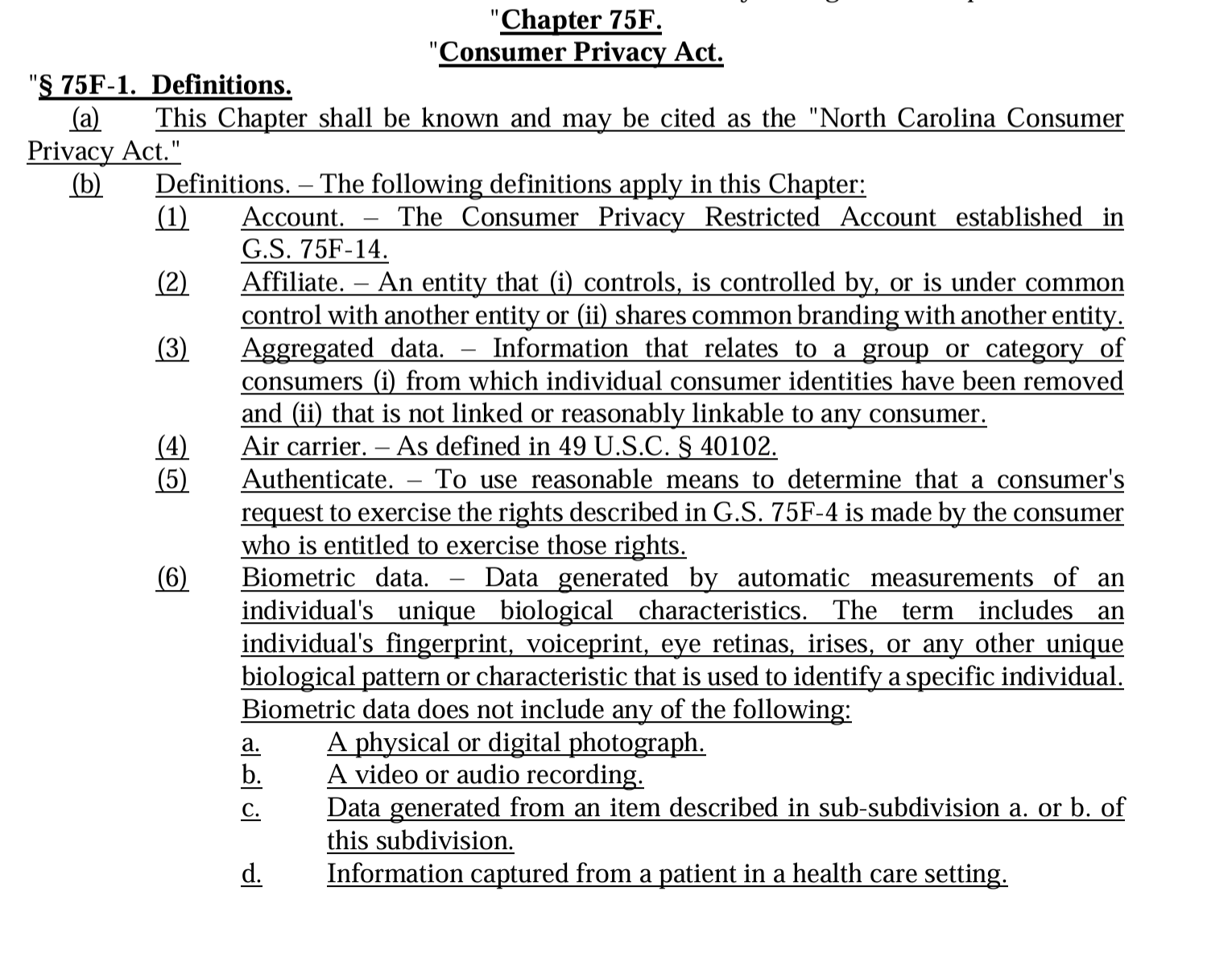
Key Provisions of North Carolina’s Consumer Privacy Act (NC-CPA)
The NC-CPA is typically structured around the roles of Controllers and Processors, granting consumers core privacy rights and imposing requirements for data security and risk assessment.
Applicability and Exemptions
The NC-CPA’s applicability is generally volume-based, focusing on entities that interact heavily with the state’s residents. It covers entities that conduct business in North Carolina or target its residents, and meet one of the following:
-
Controls or processes the personal data of 100,000 or more North Carolina consumers during a calendar year.
-
Controls or processes the personal data of 25,000 or more North Carolina consumers and derives more than 50% of gross revenue from the sale of personal data.
Crucially, the NC-CPA typically includes data-level exemptions for data subject to laws like HIPAA and GLBA, and often entity-level exemptions for government entities, non-profits, and educational institutions.
Core Consumer Rights and Sensitive Data
The rights granted to North Carolina consumers are consistent with modern privacy frameworks:
-
Access, Correction, Deletion, and Portability: Consumers have the right to confirm whether a controller is processing their data, access that data, correct inaccuracies, delete data provided by or obtained about them, and obtain a portable copy of their data.
-
Opt-Out Rights: Consumers can opt out of the processing of their personal data for the purposes of targeted advertising, the sale of personal data, or profiling that produces legal or similarly significant effects.
-
Sensitive Data: Controllers must obtain the consumer’s affirmative consent before processing sensitive data. Sensitive data is typically defined to include racial or ethnic origin, religious beliefs, mental or physical health diagnosis, sexual orientation, and precise geolocation data.
Enforcement and Penalties
North Carolina grants exclusive enforcement authority to the Attorney General (AG), relying on administrative action rather than individual lawsuits to ensure compliance.
-
No Private Right of Action (PRA): Individuals do not have the right to sue businesses directly under the NC-CPA.
-
Cure Period: The AG typically provides a 30-day notice and opportunity to cure an alleged violation before initiating a formal enforcement action.
-
Civil Penalties: The AG is authorized to seek civil penalties of up to $5,000 per violation.
Why You Need Privacy Software Solutions To Comply with North Carolina’s Privacy Law
Compliance with the NC-CPA largely overlaps with other states but requires specific emphasis on consent management and data governance documentation. Only a select few software providers are able to do this and Captain Compliance stands in a class of it’s own to help business owners comply with the NC privacy law.
-
Establish Strict Sensitive Data Opt-In: Compliance solutions must treat all North Carolina sensitive data as requiring an affirmative opt-in, isolating this data from general processing until consent is verifiably logged. This means implementing granular consent management at the point of collection.
-
Automate Opt-Out Request Fulfillment: The privacy platform must provide clear mechanisms for consumers to exercise their right to opt out of sale, targeted advertising, and profiling, and efficiently propagate these opt-out signals throughout the data ecosystem.
-
Mandate Data Protection Assessments (DPAs): Controllers must conduct and document DPAs for all high-risk processing activities (e.g., targeted advertising, sale of personal data, sensitive data processing). The software must facilitate the documentation of these assessments and the safeguards implemented to mitigate risks.
-
Vendor Vetting: Review all Processor contracts to ensure they include explicit provisions requiring the processor to adhere to the controller’s instructions and assist in complying with consumer rights requests (deletion, access, etc.), which is critical to meeting the 45-day response timeline.
Comparative Analysis: North Carolina vs. Leading State Privacy Laws
| Feature | North Carolina NC-CPA (Proposed) | California CPRA (Enacted) | Michigan PDPA (Proposed) | Virginia VCDPA (Enacted) |
| Applicability Threshold (Consumer Count) | 100,000 or 25,000 + 50% Revenue from Sale | 100,000 Consumers/HH | 100,000 or 25,000 + Any Revenue from Sale | 100,000 Consumers |
| Sensitive Data Consent | Affirmative Opt-In Consent Required for Processing. | Opt-Out/Limit Use right for consumer. | Affirmative Opt-In Consent Required for Processing. | Opt-In Consent Required for Processing. |
| Universal Opt-Out (GPC) | Not explicitly noted in highlights, but often included in later drafts. | Required for Opt-Out of Sale/Sharing. | Required for Opt-Out of Sale/Targeted Ads. | Not Required. |
| Private Right of Action (PRA) | None (Exclusive AG Enforcement). | Limited PRA for Data Breaches only. | None. | None. |
| Cure Period | Mandatory 30-day cure period. | Discretionary (AG or CPPA). | Mandatory 30-day cure period (initially). | Discretionary (AG). |
The NC-CPA solidifies the trend of opt-in consent for sensitive data while maintaining the US standard of AG-only enforcement. Businesses must prepare their privacy technology to automatically classify data as sensitive or non-sensitive, routing the former through a strict, auditable consent flow before processing. To get a free privacy audit and see what you need to do to be compliant with NC’s privacy law book a demo with a certified privacy professional from Captain Compliance today!
