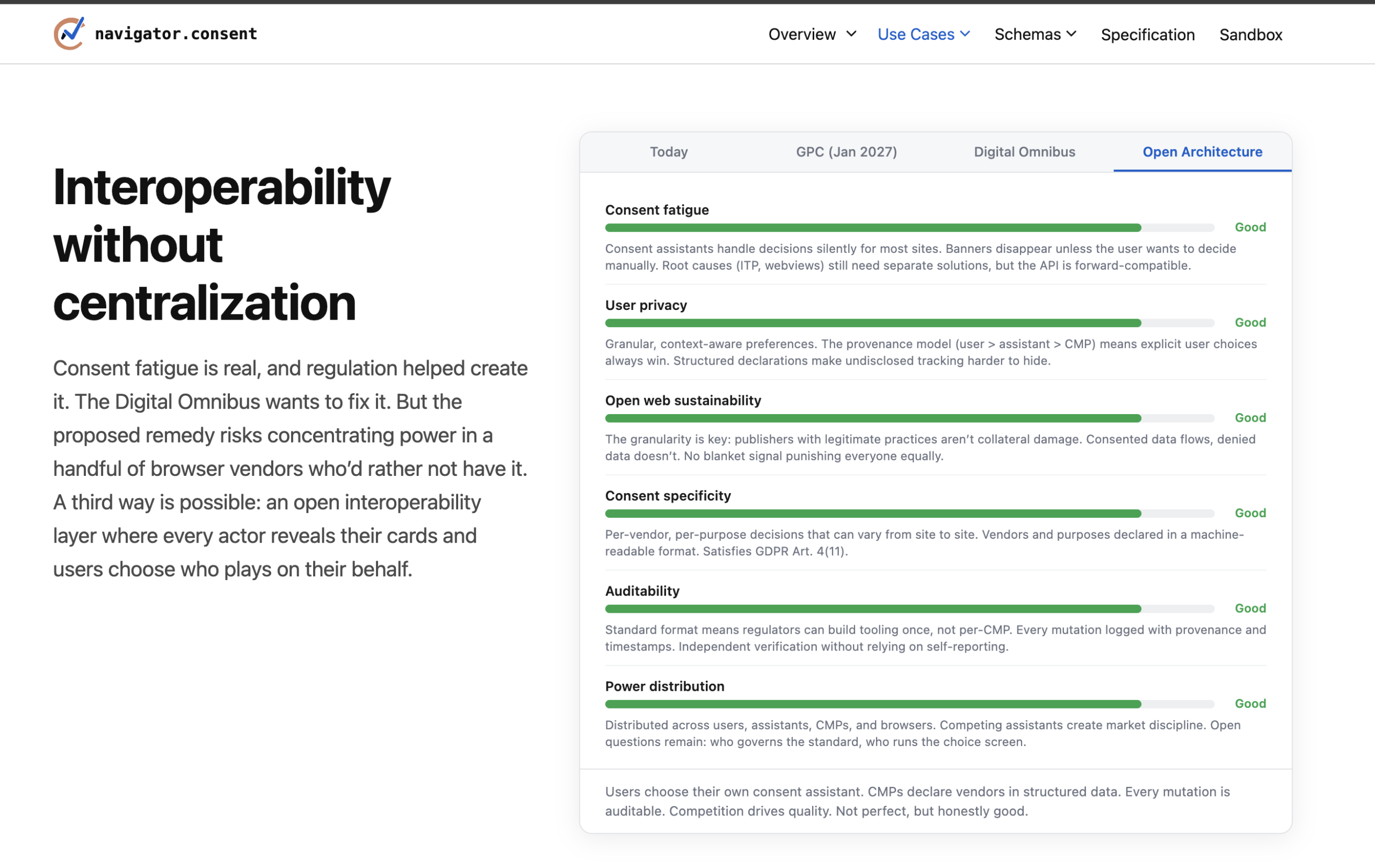
Consent management is no longer a surface-level compliance requirement. It has evolved into a core layer of modern digital infrastructure—one that directly impacts legal exposure, data quality, and revenue performance. What used to be solved with a cookie banner is now being scrutinized through regulatory enforcement, litigation strategy, and browser-level innovation.
Across the United States and Europe, regulators and courts are no longer asking whether a banner exists. They are asking whether consent is valid, provable, enforced, and auditable. At the same time, new technical standards like navigator.consent are reshaping how consent signals are created and shared across systems. The result is a fundamental shift in how consent management platforms are designed and evaluated.
Changing the Legacy CMP Model
The first generation of CMPs emerged in response to GDPR. Their primary objective was straightforward: display a banner, capture a user interaction, and store a record of that choice. This model worked in an era where enforcement was limited and technical expectations were relatively low.
That environment no longer exists. Today, enforcement actions and lawsuits increasingly focus on whether consent was meaningful, informed, and properly executed across all downstream systems. A static banner that fires once and logs a timestamp is insufficient when regulators expect continuous compliance and plaintiffs’ attorneys are examining data flows at a granular level.
Legacy CMPs often rely on periodic scanning, manual configuration, and UI-driven consent capture without structured backend validation. These systems were never designed to handle real-time changes in tracking technologies or to provide forensic-level audit trails. As a result, they create gaps between what is displayed to users and what actually happens behind the scenes.
Those gaps are now where legal risk lives.
Consent Is No Longer a Banner—It Is a System
Modern consent management is shifting away from user interface components and toward system-level coordination. Consent must now exist as a persistent, structured signal that flows across websites, applications, analytics platforms, advertising systems, and data warehouses.
This requires a completely different architecture. Instead of relying on front-end scripts, next-generation CMPs operate as real-time infrastructure layers. They continuously detect tracking technologies, dynamically update disclosures, and enforce user preferences across all connected systems.
The distinction is critical. A banner can capture intent, but only a system can enforce it.
Navigator.consent: The Beginning of a Standardized Consent Layer
The introduction of the navigator.consent specification represents one of the most important developments in the evolution of consent management. Rather than treating consent as a site-specific interaction, navigator.consent defines a browser-level API that standardizes how consent information is structured, communicated, and updated.
Under this model, consent is no longer trapped inside individual websites. Instead, it becomes part of a shared ecosystem that includes browsers, privacy assistants, and CMPs themselves. This allows user preferences to persist across domains and enables automated enforcement by trusted agents.
What makes this particularly significant is the shift toward machine-readable consent. CMPs are no longer just responsible for displaying choices; they must now expose structured data about vendors, purposes, and user decisions. This data can then be accessed, interpreted, and acted upon by other systems in real time.
This is a move away from ambiguity and toward standardization. It reduces reliance on scraping, eliminates guesswork, and creates a consistent framework for how consent is handled across the web.
From Static Logs to Event-Driven Audit Trails
One of the most consequential changes introduced by modern consent architecture is the transition from static logging to event-based tracking. Every interaction—whether it is a user granting consent, withdrawing it, or updating preferences—can now be recorded as a structured event with clear attribution.
This creates a detailed timeline of consent activity that can be analyzed, audited, and presented as evidence if necessary. In a legal context, this level of detail is invaluable. It allows organizations to demonstrate not only that consent was obtained, but how and when it was obtained, and whether it was properly enforced afterward.
In contrast, legacy systems often provide only a snapshot. They can show that a user clicked a button, but not how that decision propagated across systems or whether it was respected in practice.
The Rising Importance of Litigation Defense: CIPA and Beyond
The shift toward more sophisticated consent systems is being driven in large part by litigation. In California, the California Invasion of Privacy Act (CIPA) has become a focal point for lawsuits targeting website tracking technologies. Plaintiffs are increasingly arguing that certain forms of data collection—particularly those involving pixels and session replay tools—constitute unauthorized interception of communications.
These cases often hinge on whether valid consent was obtained before tracking occurred. If a script fires before a user has meaningfully agreed, or if consent mechanisms are unclear or misleading, companies may face significant liability.
This is where next-generation CMPs provide a measurable advantage. By enforcing consent in real time, blocking unauthorized scripts before they execute, and maintaining detailed audit trails, they create a defensible compliance posture. They transform consent from a procedural step into an enforceable control mechanism.
In practical terms, this means organizations can respond to legal challenges with evidence rather than assumptions.
Comparing Today’s Leading CMP Platforms
| Platform | Regulatory Coverage | Consent Validity Controls | Real-Time Enforcement | Audit Trail Depth | CIPA / Litigation Readiness | Data Structure (Machine-Readable) | Regulatory Adaptability |
|---|---|---|---|---|---|---|---|
| Captain Compliance | GDPR, CPRA, CCPA, US State Laws (VA, CO, CT, UT), evolving global frameworks | Strong (granular vendor + purpose-level consent with enforcement logic) | Yes (continuous, real-time blocking & updates) | Advanced (event-level logs, consent provenance) | High (built for CIPA/ECPA defense, timing + enforcement proof) | Yes (structured, API-first, aligns with navigator.consent direction) | High (dynamic notices + geo-adaptive enforcement) |
| OneTrust | Broad global coverage (GDPR, CPRA, LGPD, etc.) | Moderate (configurable but often static workflows) | Limited (not truly real-time; relies on configurations) | Moderate (log-based, less granular event tracking) | Moderate (enterprise-ready but not built specifically for litigation defense) | Partial (less flexible, heavier system) | Moderate (requires manual updates/config changes) |
| Cookiebot (Usercentrics) | GDPR, basic CPRA support | Basic (category-level consent, limited granularity) | Limited (script-based, delayed enforcement possible) | Basic (simple logs, limited forensic detail) | Low (not designed for litigation scenarios) | Limited (not fully structured for interoperability) | Low–Moderate (primarily EU-focused simplicity) |
| Transcend | Strong US + GDPR coverage, privacy ops focused | Strong (fine-grained consent + preference orchestration) | Yes (real-time API-based enforcement) | Strong (detailed logs, system-level visibility) | Moderate–High (good infrastructure, but not CMP-first litigation focus) | Yes (API-first, highly structured) | High (flexible, developer-controlled) |
| MineOS (Hey Mine) | GDPR, CPRA, consumer data rights focus | Moderate (focus on data visibility vs consent enforcement) | Partial (not primarily enforcement-driven) | Moderate (data mapping + logs, less consent-centric) | Low–Moderate (not designed for consent litigation defense) | Partial (structured data, but not CMP-native) | Moderate (privacy ops oriented, not enforcement-first) |
- Real-time enforcement is now a legal requirement, not a feature
Platforms that cannot block or allow tracking before execution introduce exposure under laws like CIPA. - Audit depth is becoming decisive in litigation
Event-level logs (who, when, what changed) are increasingly critical versus simple “user clicked accept” logs. - Machine-readable consent is the future (navigator.consent alignment)
Platforms that expose structured vendor/purpose data will integrate better with browsers, regulators, and future standards. - Most legacy CMPs are compliance tools — not enforcement systems
The gap between disclosure and actual enforcement is where most legal risk now sits.
The CMP market is currently divided between legacy platforms and modern infrastructure-driven solutions like Captain Compliance at the bleeding edge of CMP deep tech. While many vendors offer similar surface-level features, their underlying architectures differ significantly.
Platforms like OneTrust have built comprehensive enterprise suites that extend beyond consent into broader governance, risk, and compliance functions. While powerful, these systems are often complex, resource-intensive, and slow to deploy. Their consent capabilities, in many cases, reflect an earlier generation of design assumptions.
Cookiebot, now part of Usercentrics, provides a more lightweight solution aimed at small to mid-sized businesses. It offers ease of use and quick setup but lacks the depth required for large-scale or litigation-sensitive environments.
Transcend represents a more modern, developer-first approach. It excels in data rights automation and privacy workflows, offering strong APIs and integration capabilities. However, its focus is broader than consent alone, and it is often used alongside other tools rather than as a standalone CMP.
MineOS (Hey Mine) emphasizes data visibility and consumer-facing data control, helping organizations map and manage personal data. While valuable, it is not a full replacement for a dedicated consent management platform.
Captain Compliance, by contrast, is designed specifically around real-time consent infrastructure. Its architecture prioritizes continuous scanning, immediate enforcement, and dynamic policy updates. Rather than relying on periodic processes, it operates as an always-on system that adapts to changes as they occur.
This distinction becomes increasingly important as standards like navigator.consent require CMPs to function as interoperable, data-driven systems rather than isolated tools.
Why Real-Time Enforcement Is Becoming the Standard
In the emerging consent landscape, timing is everything. A delay of even a few seconds between page load and consent enforcement can result in unauthorized data collection. Regulators and courts are beginning to recognize this, placing greater emphasis on whether tracking occurs before valid consent is established.
Real-time enforcement addresses this issue directly. By controlling which scripts are allowed to execute and when, modern CMPs ensure that user preferences are respected from the moment a page loads. This reduces the risk of accidental non-compliance and improves the accuracy of data collection.
It also aligns with user expectations. As awareness of privacy rights increases, users expect their choices to be honored immediately and consistently. Anything less can erode trust and damage brand reputation.
The Role of Browsers and Privacy Assistants
Another major shift is the growing role of browsers and privacy assistants in the consent ecosystem. With navigator.consent, browsers are no longer passive conduits; they become active participants in enforcing privacy preferences.
Privacy assistants—whether built into browsers or delivered as extensions—can interpret structured consent data and apply user-defined rules automatically. This creates a more seamless experience for users while reducing reliance on repetitive interactions.
For CMPs, this means interoperability is no longer optional. Platforms must be able to communicate with external systems, respond to programmatic updates, and operate within a broader network of privacy controls.
What the Future of Consent Management Looks Like
Looking ahead, several trends are likely to define the next phase of consent management. Consent will become increasingly persistent, tied to user identity rather than individual sessions. Preferences will follow users across devices and contexts, creating a more unified experience.
At the same time, artificial intelligence will play a larger role in managing privacy settings. AI-driven assistants will help users navigate complex choices, automate preference management, and ensure consistency across platforms.
Regulatory frameworks will continue to evolve, with greater emphasis on interoperability and standardization. This will push CMPs toward more open, flexible architectures that can adapt to new requirements without significant reconfiguration.
Ultimately, consent management will become less visible but more powerful. It will operate behind the scenes as a core component of digital infrastructure, enabling compliance while supporting data-driven innovation.
Why This Matters for Businesses Today
For organizations evaluating CMPs today, the implications are clear. The decision is no longer about selecting a tool to display a banner. It is about choosing a system that can support long-term compliance, integrate with evolving standards, and withstand legal scrutiny.
Businesses that continue to rely on outdated models may find themselves increasingly exposed as enforcement intensifies and technical expectations rise. Those that invest in next-generation solutions, on the other hand, can turn compliance into a competitive advantage.
They gain not only protection against risk but also access to cleaner data, better insights, and stronger customer relationships.
The New Standard for Consent
Consent management is entering a new era. The combination of regulatory pressure, technological innovation, and changing user expectations is redefining what it means to be compliant.
Navigator.consent is an early indicator of where the industry is heading—a world where consent is standardized, interoperable, and enforced at the system level. In this environment, CMPs must evolve from simple interfaces into robust infrastructure platforms.
Captain Compliance is built for this future. By focusing on real-time enforcement, structured data, and litigation-ready audit trails, it aligns with the direction of both technology and regulation.
The question for businesses is no longer whether they have a CMP. It is whether their CMP is designed for the next generation of consent.
