The data breach litigation landscape has transformed into one of the fastest-growing and most financially punishing areas of class action law. As companies across every sector grapple with increasingly sophisticated cyber threats, a parallel threat has emerged: plaintiffs’ law firms that have turned data breach litigation into a well-oiled machine. Among the most prominent is Lynch Carpenter LLP, a Pittsburgh-based firm that has positioned itself at the forefront of privacy litigation, recovering hundreds of millions of dollars while holding major corporations accountable for security and privacy failures.
For organizations navigating today’s complex regulatory environment, understanding how firms like Lynch Carpenter operate—and why privacy litigation is surging—is essential to avoiding catastrophic legal exposure and if you’d like a free privacy audit to understand your risks and how our software can help contact one of our privacy experts today.
Lynch Carpenter: A Data Breach Litigation Powerhouse
Lynch Carpenter has built its reputation by securing leadership positions in some of the most high-profile data breach cases of the past decade. The firm’s track record includes major cases against household names like Home Depot, Equifax, Target, Marriott, and Wendy’s. These weren’t small victories they resulted in significant recoveries that have reshaped how courts view corporate responsibility for data security.
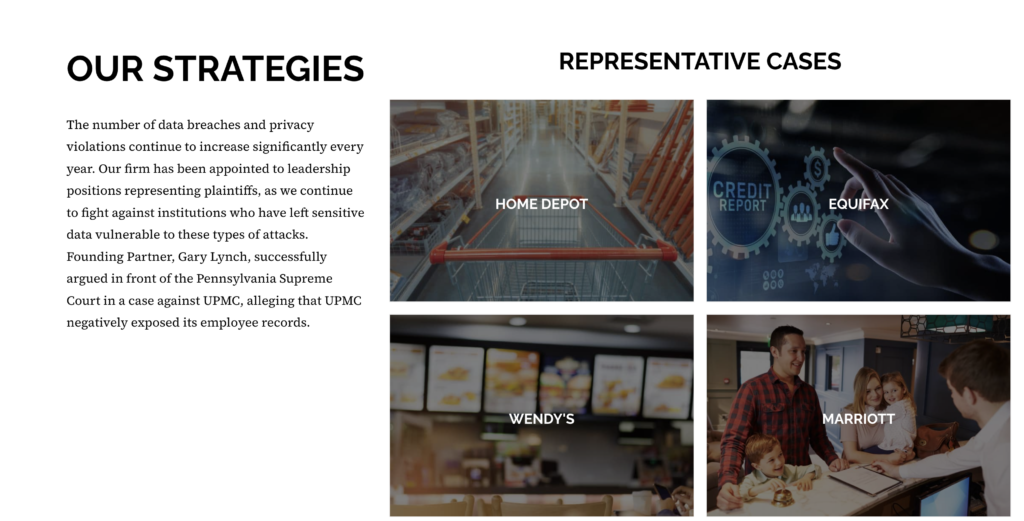
The firm’s influence extends beyond simply filing lawsuits. Founding Partner Gary Lynch achieved a landmark victory in 2018 when he successfully argued before the Pennsylvania Supreme Court in Dittman v. UPMC. In that case, the court held that UPMC had a legal duty to reasonably protect employee data from cyber theft a decision that has had profound implications for data breach litigation nationwide. The ruling established that employers collecting personal data create a foreseeable risk of breach and therefore must exercise reasonable care in securing that information.
What makes this precedent particularly significant is the court’s rejection of the economic loss doctrine as a barrier to negligence claims in data breach cases. The Pennsylvania Supreme Court clarified that if a duty arises independently of any contractual obligation, tort claims seeking purely economic damages remain viable. This opened the floodgates for plaintiffs to pursue companies for data security failures even without proving immediate financial harm.
Lynch Carpenter has also been appointed to leadership roles in multidistrict litigation, including co-lead counsel positions in the Equifax and Home Depot data breach cases. The firm’s attorneys have secured substantial settlements, including $25 million for financial institutions affected by the Home Depot breach and have been instrumental in shaping the legal frameworks that govern how companies must protect consumer and employee data.
The Plaintiff Recruitment Machine
What sets Lynch Carpenter apart isn’t just its courtroom success it’s the firm’s sophisticated approach to identifying and recruiting plaintiffs. A review of the firm’s recent activity reveals an aggressive, highly systematic strategy for capitalizing on data breaches.
The firm maintains a robust digital presence designed to capture potential class members immediately after breach announcements. Their website features a dedicated data breach section with online forms allowing individuals to submit their information for case review. The firm regularly issues press releases through major distribution services like Globe Newswire, announcing investigations into recently disclosed breaches often within days or even hours of the public disclosure.
Recent examples illustrate the speed and scale of this operation. In January 2026 alone, Lynch Carpenter announced investigations into breaches affecting:
- Betterment (investment platform)
- GSPlatform (over 500,000 individuals impacted)
- The Washington Post (nearly 10,000 individuals)
- Diversified Business Services
- Minnesota Department of Human Services (over 3,000 individuals)
- Laurel Health Centers
- First Federal Savings & Loan
Each announcement follows a similar template: identifying the breached entity, describing the types of personal information compromised (Social Security numbers, financial data, medical information), and prominently featuring contact information for potential plaintiffs to reach out. The messaging is consistent: “If your information was impacted in this incident, you may be entitled to compensation.”
This industrialized approach to plaintiff recruitment has transformed data breach litigation into what analysts describe as a “cottage industry.” According to reporting by the Wall Street Journal, lawyers are deploying digital advertisements and utilizing boilerplate filings to rapidly mobilize class actions following breach notifications. The strategy is simple but effective: be first to the courthouse, secure class representation, and leverage the threat of massive liability to extract substantial settlements.
An Unprecedented Surge in Privacy Litigation
The statistics are staggering. Data breach class action filings have exploded from just 108 cases in 2018 to 1,488 in 2024—an increase of more than 1,265% in just six years. This surge shows no signs of slowing, with analysts predicting continued growth throughout 2025 and beyond.
Several factors are driving this unprecedented litigation boom:
Increased Breach Frequency and Sophistication: Data breaches in the United States have nearly tripled since 2020, with a record 3,205 incidents reported in 2023. Cybercriminals are employing more sophisticated techniques, including ransomware attacks that affected 72.7% of surveyed businesses in 2023. High-profile incidents like the MOVEit data breach (affecting over 55 million people) and the National Public Data breach have provided abundant opportunities for class action filings.
Expanding Legal Precedents: Courts are increasingly favorable to plaintiffs in data breach litigation. Class certification success rates rose to 40% in 2024, up from historical averages, as courts have begun recognizing emotional distress and increased risk of identity theft as compensable harms—even in the absence of actual financial loss. The evolving interpretation of Article III standing requirements following the Supreme Court’s TransUnion decision has created a complex patchwork of rulings, with many courts finding that the mere public disclosure of private information constitutes concrete harm sufficient to establish standing.
Massive Settlement Values: The financial stakes have never been higher. In 2024, the top 10 data breach class action settlements totaled $593.2 million, up from $515.75 million in 2023. The largest settlement of 2024 reached $350 million in a case against Alphabet Inc. These eye-popping numbers create powerful incentives for plaintiffs’ firms to aggressively pursue breach litigation, knowing that defendants often prefer settling to avoid the costs and risks of protracted litigation.
Enhanced Regulatory Requirements: New disclosure obligations are amplifying litigation risks. SEC cybersecurity rules now require public companies to report material breaches on Form 8-K. State laws are also tightening, with states like Delaware and Minnesota introducing new privacy statutes with shorter cure periods. The GDPR’s 72-hour notification requirement for EU-related breaches and various state breach notification laws create additional compliance burdens and litigation triggers.
Sophisticated Plaintiff Recruitment: The ease with which plaintiffs’ firms can identify and recruit class members following public breach disclosures has lowered the barriers to filing suit. Digital advertising, press releases, and online intake forms allow firms to quickly assemble putative classes and file complaints while media attention remains high.
The Consequences for Unprepared Organizations
For companies that suffer data breaches, the litigation exposure is now a given. Nearly every significant breach announcement is now followed by one or more class action filings, often filed simultaneously in multiple jurisdictions. This creates enormous costs even before reaching the merits of the claims.
Organizations face several layers of expense and risk:
Immediate Response Costs: Companies must notify affected individuals, offer credit monitoring services, establish call centers to respond to inquiries, and engage forensic investigators to determine the scope and cause of the breach.
Litigation Defense: Defending against class actions requires substantial legal fees, often spanning multiple years and jurisdictions. Even when companies prevail on standing or other threshold issues, the costs of getting to that point are significant.
Settlement Pressure: The combination of massive potential exposure, unpredictable jury decisions, and the reputational damage of prolonged litigation creates strong incentives to settle. Defendants who “continue to play ball on the settlement front,” as industry observers note, inadvertently fuel further filings by demonstrating that data breach litigation is financially lucrative for plaintiffs’ firms.
Regulatory Penalties: Beyond private litigation, companies may face enforcement actions and fines from state attorneys general, the FTC, the SEC, and international regulators. California’s CCPA, for example, allows fines up to $7,500 per violation.
Reputational Harm: The negative publicity surrounding data breaches and subsequent litigation can permanently damage brand reputation and erode customer trust, leading to lost business and diminished market value.
How Captain Compliance Provides Data Privacy Lawsuit Protection
In this hostile litigation environment, proactive compliance isn’t just good practice it’s essential to have a superhero team protect you from very expensive legal headaches. Captain Compliance offers the comprehensive framework organizations need to minimize breach risks and demonstrate reasonable security measures that courts increasingly require.
Risk Assessment and Gap Analysis: Understanding your current security posture is the first step. We can help identify vulnerabilities in data handling practices, technical controls, and governance structures before they become breach vectors.
Policy Development and Implementation: Courts evaluating negligence claims examine whether companies followed industry-standard security practices. Our software helps organizations develop and implement robust data security policies, incident response plans, and employee training programs that demonstrate reasonable care.
Regulatory Compliance Management: With overlapping federal, state, and international requirements, maintaining compliance is complex. Our education center provides guidance on meeting obligations under GDPR, CCPA, HIPAA, SEC cybersecurity rules, and state breach notification laws—reducing the risk of both regulatory penalties and private litigation.
Third-Party Vendor Management: Many breaches occur through third-party vendors. Captain Compliance can assist with vendor due diligence, contractual protections, and ongoing monitoring to reduce supply chain risks.
Breach Response Preparedness: When breaches occur, swift and appropriate response is critical. Our superhero privacy and compliance team helps organizations prepare incident response plans that satisfy legal obligations and minimize potential damages—including the timing and content of notifications that often form the basis of litigation claims.
Documentation and Defensibility: In litigation, demonstrating that your organization exercised reasonable care is paramount. Captain Compliance helps create and maintain documentation of security measures, risk assessments, and compliance efforts that can serve as powerful defenses against negligence claims.
Ongoing Monitoring and Updates: The threat landscape constantly evolves, as do legal requirements. Captain Compliance provides ongoing support to ensure your data protection measures keep pace with emerging risks and regulatory changes.
Trust, Safety, and Stability to the Digital World
The surge in data breach class action litigation shows no signs of abating. Firms like Lynch Carpenter have perfected the art of identifying breaches, recruiting plaintiffs, and leveraging legal precedents to secure substantial settlements. For every company that collects, stores, or processes personal information—which is virtually every modern business—the question is not whether you’ll face a breach attempt, but when, and whether you’ll be prepared.
The costs of inadequate data security extend far beyond the immediate breach response. They include years of litigation, tens or hundreds of millions of dollars in settlements, regulatory penalties, and lasting reputational damage. In contrast, the investment in robust compliance programs, while not inexpensive, is a fraction of potential exposure.
Courts have made clear, particularly in landmark cases like Dittman v. UPMC, that companies owe a duty of reasonable care to protect the data they collect. Meeting this duty requires more than good intentions—it demands comprehensive, documented, and continuously updated security measures that reflect current threats and industry standards.
As privacy litigation continues its exponential growth, the companies that will weather this storm are those that treat data security not as an afterthought or a checkbox exercise, but as a fundamental business imperative. Captain Compliance provides the expertise, frameworks, and ongoing support organizations need to minimize risks, demonstrate reasonable care, and protect against the devastating consequences of data breaches and the litigation that inevitably follows.
In an era where a single breach can trigger immediate class action filings and hundred-million-dollar settlements, compliance isn’t just about following rules—it’s about survival.
