Know what’s on your site before a plaintiff’s firm does
A free privacy audit shows which cookies, pixels and trackers are running — and which ones commonly appear in privacy claims.
There is a company called CyRisk that has built a sophisticated cyber risk intelligence platform for the insurance industry and we compliment CyRisk’s underwriting tools with our privacy software and compliance monitoring stack for insurance underwriters.
Cyber insurance underwriting has a data problem that the industry has been working around for decades. Unlike property insurance, where actuaries can draw on centuries of loss data to model hurricane paths, fire spread rates, and flood zones, cyber risk has no equivalent historical foundation. The threat landscape mutates faster than loss data accumulates. Attack techniques that drove claims in 2020 have been superseded by techniques that didn’t exist in 2022. And the organizations being underwritten are not static risks — their attack surfaces expand and contract with every cloud migration, every SaaS adoption, every remote workforce shift, every third-party vendor added to the supply chain.
The industry’s traditional response to this data problem was the questionnaire. Ask the applicant what controls they have in place, take the answers at face value, apply judgment developed from prior loss experience, and price accordingly. The limitations of this approach became painfully visible during the ransomware surge of 2020 and 2021, when carriers discovered that self-reported security postures and actual security postures were frequently divergent — and that the pricing models built on self-reported data were systematically underpricing the risk.
CyRisk’s cyber risk analytics platform represents the market’s response to that problem: outside-in technical assessment of an organization’s actual cybersecurity posture, conducted without credentials, without questionnaires, and without relying on the applicant’s characterization of their own controls. For carriers, MGAs, and brokers navigating the current cyber insurance market, understanding what CyRisk does and how it fits into the underwriting workflow is increasingly relevant as the market moves toward data-driven risk selection. Meanwhile more and more insurance companies are pairing up Captain Compliance’s Patrol Monitoring software with CyRisk to reduce just that cyber risk.
As a compliment to Captain Compliance’s monitoring tools CyRisk’s engine scans websites and applications from the outside in — no credentials, no questionnaires — and surfaces the tracking technologies, consent failures, privacy policy gaps, and wrongful collection exposures that determine whether a business is a viable cyber insurance risk. Underwriters use it to see what is actually happening on a policyholder’s web properties before they bind coverage. It is, by any measure, a serious and well-built tool for the problem it solves.
The problem it solves is the insurer’s problem: pricing and underwriting privacy liability exposure with accuracy. What it does not solve — and is not designed to solve — is the compliance officer’s problem: knowing your own exposure before the insurer’s scanner finds it, before a regulator’s technical audit surfaces it, before a plaintiffs’ firm recruiting class members runs it against your domain.
That is the gap Captain Compliance fills. If CyRisk is the cyber privacy risk intelligence layer that insurers use to evaluate businesses from the outside, Captain Compliance Patrol is the privacy risk intelligence layer that businesses, insurance companies, and lawyers use to evaluate with the full compliance and legal context.
Why the Insurance Industry Built Privacy Risk Scanning Before Compliance Teams Did
The insurance market’s investment in privacy risk scanning technology is not accidental. It is a direct response to a claims environment that caught the industry off guard. Privacy class action filings surpassed 1,800 cases in 2025 — more than 200% growth since 2022 according to Claims Journal — driven by tracking pixels, session replay tools, biometric collectors, and consent failures that generate statutory damages claims without requiring any data breach. CIPA alone now accounts for approximately 34% of all third-party cyber liability claims, up from 7% in 2023. The fastest-growing privacy liability exposure is not from hackers — it is from the marketing and analytics stack that most businesses deployed without any privacy review.
Insurers absorbed those losses and responded by building the technical infrastructure to see the exposure before binding it. Tools like CyRisk’s PRISM engine now scan privacy policies against regulatory requirements, evaluate live consent manager configurations, check Global Privacy Control compliance, and map observed tracking technologies against a library of litigation and enforcement case law — giving underwriters a technical picture of wrongful collection exposure that no application questionnaire could produce.
The compliance function has been slower to build equivalent capability, for understandable reasons. Compliance teams are not underwriters. They are not trying to price risk across a portfolio of accounts. They are trying to manage one organization’s privacy posture — but they are managing it in an environment where the same technical signals that CyRisk surfaces for insurers are being surfaced by regulators conducting technical audits, by plaintiffs’ experts generating litigation evidence, and by the California Privacy Protection Agency’s own scanning program targeting GPC non-compliance.
The practical consequence is that many organizations are in the position of being evaluated by external technical scanners — for insurance underwriting, for regulatory compliance, for litigation purposes — without having run those same scans on themselves. They are flying blind into a technical audit environment.
What CyRisk Scans For — and Why Compliance Officers Need the Same Intelligence
CyRisk’s platform evaluates 14 signal categories mapped to enforcement actions and class action litigation. Understanding what those categories are and what they mean for a compliance program is the starting point for understanding why practitioner-side privacy risk scanning is not optional today.
Advertising and tracking pixels. The foundational CIPA exposure vector. A Meta pixel, Google tag, TikTok pixel, or any other advertising technology that intercepts user communications and transmits them to a third party is the technology behind approximately 75% of current web privacy lawsuits. CyRisk surfaces these for underwriters. Compliance officers need to know exactly what is firing on their properties — not from a tag management inventory that marketing maintains, but from a live outside-in scan that catches what the inventory misses.
Session recording scripts. Session replay tools that capture keystrokes, mouse movements, and form inputs — including tools like Hotjar, FullStory, and Microsoft Clarity — have been the subject of CIPA wiretapping claims on the theory that they intercept user communications in real time. The compliance question is not just whether a session replay tool is deployed but whether it is scoped to avoid capturing sensitive inputs and whether users have been given adequate notice and consent.
Consent manager configuration and GPC compliance. CyRisk evaluates live browser privacy signals and consent manager configurations to determine whether stated policies match actual data practices. This is the same evaluation that the CPPA’s enforcement program conducts and that plaintiffs’ experts run in discovery. A consent banner that is configured correctly in the CMP dashboard but that fails to block tags in live traffic — or that fails to honor GPC signals — will be surfaced by an outside-in scan regardless of what the internal configuration documentation says.
Privacy policy gap analysis. CyRisk’s PRISM engine scores privacy policies against the specific disclosures, opt-out mechanisms, and data sharing practices that regulators and plaintiffs target — from data collection and third-party sharing to children’s privacy, cookie statements, and jurisdiction-specific requirements. The gap between what a privacy policy discloses and what the site actually does is a primary source of both regulatory enforcement findings and litigation claims.
Biometric data practices. BIPA carries $1,000 to $5,000 per violation statutory damages and has generated some of the largest privacy settlements in history. Any site collecting facial geometry, voiceprints, fingerprints, or other biometric identifiers — including through AI features, authentication systems, or third-party SDKs — carries BIPA exposure that requires specific compliance architecture.
Device fingerprinting and geolocation collection. Both are active litigation targets under state privacy laws and wiretapping statutes. Device fingerprinting that operates without consent as a tracking mechanism independent of cookies has been the subject of enforcement attention in multiple jurisdictions. Geolocation collection — particularly precise geolocation — triggers specific consent requirements under CPRA, the Texas TDPSA, and several other state frameworks.
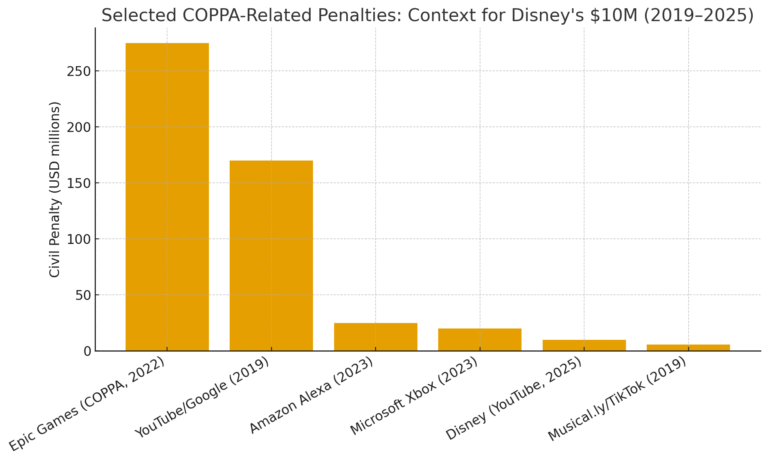
Children’s privacy exposures. COPPA violations have generated significant FTC enforcement actions — Disney’s $10 million settlement and the ongoing enforcement activity against platforms with mixed-age audiences demonstrate that children’s privacy is an active enforcement priority, not a theoretical concern. Any site that might attract users under 13 carries COPPA exposure that requires specific technical controls.
Data broker relationships. Relationships with data brokers — including through advertising platforms that monetize user data — create disclosure obligations under CCPA, the Oregon Consumer Privacy Act, and the Texas Data Broker Law, among others. CyRisk surfaces these relationships as underwriting signals. Compliance officers need to map them as disclosure and registration obligations.
Captain Compliance Patrol: The Practitioner-Side Privacy Risk Scanner
Captain Compliance’s Patrol software is built to give compliance officers and legal counsel the same outside-in technical visibility that CyRisk provides to insurers for Cyber Risk underwriting — oriented around the compliance and legal response rather than the underwriting decision.
Submit any URL to Patrol and it returns a verified privacy risk report covering the technical signals that matter most for compliance exposure in the current enforcement environment:
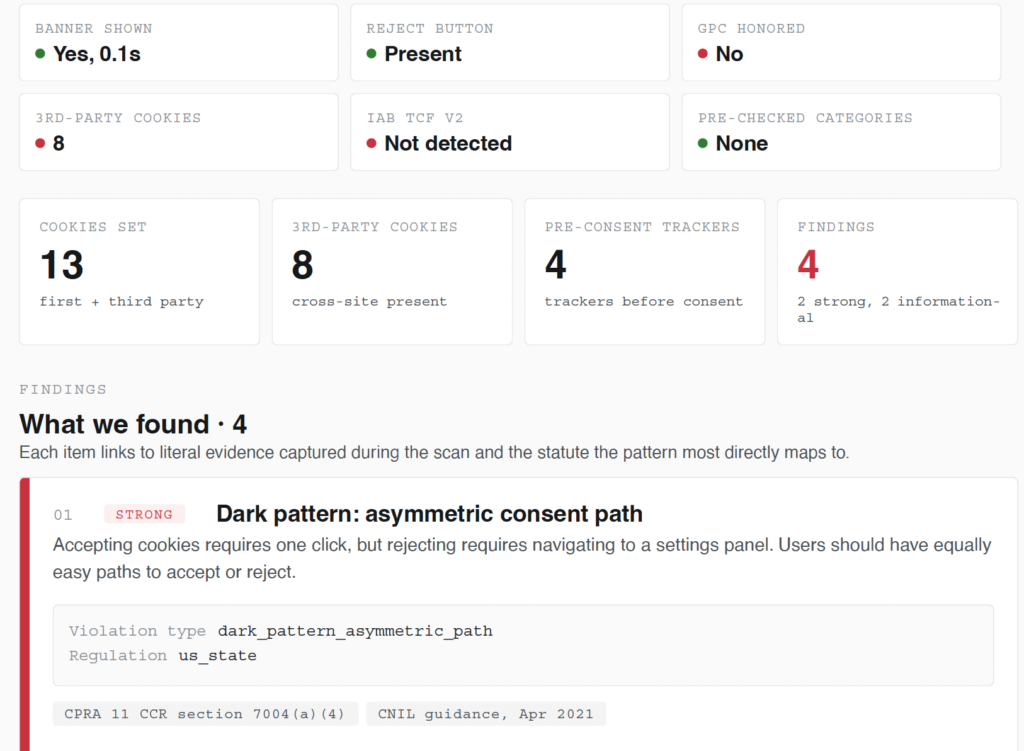
Dark pattern detection. Patrol evaluates the consent interface for asymmetric accept/reject paths, unequal visual prominence, pre-checked categories, and other design patterns that are directly actionable under CPRA 11 CCR section 7004(a)(4), CNIL guidance, and the growing body of regulatory opinion on manipulative consent design. A dark pattern finding in a Patrol report is a finding that a regulator’s technical audit will also make — and that a plaintiffs’ expert will make before filing a class action complaint.
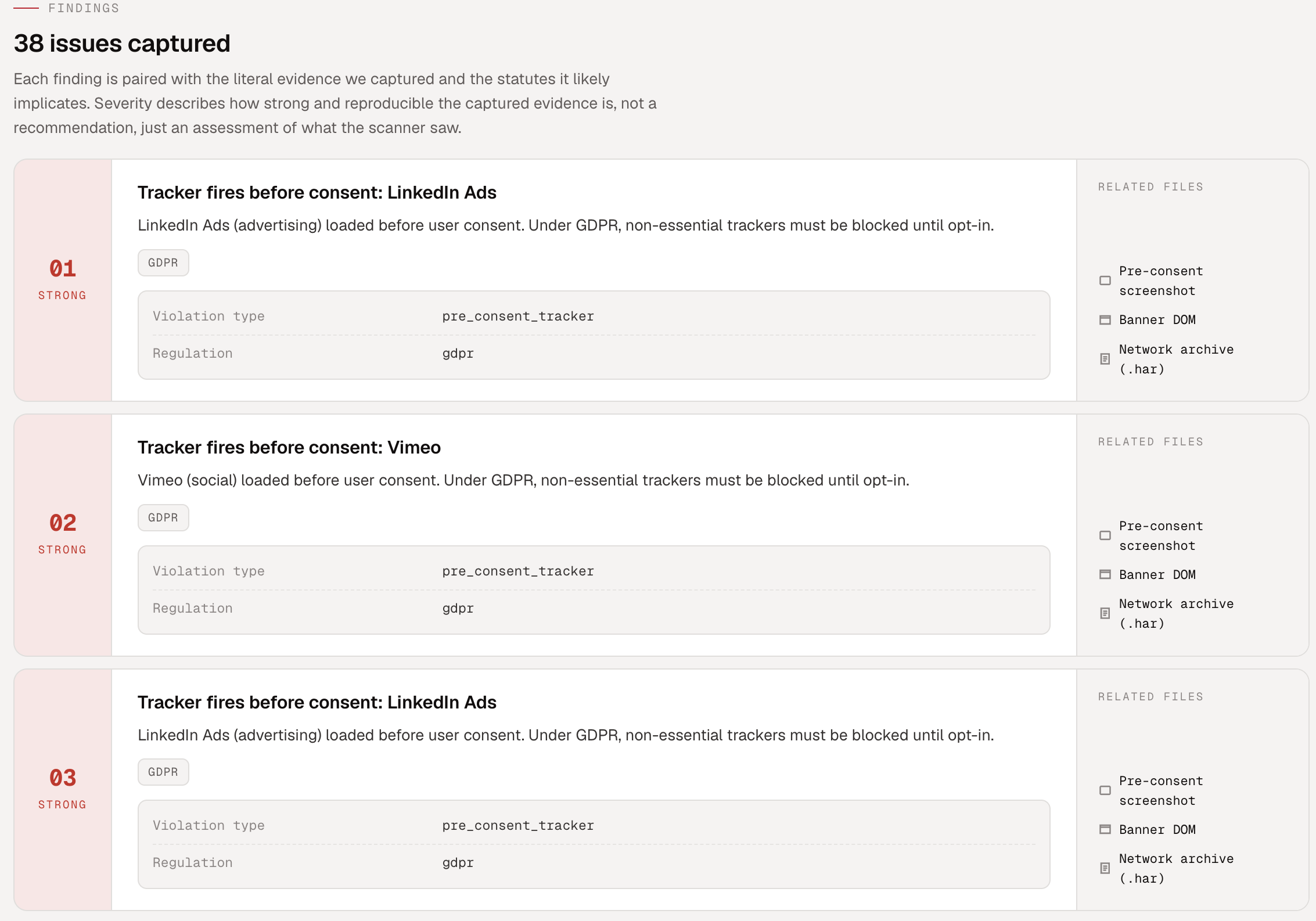
Pre-consent tracker and cookie inventory. Patrol inventories every cookie and tracker firing across the full consent state cycle — before any user interaction, after reject, and after accept. Pre-consent trackers are the technical condition most likely to appear in CIPA litigation discovery as evidence of unauthorized interception. Knowing what is firing before consent is recorded, in live production traffic, is the compliance intelligence that a tag management dashboard cannot provide.
Global Privacy Control signal verification. Patrol executes a dedicated GPC pass, simulating a user with GPC enabled and detecting which trackers and third-party cookies remain active under that signal. GPC honoring is a statutory obligation in California, Colorado, Connecticut, and multiple additional states. The CPPA has named it as an audit priority. Patrol’s GPC pass produces the technical documentation of compliance status that regulators will check when they conduct their own assessment.
IAB TCF validation. Patrol checks whether IAB TCF v2.2, IAB GPP, and Google Consent Mode are implemented and functional. For organizations running programmatic advertising, these signals are the infrastructure through which consent reaches downstream ad tech vendors. Their absence means consent captured by the CMP is not being communicated to the vendors processing user data — a structural gap in the consent architecture that surfaces in both regulatory investigations and advertiser audits.
Jurisdictional mapping across 20 US state privacy laws and GDPR. Every Patrol finding is mapped against the specific statutory provisions it implicates across the full current landscape of applicable privacy law — not just CCPA, not just GDPR, but all 20 active US state frameworks simultaneously. A dark pattern finding on a national consumer-facing property is a 20-jurisdiction compliance problem. Patrol’s jurisdictional grid makes that exposure visible in a single report.
SHA-256 verified evidentiary record. Every Patrol report is hash-verified against the underlying scan data, with a seven-screenshot archive capturing the site’s consent interface across all interaction states. This is not just operational data — it is a dated, preserved technical record of compliance posture that can be produced in response to a regulatory inquiry, a litigation discovery request, or an insurance underwriting submission.
The Two Sides of the Same Exposure
CyRisk and Captain Compliance Patrol are looking at the same technical signals from different sides of the same transaction. CyRisk surfaces privacy risk exposure so insurers can price it accurately before binding coverage. Patrol surfaces privacy risk exposure so compliance officers can remediate it before insurers, regulators, or plaintiffs find it first.
The relationship between the two is not competitive — it is sequential. A business that runs Patrol, identifies and remediates its consent failures, dark patterns, and GPC non-compliance, and documents that remediation with dated scan records is a materially better insurance risk than one that has never conducted an outside-in privacy risk assessment. The CyRisk scan that an underwriter runs at submission time will reflect the remediated state. The compliance program that produced that remediated state is what Patrol supports.
For compliance officers and legal counsel, the operational implication is straightforward: the technical audit that insurers are running against your organization at renewal time is the same technical audit that regulators run during investigations and that plaintiffs’ experts run before filing complaints. Running it yourself — on a regular cadence, before any of those external parties run it — is the compliance intelligence that turns privacy risk monitoring from a reactive function into a proactive one.
What the Current Enforcement Data Means for Your Compliance Program
The statistics that CyRisk publishes to explain the market opportunity to insurers are the same statistics that should be driving compliance program investment decisions inside organizations:
- 1,800+ privacy class action filings in 2025 — 200% growth since 2022
- CIPA accounts for 34% of all third-party cyber liability claims, up from 7% in 2023
- 69% of 2025 CIPA cases involved technologies other than Meta Pixel — meaning the exposure is in the standard marketing and analytics stack, not just high-profile tools
- Twenty-two states now have comprehensive consumer privacy laws in effect, with more coming online through 2026
- Recent FTC settlements include Disney ($10 million for COPPA violations), BetterHelp ($7.8 million for health data sharing with ad platforms), and GoDaddy (data security failures and privacy misrepresentation)
These are not abstract market statistics. They are the enforcement and litigation environment that every compliance officer with a consumer-facing web presence is operating in. The tracking pixel on the checkout page, the session replay tool the product team installed last quarter, the analytics SDK in the mobile app, the consent banner that allows tracking to begin while the user reads it — each of these is a potential class action trigger in the current environment, and none of them require a data breach to generate liability.
The compliance program that can identify these exposures through its own technical monitoring, remediate them before external scrutiny arrives, and document that remediation with a verified technical record is the program that is positioned to manage this environment rather than react to it.
Captain Compliance Can Help
Captain Compliance Patrol provides the outside-in privacy risk intelligence that compliance officers, insurance carriers, and legal counsel need to see their own exposure with the same clarity that underwriters, regulators, and plaintiffs are seeing it. From pre-consent tracker detection and dark pattern identification to GPC signal verification, IAB TCF validation, and 20-state jurisdictional mapping, Patrol delivers the technical compliance picture that the current enforcement environment demands — in a verified, evidence-linked report format built for compliance and legal use.
If your organization has never run an outside-in privacy risk scan on its own web properties, the exposure you don’t know about is the exposure that creates the most risk. The insurers underwriting your cyber policy already know what is firing on your domain. Your compliance program should too.
Contact Captain Compliance today to schedule a Patrol assessment and get the practitioner-side privacy risk intelligence your compliance program needs.
Put this into practice
Turn privacy guidance into working controls.
Captain Compliance helps teams discover tracking technologies, enforce consent, manage privacy requests and document the evidence behind every decision.