When corporate boards talk about data privacy, the conversation almost always lands on risk tolerance. What is the maximum fine if state regulators notice our opt-out button isn’t working? How much will a consent banner update actually save us? How much will our insurance company have to pay out over a wrongful collection claim?
That framing assumes non-compliance is an administrative tax—a line item you balance against engineering velocity.
It isn’t.
According to research across corporate privacy benchmarking and regulatory enforcement data, the true annual cost of regulatory non-compliance for a U.S. enterprise has hit $14.82 million.
Here is the twist that catches most executives off guard: statutory fines and legal settlements account for less than 15% of that figure. The remaining 85% isn’t handed over to state attorneys general or the FTC. It evaporates through business disruption, lost deal flow, and operational friction.
When a company drops the ball on privacy compliance, the money doesn’t leave all at once in a dramatic public penalty. It bleeds out across four distinct line items:
-
Business Disruption ($5.11M): Incident triage, emergency pipeline rewrites, and paused product launches while engineering cleans up unauthorized tracking scripts.
-
Direct Revenue Loss ($4.01M): Enterprise procurement teams walking away during vendor security reviews because the seller cannot prove compliance with state-level data rights.
-
Productivity Loss ($3.76M): Cross-functional friction as product, legal, and engineering teams stop core roadmaps to address retroactive audit findings.
-
Fines, Penalties & Legal Fees ($1.96M): The visible surface level of regulatory enforcement actions and private rights of action.
The Economics of Non-Compliance: A $9.3 Million Gap
The financial case for proactive privacy engineering isn’t built on fear; it’s built on simple ROI.
Maintaining a mature, automated privacy posture costs an enterprise an average of $5.47 million annually—including software platforms, legal oversight, and dedicated staff. Operating without one costs 2.71 times more.
That $9.35 million net gap represents pure operational waste.
Breakdown by Industry: Where the Capital Evaporates
The impact of non-compliance isn’t distributed evenly. Industries handling high volumes of sensitive customer profiles or operating under sector-specific privacy rules absorb the heaviest hits when their systems fail audit checks.
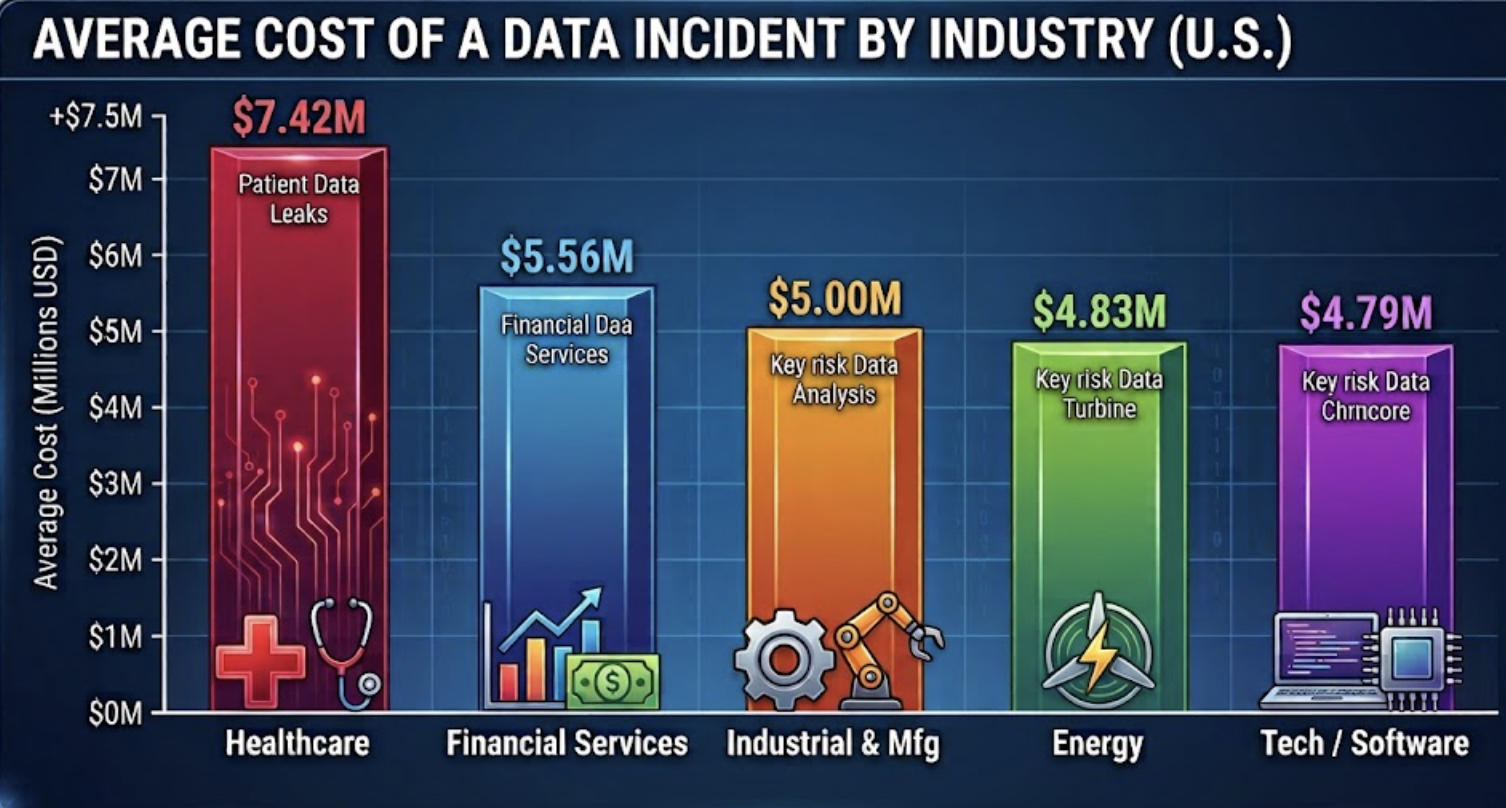
1. Healthcare & Life Sciences ($7.42M Average Impact)
Healthcare carries the longest incident lifecycles in the economy—averaging 279 days from exposure to resolution. Between strict HIPAA mandates, state-level health data acts (like Washington’s My Health My Data Act), and heavy class-action exposure around web trackers on patient portals, non-compliance in healthcare quickly triggers systemic operational freezes.
2. Financial Services & Fintech ($5.56M Average Impact)
Fintech companies operate under a dense mesh of state laws, GLBA requirements, and international frameworks. When a financial platform fails a vendor privacy audit, the financial hit isn’t just regulatory—it’s immediate termination of institutional banking partnerships and distribution agreements.
3. Industrial, Energy & Supply Chain ($4.83M–$5.00M Average Impact)
Operational technology (OT) and manufacturing environments increasingly gather personal data through worker safety wearables, IoT equipment, and vendor portals. Because these sectors historically underinvested in consumer-grade privacy pipelines, retrofitting legacy systems during an active enforcement inquiry creates massive productivity drag.
State Regulatory Fracturing: The Multi-State Tax
The state regulatory landscape has officially broken open. With over 19 state-level comprehensive privacy statutes actively enforced across the country—and more taking effect each year—the concept of “we’ll just comply with California” is obsolete.
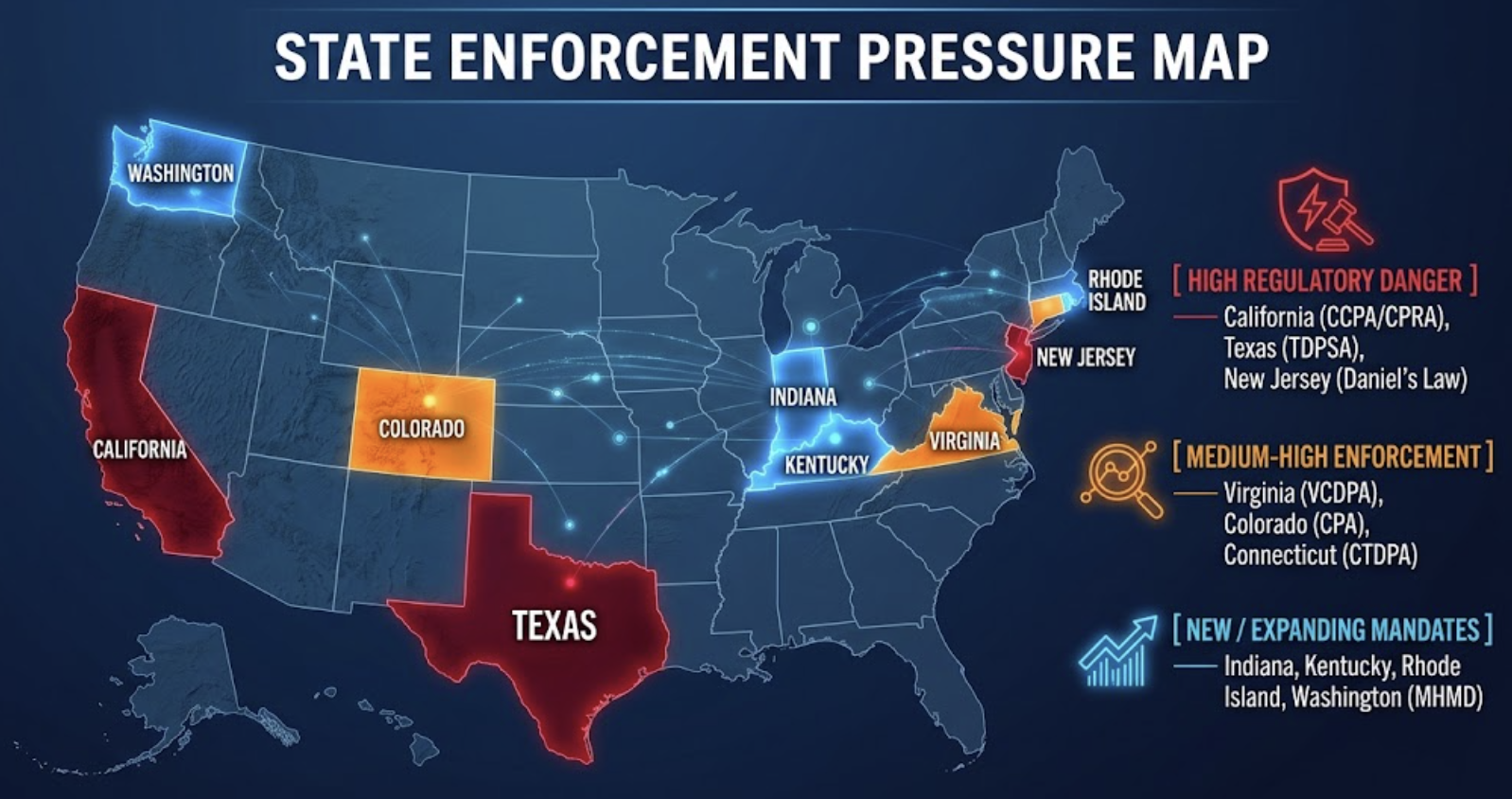
In 2025 alone, state privacy fines exceeded $3.4 billion, driven by aggressive enforcement targeting hidden tracking scripts, automated opt-out rejections, and failures to handle Data Subject Requests (DSRs) within strict statutory timelines.
When a company relies on fragmented, manual compliance across 20 different state standards, every new jurisdiction adds exponential engineering overhead. A single missed opt-out signal in a strict-liability state like New Jersey can result in loss of operations, while failing to honor a opt-out preference signal in California or Texas exposes the company to state AG enforcement actions that carry seven-figure penalties.
The fragmentation of American privacy law has created a distinct hierarchy of regulatory exposure, dividing state frameworks into three clear threat tiers. At the top sits High Regulatory Danger, anchored by California, Texas, and New Jersey. California’s dedicated privacy agency (CalPrivacy) actively levies strict fines, Texas’s specialized AG unit aggressively investigates unconsented data profiling, and New Jersey’s Daniel’s Law introduces strict-liability private actions capable of triggering domain forfeitures and total asset seizures as we saw recently with the Radaris website seizure.
In the second tier, Medium-High Enforcement states like Virginia, Colorado, and Connecticut enforce mature statutes backed by active Attorney General oversight and mandatory Universal Opt-Out Mechanism (UOOM) processing requirements.
Finally, the New / Expanding Mandates tier captures the expanding compliance perimeter—encompassing incoming omnibus statutes in Indiana, Kentucky, and Rhode Island, along with specialized legislation like Washington’s My Health My Data Act, which introduces private rights of action for non-traditional health data collection. Operating across these jurisdictions requires a unified, automated data infrastructure rather than a state-by-state patchwork solution.
The Hidden Revenue Killer: Procurement Friction
The least understood cost of privacy non-compliance happens inside the enterprise sales pipeline.
Modern enterprise procurement teams no longer treat privacy assessment questionnaires as rubber-stamp exercises. Before an enterprise signs a SaaS contract, vendor risk management teams run real-time checks:
-
Does the vendor support automated opt-out preference signals (GPC)?
-
Can they programmatically delete customer records across downstream sub-processors within 10 to 30 days?
-
Do they pass unconsented telemetry data to third-party ad networks or AI models?
When a vendor fails these checks, the buyer doesn’t issue a warning—they drop the vendor and move to a compliant competitor. Surveys of B2B procurement leaders show that 69% of enterprise buyers have abandoned a deal due to trust and data management concerns with a prospective software provider.
The Modern Compliance Mandate: Treat Privacy as Infrastructure
The financial data makes one thing unambiguous: non-compliance is no longer a legal risk to be managed with fine print. It is an engineering and operational failure that destroys enterprise value.
Companies that successfully keep non-compliance costs at zero follow three rules:
-
Automate DSR Ingestion: Move away from manual support tickets. Build real-time, event-driven deletion pipelines that propagate opt-out signals across primary databases, secondary caches, and third-party vendors simultaneously.
-
Eliminate Unsanctioned Data Leaks: Audit client-side code, pixels, and SDKs. Unsanctioned tracking scripts on marketing pages remain the single largest vector for state class-action claims and regulatory scrutiny.
-
Govern AI Data Ingress: As teams adopt generative AI tools, enforce strict ingestion filters to ensure customer personal information isn’t routinely passed into unmonitored model contexts—a fast-emerging source of multi-million-dollar compliance exposure.
Privacy non-compliance is optional. The $14.8 million price tag for ignoring it is not.