If you work at a financial institution you will want to get your privacy compliance and AI governance posture in place because the FTC is actively looking for violations.
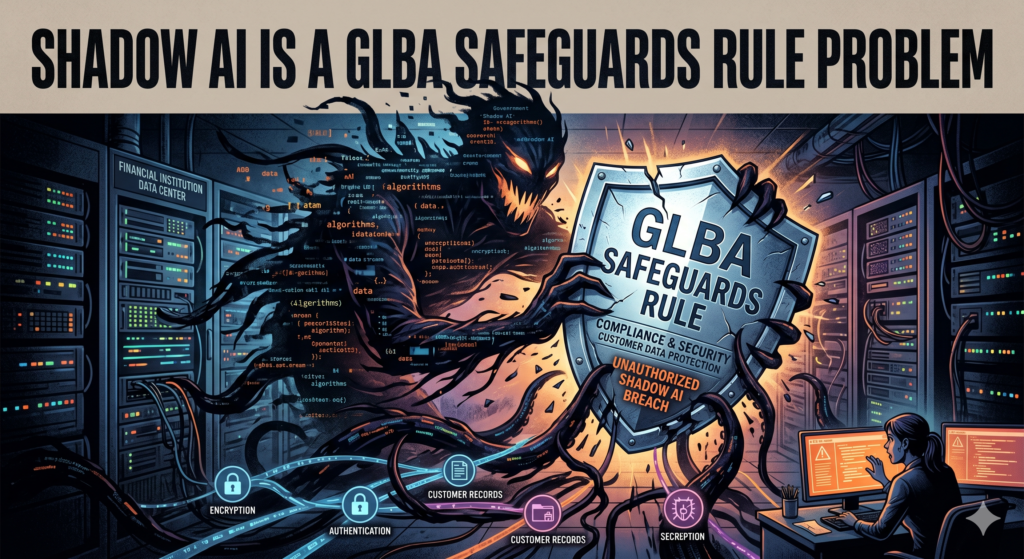
Your employees are not trying to create a compliance crisis. They are trying to do their jobs faster. But the AI tools they are reaching for — the meeting summarizers, the document drafters, the browser extensions that turn a client spreadsheet into a trend analysis in thirty seconds — are quietly building one of the most concrete regulatory exposures in the financial services sector right now.
It is called Shadow AI. It is governed, whether your institution knows it or not, by the FTC’s GLBA Safeguards Rule. And the combination of widespread employee adoption, institutional non-awareness, and a 30-day mandatory breach notification clock makes it one of the more urgent compliance problems that financial institutions and their counsel are not yet treating with appropriate seriousness.
This piece lays out the regulatory framework, the specific Safeguards Rule provisions at issue, the notification exposure, and the governance program elements that close the gap before a regulator has to find it for you.
What Shadow AI Actually Looks Like Inside a Financial Institution
Shadow AI is not exotic. It is not a sophisticated external attack. It is an employee pasting a customer account summary into ChatGPT to draft a talking-points memo before a client call. It is a financial analyst uploading a client portfolio spreadsheet into a free-tier AI tool to generate trend analysis. It is a loan officer using the embedded AI assistant inside a video conferencing platform to auto-generate meeting notes that include customer names, account numbers, and income figures.
The behavior is pervasive. A 2024 survey of more than 7,000 workers across seven countries found that 38% of employed respondents who use AI tools have submitted sensitive work-related information to AI platforms without their employer’s knowledge. A separate 2024 survey of 6,000 knowledge workers found that half of all employees qualify as Shadow AI users by definition — and 46% said they would continue using AI tools even if their employer prohibited them. Research firm Cyberhaven tracked a 485% increase in corporate data pasted into AI tools between March 2023 and March 2024, with 27.4% of that data classified as sensitive.
The data categories employees are sharing are not incidental. Financial records account for 31.2% of the sensitive data flowing into unapproved AI tools. Client information accounts for 24.7%. Legal documents make up a significant share of the remainder. For a financial institution, those numbers describe nonpublic personal information (NPI) — the precise category of customer data that federal law requires you to protect, document, monitor, and control.
The productivity motivation is real. The regulatory exposure it creates is equally real. The problem is that the two are rarely evaluated together at the executive level, which is exactly where the Safeguards Rule places the obligation.
The GLBA Safeguards Rule: Scope and Coverage
The Gramm-Leach-Bliley Act requires financial institutions to protect the nonpublic personal information of their customers. The FTC’s Safeguards Rule — substantially updated in 2021 and further amended through 2024 — translates that statutory obligation into specific, auditable program requirements.
Coverage under the Safeguards Rule is broader than many compliance teams assume. The rule applies not only to depository institutions but to the full range of nonbank financial institutions that fall within the FTC’s jurisdiction: mortgage brokers, auto dealers that arrange financing, insurance companies and brokerages, investment advisers not registered with the SEC, tax preparers, fintech companies, payday lenders, debt collectors, and many others. If your business is a “financial institution” under GLBA’s functional definition and you collect NPI from customers in connection with financial products or services, the Safeguards Rule applies to you.
The 2021 amendments moved the rule from a principles-based framework to a prescriptive, controls-based standard that specifies the technical and administrative elements a compliant information security program must include. Shadow AI implicates at least three of those elements directly.
Three Safeguards Rule Violations Hiding in Your Productivity Stack
Access Controls — 16 C.F.R. § 314.4(c)(1)
The Safeguards Rule requires covered entities to implement access controls to authenticate and permit access only to authorized users, and to limit authorized users’ access to only the customer information they need to perform their duties. A third-party AI platform that an employee reaches outside approved channels is, by definition, not an authorized user of your customers’ NPI. When an employee uploads that data, the access control framework has not been circumvented by an attacker — it has been bypassed by a well-intentioned productivity decision. The regulatory consequence is the same either way.
The access control obligation is not merely technical. It requires your institution to have identified what constitutes NPI, mapped where it exists across your systems, and implemented controls that prevent its exposure to unauthorized parties. Shadow AI proliferation is direct evidence that those controls are incomplete.
Activity Logging — 16 C.F.R. § 314.4(c)(8)
The rule requires covered entities to implement policies, procedures, and controls designed to monitor and log the activity of authorized users and detect unauthorized access or use of customer information. If employees are using personal accounts on free-tier AI platforms — and research indicates that 73.8% of ChatGPT usage in enterprise environments occurs through personal accounts — your logging and monitoring systems have no visibility into that activity. You cannot detect what you cannot see, and the absence of detection capability does not eliminate the regulatory obligation to have it.
This provision creates a meaningful enforcement exposure. An institution whose monitoring systems have no record of Shadow AI usage is not demonstrating compliance — it is demonstrating a monitoring gap that a regulator will characterize as a program deficiency.
Service Provider Oversight — 16 C.F.R. § 314.4(f)
The Safeguards Rule explicitly requires financial institutions to oversee their service providers by selecting only providers capable of maintaining appropriate safeguards and requiring those providers, by contract, to implement and maintain such safeguards. An AI tool that an employee downloaded or accessed without IT approval has no vendor contract, no security assessment, no data handling agreement, and no GLBA-compliant safeguards commitment. It is functionally a shadow service provider — one to which your institution’s customers’ NPI has been exposed without any of the legal protections the rule requires.
The service provider oversight obligation applies to the relationship as a whole, not merely to what an individual employee chose to do. If your institution lacks a vendor management process that would have prevented this tool from accessing customer data, the program is deficient regardless of whether any individual employee acted in bad faith.
The 30-Day Notification Clock
The abstract regulatory exposure becomes acutely concrete when the FTC’s 2023 breach notification amendment enters the analysis.
As of May 13, 2024, covered financial institutions must notify the FTC within 30 days of discovering a security breach involving the data of 500 or more consumers. A “security breach” under the rule is defined as the unauthorized acquisition of unencrypted customer information. Critically, the rule presumes unauthorized acquisition has occurred any time there is unauthorized access to unencrypted customer information — unless the institution can affirmatively demonstrate otherwise.
There are no exceptions for breaches unlikely to cause consumer harm. There are no exceptions for breaches involving less sensitive data categories. The threshold is unauthorized access to unencrypted NPI involving 500 or more consumers.
Walk through the math on a routine Shadow AI scenario: a financial analyst uploads a customer portfolio report containing 600 account records to a free-tier AI tool operating through a personal account with no enterprise data handling agreement. Your institution discovers this fact. Under a plain reading of the Safeguards Rule’s breach notification provision, you are arguably looking at a notification event and a 30-day countdown from the date of discovery — not the date of the upload.
Beyond the federal obligation, most states maintain independent data breach notification laws that may require disclosure to affected consumers, the state attorney general’s office, and in some cases national credit bureaus. The interplay between the federal 30-day clock and varying state notification timelines is a compliance complexity that institutions without tested incident response plans are not positioned to navigate under time pressure.
Why Executive Awareness Is a Regulatory Requirement, Not a Management Choice
The temptation for senior leadership is to treat Shadow AI as an IT department problem. The Safeguards Rule’s governance requirements make that framing legally untenable.
The amended rule requires covered institutions to designate a single Qualified Individual (QI) to oversee and implement the institution’s information security program. That person must report in writing to the board or senior governing body at least annually on the state of the program. The board or senior leadership is expected to review and approve that report. Oversight is not delegated — it is owned at the governance level.
In practice, the QI requirement is one of the most frequently ignored elements of Safeguards Rule compliance. Many covered institutions have not formally designated a QI. Many that have designated one have not established the annual written reporting mechanism the rule requires. Those gaps are independently citable program deficiencies, separate from any Shadow AI issue.
The governance structure matters for Shadow AI liability because it establishes the accountability chain that regulators will examine when an incident occurs. “We didn’t know employees were using unauthorized AI tools” is not a Safeguards Rule defense when the rule required the institution to have a program reasonably designed to detect, prevent, and respond to exactly this kind of unauthorized data exposure. The relevant regulatory question is not whether leadership had actual knowledge of specific Shadow AI usage — it is whether the institution’s information security program was reasonably designed to surface that risk. If it was not, the program was deficient before the incident occurred.
A Practical Governance Framework for Closing the Gap
Shadow AI proliferates because employees have real productivity needs that legitimate, sanctioned tools have not yet been deployed to meet. The governance gap is a business problem as much as a compliance problem. Prohibition without substitution does not work — the survey data showing 46% of employees would continue using AI tools after an explicit ban is evidence of that.
A practical framework for financial institutions involves five operational elements:
- Shadow AI audit: Conduct a current-state assessment of AI tool usage across the enterprise. Network monitoring can detect traffic to AI platforms. Employee surveys, conducted with an amnesty period for voluntary disclosure, surface usage patterns that monitoring misses. IT teams often have visibility into Shadow AI usage that has not been escalated to compliance or legal. Start there before building policy.
- Data classification: The Safeguards Rule’s access control and logging obligations are keyed to customer information and NPI. A current, accurate data classification policy — distinguishing regulated NPI from general business data — is the prerequisite for governing which AI tools may interact with which data categories. Without it, access control and logging requirements cannot be meaningfully implemented.
- Vendor vetting and contracting for approved AI tools: Every AI tool that touches customer data must be evaluated as a service provider under the Safeguards Rule. That means security assessments, written data handling agreements, and contractual commitments to implement GLBA-compliant safeguards. Many enterprise AI platforms can satisfy these requirements — but they must be formally engaged through a vendor management process, not casually adopted at the employee level.
- Role-specific employee training: General cybersecurity awareness training does not satisfy the Safeguards Rule’s training requirements in this context. Employees need to understand which specific data categories constitute NPI, which tools are and are not approved, and what the personal and institutional consequences of Shadow AI usage are. Training must be role-appropriate — what a loan officer needs to know differs from what a financial analyst needs to know — and periodically updated as the AI tool landscape evolves.
- Incident response plan testing: Most institutional incident response plans were drafted with external threat actors in mind. A Shadow AI data leakage scenario — where the exposure source is an employee productivity tool rather than an attacker — presents different detection, containment, and notification challenges. Run a tabletop exercise built around this scenario and map the institution’s response against the 30-day FTC notification clock and applicable state notification timelines. Gaps identified in a tabletop exercise are remediable. Gaps identified after an actual incident are not.
The Qualified Individual Checklist
For institutions working to close their Shadow AI governance gap, the Qualified Individual’s program review provides a useful organizing framework. Before the next annual board report, the QI should be able to answer affirmatively to each of the following:
- Has the institution conducted a current-state Shadow AI audit and documented its findings?
- Does the institution’s data classification policy accurately identify NPI and map its location across enterprise systems?
- Has the institution identified and formally contracted with AI vendors as service providers under the Safeguards Rule?
- Are access controls in place that would prevent employee upload of NPI to unapproved third-party platforms?
- Does the institution’s logging and monitoring infrastructure have visibility into AI tool usage, including usage through personal accounts?
- Have employees received role-specific training on approved AI tools and the NPI categories they may not expose to unapproved platforms?
- Has the institution’s incident response plan been tested against a Shadow AI data leakage scenario within the past 12 months?
If the answer to any of these questions is no, the information security program has a documented gap — one that the institution should remediate before a regulator identifies it first.
The Enforcement Reality
The FTC has demonstrated consistent willingness to bring Safeguards Rule enforcement actions against institutions with program deficiencies, and the 2021 and 2023 amendments significantly expanded both the specificity of the rule’s requirements and the breadth of what constitutes a citable violation. The agency does not need to demonstrate that a breach caused consumer harm to establish a program deficiency — it needs to demonstrate that the program was not reasonably designed to prevent the kind of exposure that occurred.
Shadow AI is precisely the kind of inside threat that the amended Safeguards Rule was designed to address. The regulatory framework has anticipated the problem. What it now requires is that your institution’s governance program anticipate it too.
The cost of closing the Shadow AI governance gap — audit, classification, vendor contracting, training, and incident response testing — is measurable and manageable. The cost of discovering the gap through an FTC enforcement action, measured in notification obligations, civil penalties, mandatory third-party assessments, and reputational consequences, is not.
GLBA Safeguards Software from Captain Compliance
Building a GLBA Safeguards Rule-compliant information security program that accounts for AI tool risk, establishes defensible vendor oversight, and positions your institution for regulatory scrutiny requires both regulatory precision and practical implementation expertise. Captain Compliance helps financial institutions, fintech companies, insurance companies, and their legal and compliance teams build the governance frameworks, vendor management programs, and incident response infrastructure the Safeguards Rule requires using our leading privacy software solutions.