Consent management is about to undergo its most meaningful architectural shift since the introduction of the IAB Europe Transparency & Consent Framework (TCF). Here is an overview of the Navigator Consent framework based on available information online that we gathered. If you have any questions about implementing and changes to your CMP consult with a Captain Compliance privacy superhero by booking a demo below or registering above on the top right.
For years, Consent Management Platforms (CMPs) have operated in a fragmented, website-controlled environment:
- Every CMP implements its own UI
- Browser extensions “scrape” banners to interpret choices
- Consent signals lack standardization across contexts
- Users experience constant friction and repetition
The proposed navigator.consent browser API changes that.
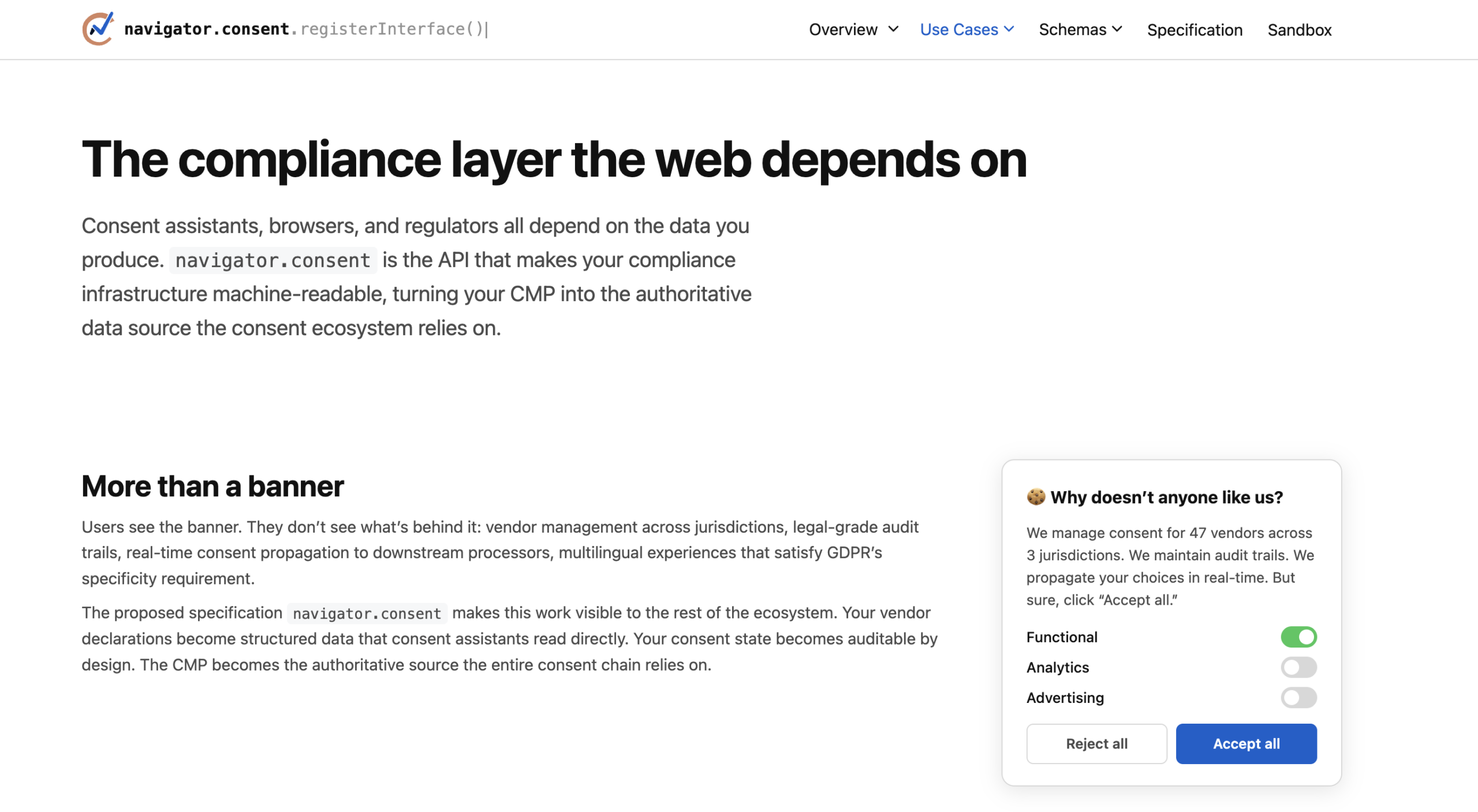
It introduces a standardized, browser-level coordination layer between:
- CMPs (like Captain Compliance)
- Privacy assistants (extensions, agents)
- Browsers themselves
And critically — it does this without removing CMP ownership of compliance.
What Is navigator.consent (In Plain Terms)
At its core:
navigator.consentis a browser-native API that standardizes how consent is communicated, updated, and audited across websites and tools. (navigator.consent)
Instead of reverse-engineering banners, systems now interact through a structured, machine-readable interface.
The Key Shift
Old model:
- CMP UI → user clicks → opaque signal → vendors
New model:
- CMP registers structured data → browser API → assistant/tools interact → auditable state
This is a transport and coordination layer, not a replacement for CMPs.
The Core Architecture (What’s Actually Changing)
1. Four Primary Actors
The spec defines a clean ecosystem:
- User
- Browser
- CMP (DOM context)
- Privacy Assistant (extension context)
This is important — because it formally legitimizes privacy assistants as first-class participants.
2. CMPs Become Structured Data Providers
CMPs must now explicitly register:
- Vendors
- Purposes
- Consent states
Instead of rendering only UI, they expose machine-readable consent metadata.
CMPs declare vendors and purposes through a structured API—no scraping, no guessing.
3. Privacy Assistants Become Executors
Privacy assistants (think next-gen tools beyond GPC) can:
- Read vendor/purpose structures
- Apply user preferences programmatically
- Update or withdraw consent
- Trigger UI behavior (show/hide)
This creates persistent, cross-site preference enforcement.
4. Browser Becomes the Arbitration Layer
The browser enforces:
- Permission boundaries
- Conflict resolution rules
- Event ordering
- Auditability
Example rule:
User-set preferences always override CMP or assistant decisions.
This is massive from a legal standpoint.
The API Surface (What Developers Actually Get)
The API introduces a clean set of methods:
CMP-side (website context)
registerInterface()registerVendors()registerPurposes()requestConsent()updatePreferences()withdraw()
Assistant-side (extension context)
getVendors()getPurposes()updatePreferences()withdraw()audit()show()/hide()
Regulatory layer
getRegulations()setRegulations()
This is a full lifecycle system, not just a read API.
Event-Driven Consent (A Huge Upgrade)
Consent is no longer a static snapshot — it becomes an event stream.
Each action generates a structured event:
updatewithdrawshowhideauditconsent_requestregulation_change
Each event includes:
- Timestamp
- Source (CMP, user, assistant, browser)
- Domain
- Payload
Why this matters
This creates:
- Forensic-grade audit trails
- Clear attribution (“who changed what”)
- Litigation defensibility (critical for CIPA / ECPA claims)
Multi-CMP Reality (Finally Addressed)
Today:
- Multiple CMPs = chaos
- Iframes break consistency
- Consent signals conflict
The spec introduces:
- Registration isolation
- Aggregated queries
- Deterministic conflict resolution
Key rule:
User-originated preferences override all others.
This is the first serious attempt at solving multi-CMP environments at scale.
How This Differs From Existing Standards
vs Global Privacy Control (GPC)
- GPC = binary signal (opt-out)
navigator.consent= granular control (vendor + purpose)
They are complementary, not competing.
vs IAB TCF
- TCF = ecosystem standard (adtech-focused)
navigator.consent= browser-level interoperability layer
Key distinction:
- TCF is mostly read-only signaling
navigator.consentsupports read + write + control
Regulatory Implications (Where This Is Headed)
This is not happening in a vacuum.
The spec explicitly references:
- EU Digital Omnibus proposal (interoperability mandates)
- Browser regulation under DMA
- Academic research showing CMP fragmentation failures
Translation for operators:
Regulators are signaling:
- Standardized consent interfaces are coming
- Browser-level enforcement will increase
- Dark pattern scrutiny will intensify
CMPs That Win in This Model
Winners will be platforms like Captain Compliance’s CMP that:
- Expose structured vendor/purpose taxonomies cleanly
- Maintain real-time consent state synchronization
- Provide audit-grade logs and provenance tracking
- Support programmatic preference updates
- Integrate seamlessly with browser APIs
CMPs That Lose
Legacy platforms that rely on:
- Static scripts
- Weekly scans
- UI-only consent capture
- Weak audit trails
…will struggle in a machine-readable, event-driven ecosystem.Risks & Open Questions
This is still a draft spec — and there are real uncertainties:
1. Browser Adoption
- Requires Chrome, Safari, Firefox buy-in
- Without this, it remains theoretical
2. Power Shift to Browsers
- Browsers become enforcement gatekeepers
- Potential for overreach or fragmentation
3. Privacy Assistant Ecosystem
- Who controls assistants?
- Will large platforms dominate this layer?
4. Standard Fragmentation Risk
If:
- EU pushes one model
- US evolves another
We could see competing standards again.
Strategic Takeaway
navigator.consent is not just a technical proposal.
It’s a blueprint for the next generation of consent infrastructure:
- Browser-native
- Event-driven
- Interoperable
- Auditable
And most importantly:
It shifts consent from a UI problem to a systems architecture problem.
For companies serious about compliance, this changes the roadmap:
- Consent is no longer just banners
- It’s APIs, events, and audit systems
- It’s infrastructure — not UX
And the platforms that treat it that way will define the next decade of privacy tech.