If you’ve received a demand letter for an ADA compliance lawsuit or a data privacy lawsuit for running trackers on your site don’t worry we provide the compliance software to protect you against any future lawsuits and can help clients of ours with responses to help get cases either fully dismissed or a minimal settlement thanks to our deep experience dealing with clients each week who are dealing with these legal issues.
Did You Receive a Demand Letter or Lawsuit?
Don’t respond alone. A 30-minute call could save you thousands — and reveal a bigger risk most businesses overlook.
You opened your mail. Or maybe it was a process server. Either way, there it is: a demand letter or federal complaint from Gottlieb & Associates, a New York-based law firm, alleging your website violates the Americans with Disabilities Act or violated the Electronics Communication Privacy Act for running Facebook’s Meta-Pixel.
Your stomach dropped. We get it. But before you do anything including calling the first lawyer you find on Google or ChatGPT — you need to understand exactly what you’re dealing with, what it will realistically cost you, and why the lawsuit you just received may actually be the least of your website’s legal problems.
Who Is Gottlieb & Associates?
Gottlieb & Associates PLLC is a New York-based boutique litigation firm that focuses almost exclusively on plaintiff-side disability rights and consumer protection cases. The firm’s principal attorneys are Jeffrey M. Gottlieb, Dana L. Gottlieb, and Michael A. LaBollita.
The firm describes itself as dedicated to representing disabled persons whose rights have been violated under the Americans with Disabilities Act. It operates on a contingency fee basis, meaning attorneys collect fees only when they win — which creates a strong structural incentive to file high volumes of cases.
200+ Lawsuits filed in H1 2025 alone
In the ADA website litigation space, Gottlieb & Associates is among the most prolific filers in the United States. Industry data shows the firm filed the highest number of ADA website lawsuits in November 2024 — 54 in a single month, representing nearly 20% of all such cases filed nationally that month. In the first half of 2025, the firm filed over 200 lawsuits, placing it among the top two most active firms in the country alongside Manning Law, APC.
— Blank Rome LLP Legal Analysis
The firm’s targets are broad. If your business has a public-facing website — and especially if you’re in retail, fashion, food and beverage, healthcare, or beauty — you are in their crosshairs. Common plaintiffs the firm represents include individuals like Denise Crumwell, Victor Lopez, Lawrence Young, Henry Tucker, and Donna Hedges, who file on behalf of themselves and all other persons similarly situated.
How Their ADA Lawsuit Machine Works
Understanding Gottlieb & Associates’ methodology is the first step to responding strategically. Their operation follows a well-worn template:
Step 1: Automated Site Scanning
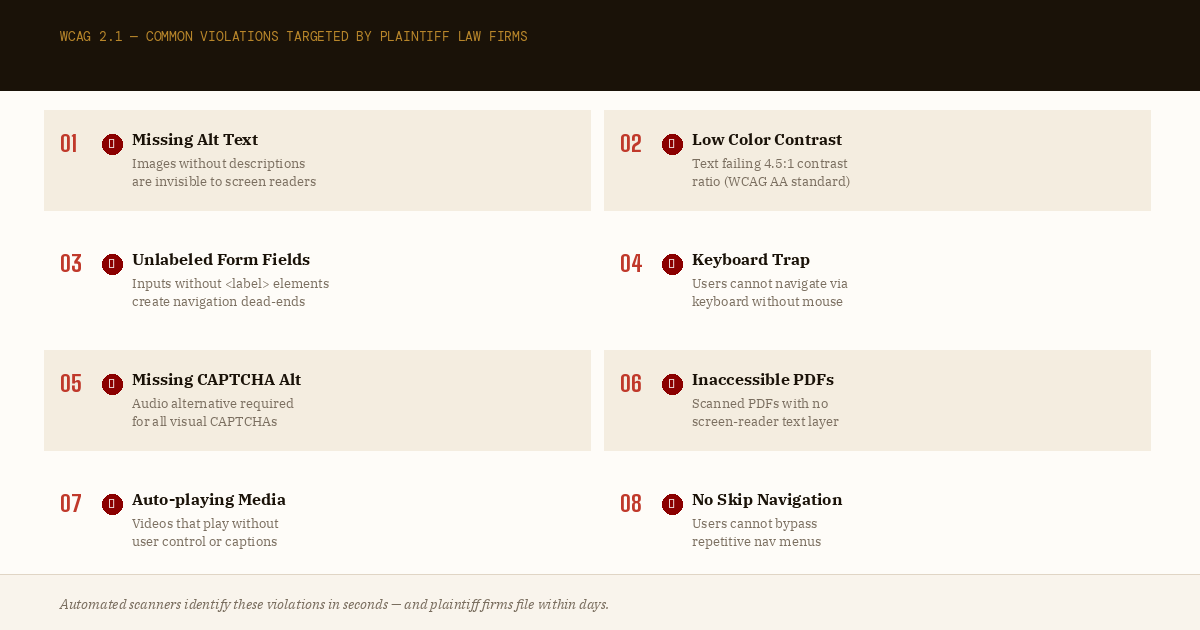
Plaintiff law firms in this space use automated tools to scan thousands of websites simultaneously, flagging technical accessibility failures. Common violations they target include:
- Missing or inadequate alternative text (alt-text) on images
- Poor color contrast ratios that screen readers cannot navigate
- Forms without proper labels
- Missing CAPTCHA alternatives
- PDFs that are not screen-reader compatible
- Videos without closed captions
- Navigation that cannot be operated by keyboard alone
Step 2: Boilerplate Complaints Filed En Masse
Once a violation is flagged, the firm files a near-identical complaint in federal court — typically in the Southern District of New York — on behalf of a visually impaired “tester” plaintiff. The complaints allege the site’s inaccessibility violates Title III of the ADA, as well as the New York State Human Rights Law (NYSHRL) and the New York City Human Rights Law (NYCHRL) where applicable.
Step 3: Settlement Demand
The firm sends or serves a demand that typically includes: a monetary payment, a requirement that you make your website accessible, often an independent audit, and attorney’s fees. Because fighting these cases costs more than settling, most businesses pay.
⚠ Important to KnowThe firm’s complaints are largely boilerplate, which has occasionally led to errors — allegations that don’t actually apply to the specific website in question. An experienced defense attorney can identify these discrepancies, which can significantly affect negotiations.
Also critical: Gottlieb & Associates filed Braille gift card lawsuits in addition to website cases, expanding their reach to physical products. Their legal creativity means the ADA exposure your business faces may extend beyond your website.
What You’re Actually Facing: Costs & Timeline
Let’s be direct. Here’s a realistic picture of what an ADA website lawsuit from Gottlieb & Associates will cost you:
| Scenario | Estimated Cost Range | Timeline |
|---|---|---|
| Demand letter — early settlement before lawsuit filed | $5,000 – $10,000 | 4–8 weeks |
| Federal complaint filed — settled within 60–90 days | $10,000 – $20,000 + attorney fees | 2–4 months |
| Contested litigation — motions phase | $30,000 – $75,000+ | 6–18 months |
| Default judgment (you ignore it) | Full damages + interest + fees | Permanent record |
| Website remediation costs (required regardless) | $2,000 – $15,000 | Ongoing |
Settlement amounts for small businesses typically land between $5,000 and $20,000, with those resolving before a complaint is filed often settling for less. Size matters: firms are often willing to reduce demands when defendants can document limited revenue. But the settlement is only part of the cost — attorney fees, website repairs, mandatory audits, and ongoing monitoring can easily double or triple your total exposure. If you don’t fix your website expect to have 5-10 ADA lawsuits a year.
Do Not Ignore ThisFederal lawsuits have a 21-day response deadline once you are formally served. Missing this deadline results in a default judgment — meaning you automatically lose, the plaintiff wins everything they asked for, and you have minimal recourse. If you’ve received a complaint (not just a letter), your clock is running right now.
Immediate Steps If You’ve Been Served
Do not respond to the plaintiff’s attorney directly
Anything you say can be used to strengthen their case. Plaintiff ADA attorneys are specialists who know exactly how to leverage casual conversations. All communications should go through your legal representative.
Hire an ADA Title III defense specialist — not a general attorney
This is a highly technical area of law. You need counsel who understands WCAG standards, how screen readers interact with code, and how Southern District of New York judges typically handle these cases. Verify they have experience specifically defending against Gottlieb & Associates.
Immediately begin documenting your good-faith remediation efforts
Courts and opposing counsel respond more favorably to defendants who act quickly to fix problems. Documented remediation — even if incomplete — strengthens every negotiating position. Don’t just install an accessibility widget; courts are increasingly skeptical of overlay-only solutions.
Check the complaint for errors
Because Gottlieb & Associates files high volumes using templated complaints, errors do occur — including allegations that reference barriers that don’t exist on your specific site. An experienced attorney will audit this closely.
Run a full website audit — ADA AND privacy
While you’re reacting to the ADA lawsuit, don’t miss the bigger picture. Your site almost certainly has privacy compliance gaps that carry far larger financial exposure than the ADA claim you just received and run a privacy audit right away.
Not Sure Where to Start?
We help businesses respond to ADA demands and fix the underlying compliance gaps — including the privacy issues that carry far greater risk. Our team can review your situation and help fix your website with our privacy and compliance software solutions.
What Not to Do
Businesses facing ADA lawsuits for the first time make predictable — and costly — mistakes. Avoid these:
- Don’t install an accessibility overlay and call it done. Tools like accessiBe, UserWay, and AudioEye modify how your site appears to some assistive technology users, but they don’t fix underlying source code. Courts are increasingly rejecting these as adequate compliance — the FTC settled with accessiBe in April 2025 for deceptive marketing claims about WCAG compliance. Gottlieb & Associates continues to sue sites that use these widgets.
- Don’t try to ignore the lawsuit to see if it goes away. It won’t. Default judgments are final, enforceable, and damaging to your credit and business records.
- Don’t hire a generalist attorney to handle this. ADA Title III digital accessibility cases require specialized knowledge of WCAG technical standards and federal civil procedure. A lawyer without ADA defense experience can dramatically increase your costs.
- Don’t admit knowledge of the accessibility barriers in writing or verbally. This can affect damages calculations in negotiations.
- Don’t assume that fixing your site ends your risk. Nearly half of businesses sued in 2024 had already been sued before. Once Gottlieb & Associates or any serial filer identifies your site as non-compliant, it enters a pool of known targets.
Why Your Website’s Privacy Violations Are a Far Bigger Threat
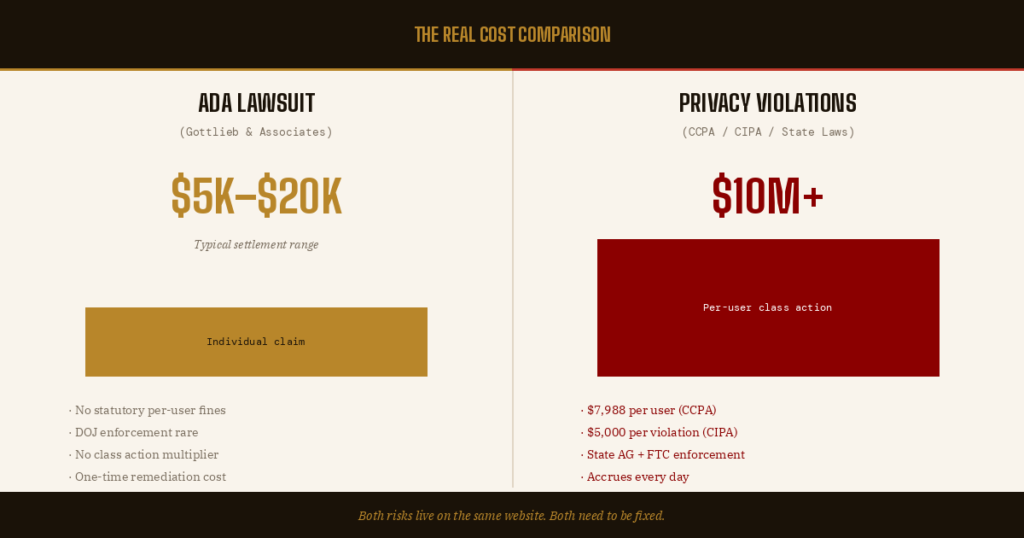
Here’s what most businesses miss when they’re staring down a Gottlieb & Associates lawsuit: the ADA claim is often the smallest legal risk your website carries.
While you’re worried about a $10,000–$20,000 ADA settlement, your website is almost certainly engaging in data collection practices that expose you to class-action lawsuits with per-user statutory damages, state attorney general enforcement, and FTC investigations. Recent cases have been up to $5 million for violations.
This isn’t hypothetical. A new wave of litigation is accelerating across the country under laws with far sharper teeth than the ADA’s Title III:
California’s Privacy Laws: CCPA, CPRA, and CIPA
The California Consumer Privacy Act (CCPA) and its amendment, the California Privacy Rights Act (CPRA), impose statutory penalties of up to $7,988 per intentional violation — and that number is applied per consumer. A single class action representing tens of thousands of California visitors to your website can result in liability in the tens of millions of dollars. Just ask Healthline or Honda how they feel about paying out big fines to California?
Even more aggressive is the California Invasion of Privacy Act (CIPA), which courts have increasingly applied to websites that use third-party tracking pixels, session recording tools, and embedded analytics. CIPA’s statutory damages reach the greater of $5,000 or triple actual damages — per violation. A recent court ruling affirmed CIPA’s private right of action, and courts have ruled that CCPA claims do not preempt CIPA claims, meaning plaintiffs can pursue both simultaneously.
High Exposure AlertIf your website uses any of the following, you likely have CCPA, CPRA, or CIPA exposure: Google Analytics, Meta Pixel (Facebook Pixel), TikTok Pixel, Hotjar, FullStory, Microsoft Clarity, embedded YouTube videos, retargeting cookies, or any third-party advertising scripts.
These tools collect, share, or sell user data. Without proper consent mechanisms, they can constitute violations of California, Virginia, Colorado, Connecticut, Texas, and a growing number of other state privacy laws.
The Rise of “Trap and Trace” Lawsuits
A new category of privacy class actions is emerging under California Penal Code Sections 638.51 and 637.2 — so-called “trap and trace” lawsuits. These allege that websites collecting user data without proper authorization are intercepting private communications. Industry reports flagged this trend explicitly in the 2024 ADA Annual Report as a significant escalation in litigation risk for website owners and firms like Swigart Law & Vivek Shah are going crazy filing lawsuits.
State Privacy Laws Expanding Nationwide
As of 2026, over 20 U.S. states have enacted comprehensive privacy legislation. Virginia, Colorado, Connecticut, Texas, Oregon, Montana, Florida, and others now have enforceable consumer privacy rights with real penalties. Your website may be out of compliance in multiple states simultaneously, each with its own penalty structure.
ADA vs. Privacy Violations: A Direct Cost Comparison
| Factor | ADA Lawsuit (Gottlieb) | Privacy Violations (CCPA/CIPA) |
|---|---|---|
| Typical settlement range | $5,000 – $20,000 | $100,000 – $10M+ |
| Class action risk | Limited (individual claims) | Very high — per-user damages multiply fast |
| Statutory damages per violation | No fixed fines under Title III | Up to $7,988 (CCPA) or $5,000 (CIPA) per user |
| Government enforcement | DOJ (rare for small businesses) | State AGs, FTC, CPPA actively pursuing cases |
| Plaintiff bar activity | High — ~40 active plaintiff firms | Rapidly growing — new firms entering weekly |
| Repeat lawsuit risk | High — ~50% of sued sites get re-sued | Ongoing — new violations accrue daily |
Real Enforcement Actions You Should Know About
- American Honda Motor Co. — Fined $632,500 by the California Privacy Protection Agency for failing to honor opt-out preference signals and imposing excessive verification hurdles on consumer requests.
- Sephora — $1.2 million CCPA settlement with California AG, plus injunctive requirements to honor opt-outs and Global Privacy Control signals.
- BetterHelp — FTC enforcement action over sharing users’ health information with advertising partners via tracking software. The court found that allowing tracking software amounted to an unauthorized disclosure.
- Harvard University — Paid $1.575 million in attorney costs and fees in an ADA case involving inaccessible online course content. The underlying remediation cost millions more.
How to Fix Both Problems — and Build Real Legal Protection
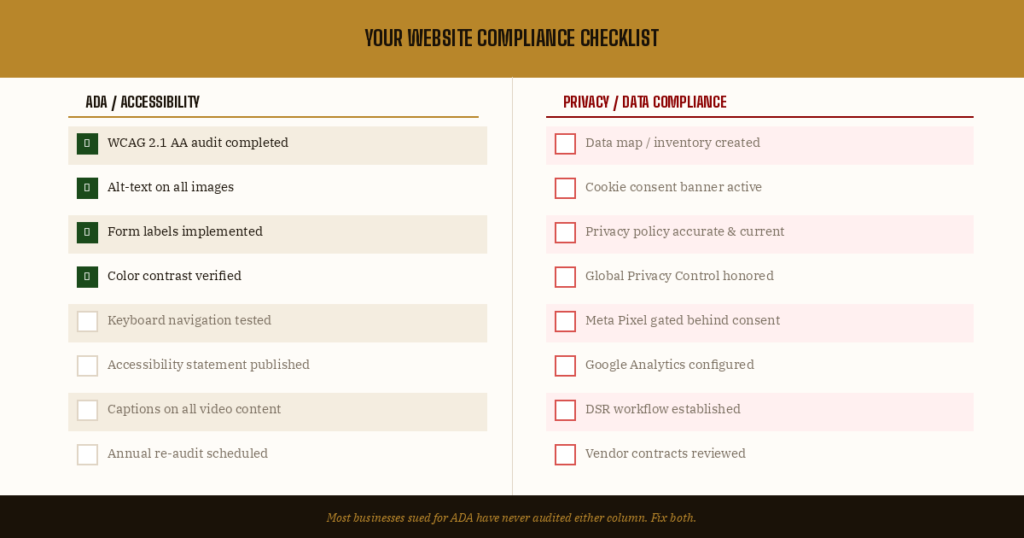
The good news: solving your ADA compliance and your privacy compliance involves much of the same underlying work — a thorough audit of your website, identification of what data is collected and shared, implementation of proper consent mechanisms, and ongoing monitoring.
Businesses that address both simultaneously are in the strongest legal position: they can demonstrate good-faith compliance to ADA plaintiffs while reducing the surface area for privacy class actions.
For ADA Compliance:
- Commission a full WCAG 2.1 AA audit by a certified accessibility specialist — not an automated scan alone
- Implement substantive code-level fixes (not just an overlay widget)
- Publish an accessibility statement with a feedback mechanism
- Establish ongoing monitoring and annual re-audits
- Train content editors to maintain accessibility as they add new content
For Privacy Compliance:
- Map all data collected from website visitors — including data shared with third parties through pixels, analytics, and ad tools
- Implement a compliant consent management platform (CMP) that properly gates data collection
- Honor Global Privacy Control (GPC) signals, which California law now requires
- Update your privacy policy with specific, accurate disclosures — not vague boilerplate
- Establish data subject request (DSR) workflows for consumer access, deletion, and opt-out rights
- Review and update contracts with any third-party vendors who receive user data
The Most Important Insight in This Article
If Gottlieb & Associates just sued you — or sent you a demand letter — treat it as a wake-up call. Not just about accessibility. About the entire legal compliance posture of your website.
The firm’s lawsuit likely cost them almost nothing to file. But the data your website is currently collecting, sharing, and selling without proper consent is accruing liability every single day — at a scale that can turn into a class action with damages that dwarf what you’re facing right now.
Businesses that address ADA and privacy compliance together, with proper counsel, get sued less, settle faster when they are sued, and pay significantly less when they do. Those that fix only the ADA problem while ignoring privacy are simply waiting for the next, larger lawsuit.
Talk to Our Compliance Team Today — Free Consultation
We work with businesses that have received ADA lawsuits or demand letters to address privacy compliance and work with WCAG accessibility standards to get your business compliant — because solving only one problem leaves you exposed to a much bigger one and privacy is the multi-million dollar problem you’ll want to fix right away.