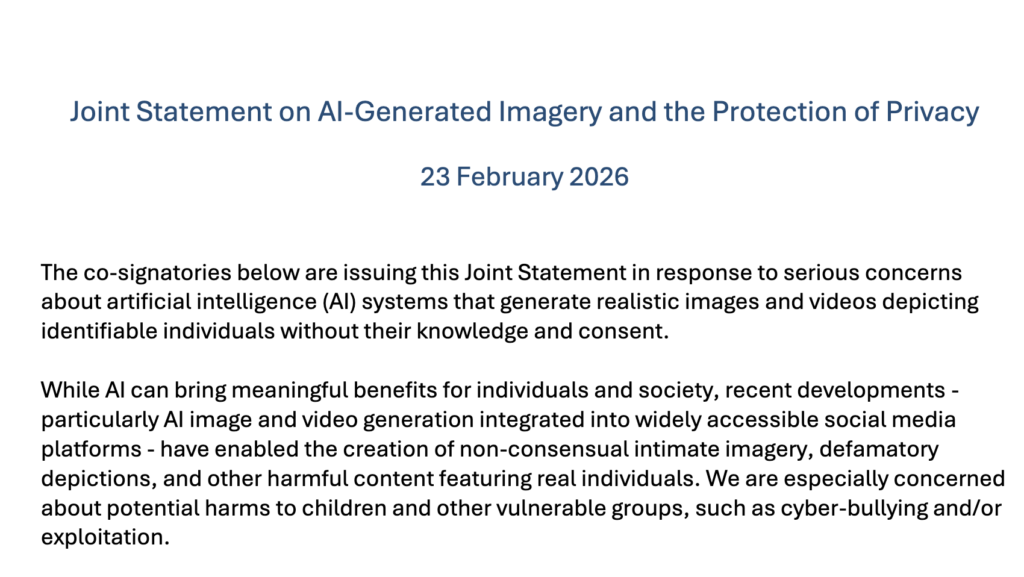
A coalition of 61 privacy and data protection authorities released a joint statement that reads less like a policy memo and more like a coordinated enforcement signal. The target is not “AI” in the abstract. It’s a specific class of harm that has accelerated from niche abuse to mainstream risk: AI systems that can generate realistic images and videos of identifiable people without their knowledge or consent.
The statement is concise, but its implications are expansive. It frames AI-generated imagery as a privacy problem, a child-safety problem, and—where the content is sexual or exploitative—often a criminal-law problem. It also collapses the most common defense platforms and developers reach for (“we’re just providing tools”) by emphasizing that organizations developing and deploying these systems are expected to engineer safeguards, provide transparency, and run responsive removal mechanisms as baseline governance—not optional add-ons after the first scandal.
What makes this moment different is the alignment. Privacy regulators have issued guidance on biometrics, facial recognition, and automated decision-making for years. But generative imagery pushes the issue from “data processing” into “identity integrity.” A deepfake can be created without access to the victim’s camera roll. A nudified image can be produced without an intimate photo ever existing. The harm is not merely that data was collected; it’s that someone’s likeness can be weaponized at scale.
Why Regulators Are Escalating Now
The joint statement acknowledges that generative AI can deliver meaningful benefits. But it places an unmistakable weight on the downside risks created by image and video generation features being integrated into widely accessible platforms. In other words: the distribution channel has matured, the friction has collapsed, and the “cost” of abuse is now a few prompts and a click.
Regulators highlight a set of harms that are now familiar to anyone tracking AI misuse:
- Non-consensual intimate imagery (including nudification and explicit deepfakes)
- Defamatory depictions and reputation sabotage featuring real individuals
- Cyberbullying and exploitation, with heightened risks for children and other vulnerable groups
- Social manipulation as synthetic media becomes easier to produce and harder to dispute
The subtext is that existing privacy principles—lawfulness, fairness, transparency, data minimization, purpose limitation, security, and accountability—are being stress-tested by synthetic media. When the harm is a fabricated image rather than leaked personal information, organizations can mistakenly assume they’re outside the traditional privacy perimeter. Regulators are saying: you’re not.
The Four Expectations: What the Statement Demands From Organizations
The joint statement sets out four expectations for organizations developing or using AI image/video generation systems. These are not framed as “best practices.” They’re presented as foundational principles that should guide development and deployment across jurisdictions, even where legal requirements differ.
1) Implement robust safeguards to prevent misuse
The first expectation is direct: organizations should implement safeguards that prevent the misuse of personal information and reduce the generation of non-consensual intimate imagery and other harmful materials—particularly where children are depicted.
In practice, “robust safeguards” is not a single control. It’s a stack:
- Training data governance: provenance controls, exclusions, and documented lawful basis for data use
- Model behavior controls: guardrails that refuse or degrade outputs likely to be exploitative or non-consensual
- Abuse monitoring: detection and rate-limiting for repeated harmful prompting patterns
- Identity protection: mechanisms that reduce “likeness cloning,” face swapping, or nudification misuse
- Child-safety hardening: heightened restrictions where prompts involve minors or school environments
What regulators are effectively saying is that “we’ll rely on users to behave” is not a defensible governance posture when the product’s core feature can predictably generate abuse.
2) Ensure meaningful transparency about capabilities, safeguards, acceptable uses, and consequences
Transparency is treated as an engineering requirement, not a legal footnote. The statement calls for transparency about what the system can do, what safeguards are in place, what uses are acceptable, and what consequences attach to misuse.
That’s a wider transparency scope than most product disclosures currently offer. Many AI tools publish a terms-of-service page and a generic “don’t do illegal things” policy. The regulators’ framing suggests a more concrete standard:
- Capability transparency: what the tool can generate (and what it’s designed to refuse)
- Safeguard transparency: what protections exist and their limitations
- Use-policy clarity: plain-language boundaries that map to realistic scenarios
- Consequences: enforcement actions (account bans), reporting pathways, and referrals where required
The goal is not to write longer legal terms. The goal is to make the operating rules legible to normal people before harm occurs.
3) Provide effective and accessible mechanisms for removal requests—and respond rapidly
This is where the statement becomes operational. It calls for effective and accessible mechanisms for individuals to request the removal of harmful content involving personal information, and for organizations to respond rapidly.
“Accessible” is doing important work here. Many reporting processes are either buried, confusing, or structurally hostile—designed more to reduce inbound volume than to help victims. The statement’s expectation implies:
- Simple reporting paths (not a maze of menus)
- Clear timelines for acknowledgement and action
- Human review escalation for high-severity cases
- Repeat abuse handling (hashing, re-upload prevention, account/device patterns)
There’s an emerging reality regulators are leaning into: in synthetic media, “takedown” is not enough if the system can regenerate the content instantly. Platforms need “takedown plus friction” and “takedown plus prevention.”
4) Address specific risks to children with enhanced safeguards and age-appropriate information
The statement explicitly elevates child protection. It calls on organizations to address risks to children by implementing enhanced safeguards and providing clear, age-appropriate information to children, parents, guardians, and educators.
This is a signal that child-directed and child-accessible AI imagery systems will likely be treated as higher-risk products in enforcement and policy. It also reflects a practical reality: children are disproportionately targeted by certain abuse patterns (including “nudification” and school-based harassment), and they have less capacity to respond, preserve evidence, or pursue redress.
Expect regulators to push for stronger default settings, stricter content boundaries, and clearer reporting processes when minors are involved—especially as synthetic abuse moves from fringe communities into mainstream social platforms.
Why This Joint Statement Has Teeth, Even Without Creating New Law
The joint statement is not a statute. It does not rewrite national legal frameworks. But it matters because it sets enforcement expectations across jurisdictions and reduces the room for companies to play regulator arbitrage.
In practical terms, global alignment does three things:
- Converges standards: privacy-by-design expectations become consistent across markets
- Accelerates enforcement: regulators can share signals, patterns, and investigative approaches
- Raises baseline compliance: companies face pressure to adopt protections globally rather than market-by-market
For developers and platforms, the strategic takeaway is that generative imagery risk is now a first-class regulatory issue. It is increasingly treated alongside biometrics, children’s privacy, and harmful online content as a priority domain—not a public relations problem to handle after the fact.
Global AI Laws Chart: Where AI Governance Is Already Hard Law vs. Soft Law
Below is a high-level snapshot of major AI governance regimes and related legal instruments worldwide. This is not exhaustive, but it covers the most influential frameworks shaping how AI systems (including synthetic media) are regulated, restricted, or enforced.
| Jurisdiction | Primary AI Law / Instrument | Status | Coverage | Notable Requirements (High Level) | Enforcement / Penalties (High Level) |
|---|---|---|---|---|---|
| European Union | EU AI Act | In force; phased applicability | Comprehensive AI regulation with risk tiers (prohibited, high-risk, transparency, GPAI) | Risk classification, compliance obligations for high-risk systems, transparency duties, governance rules for general-purpose AI models | Administrative fines and supervisory oversight through EU/Member State structures |
| China | Interim Measures for Generative AI + Deep Synthesis provisions | Effective | Binding rules on generative AI services and synthetic content management | Content governance obligations, personal information handling requirements, and labeling expectations for generated content | Regulatory enforcement through sector regulators; platform accountability |
| South Korea | AI Basic Act (Act on the Development of AI and Establishment of Trust) | Effective | Comprehensive AI framework with trust/safety orientation | High-level transparency and risk management expectations; compliance structure for certain high-impact uses | Regulatory oversight with implementing measures and guidance |
| United Kingdom | Online Safety Act (plus criminal law updates targeting intimate deepfakes) | Effective / expanding | Platform safety and content governance; specific attention to image-based abuse | Duties for platforms to mitigate harmful content and protect users; criminalization moves addressing non-consensual intimate deepfakes | Regulator-led enforcement with significant penalties for platforms |
| United States | Patchwork: state AI laws + sector rules + consumer protection enforcement | Active, fragmented | State-by-state AI governance and privacy enforcement; federal agencies pursue deceptive/unfair AI practices | Varies by state; common themes include transparency, impact assessments, and protections against algorithmic discrimination | State AG actions and agency enforcement; private litigation risk |
| United States (Colorado) | Colorado AI Act (SB24-205) | Effective date set for mid-2026 (delayed) | Consumer protections focused on high-risk AI and algorithmic discrimination | Risk management, disclosures, and governance obligations for high-risk automated decision systems | State enforcement mechanisms and compliance duties tied to consumer harm |
| Brazil | Bill 2338/2023 (Proposed Brazil AI framework) | Proposed (legislative process ongoing) | Comprehensive AI governance proposal inspired by risk-based models | Principles, responsibilities, and accountability mechanisms for AI development and deployment | Would be enforced through defined supervisory structures if enacted |
| Canada | AIDA (Artificial Intelligence and Data Act) within Bill C-27 | Not enacted (status uncertain / legislative reset risk) | Proposed national AI regulation framework | Would regulate “high-impact” AI systems with governance and compliance obligations | Would create enforcement powers and penalties if enacted |
| Singapore | Model AI Governance Framework (guidance) | Non-binding guidance | Practical governance guidance for responsible AI | Risk management, transparency principles, human oversight expectations | Soft law; influences industry practices and regulatory expectations |
| OECD / Global | OECD AI Principles (and other multi-stakeholder frameworks) | Non-binding principles | Global norms shaping “trustworthy AI” expectations | Fairness, transparency, robustness, accountability | Soft law; used as benchmarks by regulators and enterprises |
How This Joint Statement Fits Into the Global AI Compliance Reality
The AI law landscape is splitting into two parallel tracks:
- Hard law: risk-tier AI statutes and binding platform rules that impose documented obligations and penalties
- Enforcement-through-existing-law: privacy, consumer protection, civil rights, and competition authorities applying existing powers to new AI harms
The joint statement lives squarely in the second track, but it accelerates convergence toward the first. When dozens of regulators align publicly on what they expect from AI imagery systems, it becomes harder for platforms to claim uncertainty about the compliance standard—even before new laws are passed.
I Use AI Imagery What do I do?
If you build, deploy, or integrate AI imagery tools, the statement implies an immediate checklist:
- Harden the product: add safeguards that meaningfully reduce non-consensual and child-related abuse
- Make transparency real: explain capabilities and limits in plain language users will actually read
- Build a fast lane for victims: removal pathways must be accessible and rapid
- Document governance: be able to show what you did, why, and how it works
- Prepare for cross-border scrutiny: regulators are coordinating; your risk is global
And if you’re an enterprise using synthetic media for marketing, training, or internal communications, you should treat “likeness rights,” consent, and disclosure as part of your brand safety posture—because synthetic identity abuse is quickly becoming a reputational and legal accelerant.
“It’s Just a Tool”
The joint statement’s biggest contribution is cultural, not just legal: it rejects the premise that generative imagery harms are an unavoidable side effect of innovation. The signatories are insisting that safety, consent, and accountability are product requirements.
Synthetic media will keep improving. The question regulators are forcing onto the table is whether the systems that generate it will mature at the same pace—and whether the organizations behind them are willing to be accountable for predictable misuse.
This joint statement is the clearest sign yet that privacy regulators globally have moved from concern to coordination. And in the AI era, coordination is where enforcement begins.