Know what’s on your site before a plaintiff’s firm does
A free privacy audit shows which cookies, pixels and trackers are running — and which ones commonly appear in privacy claims.
She is not a privacy professional in any conventional sense of the term. She has never chaired a data protection authority, drafted a consent framework, or presented at an IAPP conference. But if you work in privacy compliance, data governance, or digital rights, Sarah B. Rogers is a consequential figure operating in our world and almost certainly not in the way you would want.
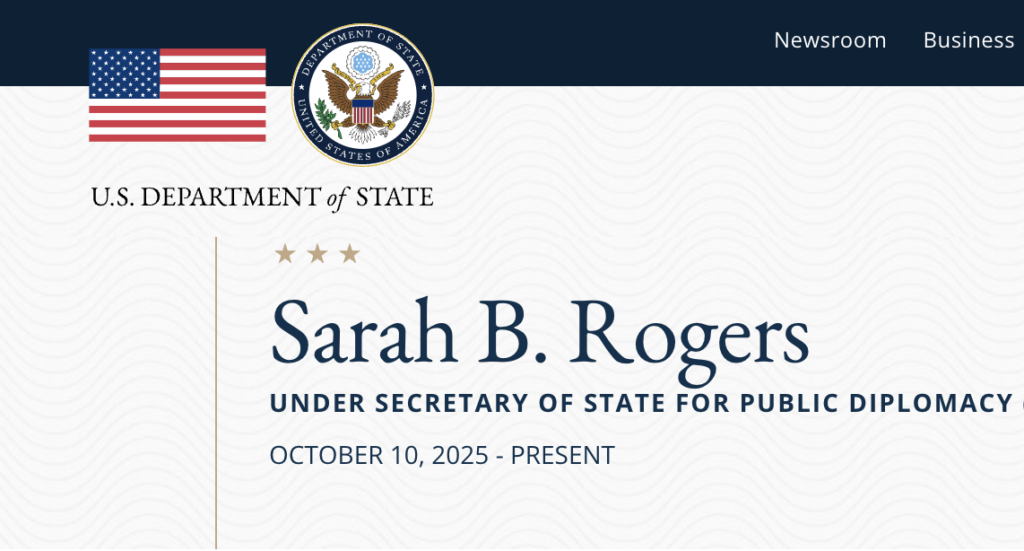
Rogers was sworn in as the 11th Under Secretary of State for Public Diplomacy on October 10, 2025, joining the Trump administration following a career as a law firm partner and free speech activist. In the months since, she has become the most aggressive and visible American government official challenging the legal frameworks that European regulators have spent years building around online platforms — frameworks that include the Digital Services Act, the UK Online Safety Act, and, at least implicitly, the GDPR’s content-adjacent provisions. For privacy professionals navigating the transatlantic regulatory environment, understanding who she is, what she believes, and what she has actually done in office is no longer optional background reading.
The Career Before Government
Rogers’s pre-government profile is worth understanding because it explains her ideological commitments and her strategic instincts. She received her undergraduate degree in International Relations from Dartmouth College in 2005 and her law degree from Columbia Law School in 2008, where she was a Harlan Fiske Stone Scholar. Her first exposure to public diplomacy came as an undergraduate intern in the State Department’s Bureau of International Information Programs — the same department she now leads.
Her legal career took her first to Latham & Watkins and later to Brewer Attorneys & Counselors, where she built a practice centered on First Amendment litigation and high-stakes advocacy. She represented clients including the National Rifle Association, major tobacco manufacturers, and investors and executives in the artificial intelligence industry. The NRA representation is particularly relevant to her current role: she litigated a winning Supreme Court appeal in 2024 in NRA v. Vullo, challenging the “debanking” of disfavored speakers — the practice of regulators pressuring financial institutions to cut off services to organizations they politically opposed. The case was argued alongside the ACLU, which underscores that her free speech commitments predate and exist independently of her current political alignment.
She also spearheaded challenges to social media censorship and the weaponization of law enforcement, including the successful appeal of the wrongful conviction of Douglass Mackey — a man convicted for posting election memes — and cases involving the online censorship of Charlie Kirk. The pattern across her legal career is consistent: Rogers is a First Amendment absolutist who views government pressure on speech, whether exerted directly or through third-party intermediaries, as one of the defining civil liberties issues of her generation.
The Viral Video That Announced Her Arrival
In December 2025, Rogers recorded a viral video from a European hotel room, criticizing European and UK speech laws by reciting statements that had led to investigations or jail time in those regions. The video was pointed, provocative, and clearly designed for maximum circulation. It worked. It was shared widely across both mainstream media and right-wing social networks, earned praise from Elon Musk, generated diplomatic protests from European governments, and established Rogers as a distinctive voice — confrontational, media-savvy, and uninterested in the usual niceties of diplomatic communication.
Rogers argued that the UK had arrested more people for speech acts than some authoritarian countries — citing a figure of over 12,000 arrests for speech acts in a single year — and characterized the Digital Services Act and Online Safety Act as “portals through which existing censorship laws get applied to the internet.” Whether you find these arguments compelling or alarming depends almost entirely on whether you view European content moderation frameworks as proportionate consumer protections or as state-backed censorship infrastructure. What is not in dispute is that Rogers made these arguments in her official capacity as a senior U.S. diplomat, on camera, from a hotel room in Europe, in a manner that no previous Under Secretary of State for Public Diplomacy had attempted.
Semafor described her as getting “a lot of attention, like more attention than I think under secretaries of state for public diplomacy sometimes get.” That attention has been both her tool and her point.
The DSA Campaign: Diplomatic Pressure as Regulatory Counter-Strategy
The viral video was a tactic. The DSA campaign is the strategy. Since taking office, Rogers has been the operational center of the Trump administration’s effort to treat European digital regulation as a trade and national security issue rather than a legitimate exercise of regulatory sovereignty.
In December 2025, Rogers sent a formal letter to Senate colleagues characterizing the EU’s €140 million fine against X as an attack on American sovereignty, arguing that the DSA “is the main law the EU wields to impose European censorship standards” and that the transparency requirements cited in the fine were “a ruse” enabling “an army of censorial, far-left NGOs” to harass pro-free speech companies.
She has referred to the DSA as “a censorship tariff that disproportionately affects American tech companies” and suggested that fines imposed on American platforms are “a de facto tax.” This framing — recharacterizing content moderation regulation as economic protectionism — is a deliberate strategic move. It shifts the debate from a human rights and consumer protection frame, where European regulators are comfortable operating, to a trade frame, where the United States has considerably more leverage.
In January 2026, Rogers warned the UK government that “nothing is off the table” in response to threats to ban X over AI-generated sexualized deepfakes. That warning came in the context of a UK Online Safety Act enforcement discussion — a law that, from the perspective of most privacy and child safety advocates, exists to protect children from exactly the kind of content Rogers appeared to be defending platforms’ rights to host.
The Visa Bans: Turning Diplomatic Rhetoric Into Real Consequences
The most consequential and controversial action Rogers has taken in office was not a speech or a letter. It was the identification and targeting of five European individuals for visa bans.
The five Europeans named by Rogers were Imran Ahmed, chief executive of the Centre for Countering Digital Hate; Josephine Ballon and Anna-Lena von Hodenberg, leaders of HateAid, a German organization; Clare Melford, who runs the Global Disinformation Index; and former EU Commissioner Thierry Breton. Rogers called Breton the “mastermind” behind the EU’s Digital Services Act in a series of social media posts, citing his warning to Elon Musk about potential “amplification of harmful content” when Musk broadcast an interview with then-candidate Trump in August 2024.
The EU’s Digital Services Act requires that large online platforms take greater responsibility for content posted on their services, mandating that companies remove illegal content such as hate speech and child sexual abuse imagery. The individuals Rogers targeted were not rogue actors or bad-faith regulators — they were people who had worked within the EU’s legal framework to enforce laws that were democratically enacted. Thierry Breton noted pointedly in response that all 27 EU member states voted for the DSA. “To our American friends,” he wrote on X: “Censorship isn’t where you think it is.”
The visa bans triggered diplomatic backlash, with European leaders condemning the sanctions as intimidation. HateAid’s leaders issued a joint statement saying the action represented “a new escalation” in which “the U.S. government is clearly questioning European sovereignty.” France’s Foreign Minister condemned the restrictions on Breton specifically. The diplomatic fallout was significant — and appeared to be precisely the point.
The Far-Right Funding Controversy
The most serious allegation against Rogers — and the one that generated the most sustained critical coverage — concerns the direction of U.S. government grant-making under her stewardship.
As Under Secretary of State for Public Diplomacy, Rogers is leading a Trump administration grant-making strategy to financially support MAGA-aligned organizations in Europe, presenting it as part of Washington’s 250th anniversary of U.S. Independence and an effort to promote “American values” abroad. The U.S. administration has leveraged this dispute with the EU and European governments to amplify Christian nationalist rhetoric and anti-LGBTQ+, anti-woman, and anti-immigrant narratives.
Rogers met with Markus Frohnmaier, a German AfD politician who has been reported to have ties to the Kremlin, in December 2025. She also met with Päivi Räsänen, a Finnish politician who faces hate speech prosecution in Finland for publicly condemning homosexuality on religious grounds — a case Rogers said contains “nuances that should stun any Western lawyer.”
These associations have led critics — including the Global Project Against Hate and Extremism — to characterize Rogers’s public diplomacy agenda not as a genuine defense of free speech principles but as a cover for advancing a specific political project: funding and legitimizing the European hard right under the banner of First Amendment values. Rogers disputes this characterization, and her supporters argue that defending controversial speech is precisely what First Amendment absolutism requires.
What This Means for Privacy Professionals
For the privacy community, Rogers represents something that does not fit neatly into the usual compliance frameworks. She is not a regulator, not a privacy advocate, and not a data protection authority. But the campaign she is leading has direct implications for the frameworks within which European privacy and digital regulation operates.
The most immediate implication concerns the trajectory of the DSA. Rogers’s characterization of the act as a censorship tool — and the Trump administration’s willingness to use diplomatic, economic, and immigration leverage to push back against its enforcement — creates regulatory uncertainty for organizations operating under the DSA’s requirements. If U.S. government pressure succeeds in weakening enforcement against American platforms, the content moderation obligations that the DSA imposes on large platforms become harder to sustain operationally and politically.
Rogers has also expressed a view on AI regulation that privacy professionals will find notable: she has argued that “just because you don’t have AI-specific laws doesn’t mean that you can do whatever you want with AI” while simultaneously suggesting that “the impulse to restrain that zeal to regulate tends to be vindicated over time.” This is not an anti-regulation position so much as a pro-market, anti-preemptive-regulation position — one that treats existing frameworks as sufficient and resists the creation of new AI-specific requirements.
The deeper tension Rogers embodies for the privacy community is one that has existed for years but has rarely been articulated as aggressively at a government diplomatic level: the fundamental disagreement between the American First Amendment tradition and the European human dignity tradition about where the legitimate limits of speech online lie. Content moderation, data protection, disinformation governance, and platform accountability are all downstream of that foundational disagreement. Rogers is pushing on that disagreement with more force, more visibility, and more diplomatic tools than any previous American official has deployed.
Whether that pressure produces genuine regulatory reform, a transatlantic trade dispute, a weakening of consumer protections, or simply a lot of diplomatic friction without lasting structural change remains to be seen. What is not in question is that the person applying that pressure is charismatic, legally sophisticated, ideologically committed, and operating with the full backing of the current U.S. administration.
For privacy professionals working at the intersection of U.S. and European law, that combination is not something to monitor from a distance. It is something to actively plan around.
Put this into practice
Turn privacy guidance into working controls.
Captain Compliance helps teams discover tracking technologies, enforce consent, manage privacy requests and document the evidence behind every decision.